Showing posts with label uruguay. Show all posts

Wednesday, November 2, 2022

November 2, 1924: Death In South American Soccer

November 2, 1924: Uruguay, which recently won the Gold Medal in soccer at the Olympics in Paris, playing Argentina at home at Parque Central in Montevideo. The game ends in a 0-0 draw. That's good enough to clinch the South American Championship, the tournament now known as the Copa América, for Uruguay.

That night, a group of Argentine fans gathered at the door of the Colón Hotel, where the Argentina delegation were staying. The fans began to sing, and the players came out to salute them. A bit noisy, perhaps rude, for the locals at such an hour, but it shouldn't have been that big a deal.

It became one when a Uruguayan began a counterdemonstration, and, as had so often happened before in soccer fandom, and has since, the songs and the insults flew. Soon, also flying were fists and objects. Then came some shooting, and 3 men were wounded. One of them, Pedro Demby, a 26-year-old Montevideo bank clerk who had been punching Argentines, died.

He went down as the 1st man ever to die as a result of violence connected to South American soccer. He would not be the last, as fan groups, including Argentina's Barras bravas (meaning "fierce gangs") have attempted to show that, contrary to common sense, sports, especially soccer, can be war.

*

November 2, 1924 was a Sunday. These NFL games were played that day:

* The Frankford Yellow Jackets, of Northeast Philadelphia, beat the Buffalo Bisons, 24-0 at Bison Stadium in Buffalo.

* The Cleveland Bulldogs beat their fellow Ohioans, the Dayton Triangles, 35-0 at League Park in Cleveland.

* The Columbus Tigers beat their fellow Ohioans, the Akron Pros, 17-6 at Indianola Park in Columbus.

* The Chicago Bears and the Rock Island Independents, both of Illinois, played to a tie, 3-3 at Cubs Park in Chicago. (The stadium was renamed Wrigley Field 2 years later.)

* The Milwaukee Badgers beat the Chicago Cardinals, 17-8 at Comiskey Park in Chicago.

* The Green Bay Packers beat their fellow Wisconsans, the Racine Legion, 6-3 at Bellevue Park in Green Bay.

* The Duluth Kelleys beat their cross-State rivals, the Minneapolis Marines, 6-0 at Nicollet Park in Minneapolis.

* The Hammond Pros, from a city in Indiana just outside Chicago, beat the Kansas City Blues, 6-0 at Muehlebach Field (later Municipal Stadium) in Kansas City.

Of all of these teams, only 3 still exist: The Bears, the Packers, and the Cardinals, who have moved twice, from Chicago to St. Louis in 1960, and to Arizona in 1988.

Monday, August 15, 2022

August 16, 1869: The Battle of Acosta Ñu

August 16, 1869: The Battle of Acosta Ñu is fought in Eusebio Ayala, Paraguay. It is a disaster for the host nation.

The Treaty of the Triple Alliance was signed on May 1, 1865, by Brazil, Argentina and Uruguay, against Paraguay. Brazil and Paraguay had gone to war over territory the year before, and Brazil, then an Empire under Emperor Pedro II, was able to build alliances, while Paraguay was not.

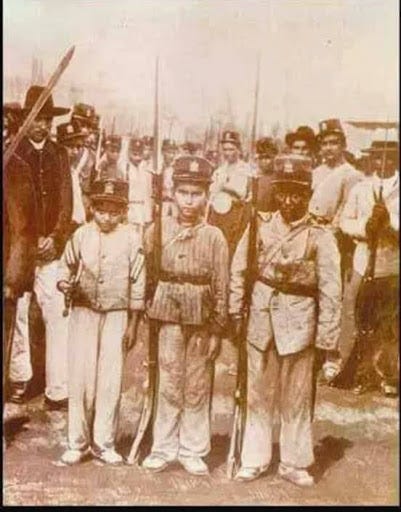
By the Summer of 1869, the Paraguayan capital of Asunción was occupied, and the Paraguayan Army was in full retreat. President Francisco Solano López refused to surrender, and retreated to the hills. A battle was set up at Acosta Ñu (meaning "Acosta's Field"), but, as has happened so often when an army is near defeat, the country was desperate, taking whatever it could get, including children. The 3,500 poorly armed Paraguayans, mostly boys between nine and 15 years old, old men and wounded combatants, confronted 20,000 Brazilian and Argentine veteran soldiers.

It was a wipeout. Children were said to cling to the legs of Brazilian soldiers amidst the raging battle, pleading for mercy, only to be decapitated without hesitation. Once all flanks collapsed, the wounded children tried to flee the battlefield alongside their relatives. Yet the Brazilian commander ordered his cavalry to cut the retreat and set the battlefield ablaze, including the field hospital. Large numbers of children died because of these actions.

The war lost, Paraguay was left to try a drawn-out guerrilla resistance. Much of the civilian population died due to battle, hunger, and disease. Left to lead troops personally, Solano López was killed in the Battle of Cerro Corá on March 1, 1870. Argentine and Brazilian troops occupied Paraguay until 1876.

After the defeat of Paraguay in 1870, Brazil and Argentina, who were traditional enemies, hovered on the brink of mutual warfare for six years because of disputes and misunderstandings about the treaty.

*

August 16, 1869 was a Monday. This was the 1st year of open professional sports in America, as the Cincinnati Red Stockings became the 1st baseball club to publicly admit that its players were being paid. On this day, they beat the Eckford club of Brooklyn, 38-0 at the Union Grounds in Brooklyn.

Saturday, July 30, 2022

July 30, 1930: The 1st World Cup Final

The Uruguay team that won the 1930 World Cup

July 30, 1930: The Final of the 1st FIFA World Cup is held at the Estadio Centenario in Montevideo, the capital of Uruguay. The host nation had advanced to it, to play Argentina, the nation across the Rio de la Plata from Montevideo. (Argentina's capital of Buenos Aires is accessible from Montevideo by ferry, 130 miles, taking 9 hours.)

Only 13 countries competed in that 1st World Cup. The only European countries that did so were France, Belgium, Yugoslavia and Romania. Britain's "Home Nations" -- England, Scotland, Wales and Northern Ireland -- refused to play, due to a dispute with FIFA (Fédération Internationale de Football Association), the governing body of world soccer, and would continue to refuse until 1950.

No Asian nations took part. Nor did any African nations. The United States of America took part. So did Mexico. The other 6 were all from South America: Uruguay, Argentina, Brazil, Peru, Paraguay, Bolivia and Chile.

The main reason for this was the distance involved. The 1934 and 1938 World Cups were held in Europe, and the tournament was canceled for 1942 and 1946, due to the effects of World War II. (Most of Europe was in no condition to hold qualifying matches in 1945, even after V-E Day.) By 1950, the world situation had stabilized, and air travel had become a lot safer. Still, only 13 countries went to Brazil. The next time it was held in South America, in 1962, there were a full 16 teams.

The tournament began on July 13. Argentina won Group 1, over Chile, France and Mexico. Yugoslavia won Group 2, over Brazil and Bolivia. Uruguay won Group 3, over Romania and Peru. And the U.S. won Group 4, beating Belgium 3-0 on July 13, and Paraguay 1-0 on July 17.

On July 26, Argentina beat the U.S. 6-1 in one Semifinal. In the other, on July 27, Uruguay beat Yugoslavia by the same score. The U.S. has never been so close to winning the World Cup again. Neither would Yugoslavia, nor any sub-nation thereof, get that close again until 2018, when Croatia lost to France in the Final.

The 1930 World Cup Final was held on July 30, before a crowd of 68,346. Pablo Dorado, an outside right for Bella Vista, scored in the 12th minute. Carlos Puecelle, an outside right for Sportivo Buenos Aires, tied it for Argentina in the 20th. Guillermo Stábile, a forward for Huracán, scored in the 37th, and it was 2-1 Argentina at halftime.

Pedro Cea, an inside left for Nacional, equalized for Uruguay in the 57th. Santos Iriarte, an outside left for Racing Montevideo, gave Uruguay the lead in the 68th minute. Héctor Castro, a forward for Nacional, capped the scoring in the 89th. Uruguay 4, Argentina 2.

Alberto Suppici was the winning manager. José Nasazzi, a right back from Bella Vista, was the winning Captain. Ernesto Mascheroni, a left back from Olimpia, lived until 1984, making him the last survivor of the winning team. Francisco Varallo, an inside right from Gimnasia, was the last survivor from Argentina, making it all the way to 2010, age 100.

Uruguay won the World Cup again in 1950, in a shocking upset of Brazil. Along with Italy, Germany, Brazil, England, Argentina, France and Spain, they remain 1 of only 8 countries to win the World Cup. Along with Italy, Germany, Brazil, Argentina and France, they remain 1 of only 6 countries to win it more than once.

They reached the Semifinals in 1954, 1970 and 2010. They reached the Quarterfinals in 1966 and 2018. They reached the Round of 16 in 1986, 1990 and 2014. The got into the Group Stage in 1962, 1974 and 2002. They did not enter in 1934 and 1938; and did not qualify in 1958, 1978, 1982, 1994, 1998 and 2006.

The Estadio Centenario still stands, seating 60,235.
UPDATE: An article for ESPN.com, published after the 2026 World Cup, ranking all 23 tournaments, rated this 1st one 22nd, next-to-last, citing the lack of competition, and there not being any real sense of talent level.
 
*

July 30, 1930 was a Wednesday. It was the off-season for the NFL and the NHL, and the NBA hadn't been founded yet. But there were Major League Baseball games played that day:

* The New York Yankees swept a doubleheader from the Boston Red Sox at Fenway Park. They won the 1st game 8-2, in 10 innings. Herb Pennock went the distance. So did former Yankee Milt Gaston, whom they pounded for 6 runs in the 10th inning, including home runs by Lou Gehrig (of whom you've surely heard) and Harry Rice (of whom you probably haven't).

They won the 2nd game 10-1, with George Pipgras going the distance. No home runs were hit. Over the doubleheader, Gehrig went 3-for-10 with 4 RBIs, and Babe Ruth went 4-for-9 with 3 RBIs.

* The New York Giants beat the Boston Braves, 5-2 at the Polo Grounds.

* The Brooklyn Robins swept a doubleheader from the Philadelphia Phillies at Baker Bowl in Philadelphia. "Dem Bums won the opener, 9-5; and the nightcap, 9-4. After 1 more season, Brooklyn manager Wilbert Robinson, for whom the team was then named, would be fired, and the old name of "Dodgers" would be restored.

* The Philadelphia Athletics beat the Washington Senators, 7-4 at Griffith Stadium in Washington.

* The Pittsburgh Pirates beat the St. Louis Cardinals, 6-5 at Forbes Field in Pittsburgh.

* The Detroit Tigers beat the Cleveland Indians, 6-5 at League Park in Cleveland.

* The St. Louis Browns swept a doubleheader from the Chicago White Sox at Comiskey Park in Chicago. They won the 1st game, 3-2, on Oscar Melillo's sacrifice fly in the 10th inning. They won the 2nd game, 6-1.

* And the Chicago Cubs and the Cincinnati Reds were not scheduled. 

Saturday, July 16, 2022

July 16, 1950: Maracanazo

July 16, 1950: The last game -- officially, not a "Final," since this edition was not a knockout tournament in the traditional sense -- of the World Cup is played at the Estádio do Maracanã in Rio de Janeiro, Brazil. Given the goal difference, all that hosts Brazil had to do was gain a draw, and they would be World Champions on home soil. Uruguay, on the other hand, had to win.

This was the 1st World Cup after World War II. Of the 3 main Axis nations, Germany and Japan were still banned; and Italy, allowed in the tournament, were still recovering from the Superga crash the year before, when most of the Torino team, and thus a big part of the national side, were killed. This tournament also featured the U.S.' upset of England. But the true shock, as far as the hosts were concerned, was in the last game.

The 1st half ended scoreless. Shortly after play resumed, Albino Friaça put Brazil on the board. The gigantic crowd of 199,854 was ecstatic. Being 1-0 up in the 2nd half made it look like the tremendous pre-tournament and pre-game hype and confidence had been worth it.

But Uruguay's Captain, Obdulio Varela, was smart: He went to the referee, an Englishman named George Reader, and disputed the validity of the goal. Varela didn't speak English, and Reader didn't speak Spanish. An interpreter was found, and Reader learned Varela's objection: He believed (or said he did) that Friaça was offside. Reader called the linesman over, and the linesman denied it. Reader made his decision final: The goal stood.

Varela didn't get everything he wanted, but he got a big thing that he wanted: He stopped Brazil's momentum. They were standing around, waiting for play to be allowed to resume. Their fans had calmed down a bit. The home-field advantage had been dented. Reader handed the ball to Varela, who took it to the center of the field, and shouted to his teammates, "Now, it's time to win!"

And they did as he wanted: They attacked. Brazil didn't have a defense as good as their offense, and, in the 66th minute, Pepe Schiaffino equalized for Uruguay. That didn't matter much: If that 1-1 score had held, Brazil would still be World Champions.

In the 79th minute, Alcides Ghiggia ran down the right sideline, and fired a low shot that went under Brazilian goalkeeper Moacir Barbosa. It was Uruguay 2, Brazil 1. Every Brazilian -- on the pitch, in the stadium, and listening on the radio -- was in shock. Brazil attacked the rest of the way, but couldn't find the all-important equalizer. The home crowd was quiet.
Alcides Ghiggia

Shortly after 5:00, Reader blew his whistle to end the match. Uruguay had now won 2 of the 1st 4 World Cups. Brazil had lost the world championship of their national sport, in their national stadium.

In that stadium, 3 fans died from heart attacks. Another, who had brought a gun in, killed himself.

There was no public ceremony after the game. FIFA President Jules Rimet wisely chose to present the trophy that would later bear his name to Uruguay in their locker room. Brazil manager Flavio Costa had to leave the stadium in disguise -- as a nanny. Yes, like some deposed dictators have done, he left in drag, so as not to be recognized.

The loss was a blow to the national psyche of Brazil, so often wrapped up in this sport of soccer. It is known as Maracanazo in Spanish, Maracanaço in Portuguese: "The Agony of Maracanã." The 1950 World Cup was supposed to be a statement for Brazil, showing the world that it was a modern country, worthy of respect and admiration around the postwar world. This was the country's coming-out party, and it was ruined.

Minister of Sport Aldo Rebelo said, "Losing to Uruguay in 1950 not only impacted on Brazilian football, it impacted on the country's self-esteem." Instead of hating Uruguay for the ruination, Brazilians blamed themselves.

Brazil have gone on to win the World Cup a record 5 times: Beating Sweden in the Final in Sweden in 1958, beating Czechoslovakia in the Final in Chile in 1962, avenging their defeated to Uruguay in the Semifinal and then beating Italy in the Final in Mexico City in 1970, beating Italy in the Final again in the Rose Bowl in 1994, and beating Germany in Japan in 2002. They have also lost the Final to France in Paris in 1998.

You will notice that none of those 5 wins have been in Brazil. The World Cup has returned to that country only once, in 2014, and Brazil got to the Semifinal, but had an even more stunning loss at the Maracanã. It wasn't that they lost to Germany, who then beat Argentina in the Final. It wasn't even that they were looking forward to beating Argentina in the Final in the Maracanã themselves. The truly shocking part was the score: Germany beat Brazil, in the Maracanã, by a score of 7-1.
The Maracanã is 1 of 2 stadiums to have hosted 2 World Cup Finals, along with the Estadio Azteca in Mexico City. And it's 1 of 4 stadiums to have hosted a World Cup Final and be the main stadium for the Olympic Games. The Azteca is not 1 of the other 4: Although it was used during the 1968 Olympics, it was not the main stadium for those games. The others are the old Wembley Stadium in London, and the Olympiastadions in Berlin and Munich. In 2024, the Stade de France outside Paris will make it 5.

Much as the 1980 and 2008 World Series wins have not fully erased the humiliation of the blown 1964 National League Pennant for Philadelphia Phillies fans, Brazilians still have not gotten over Maracanazo after 72 years, despite winning 5 World Cups and the admiration of the rest of the world.

Because of the soccer connection, it remains the most famous building on the entire continent. It is home to Rio’s 2 biggest teams, Flamengo and Fluminense, and "the Fla-Flu Derby" is the event of the year in Rio. (Aside from that whole Carnival business.)

Outside of soccer, in 1980, it hosted the largest crowd ever to watch a volleyball match, 95,000 to see the national teams of Brazil and the Soviet Union. It hosted the preaching of Billy Graham in 1960 and 1974, and Pope John Paul II in 1980, 1987 and 1997.

Frank Sinatra sang before 175,000 in 1980, and "Rock In Rio" brought more than that for Sting in 1987, Tina Turner in 1988, Paul McCartney in 1990, a-ha in 1991, Madonna in 1993, and the Rolling Stones in 1995.

In 1966, the stadium was officially renamed Estádio Jornalista Mário Filho, for a sportswriter who had just died, but everybody still calls it the Maracanã. A conversion to all-seater and renovations for the 2014 World Cup and the 2016 Olympics has reduced capacity to 78,838, making it still the largest stadium in South America.

UPDATE: An article for ESPN.com, published after the 2026 World Cup, ranking all 23 tournaments, rated this one tied for 8th, suggesting that the upsets overcame the comparative lack of star power.

*

July 16, 1950 was a Sunday. It was the off-season for the NFL, the NBA and the NHL. But, being a Sunday, a full slate of Major League Baseball games was played. as was the custom at the time, there were even doubleheaders:

* The New York Yankees split a doubleheader with the Chicago White Sox at Yankee Stadium. The Yankees won the opener 2-1. Gene Woodling's 2nd inning double allowed Vic Raschi to outpitch Billy Pierce. The White Sox won the nightcap 5-2, with Bob Cain outpitching Allie Reynolds.

* The New York Giants got swept in a doubleheader by the Cincinnati Reds at Crosley Field in Cincinnati. The Reds won the 1st game 16-4. The 2nd game went back and forth. The Giants jumped out to a 3-0 lead in the top of the 1st, but the Reds scored 4 in the bottom of the 1st. The Giants led 8-4 going to the bottom of the 5th, and 10-5 going to the bottom of the 6th. But the Reds tied it in the bottom of the 7th. An error by Hank Thompson gave the Reds the win in the 12th, 11-10.

* The Brooklyn Dodgers beat the St. Louis Cardinals, 10-2 at Sportsman's Park in St. Louis. Chris Van Cuyk was not one of the Dodgers' more prominent pitchers, but he got the win in this game, backed by home runs from Jackie Robinson and Duke Snider.

* A doubleheader was split at Fenway Park in Boston. The Boston Red Sox won the opener 13-10, and the Cleveland Indians won the nightcap 8-4. Ted Williams was injured, and did not play in either game.

* A doubleheader was split at Shibe Park in Philadelphia. The Philadelphia Athletics won the 1st game 5-2, and the Detroit Tigers won the 2nd game 7-6.

* A doubleheader was split at Griffith Stadium in Washington. The Washington Senators won the 1st game 5-1, and the St. Louis Browns won the 2nd game 10-8.

* A doubleheader was split at Forbes Field in Pittsburgh. The Boston Braves won the 1st game 9-5, and the Pittsburgh Pirates won the 2nd game 6-5.

* The Chicago Cubs swept a doubleheader with the Philadelphia Phillies at Wrigley Field in Chicago. They won the opener 8-0, and the nightcap 10-3. 

Monday, July 11, 2022

July 11, 1966: Marvel Comics Introduces the 1st Black Superhero

Chadwick Boseman as T'Challa

July 11, 1966: Marvel Comics publishes Fantastic Four #52, introducing the character of Black Panther, generally considered to be the 1st black superhero in mainstream comic books.

The name "Black Panther" long predates the character -- and the Black Panther Party, which formed a few weeks later. In World War II, the U.S. Army's segregated 761st Tank Battalion was known as the Black Panthers. And Portugal's Mozambique-born soccer star Eusébio, already world-famous but about to become more so as the World Cup began, was already nicknamed "The Black Panther." (He was also nicknamed "The Black Pearl," as was his fellow Portuguese speaker, Brazilian star Pelé.)

There had been black heroes in comic books before, but no major publisher had dared try it. In 1947, with Jackie Robinson debuting in Major League Baseball and Joe Louis as Heavyweight Champion of the World, All-Negro Comics #1 was published. But it sold so poorly that there was no issue #2.

Marvel, under a previous name, Atlas Comics, had published Jungle Tales, including Waku, Prince of the Bantu, clearly an inspiration for the character to come. But that magazine ran only 7 issues, from September 1954 to September 1955, and, as was all too common at the time, indulged in too many stereotypes. In 1963, Marvel had included Private Gabriel Jones in the World War II-themed book Sgt. Fury and his Howling Commandos.

With the knowledge that the Lone Ranger had been partly inspired by an African-American lawman named Bass Reeves (1838-1910), Dell Comics released Lobo in December 1965. Bearing no resemblance to the later DC character of the same name, which is Spanish for "wolf," this was a gunslinger who bore stylistic resemblances to the protagonists of 2 current TV series: Dr. Richard Kimble of The Fugitive and Captain Jason McCord of the Western Branded: The cover identified him as "Branded for Life: An honest man... blamed for a crime he did not commit!"

On the heads of his defeated foes, would leave a gold coin imprinted with the letter L and the image of a wolf, similar to the Lone Ranger leaving a silver bullet and Zorro using his sword to cut a letter Z on his opponents' shirts.

Lobo #1 was released after the March On Washington, the Civil Rights Act of 1964, the Selma-to-Montgomery March and the Voting Rights Act of 1965 -- but also after the riots in Harlem, North Philadelphia and Watts. It didn't sell well, not even in black neighborhoods. When Marvel released the issue of Fantastic Four with Black Panther, Dell thought to try again, and, in September 1966, released Lobo #2. But that didn't sell well, either, and, except for a brief revival in 2017-18, the character has never appeared again.

A character's in-story origin sometimes gets embellished, but rarely has substantive change. But, as was often the case with Marvel and its boss man, Stan Lee, there is a dispute as to this character's real-world origin. Smilin' Stan said that a black hero was the next step in Marvel's progress.

But Marvel's main artist, Jack Kirby, said, "I came up with the Black Panther because I realized I had no blacks in my strip. I'd never drawn a black. I needed a black. I suddenly discovered that I had a lot of black readers. My first friend was a black! And here I was ignoring them because I was associating with everybody else." Lee's story was backed up by writer Roy Thomas, who later succeeded him as Marvel's editor; while Kirby's story is backed up by documentation, including drawings that predate the issue.

With Black Panther, the in-story origin of the character is not the only thing that matters: There's also the origin story of his homeland, the African nation of Wakanda. At some point in the past, a meteorite landed there. It was made of vibranium, and this fictional material allowed Wakanda to develop technology beyond anything the world had yet seen, including the ability to conceal themselves from the outside world. Their King decided to do this, for fear that the technology could be stolen. (Vibranium would eventually be found elsewhere, and was used to make Captain America's shield.)

In-universe, the title "Black Panther" is a rank of office, chieftain of the Wakandan Panther Clan. As chieftain, the Panther is entitled to consume a special heart-shaped herb which, in addition to his mystical, shamanistic connection with Bast, the Panther Goddess, grants him superhumanly acute senses, strength, speed, agility, stamina, durability, healing, and reflexes. In essence, he has the powers of Spider-Man, without the addition of web-shooters.

In the comics, the King of Wakanda, and thus the Black Panther, is named T'Challa, whose father and predecessor, T'Chaka, was murdered by a rival. Thus, like so many other superheroes, T'Challa is motivated to fight for justice in remembrance of, and to avenge, a parental figure. Just as so many other heroes protect a city -- or, in the case of Daredevil, just one neighborhood -- T'Challa protects an entire country.

In the story that introduced him, he invited the Fantastic Four to Wakanda, and then tested their abilities. The tests passed, he made amends by explaining that he needed to see if they would be worthy allies. They subsequently fought a would-be invader. Black Panther later joined the Avengers, and, for a time, was married to Ororo Munroe, a.k.a. Storm of the X-Men.
T'Challa made his television debut in the 1994-96 Fantastic Four animated series, where he was voiced by Keith David. Djimon Hounsou provided the voice of T'Challa for a 2011 animated series. Chadwick Boseman played the character in 4 live-action Marvel Cinematic Universe films: Captain America: Civil War, in 2016, in which he's on the pro-registration side; Black Panther, in 2018, the 1st superhero film with a black lead that wasn't a comedy (I'm counting Wesley Snipes' Blade films as more horror than superhero films); Avengers: Infinity War, also in 2018, in which he was one of the heroes who was "snapped away" by Thanos; and Avengers: Endgame, in 2019, in which the Hulk snaps him back, and he leads Wakanda's army in the final battle against Thanos.
Boseman, who had previously played black American icons Jackie Robinson, Thurgood Marshall and James Brown, became beloved all over the world for his portrayal of T'Challa. Unbeknownst to the world at large, he was already battling cancer during the filming of Endgame, and died in 2020. So, while the character still lives in comic books, in the MCU, the 2022 sequel Black Panther: Wakanda Forever reveals that their version of T'Challa has died from an incurable illness, and his sister, Shuri, played by Letitia Wright as in the previous film, becomes the new Black Panther.

*

July 11, 1966 was a Monday. There were no baseball games played, as the All-Star Break was underway. The next night, the All-Star Game was held at the new Busch Memorial Stadium in St. Louis, and, under very hot conditions -- Casey Stengel noted of the new facility, "It sure holds the heat well" -- the National League beat the American League, 2-1.

But there was one score on this historic day. Or, rather, one game that ending with neither side scoring: The World Cup got underway in England, with the host country and Uruguay playing to a 0-0 draw at Wembley Stadium in West London.

Friday, June 24, 2022

June 24, 2014: Luis Suarez: Once, Twice, Three Times a Biter

June 24, 2014: You can't say Luis Suárez sucks. But he does bite.

Before him, there was another Luis Suárez who played for FC Barcelona. Luis Suárez Miramontes, born in Spain in 1935, helped them win Spain's La Liga in 1959 and 1960; then helped Internazionale Milano win Italy's Serie A in 1963, 1965 and 1966; and the 1964 and 1965 European Cup, the tournament now known as the UEFA Champions League; and led Spain to win the European Nations' Cup, the tournament now known as the UEFA Euro, in 1964. (UPDATE: He died in 2023, at the age of 88.)

Luis Alberto Suárez Díaz was born in Uruguay in 1987, and led Nacional to that country's league title in 2006. He went to Europe, and won the Netherlands' Eredivisie with Ajax Amsterdam in 2011. England's Liverpool swooped in, expecting he would lead them to trophies, but, for reasons beyond his control (in spite of his constant diving), they only won the 2012 League Cup while he was there.

He was signed by Barcelona, and from 2014 to 2019, he helped them win 4 La Liga titles and the 2015 UEFA Champions League. He won La Liga again in 2021 with Atlético Madrid, before returning to South America, winning the Uruguayan Primera División with Nacional in 2022. He helped his country reach the Semifinal of the 2010 World Cup, and win the Copa América, South America's continental tournament for national teams, in 2011.

But that's not what he will be known for. He will be known for his cheating. His diving for penalties. His handballs. And for biting his opponents.

That's "opponents." Plural. Luis Suárez has sunk his teeth into not one, not two, but three different opposing players during the course of his professional career. Through the 2021-22 season, he has played 848 career games for club and country, meaning the chances of Suarez biting another player are one in every 282 matches. For context, the odds of getting bitten by a shark are 1 in 3.7 million.

During his time as Ajax captain, Suarez was banned for seven games for biting PSV Eindhoven midfielder Otman Bakkal’s shoulder on November 20, 2010. Dutch newspaper De Telegraaf (The Telegraph) called him "the Cannibal of Ajax," and it was a nickname that stuck through his career.

The referee missed it, but the KNVB, the governing body for Dutch soccer banned him retroactively for seven games, and it proved to be his last appearance for the Eredivisie giants (still receiving an Eredivisie winner's medal), before being sold to Liverpool.

On October 15, 2011, Suárez was accused of racial abuse by Patrice Evra, a black defender for Manchester United, during their 1-1 draw with Liverpool. The Football Association's investigation found in Evra's favor, and Suárez was suspended for 8 domestic matches and fined £40,000.

Evra was also a known diver, and, like most Manchester United players, was hated by just about every soccer fan in the world who supported a team other than Man U. Suárez had done the impossible: He made Evra a sympathetic figure.

On April 21, 2013, Suarez struck again, with Branislav Ivanovic his next victim, during a 2-2 draw between Liverpool and Chelsea. Again, the incident was missed by the referee and, to add insult to injury, Suarez scored a later equalizer to rescue a point for the Reds. The FA slapped him with a 10-game ban this time, which crucially carried over into the start of the 2013-14 campaign, in which Liverpool went onto lose the Premier League title by 2 points. One loss, or two draws, turned into wins would have made them Champions.

And then, on June 24, 2014, during the World Cup, at Arena das Dunas in Natal, Brazil, he left bite marks on the shoulder of Italy's Giorgio Chiellini. Yet again, the referee missed the incident at the time. Diego Godín scored in the 81st minute, and Uruguay won, 1-0, guaranteeing their advancement out of Group D to the knockout stage, and preventing Italy from advancing.

But FIFA, the governing body for world soccer, stepped in after the game, and suspended Suarez from all football-related activity for 4 months. He was additionally banned for nine international games. Without him, Uruguay were knocked out by Colombia in the Round of 16.

Earlier in the game, there was another call that the officials missed, a handball committed by Suárez. I saw somebody on Twitter combine the two offenses, and call him "Handball Lecter." Now, the fictional cannibal killer Hannibal Lecter might be willing to engage in deception to get what he wants. But for all his sociopathy, Dr. Lecter had class. He would be appalled by Suárez's character and manners -- the only thing against which Lecter would discriminate, as opposed to Suárez's unrepentant racism.

*

June 24, 2014 was a Tuesday. Other games played in the World Cup that day:

* England and Costa Rica played to a draw, 0-0 at Estádio Mineirão in Belo Horizonte. Costa Rica also advanced out of Group D, while England finished 4th and last. Not the most ignominious defeat England had ever suffered in a World Cup match in Belo Horizonte -- see 1950 -- but bad enough.

* Colombia beat Japan, 4-1 at Arena Pantanal in Cuiabá.

* And Greece beat the Ivory Coast, 2-1 at Estádio Castelão in Fortaleza.

And these Major League Baseball games were played:

* The New York Yankees lost to the Toronto Blue Jays, 7-6 at the Rogers Centre in Toronto. The Yankees were down 6-0 after 5 innings, tied it in the 7th. But a bunt by ex-Yankee Melky Cabrera led to an error by Yankee 3rd baseman Yangervis Solarte, and ex-Met José Reyes scoring the winning run. Adam Warren was the losing pitcher. Derek Jeter, in his final season, hit a home run.

* The New York Mets beat the Oakland Athletics, 10-1 at Citi Field.

* The Philadelphia Phillies beat the Miami Marlins, 7-4 at Citizens Bank Park in Philadelphia.

* The Chicago White Sox beat the Baltimore Orioles, 4-2 at Camden Yards in Baltimore.

* The Pittsburgh Pirates beat the Tampa Bay Rays, 6-5 at Tropicana Field in St. Petersburg, Florida.

* The Chicago Cubs beat the Cincinnati Reds, 7-3 at Wrigley Field in Chicago.

* The Washington Nationals beat the Milwaukee Brewers, 4-2 at Miller Park (now American Family Field) in Milwaukee. Ryan Zimmerman hit a home run in the top of the 16th inning.

* The Los Angeles Dodgers beat the Kansas City Royals, 2-0 at Kauffman Stadium in Kansas City. Clayton Kershaw pitched 8 innings of 6-hit shutout ball, before Kenley Jansen pitched a perfect 9th.

* The Detroit Tigers beat the Texas Rangers, 8-2 at Globe Life Park (now Choctaw Stadium) in the Dallas suburb of Arlington, Texas.

* The Atlanta Braves beat the Houston Astros, 3-2 at Minute Maid Park (now Daikin Park) in Houston.

* The Colorado Rockies beat the St. Louis Cardinals, 10-5 at Coors Field in Denver.

* The Arizona Diamondbacks beat the Cleveland Indians, 9-8 at Chase Field in Phoenix. Aaron Hill singled Gerardo Parra home with the winning run in the bottom of the 14th inning.

* The Los Angeles Angels beat the Minnesota Twins, 8-6 at Angel Stadium of Anaheim.

* The San Diego Padres beat the San Francisco Giants, 7-2 at AT&T Park (now Oracle Park) in San Francisco.

* And the Seattle Mariners beat the Boston Red Sox, 8-2 at Safeco Field (now T-Mobile Park) in Seattle.

Thursday, February 17, 2022

February 17, 2017: A Soccer Lineup From 11 Different Countries

February 17, 2017: Granada Club de Fútbol play Seville-based Real Betis, at Nuevo Estadio de Los Cármenes in Granada, in Andalusia in southern Spain. This game, in Spain's La Liga, is a milestone: Granada fielded players from 11 different countries. No two of their players came from the same country. This is believed to be the first time it has ever happened in any soccer league, anywhere in the world. Here is the lineup:

Goalkeeper: Number 13, Guillermo Ochoa, Mexico.
Right Back: 25, Sverrir Ingi Ingason, Iceland.
Left Back: 3, Gastón Silva, Uruguay.
Centerback: 23, Héctor Hernández (known by just his first name), Spain
Centerback: 22, Dmitri Foulquier, France, the team's Captain.
Central Midfielder: 5 Uche Agbo (also known by just his first name), Nigeria.
Right Midfielder: 29, Martin Hongla, Cameroon.
Left Midfielder: 8, Mubarak Wakaso, Ghana.
Center Forward: 18, Andreas Pereira, Brazil
Right Wing: 16, Mehdi Carcela, Morocco.
Left Wing: 7, Adrián Ramos, Colombia.

That's 11 different players, from 11 different countries, and from 4 different continents: 4 from Africa, 3 from Europe, 3 from South America, and 1 from North America.

And it worked: Carcela scored in the 18th minute. Ramos scored in the 28th. Pereira scored in the 33rd, and Granada went into halftime up 3-0. Ramos scored again in the 64th. There was a fight in the 66th minute, and both Pereira and Matías Nahuel of Betis were sent off, leaving both teams to finish the game with 10 men. Brazilian player Petros got a consolation goal in the 75th, and it ended 4-1 to Granada.

It was the highlight of the season for Granada. They had already fired manager Paco Jémez early in the season. His successor, Lucas Alcaraz, was no better, as they won only 1 of their 15 remaining La Liga games, and were relegated. Alcaraz was fired on April 10, and former Arsenal Captain Tony Adams managed their last 7 games, all losses.

Granada were promoted back to La Liga in 2019. Jémez now manages U.D. Ibiza in Spain's 2nd division, Alcaraz manages Olympiakos Nicosia in Cyprus' 1st division, and Adams has never managed again.

(UPDATE: Granada were relegated again in 2022. Jémez now manages a team in Iran's 1st division. Oddly, Alcaraz succeeded Jémez as manager in Ibiza. As of the conclusion of the 2024-25 season, Adams, one of the greatest centrebacks of his generation, still has never managed since being fired by Granada in 2017.)

*

February 17, 2017 was a Friday. Baseball and football were out of season. The NBA was in its All-Star Break. There were 3 games played in the NHL:

* The Colorado Avalanche beat the Carolina Hurricanes, 2-1 at the PNC Arena (now the Lenovo Center) in Raleigh. Mikko Rantanen scored the winning goal with 37 seconds left in overtime.

* The Columbus Blue Jackets beat the Pittsburgh Penguins, 2-1 at the Nationwide Arena in in Columbus. Brandon Dubinsky scored the winning goal with 3:56 left in overtime.

* And the Florida Panthers beat the Anaheim Ducks, 4-1 at the Honda Center in Anaheim.

December 31, 1999 & January 1, 2000: The Millennium

December 31, 1999:  The Millennium arrives. The people of planet Earth survived. At a terrible cost. But we hadn't destroyed ourselves. ...