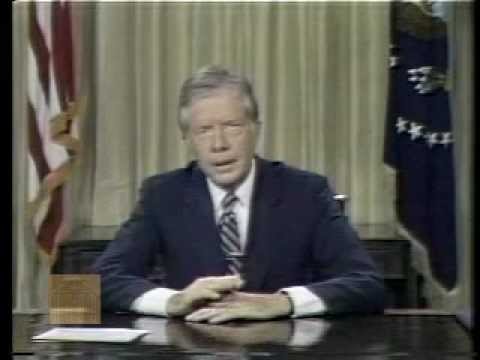
I invited to Camp David people from almost every segment of our society: Business and labor, teachers and preachers, governors, mayors, and private citizens. And then I left Camp David to listen to other Americans, men and women like you.
It has been an extraordinary ten days, and I want to share with you what I've heard. First of all, I got a lot of personal advice. Let me quote a few of the typical comments that I wrote down.
This from a Southern Governor: "Mr. President, you are not leading this nation -- you're just managing the government."
"You don't see the people enough any more."
"Some of your Cabinet members don't seem loyal. There is not enough discipline among your disciples."
"Don't talk to us about politics or the mechanics of government, but about an understanding of our common good."
"Mr. President, we're in trouble. Talk to us about blood and sweat and tears."
"If you lead, Mr. President, we will follow."
I do not refer to the outward strength of America, a nation that is at peace tonight everywhere in the world, with unmatched economic power and military might. The threat is nearly invisible in ordinary ways. It is a crisis of confidence.
It is a crisis that strikes at the very heart and soul and spirit of our national will. We can see this crisis in the growing doubt about the meaning of our own lives and in the loss of a unity of purpose for our nation.
* Carter's "giveaway" of the Panama Canal to, you know, the country it was actually in, Panama. Never mind that it was the idea of the preceding President, Gerald Ford, a Republican. (It was one of the big reasons that Reagan ran against Ford in the 1976 Republican Primaries.)
* Carter's own inability to handle a 2nd round of inflation -- in each case, caused largely by Middle Eastern nations raising the price of oil.
All of this happened before the speech, as well as before the Iran Hostage Crisis that began on November 4, 1979, and the Soviet invasion of Afghanistan on December 27, 1979, and Carter's reaction to each: For the former, his dragged-out negotiations to get the hostages out and the failure of the "Desert One" rescue mission on April 25, 1980, which probably gave his re-election campaign a mortal wound; and for the latter, his boycott of the 1980 Summer Olympics that were scheduled for Moscow, which did more to effectively depict the Soviets as an "Evil Empire" than anything Reagan ever said his life.
But it jumped to 6.0 percent the next month, was 6.3 percent by January 1980, and then in the Spring, it shot up: 6.9 percent in April, 7.5 percent in May, 7.8 percent in July -- just in time for Reagan to accept the Republican nomination. It was around 7.5 percent for the rest of Carter's Presidency, including when he left office on January 20, 1981 -- in other words, exactly the same as it was when he was inaugurated.
But how was it under Reagan? By the end of 1982, it was 11 percent, because of his stupid tax cut. It didn't get back below the 5.6 percent that it was in May 1979 until... April 1988.
However, it wasn't just the unemployment rate. Inflation was high. So were interest rates. And wages had begun to stagnate. The stagnancy and the inflation were combined into a single word: "Stagflation." That, as much as anything else, created the malaise.
And a generation of working people in their 30s and 40s, who had been activists as young people in the 1960s, were used to standing up to those in power and saying, "Enough! We will not put up with this crap anymore!" And they saw the "malaise," and, as they had been trained to do, they blamed the people in power.
That's why so many of them sided with Ted Kennedy in the Winter and Spring of 1980. It wasn't so much a vote for the insurgent candidate (many people, as it turned out, had a problem with Ted's private life) as it was a protest vote against the incumbent or establishment candidate, as in for Henry Wallace against Harry Truman in 1948, for Gene McCarthy and then Robert Kennedy against Lyndon Johnson and then Hubert Humphrey in 1968, for Reagan against Ford in 1976, and later for Pat Robertson against George H.W. Bush in 1988, for Pat Buchanan against Daddy Bush in 1992, for Ralph Nader against Al Gore in 2000, for Barack Obama against Hillary Clinton in 2008 (the only one of these that went all the way), and for Bernie Sanders against Hillary in 2016.
It's a different generation of workingmen. None of these guys came over from the old country, poor and starving, grateful for any job they could get. None of them have been through a depression. They've been exposed, at least through television, to all the youth movements of the last ten years...
They're just not going to swallow the same kind of treatment their fathers did... They want more than just a job for 30 years.
Compared to his successors, Carter did amazingly well at creating jobs. Under his Presidency, jobs increased by an average of 2.58 million per year; Reagan, 2.01 million; Bush 41, 668 thousand (not million, thousand); Bill Clinton, 2.86 million; Bush 43, 160 thousand; Obama so far, 1.40 million.
Annual rate increase? Carter 3.06 percent, Reagan, 2.06 percent; Bush 41, 0.62 percent; Bill Clinton, 2.48 percent; Bush 43, 0.12 percent; Obama so far, 1.11 percent (keeping in mind that he inherited the Dubya meltdown of 2008). Jimmy Carter created jobs at a greater rate per year than any President since LBJ.
Want that in table form? Jobs per year, in millions:
D Clinton 2.86
D Carter 2.58
R Reagan 2.01
D Obama 1.58
R Bush 41 0.67
R Bush 43 0.16
Job growth per year:
D Carter 3.06
D Clinton 2.48
R Reagan 2.06
D Obama 1.04
R Bush 41 0.62
R Bush 43 0.12
In other words, Carter was 23 percent better at creating jobs that "job-creating machine" Clinton, and 48 percent better at it than Reagan who "turned the economy around" and brought about "Morning in America."
You know conservatives: As their avatar, Reagan, said, "Facts are stupid things." He was trying to quote John Adams: "Facts are stubborn things."
Conservatives always want you to believe that everything was just fine until noon on Inauguration Day when the Republican President went home; and then went to hell as soon as the Democratic President-elect says, "So help me, God." And that it works the other way: As soon as the Democratic President gives way to the Republican President-elect, everything became fine.
Never mind that Reagan himself, in his Inaugural Address, said that America's problems "will not go away in days, weeks, or months. But they will go away." Which was true: The only questions were how, and when. And then he preceded to tell the biggest lie any President had ever told to that point: "Government is not the solution to the problem. Government is the problem." And then, he spent the next 8 years proving his point.
Why, a conservative born after 1980, not old enough to really remember Reagan as the sitting President, and raised on the myth more than the man, would probably find it hard to believe that the U.S. hockey team that beat the Soviets at the 1980 Winter Olympics in Lake Placid, New York, could have done so under President Carter, rather than under President Reagan. (Carter wasn't there for that game, but Vice President Walter Mondale, a Minnesotan and a hockey buff, was.)
Or maybe Reagan was just lucky, and Carter wasn't. As someone put it in the Summer of 1981, "If Carter had fired the air-traffic controllers, there would have been a crash the next day."


No comments:
Post a Comment