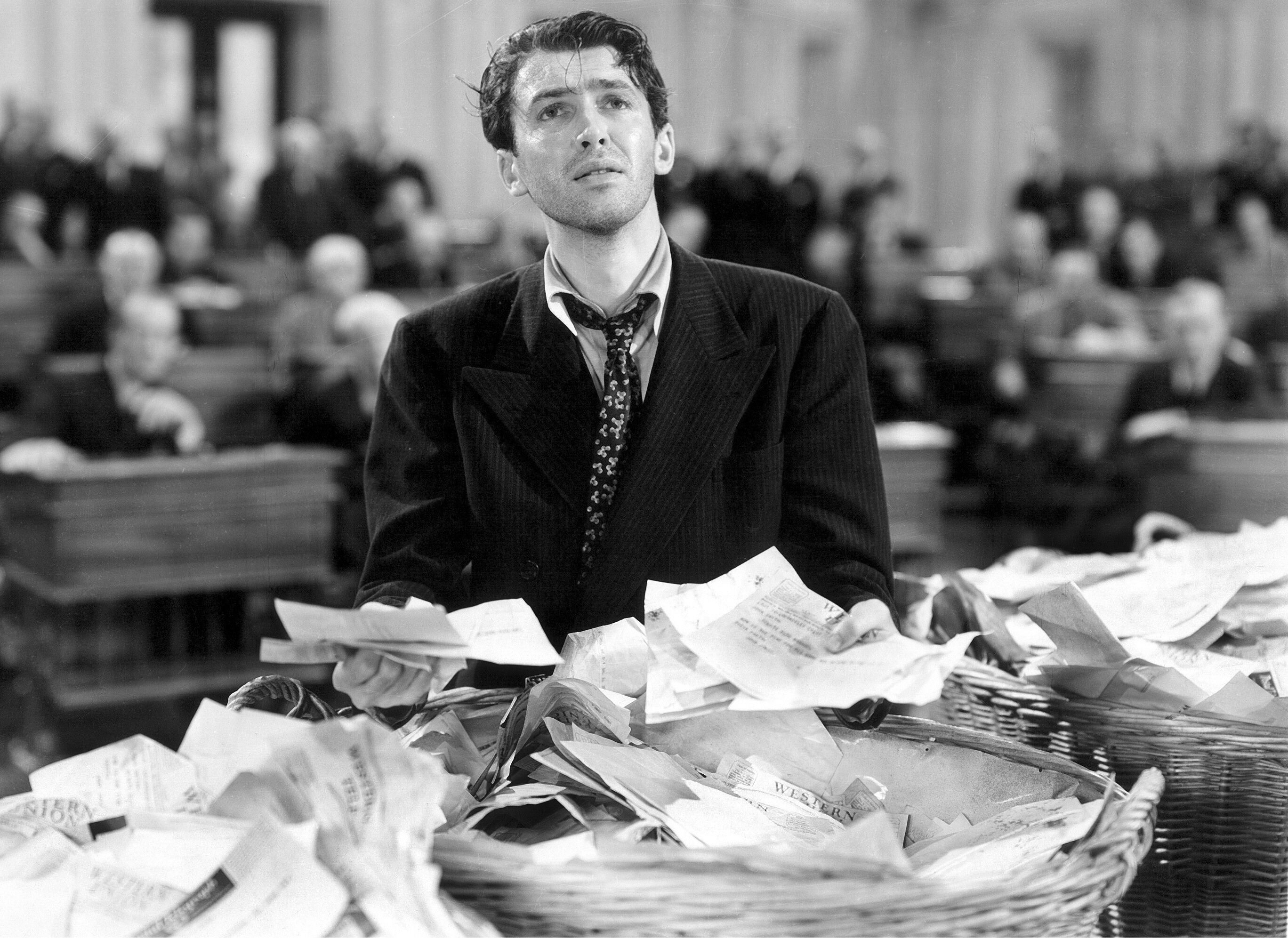
October 17, 1939: Mr. Smith Goes to Washington premieres, at Constitution Hall in Washington, D.C. It was the 2nd of the 3 films that were directed by Frank Capra and starred James Stewart. The 1st was You Can't Take It With You in 1938. The 3rd was It's a Wonderful Life in 1946, which became the defining Frank Capra film and the defining Jimmy Stewart film.
U.S. Senator Sam Foley -- his State is never identified, but is said to be in the West -- dies in office. The Governor Hubert "Happy" Hopper (played by Guy Kibbee) appoints Jefferson Smith (Stewart) to replace him, thinking the young activist will be easy to manipulate. Senator Joseph Paine (Claude Rains), a friend of Smith's late father, mentors him, and Smith takes a liking to the Senator's daughter, Susan (Jean Arthur).
The Washington press take advantage of Smith's naïveté, and he ends up looking like a dim country bumpkin. He comes up with a bill to authorize a federal government loan to buy some land in his home State for a national boys' camp, to be paid back by youngsters across America. It sounds like a typical Franklin Roosevelt-style New Deal bill, and the public likes it, with donations pouring in immediately. However, the proposed campsite is already part of a dam-building graft scheme included in an appropriations bill framed by the the political machine of the State's party boss, Jim Taylor (Edward Arnold), and supported by Paine.
Unwilling to politically destroy Smith so that their graft plan will go through, Paine tells Taylor he wants out, but Taylor reminds him that Paine is in power primarily through Taylor's influence. Paine then advises Smith to keep silent about the matter. The following day, when Smith speaks out about the bill at Senate, the machine, through Paine, accuses Smith of trying to profit from his bill, by producing fraudulent evidence that Smith already owns the land in question. Smith is too shocked and angry by Paine's betrayal to defend himself, and runs away.
Saunders, who looked down on Smith at first, but has come to believe in him, talks him into launching a filibuster, to postpone the appropriations bill and prove his innocence on the Senate floor just before the vote to expel him. In his last chance to prove his innocence, he talks non-stop for about 25 hours, reaffirming the American ideals of freedom and disclosing the dam scheme's true motives. Yet none of the other Senators are convinced.
Newspapers and radio stations in Smith's home State, on Taylor's orders, refuse to report what Smith has to say, and even distort the facts against the Senator. The Boy Rangers' effort to spread the news in support of Smith results in vicious attacks on the children by Taylor's gangsters.
Although all hope seems lost, the Senators begin to pay attention as Smith approaches utter exhaustion. Paine has one last card up his sleeve: He brings in bins of letters and telegrams from the home State, purportedly from average people demanding his expulsion. Nearly broken by the news, Smith finds a small ray of hope in a friendly smile from the President of the Senate. Smith vows to press on until people believe him, but immediately collapses in a faint.
Overcome with the pangs of remorse, Paine leaves the Senate chamber, and attempts to commit suicide by gunshot, but is stopped by onlooking Senators. He then bursts back into the Senate chamber, shouting a confession to the whole scheme. The reformed Paine further insists that he must be expelled from the Senate, and affirms Smith's innocence.
Because the film even suggested that the American federal government might harbor corruption, it was slammed as anti-American and pro-Communist. Senator Alben Barkley of Kentucky, the Majority Leader (and later Vice President under Harry Truman), called the film "a grotesque distortion."
Joseph P. Kennedy, the U.S. Ambassador to Britain (and later father to 3 U.S. Senators, 1 of whom became President), wrote to Harry Cohn, head of Columbia Pictures, the film's distributor, and urged that it be withdrawn from European release, because it would damage America's prestige in Europe. He needn't have worried: The major Fascist dictators -- Adolf Hitler in Germany, Benito Mussolini in Italy, and Francisco Franco in Spain -- all banned it in their countries. It wasn't shown in the Soviet Union until 1950.
Since World War II, the words "Mr. Smith goes to Washington" have become code for a "citizen legislator" getting himself elected and fighting the entrenched interests in Congress. Many such candidates have proven to have been already bought by special interests before they got there.
*
October 17, 1939 was a Tuesday. Baseball season had just ended, with the New Yankees sweeping the Cincinnati Reds in the World Series. The NBA hadn't been founded yet. And the NHL season didn't start for another 2 weeks. There was one score on this historic day, and it was in college football: William & Mary and VPI played to a 6-6 tie at City Stadium in Richmond, Virginia.
"VPI" was the abbreviation for what was known from 1896 to 1944 as the Virginia Agricultural and Mechanical College and Polytechnic Institute; and from 1944 to 1970 as simply the Virginia Polytechnic Institute. Since 1970, it has been Virginia Tech University.


No comments:
Post a Comment