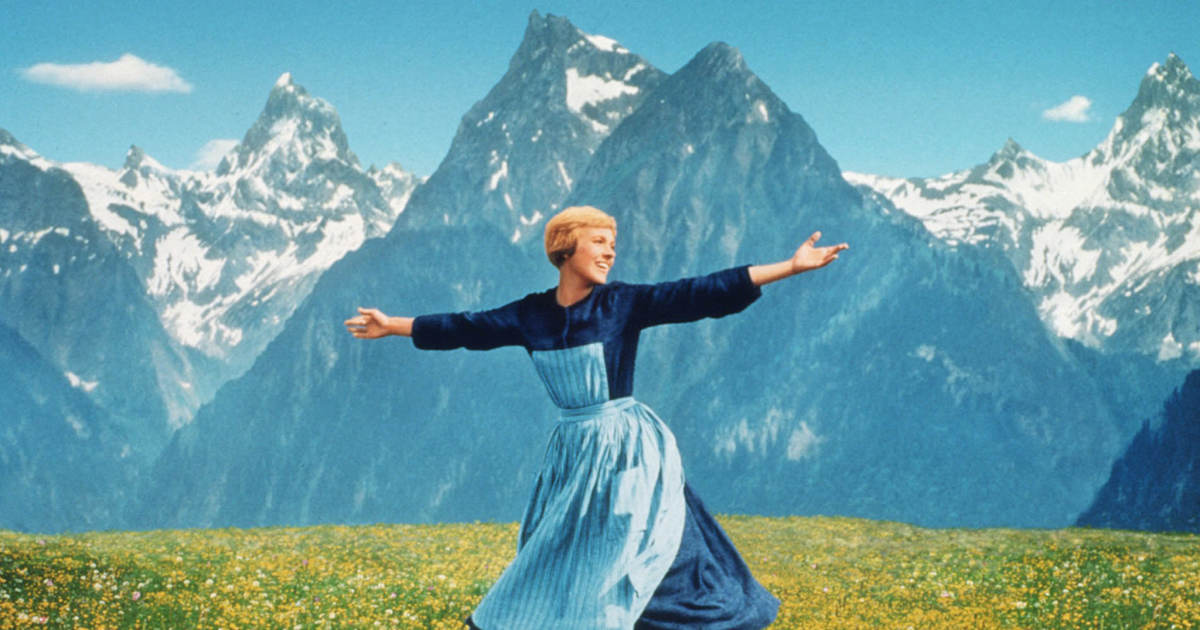
March 2, 1965: The film version of the 1959 musical The Sound of Music premieres, starring Julie Andrews and Christopher Plummer. It proves to be more significant than the musical on which it was based.
The musical was written by Richard Rodgers and Oscar Hammerstein II, and based on The Story of the Trapp Family Singers, published in 1949 by Maria von Trapp. It premiered on November 16, 1959, at the Lunt-Fontanne Theatre. It starred Mary Martin -- already a Broadway legend, and her son Larry Hagman had already begun his acting career) as the woman who begins the story as Sister Maria Rainer and ends it was Mrs. von Trapp; and Theodore Bikel as Captain Georg von Trapp. It ran for 3 1/2 years, and won the Tony Award for Best Musical, with Martin winning the Tony for Best Actress.
Multiple directors were chosen for the film adaptation, before Robert Wise, who had done the film version of West Side Story, was chosen. His only choice to play Maria was Julie Andrews, who had originated the Broadway roles of Eliza Doolittle in My Fair Lady and Queen Guinevere in Camelot. She had been rejected for the film version of My Fair Lady, in favor of Audrey Hepburn, because she'd never been in a movie before. Result? In her 1st movie, Mary Poppins, she beat Hepburn for the Academy Award for Best Actress.
Wise had to talk Broadway veteran Christopher Plummer into playing Captain von Trapp. He ended up hating the film for the rest of his life, but he was great in it. Some of the filming was done in Salzburg, Austria, hometown of the Captain -- and of Wolfgang Amadeus Mozart.
The story begins in 1938, just before Austria was annexed by Nazi Germany in the Anschluss. The nuns at an abbey are wondering about a free-spirited novice: The song is titled "How Do You Solve a Problem Like Maria?" (Definitely not to be confused with the "Maria" song from West Side Story.) She is loaned out to be the governess of the 7 children of the widowed retired naval officer, Captain Georg von Trapp. The children have chased several governesses away, but Maria wins them over.
She even wins over the hard-hearted, strict Captain, who had been engaged to be married to a Baroness, but, seeing that he has feelings for Maria, she breaks the engagement. Maria gets permission from the convent to leave the order and marry Georg. She has been instructing the children in music, and they enter the Salzburg Festival.
But the Anschluss comes first, and Georg is ordered to report to the Kriegsmarine, the Nazi Navy. Georg despises the Nazis, but an agreement is reached: The family will be allowed to compete in the festival, and after it, he will be escorted to the naval base. They sing, and win, but the nuns aid them in escaping. The final scene shows them escaping over the border into Switzerland: The song is "Climb Ev'ry Mountain."
Other songs include the title tract, "Sixteen Going on Seventeen," "The Lonely Goatherd," "Do-Re-Mi," "Edelweiss," "So Long, Farewell," and "My Favorite Things." This last song had been considered one of the most saccharine ever written in its Broadway period, but jazz saxophonist John Coltrane had turned it into a long instrumental masterpiece.
The film was nominated for 10 Oscars, winning 5, including Best Picture, and Best Director for Wise. Andrews was nominated, but lost to Julie Christie for Darling. Plummer was not nominated. These other heavyweights were: Richard Burton for The Spy Who Came In from the Cold, Laurence Olivier for Othello, Rod Steiger for The Pawnbroker, Oskar Werner for Ship of Fools, and the winner, Lee Marvin, for Cat Ballou.
How accurate was the story? Many details were correct, but the names of the children were changed, to protect their real-life privacy. Maria's surname in the movie was Rainer (perhaps a tip of the hat to Oscar-winning German actress Luise Rainer), when, in real life, it was the much harsher Kutschera. And she married Georg not in 1938, but all the way back in 1927. It's been reported that Georg wasn't that strict in real life, that this was exaggerated for dramatic effect. Likewise, the real Maria was, apparently, not very nice. But it was, by all accounts, a loving marriage.
The musical suggests that "Edelweiss," named for a white flower that grows in the Alps, was a traditional Austrian folk song. In fact, it was written for the musical, and was unknown in Austria until after the film was released. It was the last song written by Hammerstein, who died in 1960. Rodgers lived on until 1979.
And the Von Trapps did not try to escape Austria by going over the mountains -- because that would have taken them right into not just Germany, but Berchtesgaden, almost literally into Hitler's backyard. Indeed, their "escape" was not dramatic at all. The family simply walked to the Salzburg Hauptbahnhof and boarded a train to Italy. They were entitled to Italian citizenship since Georg had been born in Zadar, now in Croatia, but then part of the Austro-Hungarian Empire, and had been annexed by Italy after World War I. They were able to emigrate to the United States, via the United Kingdom, on their Italian passports.
The family moved to Stowe, Vermont, where they ran a hotel and ski lodge. Georg died in 1947. Maria never remarried, and lived until 1987. Of the real-life versions of the children: Martina died in 1953 (only 32 years old), Hedwig in 1972, Rupert in 1992, Johanna in 1994, Werner in 2007, Agathe in 2010, Maria Franziska in 2014; and, of the children Georg and Maria had together, Eleonore died in 2021, while Rosemarie and Johannes are still alive. (UPDATE: Rosemarie died on May 13, 2022, age 93.) Various descendants of the various children now make up the touring Trapp Family Singers, while others run the lodge.
Mary Martin died in 1990, Robert Wise in 2005, Theodore Bikel in 2015, and Christopher Plummer in 2021. As of March 2, 2022, Julie Andrews is still alive.
*
March 2, 1965 was a Tuesday. Baseball was in Spring Training. Football was out of season. No NHL games were scheduled. There were 3 games in the NBA:
* The New York Knicks lost to the St. Louis Hawks, 99-98 at the old Madison Square Garden.
* The Cincinnati Royals beat the San Francisco Warriors, 121-105 at the Cincinnati Gardens.
* And the Los Angeles Lakers beat the Philadelphia 76ers, 126-117 at the Los Angeles Memorial Sports Arena. Jerry West scored 34 points.


No comments:
Post a Comment