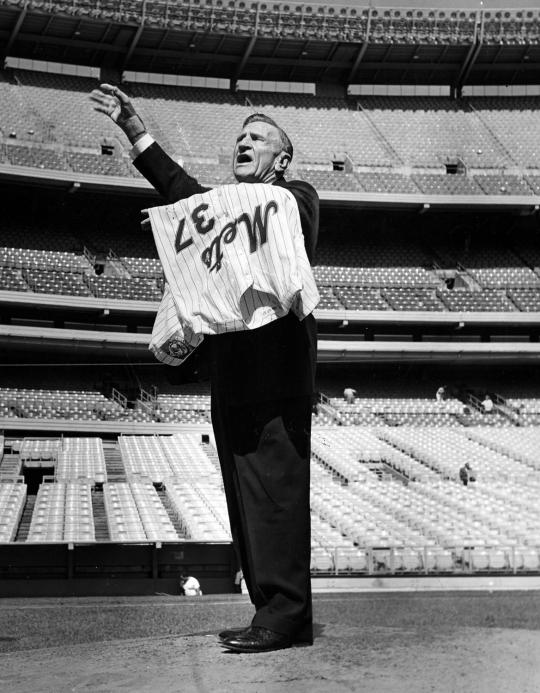
July 24, 1965: The New York Mets lose to the Philadelphia Phillies, 5-1 at Shea Stadium. Jim Bunning allows only 2 hits, striking out 12, while the Phils hit 3 home runs: By Wes Covington, Johnny Lewis and Dick "Dr. Strangeglove" Stuart. Nothing unusual for the early Mets.
What is unusual is that it was Casey Stengel's last game in a major league uniform. The Mets had an Old-Timers game that weekend, and that night, at Toots Shor's restaurant in Midtown Manhattan, with old friends from his various travels around baseball -- going back to his debut as a player in 1912, 53 years earlier -- the 75-year-old Stengel, who drank as much as any player he ever had, got hurt and broke his hip.
The details aren't clear. Maybe he fell off a barstool. Maybe he slipped and fell in the men's room. Maybe he slipped and fell getting into a taxi on the way out. Maybe he slipped and fell getting out of it. If that was the case, maybe it happened outside the Essex House on Central Park South (59th Street), where Casey had kept his New York residence since he first managed the Yankees in 1949. It was just a few blocks from Toots'. Or maybe it happened at the home of Joe DeGregorio, the Mets' comptroller, who lived in Whitestone, Queens, close to Shea, because it would be easier for Casey to get to the stadium in the morning that way. Whatever happened, he woke up in the morning and felt a lot worse, and was taken to the hospital, and was properly diagnosed.
He had been falling asleep while sitting in the dugout during games for years. When the Yankees' owners, Dan Topping and Del Webb, fired him after the 1960 season, Stengel said, "I'll never make the mistake of being 70 again." But the Mets' founding owner, Joan Payson, and hired outgoing Yankee general manager George Weiss, and he said hiring Casey would be great for public relations, and they would need all they could get, because the team would be bad for years to come, no matter what.
By the start of the 1965 season, Mrs. Payson, who loved Casey, and her team president, M. Donald Grant, who loved nothing but money and privilege, wanted Casey to retire, because he couldn't do the job anymore. He thought he still could. And they knew that, if they fired him, all the goodwill they'd gotten as New York's "loveable losers" and team of "human beings" as opposed to the Yankees' "corporate culture" would evaporate. They had to appease Casey.
Now, Casey admitted that if he couldn't walk out to the mound and take a pitcher out of a game, he couldn't manage. (Connie Mack of the Philadelphia Athletics, who was 87 when his sons finally ganged up on him and forced him out, never left the dugout, but that was because of a rule saying that a man had to be in uniform to take the field, and Mack wore suits.) And so, at 75, the injury forced Casey out, and Mrs. Payson and Grant were given the dignified way out.
On August 30, with one of his coaches, former New York Giants catcher Wes Westrum, having managed the Mets in the interim, Casey officially announced his retirement, and Westrum was given the job full-time.
On September 2, on the field at Shea, with Casey leaning on a cane, Weiss, himself to retire after the season, announced that Casey's uniform Number 37 would be retired, the team's 1st such honoree, and the uniform would be placed in a glass case on display at the stadium. Casey, with one last witticism, said, "I hope they don't make a mummy out if me and put me under glass!"
Well, maybe that wasn't the last one. Somebody asked Casey what he was going to do with the rest of his life. He said, "How should I know? Most people my age are dead, and you could look it up!"
Officially, Casey was still on the Mets' payroll, as a "vice president." For the most part, he stayed with his wife, Edna (they had no children), at their modest house in the Los Angeles suburb of Glendale, California, where they owned a bank, and made money on that and on oil wells they owned in Texas and Oklahoma. One of the reasons Casey could be so outspoken is that, unlike most men in baseball, he didn't need the money, and wasn't beholden to owners and GMs.
He flew to St. Petersburg, Florida for the Mets' Spring Training. He was elected to the Baseball Hall of Fame in 1966. He attended All-Star Games, World Series games, Old-Timers games, and the Hall of Fame's induction ceremonies. In 1969, he got to see the Mets, whom he had sarcastically given the tag "Amazing," actually become amazing and win the World Series. (They have been "The Amazins" ever since.) On August 8, 1970, he returned to Yankee Stadium, as new ownership had retired Number 37 for him, making him the 1st man in baseball to have his number retired by 2 different teams.
He died of cancer on September 29, 1975, at the age of 85. Jim Murray, the great sports columnist for the Los Angeles Times, began his column the next day by saying, "Well, God is certainly getting an earful today." The following year, the Yankees gave Casey a Plaque for Monument Park at the renovated Yankee Stadium.
As for that glass case with Casey's Mets uniform in it: I never saw it, despite a few trips to Shea, until the Mets opened their team Hall of Fame at Citi Field in 2010. They also had the original uniform of the Mr. Met mascot; surviving seats from Ebbets Field, the Polo Grounds, and Shea; and the team's 2 World Championship trophies, from 1969 and 1986.
*
July 24, 1965 was a Saturday. These other baseball games were played:
* The New York Yankees lost to the Cleveland Indians, 3-0 at Cleveland Municipal Stadium. Sam McDowell pitched a 5-hit shutout, striking out 10. Leon Wagner hit a home run. Mickey Mantle went 0-for-4, supplying 3 of the strikeouts. Roger Maris was injured, and did not play.
* The Boston Red Sox beat the California Angels, 8-5 at Fenway Park in Boston. Carl Yastrzemski went 1-for-4, and future Seattle Pilot Jim Gosger hit a home run. "Yeah, surrre." Yeah, sure: He hit it in the 7th inning, off Jim Sukla.
* The Baltimore Orioles beat the Minnesota Twins, 3-1 at Memorial Stadium in Baltimore. Boog Powell hit a home run. Brooks Robinson went 0-for-2 with a walk. Harmon Killebrew went 0-for-3 with a walk.
* The Washington Senators beat the Kansas City Athletics, 9-2 at District of Columbia Stadium (later Robert F. Kennedy Stadium) in Washington. Doc Lock hit 2 home runs.
* The Detroit Tigers beat the Chicago White Sox, 7-4 at Tiger Stadium in Detroit. Al Kaline, Norm Cash and Bill Freehan all homered for the Tigers.
* The Pittsburgh Pirates beat the Chicago Cubs, 8-5 at Wrigley Field in Chicago. Roberto Clemente and Bill Virdon homered for the Pirates, Ron Santo and Billy Williams for the Cubs. Ernie Banks went 0-for-4, and Willie Stargell went 0-for-5.
* A doubleheader was split at the Astrodome in Houston. The Houston Astros won the opener, 4-2. The Cincinnati Reds won the nightcap, 2-0, as Joe Nuxhall, once the youngest player ever to enter an MLB game but now in his final season, allowed just 1 hit and 2 walks, striking out 11. Over the 2 games, Frank Robinson went 3-for-7 with an RBI, Pete Rose went 3-for-8 with 2 RBIs, and Joe Morgan went 1-for-7 with a walk and an RBI -- for the Astros.
* The St. Louis Cardinals beat the Los Angeles Dodgers, 3-2 at Dodger Stadium in Los Angeles. In this game, Cardinal catcher, and future Milwaukee Brewers broadcaster and comic actor, Bob Uecker hit 1 of his 14 career home runs, off Sandy Koufax. I have a separate entry for this event.
The loss wasn't Koufax's fault: He pitched 9 innings, allowing just 2 runs, including Uecker's homer. But the Cards' Ray Sadecki was equal to the task, and the game went to extra innings. The Cards won it in the 10th inning, when Dodger center fielder Willie Davis mishandled a fly ball by the Dick Groat, allowing Lou Brock to score.
* And the San Francisco Giants beat the Milwaukee Braves, 4-2 at Candlestick Park in San Francisco. Willie Mays went 0-for-3, but Tom Haller hit a home run. Hank Aaron went 0-for-4, but Mack Jones hit a home run.


No comments:
Post a Comment