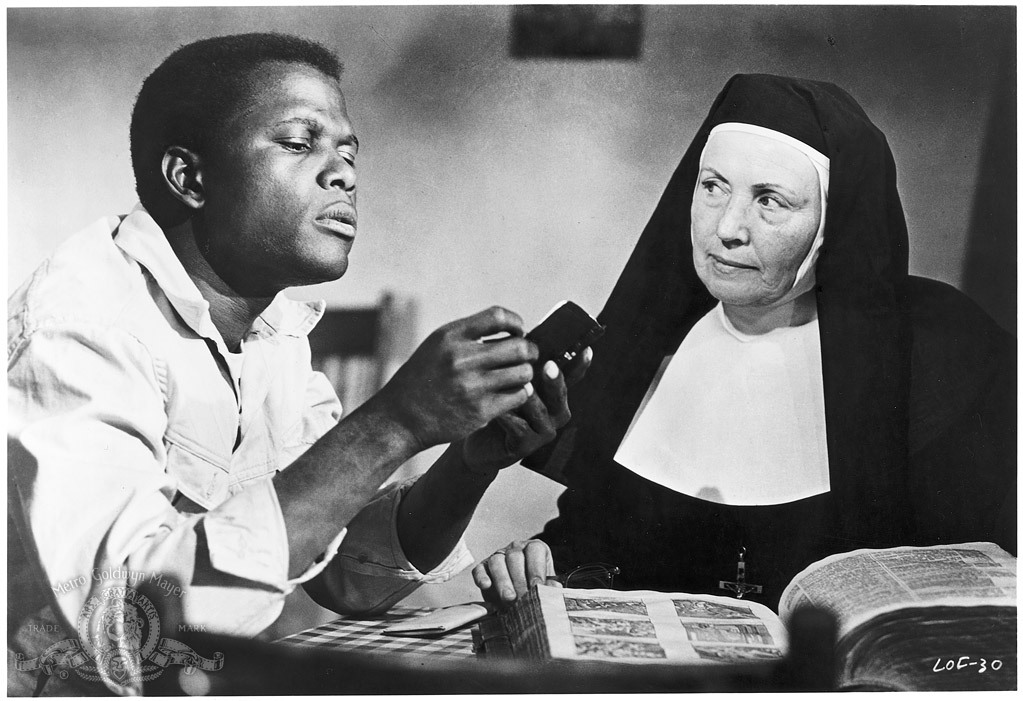
October 3, 1963: Lilies of the Field premieres, based on the novel by William Edmund Barrett, published the year before. Ralph Nelson directed.
Sidney Poitier plays Homer Smith, a traveling handyman. He stops in the Arizona desert to get water for his car, when he sees some women trying to fix a fence. They are nuns: German, Austrian and Hungarian. The mother superior, Mother Maria asks him to fix the roof of their convent. But instead of paying him, she offers him a free dinner. Since all the nuns speak German, he doesn't understand them. He teaches them some helpful English phrases.
The next morning, again instead of paying him for his work, Mother Maria gives him breakfast and asks him to build them a chapel. Knowing that she is taking advantage of him and his work, he responds in a way he thinks she will understand, by quoting Scripture, Luke 10:7: "The laborer is worthy of his hire." She comes right back, with Matthew 6:28 and 29: "Consider the lilies of the field, how they grow; they toil not, neither do they spin. And yet I say unto you that even Solomon in all his glory was not arrayed like one of these." He is smart enough to know that, this time, he is not going to win a battle of words and knowledge.
The nuns -- who call Homer "Schmidt," the German version of his surname "Smith" -- need the chapel because their church is a long walk away. Homer drives them to Mass on Sunday. At the trading post next door, he meets the shopkeeper, a Mexican immigrant named Juan, who tells him that the nuns had escaped from Eastern Europe, over the Berlin Wall, leaving everything they had behind, to come to America. They had no money, living off the land, selling whatever vegetables they could grow, but told Juan that Homer would build a chapel. Homer comes to understand it's not for the nuns, but for the locals, all Mexican-Americans, quite poor, and many of them also far from the church.
Homer admits that he had wanted to be an architect, but couldn't afford college. By day, he works on the chapel, eventually being joined by the locals. By night, he teaches the nuns English (except for Mother Maria, the only one who was already fluent). They teach him Catholic chants, and he teaches them Baptist hymns and "Amen," a recent hit song by the Chicago-based rhythm & blues group The Impressions, which serves as the film's opening and closing theme -- a bold move for a film intended for white audiences in 1963. Indeed, as Homer drives off at the end of the film, his work done and the nuns singing inside the chapel, instead of "The End," the closing graphic reads, "Amen."
This is one of my mother's all-time favorite movies. She told me she rarely watches a movie more than once, but she once insisted that I watch it with her, and that it was the 4th time she'd seen it. The following Spring, Poitier became the 1st black man to win an Academy Award. (Hattie McDaniel, 24 years earlier, for her supporting role in Gone with the Wind, had become the 1st black person to win one.)
Lilia Skala, who fled Austria from the Nazis instead of Germany from the Communists, lived until 1994. Sir Sidney Poitier, born in Miami to Bahamian parents and raised in the Bahamas, and thus a British subject and eligible for a knighthood, one of the most beloved actors in American history, passed away on January 6, 2022.
*
October 3, 1963 was a Thursday. There was only 1 score on this historic day. It was Game 2 of the World Series. The Los Angeles Dodgers beat the New York Yankees, 4-1 at Yankee Stadium. Johnny Podres, who had shut the Yankees out for the Brooklyn version of the Dodgers in Game 7 in 1955, beats them again. Al Downing, the 1st black pitcher for the Yankees and the 1st black pitcher to lead the American League in strikeouts, is valiant in defeat.
Willie Davis doubled in 2 runs in the top of the 1st inning. Bill "Moose" Skowron, the 1st baseman who had helped the Yankees win 8 Pennants and 4 World Series, but was traded away to make room for the rising Joe Pepitone, gets revenge by hitting a home run in the 4th. He is only the 2nd player ever to hit home runs in World Series play for both Leagues, following Enos Slaughter, who did it for the Yankees in 1956 after doing it for the St. Louis Cardinals.
Sandy Koufax had struck out 15 Yankees, setting a Series record that would last for 5 years, in Game 1. Don Drysdale would shut the Yankees out in Game 3 in Los Angeles, and Koufax would complete the sweep in Game 4. It was the 1st time the Yankees had ever been swept in a World Series. The Cincinnati Reds would do it to them in 1976.


No comments:
Post a Comment