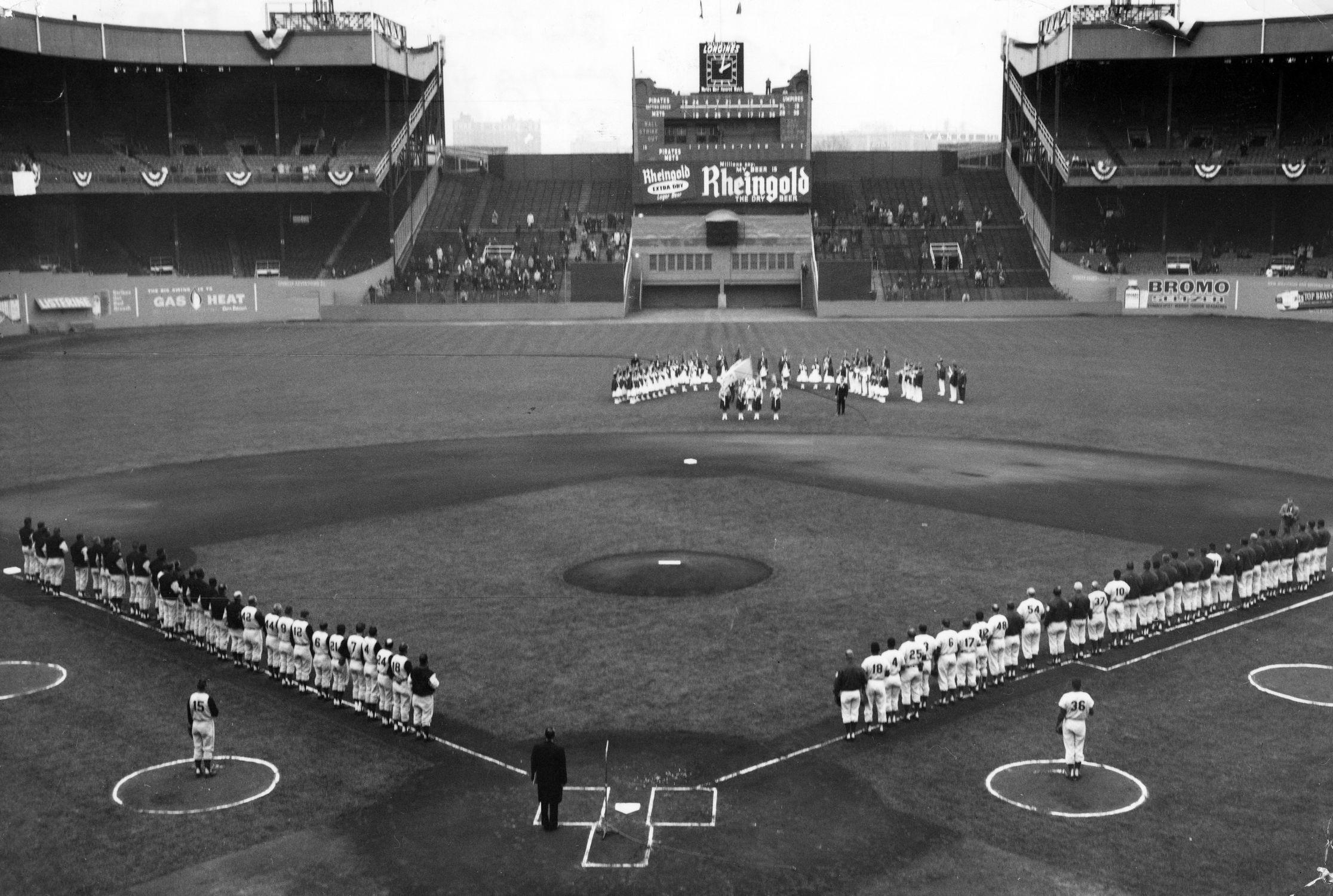
Vic Power at Yankee Stadium -- after the trade
December 16, 1953. The New York Yankees trade Vic Power, Don Bollweg, Jim Finigan, Johnny Gray, Bill Renna and Jim Robertson to the Philadelphia Athletics for Loren Babe, Harry Byrd, Tom Hamilton, Carmen Mauro and Eddie Robinson.
Byrd was a decent pitcher, who simply didn't get run support with the A's. But he didn't do much for the Yankees. Other than him, the only name in this trade that you really need to know is Vic Power. Or, legally, Victor Pellot, which is what he always called himself.
Born in 1927 in Arecibo, Puerto Rico as Victor Felipe Pellot Pove (first name, middle name, father's family name, mother's family name, as is common in Spanish-speaking places), Power was a sensational fielder at 1st base, and in the 1952 season batted .331 with 40 doubles, 17 triples, 16 home runs and 109 RBIs for the Yankees' top farm team, the Kansas City Blues, playing in Blues Stadium, which eventually became Kansas City Municipal Stadium, and was always a pitcher's park.
In 1953, Power batted .349 for the Blues, winning the American Association batting title, with 39 doubles, 10 triples, 16 homers and 93 RBIs. At the time of the trade, he was already 27 years old.
And still, the Yankees hadn't yet brought him up to the majors. This at a time when the Yanks' starting 1st baseman was Joe Collins. He was a good player, but Power was probably already better.
(For comparison's sake: Mickey Mantle was 24 when he won the Triple Crown in 1956; Reggie Jackson, not yet a Yankee, was 23 when he hit 47 home runs in 1969; and Aaron Judge was 25 when he hit 52 home runs in 2017.)
So why would the Yankees trade Vic Power for 5 guys who amounted to nothing in Pinstripes? The official reason was that he was "too flashy" or a "hot dog," for the way he fielded at 1st base. It wasn't "the Yankee way."
Turned out that the real reason was that general manager George Weiss was a bigot, and didn't want black players on the Yankees. To make matters worse, Power was dating a white woman at the time. This was the final straw. How "uppity," as was said at the time of black men who acted out of line with what white men in positions of power demand. Off you go, to the House of Mack.
So why would the Yankees trade Vic Power for 5 guys who amounted to nothing in Pinstripes? The official reason was that he was "too flashy" or a "hot dog," for the way he fielded at 1st base. It wasn't "the Yankee way."
Turned out that the real reason was that general manager George Weiss was a bigot, and didn't want black players on the Yankees. To make matters worse, Power was dating a white woman at the time. This was the final straw. How "uppity," as was said at the time of black men who acted out of line with what white men in positions of power demand. Off you go, to the House of Mack.
The A's had already been integrated for 5 years, and Power broke into their starting lineup right away in 1954, and became a star after their move to Kansas City, where he'd starred in Triple-A, and later with the Cleveland Indians.
He won 7 straight Gold Gloves, batted over .300 3 times, led the AL in triples in 1958 with 10, and made 4 All-Star teams. In 12 big-league seasons, he batted .284, collected 1,716 hits, including 290 doubles, 49 triples and 126 homers. And, in the media, he never seemed to be all that controversial after leaving the Yankees.
After his retirement, he went back to Puerto Rico and became a youth baseball coach, living until 2005, dying of cancer at age 78.
Late in life, as the number of Hispanic players in the majors grew, and interest in their forebears did the same, he gave some interviews in English, and did not seem particularly bitter about his treatment by the Yankees.
Was the decision to trade him justified? In any way? Well, in 1954, the Yankees did get a new starting 1st baseman, Bill "Moose" Skowron, and he was terrific for them until 1962, playing the position superbly, and hitting with more power than any righthanded Yankee would between Joe DiMaggio and Dave Winfield.
And, a year later, in 1955, tired of the mounting criticism from civil rights groups, Yankee owners Dan Topping and Del Webb overruled Weiss, and promoted outfielder/catcher Elston Howard to become the 1st black Yankee. He was 26.
Unlike Power, he was quiet, unflashy, already married to a woman of his own race, and did his job well, and was thus "worthy of the Yankee uniform." He became the 1st black Most Valuable Player award winner in the American League -- in 1963, after the National League had already had black MVPs Jackie Robinson, Roy Campanella (3 times), Willie Mays (the 1st of 2 he would win), Don Newcombe, Hank Aaron, Ernie Banks (twice), Frank Robinson and Maury Wills.
Based on the successes of Skowron and Howard, it can be argued from a competitive standpoint -- if not from a moral one -- that the Yankees lost nothing by trading Power away. Still, they should have gotten something more for him than 5 who's-he's.
And I wonder how much good it would have done in the community to have a terrific player who was not only black, but Hispanic. But Weiss thought it would upset the Yankee fan base, which he considered to be white commuters from Westchester, Connecticut and North Jersey. If only he had known that the real base was working-class Irish and Italians, guys who wore T-shirts, jeans and boots to work, and only wore suits for weddings and funerals. You know: Just like the fans at the Polo Grounds and Ebbets Field.
He won 7 straight Gold Gloves, batted over .300 3 times, led the AL in triples in 1958 with 10, and made 4 All-Star teams. In 12 big-league seasons, he batted .284, collected 1,716 hits, including 290 doubles, 49 triples and 126 homers. And, in the media, he never seemed to be all that controversial after leaving the Yankees.
After his retirement, he went back to Puerto Rico and became a youth baseball coach, living until 2005, dying of cancer at age 78.
Late in life, as the number of Hispanic players in the majors grew, and interest in their forebears did the same, he gave some interviews in English, and did not seem particularly bitter about his treatment by the Yankees.
Was the decision to trade him justified? In any way? Well, in 1954, the Yankees did get a new starting 1st baseman, Bill "Moose" Skowron, and he was terrific for them until 1962, playing the position superbly, and hitting with more power than any righthanded Yankee would between Joe DiMaggio and Dave Winfield.
And, a year later, in 1955, tired of the mounting criticism from civil rights groups, Yankee owners Dan Topping and Del Webb overruled Weiss, and promoted outfielder/catcher Elston Howard to become the 1st black Yankee. He was 26.
Unlike Power, he was quiet, unflashy, already married to a woman of his own race, and did his job well, and was thus "worthy of the Yankee uniform." He became the 1st black Most Valuable Player award winner in the American League -- in 1963, after the National League had already had black MVPs Jackie Robinson, Roy Campanella (3 times), Willie Mays (the 1st of 2 he would win), Don Newcombe, Hank Aaron, Ernie Banks (twice), Frank Robinson and Maury Wills.
Based on the successes of Skowron and Howard, it can be argued from a competitive standpoint -- if not from a moral one -- that the Yankees lost nothing by trading Power away. Still, they should have gotten something more for him than 5 who's-he's.
And I wonder how much good it would have done in the community to have a terrific player who was not only black, but Hispanic. But Weiss thought it would upset the Yankee fan base, which he considered to be white commuters from Westchester, Connecticut and North Jersey. If only he had known that the real base was working-class Irish and Italians, guys who wore T-shirts, jeans and boots to work, and only wore suits for weddings and funerals. You know: Just like the fans at the Polo Grounds and Ebbets Field.
Power, despite playing less than 4 full seasons with the Indians, was named one of the team's 100th Anniversary 100 Greatest Players. Howard is honored with a Plaque in Yankee Stadium's Monument Park. But Weiss has no Monument Park Plaque, although he is, unlike the other two, in the Hall of Fame.
*
December 16, 1953 was a Wednesday. Baseball and football were out of season. There were 2 games played in the NBA. The Boston Celtics beat the Fort Wayne Pistons, 91-74 at the Boston Garden. And the Minneapolis Lakers beat the Milwaukee Hawks, 69-63 at the Milwaukee Arena. In 1974, it was renamed the Milwaukee Exposition, Convention Center and Arena, or "The MECCA." Since 2014, it has been named the UW-Panther Arena.
One game was played in the NHL: The New York Rangers beat the Boston Bruins, 4-3 at the old Madison Square Garden. Ron Murphy scored the winning goal with 3:41 left in regulation.