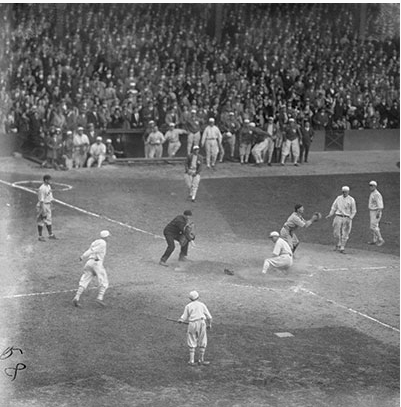
Haas scoring on his inside-the-park homer

Shibe Park
Then the A's came storming back. Slugging left fielder Al Simmons led off with a home run. Jimmie Foxx singled. Edmund "Bing" Miller singled. Jimmy Dykes singled Foxx home. Joe Boley singled Miller home. Mack sent George Burns (a former All-Star outfielder, not the comedian) up to pinch-hit for pitcher Eddie Rommel. He popped up, but Max Bishop singled Dykes home. It was 8-4 Cubs.
McCarthy took Root out, and brought in Art Nehf, the ace pitcher of the New York Giants' 1921 and '22 World Champions. Lewis "Hack" Wilson, a great slugger but not the best of outfielders even when not drunk or hungover, misjudged a fly ball from George "Mule" Haas, and it turned into a 3-run inside-the-park home run, making the score 8-7 Cubs.
Simmons began jumping around in the dugout, yelling, "We're back in the game, boys!" His momentum caused him to crash into Mack – as I said, nearly 67, if not the elderly figure some of us imagine him to have always been. Simmons apologized profusely, but Mack, a former big-league catcher and familiar with ballplayers crashing into him, was just as enthused, and told him, "That's all right, Al."
Mickey Cochrane drew a walk, and McCarthy brought in a 3rd pitcher, John "Sheriff" Blake. The A's had now batted around, and Simmons singled. Foxx singled Cochrane home, and the game was tied. McCarthy brought in a 4th pitcher, Pat Malone. Malone would later help McCarthy win 2 Pennants with the Yankees. This time, he hit with Miller with a pitch, and allowed a double to Dykes that scored Simmons and Foxx.
Malone finally ended the onslaught by striking out Boley and Burns, but 10 runs had scored, and that remains a Series record for a single inning. Mack brought in his ace Lefty Grove, to relieve and finish the Cubs off, and 10-8 remained the final score. The A's closed the shellshocked Cubs down 2 days later -- not being able to play the next day, because sports on Sunday were still illegal in Pennsylvania until 1933.
In 1981, baseball historian John Thorn published Baseball's 10 Greatest Games. He included this game as one of them.
The 1929 Philadelphia Athletics are remembered as one of the greatest teams in baseball history. They might have been the greatest non-Yankee team in American League history. They won the World Series again the next season, beating the St. Louis Cardinals. They won a 3rd straight Pennant in 1931, with 107 regular-season wins, but lost Game 7 of the World Series, to the Cardinals.
They finished a distant 2nd to the Yankees in 1932, and Mack then broke up his team due to the financial constraints of the Great Depression. The team would not win another Pennant until 1972, 41 years -- and two moves to other cities -- later.
In 1978, the Philadelphia Phillies established the Philadelphia Baseball Wall of Fame. From then until 2003, they elected an Athletics figure every year, starting with Mack. From the 1929-31 dynasty, they also elected Jimmie Foxx, Lefty Grove, Al Simmons, Mickey Cochrane, Jimmy Dykes, Eddie Rommel, Bing Miller, George Earnshaw and Rube Walberg. Mack, Foxx, Grove, Simmons, Cochrane and Dykes have also been elected to the Philadelphia Sports Hall of Fame.
UPDATE: The Cubs also have a team Hall of Fame. Inducted from their 1929 Pennant winners have been catcher Charles "Gabby" Hartnett, 1st baseman Charlie Grimm, 2nd baseman Rogers Hornsby, left fielder Riggs Stephenson, center fielder Lewis "Hack" Wilson, right fielder Hazen "Kiki" Cuyler, pitcher Charlie Root, manager Joe McCarthy, team owner William Wrigley Jr., executive Margaret Donahue, and public address announcer Pat Pieper.
*
October 12, 1929 was a Saturday. This was the only baseball game played that day. Pro football was in midweek. Pro basketball was still strictly minor-league. And the NHL season didn't begin until November 14.
But there were college football scores. Most notably, Sanford Stadium opened in Athens, Georgia. The University of Georgia opened it with a 15-0 win over Yale. I have a separate entry for this event. Other notable games played that day:
* The top team in the South, Tulane University, beat Mississippi A&M, 34-0 at Tulane Stadium in New Orleans. (A&M would rename itself Mississippi State in 1932.)
* Notre Dame beat Navy, 14-7 at Municipal Stadium in Baltimore. From 1950 to 1954, piece by piece, it was converted into Memorial Stadium, longtime home of the Orioles and Colts. Notre Dame went 9-0, and were retroactively declared National Champions.
* The University of Pittsburgh also claim a National Championship for this season. They went 9-1, including on this day, winning their annual "Backyard Brawl" with West Virginia, 27-7.
* Purdue beat Michigan, 30-16 at Ross-Ade Stadium in West Lafayette, Indiana. This game decided the Big Ten Conference title.
* The top team on the Pacific Coast, USC beat the University of Washington, 48-0 at Husky Stadium in Seattle.
* In New York City, Fordham beat New York University, 26-0 at the Polo Grounds.
* And City College of New York lost to St. Lawrence University, 22-0 at Weeks Field in Canton, New York.
* In New Jersey, Princeton lost to Brown, 13-12 at Palmer Stadium in Princeton.
* And Rutgers lost to Holy Cross, 20-3 at Fitton Field in Worcester, Massachusetts.


No comments:
Post a Comment