November 9, 1946: One of those college football games that gets the label "Game of the Century" is played at the original Yankee Stadium.
The football team at the United States Military Academy at West Point, New York -- 47 miles north of The Stadium, and they'd used both it and the nearby Polo Grounds as a home-away-from-home a few times -- was usually just called "Army." The teams, as were the students, were known as the Cadets. But, by this point, they were already being called "the Black Knights of the Hudson" in the press. In 1999, the Academy dropped "Cadets," and made "Black Knights" official.
Unlike most college football teams, Army didn't have a manpower drain due to World War II: Quite the opposite: They were training men for war. As a result, head coach Earl "Red" Blaik had the best backfield in the sport, and that included the NFL: Felix "Doc" Blanchard, Number 35; and Glenn Davis, Number 41. Due to their running style, Blanchard became known as "Mr. Inside" and Davis as "Mr. Outside."

In 1943, Army went 7-2-1. They were ranked Number 3 when they played the University of Notre Dame, ranked Number 1, at Yankee Stadium, and lost, 26-0. Army also lost their season finale, to Navy, at Municipal Stadium in Philadelphia (later renamed John F. Kennedy Stadium), 13-0.
But they went 9-0 in 1944, and were named National Champions. This included a 59-0 shellacking of then-Number 5 Notre Dame at Yankee Stadium, and a 23-7 win over Navy at Municipal Stadium in Baltimore. (Memorial Stadium was built on the site in 1954.)
In 1945, again, they went 9-0 and were named National Champions. This included another game at Yankee Stadium, against Notre Dame, then Number 2, and they won it 48-0. And they beat Navy, who had risen to Number 2, 32-13 at Philadelphia Municipal Stadium.
In 1946, they won their 1st 7 games. They beat Villanova at home, 35-0. They beat a rising Oklahoma team at home, 21-7. They beat Cornell at home, 46-21. They went to Ann Arbor and beat Number 4 Michigan, 20-13. They hosted Columbia and won, 48-14. The played Number 13 Duke at the Polo Grounds, and won 19-0. They hosted West Virginia and won, 19-0. They went into Yankee Stadium for the Notre Dame game with a 25-game winning streak.
Notre Dame, based in South Bend, Indiana and known as the Fighting Irish, were coached by Frank Leahy. They won the National Championship in 1943, led by quarterback Angelo Bertelli, who won the Heisman Trophy. In 1944, they went 8-2, losing to Navy and Army in back-to-back games. In 1945, they went 7-2-1. Their loss to Army was immediately preceded by a tie against Navy, and they also lost to the Great Lakes Naval Training Station team.
But in 1946, they were ready to make another run at the National Championship. They beat eventual Big Ten Champion Illinois in Champaign, 26-6. They beat the University of Pittsburgh at home, 33-0. They beat Purdue at home, 49-6. They went to Number 17 Iowa and beat them, 41-6. Then they went to Baltimore and beat Navy, 28-0. They were 5-0 and ranked Number 2 as they went into The Bronx to face Army.
When the teams took the field, there were 4 men who had, or would, win the Heisman Trophy: Blanchard won it in 1945, Davis would win it for 1946, Notre Dame quarterback Johnny Lujack would win it for 1947, and Notre Dame end Leon Hart -- due to the war, freshmen were temporarily made eligible -- would win it for 1949.

Johnny Lujack
There was already history between these teams, and not just in the 3 preceding seasons. In 1913, when Army was one of the top teams in the country and Notre Dame was almost unnoticed, Notre Dame became the 1st college football team to make headlines with the passing game, and upset Army at West Point.
In 1924, they played each other at the Polo Grounds, and Notre Dame won. Nationally-syndicated sportswriter Grantland Rice labeled Notre Dame's backfield "the Four Horsemen." In 1928, they played each other at Yankee Stadium, and Notre Dame coach Knute Rockne invoked the memory of George Gipp, a player who had starred for their 1920 National Championship team and then died, telling them to "win one for the Gipper." The Fighting Irish did just that.
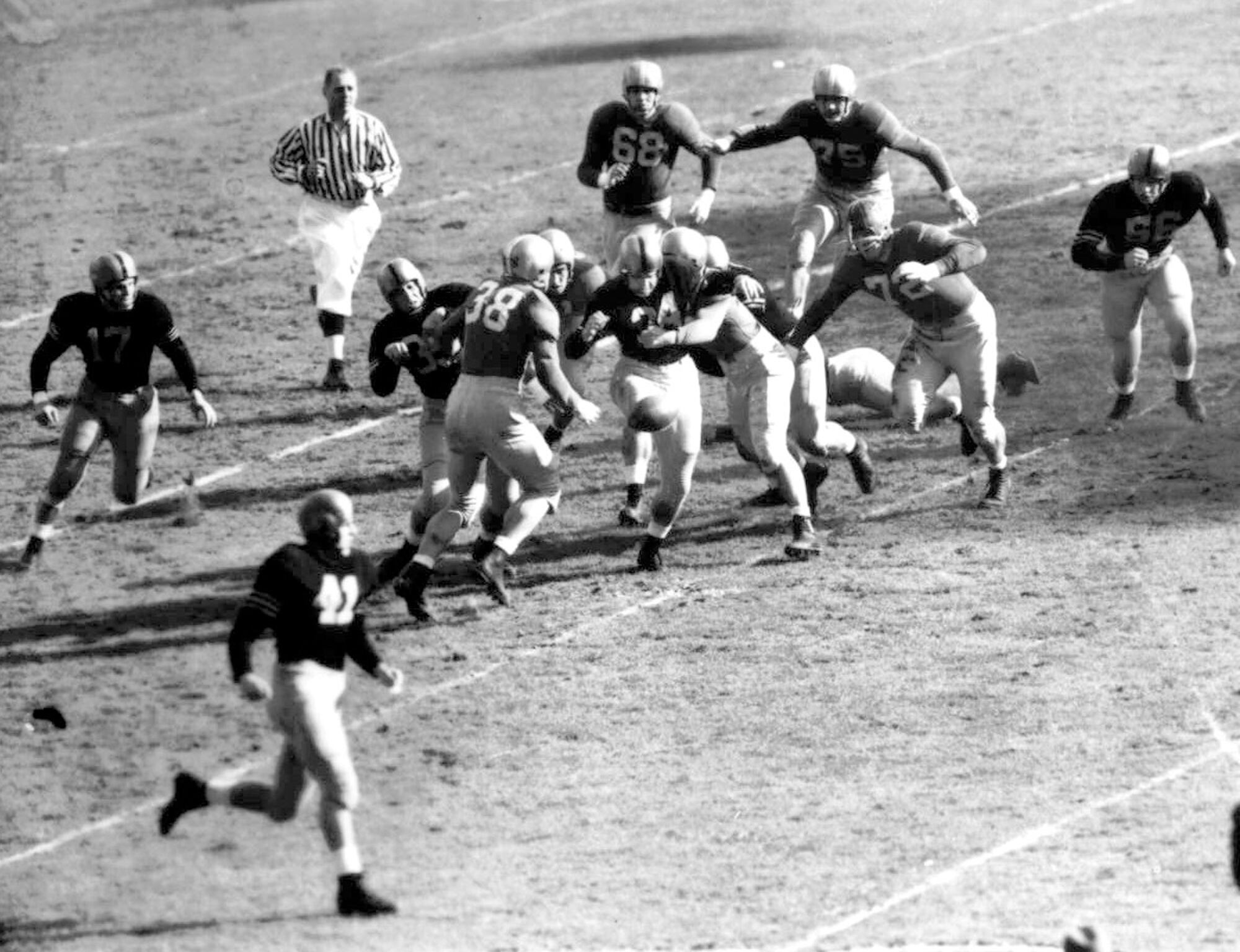
Now, these two powerhouses were playing to set the winner up for the National Championship, in front of 74,121 fans. They saw it in color, but people seeing photographs and newsreels after the fact only saw black & white, and had trouble telling the teams apart: Army wore black jerseys, Notre Dame navy blue ones, and both teams wore gold helmets, with Army's having a black stripe down the middle.

The Corps of Cadets, in formation on the field prior to the game
With the New York and Eastern press pushing Army, and the Chicago and Midwestern press pushing Notre Dame, it was billed as "The Game of the Century."
Sometimes, when a game gets that label, it lives up to the hype. This one did not. Notre Dame had 6 turnovers, 3 of them interceptions of Lujack by Arnold Tucker, who was also Army's quarterback, and finished 5th in the Heisman balloting, behind Davis, Charley Trippi of Georgia, Lujack and Blanchard. (Future Detroit Lions Hall of Fame quarterback Bobby Layne finished 8th.) Army had 4 turnovers.
Notre Dame fumbled on their 1st possession of the game, giving Army the ball on the Notre Dame 23-yard line. But the Cadets couldn't capitalize, and turned the ball over on downs. Notre Dame got to Army's 4-yard line in the 2nd quarter, but also turned it over on downs. Neither Blaik nor Leahy was willing to attempt a field goal; at the very least, the game should have been 3-3 at that point.
In the 3rd quarter, Lujack threw deep, but Tucker intercepted him. Tucker looked like he might return it all the way for a touchdown, but Lujack himself brought him down. A few plays later, Davis tried an option pass, but was intercepted.
And that was the game's last scoring threat. Blanchard and Davis were held to a total of 79 yards. Neither team attempted a field goal. Final score: Army 0, Notre Dame 0. Leahy called it "a terrific battle of defenses."
Army went to Philadelphia, and beat Penn at Franklin Field, and went back there 2 weeks later and beat Navy, to finish the season 9-0-1. Notre Dame hosted Northwestern and beat them, went to New Orleans and beat Tulane, and closed the season by beating Number 16 USC at home.
Neither team accepted an invitation to a postseason bowl game, which was usually the case for each of them. (Although, by playing at Tulane Stadium, site of the Sugar Bowl, it could be argued that Notre Dame played in an equivalent game.) Number 3 Georgia beat Number 9 North Carolina in the Sugar Bowl. Number 5 Illinois beat Number 4 UCLA in the Rose Bowl, the 1st time that game would officially be between the Champions of the Big Nine and the Pacific Coast Conference, the leagues now known as the Big Ten and the Pacific Twelve (or Pac-12). Number 10 Rice beat Number 7 Tennessee in the Orange Bowl. And Number 16 Arkansas beat Number 8 Louisiana State in the Cotton Bowl.
So the question for the National Championship wasn't whether 9-0-1 Army or 8-0-1 Notre Dame was going to receive it, but which one of them. After the season, the Associated Press (AP) released a final poll, with Notre Dame at Number 1 and Army at Number 2. The American Football Coaches Association poll, which became the United Press International (UPI) poll in 1958, also chose Notre Dame. A few minor polls chose Army, and one chose 11-0 Georgia. But Notre Dame was the main pick.
Army eventually extended their unbeaten streak to 31 games, before October 25, 1947, losing to Columbia in a game known as "The Miracle of Morningside Heights." Two weeks after that, they lost to Notre Dame again.
Notre Dame repeated as National Champions, although they split the polls with Michigan. (Now considered big rivals, the teams did not play each other that season.) Only a tie with USC in the season finale spoiled things for the Fighting Irish in 1948, as they again split the polls with Michigan. They went undefeated again in 1949, and there was no split. It was 4 straight National Championships, and a 39-game unbeaten streak. Not until October 7, 1950 did they lose again, at home to Purdue.
That streak would be a record until 1957, when Oklahoma made it 47 straight. Just as would be the case with UCLA basketball and their record 88-game streak from 1971 to 1974, the last team to beat Oklahoma, and the next one, was Notre Dame.
The 1913 game at West Point was the 1st between Army and Notre Dame. They also played each other at West Point in 1914, 1915, 1916, 1917, 1919, 1920, 1921 and 1922. They played at Ebbets Field in 1923. They played at the Polo Grounds in 1925. They played at Yankee Stadium from 1925 to 1929, at Soldier Field in Chicago, Yankee Stadium again from 1931 to 1946. They played at South Bend in 1947, fulfilling their contract. But then they called the rivalry off, as they agreed that the hype had gotten out of control.
They resumed in 1957, at Philadelphia Municipal Stadium. They played at Notre Dame in 1958, 1966, 1970, 1974, 1980, 1985, 1998 and 2006. They played at Shea Stadium in 1965, the old Yankee Stadium in 1969, and West Point in 1973. They played at Giants Stadium in 1977, 1983 and 1995. They played at the new Yankee Stadium in 2010 -- with Notre Dame as the official home team despite Army's proximity -- and the Alamodome in San Antonio in 2016.
Notre Dame leads the rivalry, 39-8-4. Army hasn't beaten Notre Dame since 1958, when Army had Heisman Trophy winner Pete Dawkins. That was Blaik's last season as Army head coach. He lived until 1989. Leahy stayed at Notre Dame through the 1953 season, one more National Championship, and lived until 1973.
The U.S. Army spun the U.S. Air Force off in 1947, and Doc Blanchard was part of its charter officer corps. He later coached Army's freshman football team. He flew 84 combat missions in the Vietnam War, and retired with the rank of Colonel. He served as Commandant of the New Mexico Military Institute, and died in 2009.
Unlike Blanchard, Davis did serve out his military commitment and then play pro football. Unfortunately, when he and Blanchard were filming the movie Spirit of West Point in early 1947 -- which turned out to be Blanchard's last football action -- Davis injured his knee, and arrived with the Los Angeles Rams as damaged goods. He reached the NFL Championship Game in 1950, losing to the Cleveland Browns; and got the Rams back into it in 1951, this time beating the Browns.
Although he made the Pro Bowl in 1950, the knee held him back. And the Rams were loaded in their backfield, with players like Paul "Tank" Younger, "Deacon" Dan Towler and V.T. "Vitamin" Smith. A reinjury of the knee cost Davis the entire 1952 season, and he was released afterward, never to play again. Although both he and Blanchard were elected to the College Football Hall of Fame during their lifetimes, neither became a pro legend. Davis became the organizer of charity events for the Los Angeles Times, and died in 2005.
Lujack played 4 seasons in the NFL, all with the Chicago Bears, succeeding Hall-of-Famer Sid Luckman as starting quarterback. He led the NFL in passing yards and passing touchdowns in 1949, and, despite being a quarterback, led it in rushing touchdowns in 1950. He made the Pro Bowl in 1950 (making him, for the only time in his career, a teammate of Glenn Davis) and 1951.
He returned to Notre Dame as an assistant coach in 1952 and '53, and then became a successful car dealer. As far as I know, Johnny Lujack, now 97 years old, is the last surviving player from this game. He is also the earliest living Heisman Trophy winner. (UPDATE: He died in 2023, leaving Dawkins as the earliest living Heisman winner.)
*
November 9, 1946 was a Saturday. There were other major college football games played that day:
* Number 3 Georgia beat Florida, 33-14 at Fairfield Stadium in Jacksonville, the precursor stadium to the Gator Bowl and the stadium now named TIAA Bank Field.
* Number 6 Michigan beat Michigan State, 55-7 at Michigan Stadium in Ann Arbor.
* Rutgers beat Lafayette, 41-2 at Rutgers Stadium in Piscataway, New Jersey.
* And Princeton lost to Virginia, 20-6 at Palmer Stadium in Princeton, New Jersey.
The baseball season was over. There were 4 games played in the brand-new Basketball Association of America, the league that would become the NBA:
* The Providence Steamrollers beat the Pittsburgh Ironmen, 76-66 at the Rhode Island Auditorium in Providence.
* The Detroit Falcons beat the Boston Celtics, 69-46 at the Olympia Stadium in Detroit.
* The Chicago Stags beat the Toronto Huskies, 62-54 at the Chicago Stadium.
* And the St. Louis Bombers beat the Washington Capitols, 70-69 at the St. Louis Arena.
And there were 2 games played in the NHL:
* The New York Rangers lost to the Toronto Maple Leafs, 4-2 at Maple Leaf Gardens.
* And the Montreal Canadiens beat the Boston Bruins, 5-2 at the Montreal Forum.
Also, Arsenal lost to Preston North End, 2-0 at Deepdale in Preston, Lancashire.