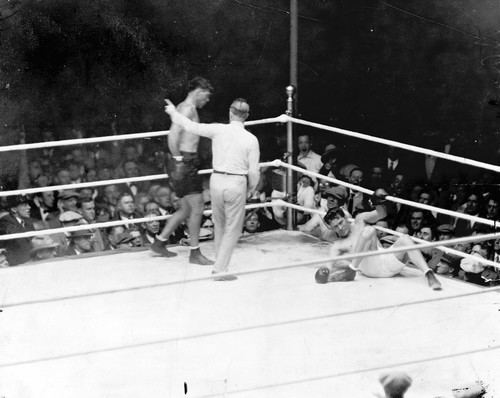
Jack Dempsey became Heavyweight Champion of the World on July 4, 1919, right after World War I. He was a polarizing figure, a devastating puncher known for his early knockouts, but also for being called a "slacker," because he had worked in a shipyard and continued to box during the war.
Gene Tunney, grew up a poor Irish-American kid as well. That aside, he couldn't have been much more different from Dempsey: Instead of a rural area, he grew up in Manhattan, and was a highly intelligent, very cultured, well-read man. He enlisted in the U.S. Marine Corps, and that's where he learned to box, earning him the rather redundant nickname "The Fighting Marine."
He was no stereotypical gruff "leatherneck" (an old term for Marines). He decided to treat boxing as a science. The term "the sweet science" had not yet been used, but Tunney treated it as such. He even preferred to call it "pugilism" rather than "boxing" or even "prizefighting."
He was no stereotypical gruff "leatherneck" (an old term for Marines). He decided to treat boxing as a science. The term "the sweet science" had not yet been used, but Tunney treated it as such. He even preferred to call it "pugilism" rather than "boxing" or even "prizefighting."
On September 23, 1926, Dempsey got into the ring with Tunney, at the 105,000-seat Municipal Stadium in Philadelphia, later renamed John F. Kennedy Stadium. The crowd was listed at 120,557, which is still the highest official total for a prizefight, ever, anywhere in the world. Dempsey was not in shape, and was incredibly rusty. Tunney sensed this before the fight, and saw his suspicions confirmed during it. Tunney won the fight on a decision.
A rematch was set for Soldier Field in Chicago a year later, on September 22, 1927, in front of 104,000 people. Tunney led for the 1st 6 rounds. But in the 7th, Dempsey made a breakthrough, and knocked Tunney down. against the ropes. The Mauler smashed 2 right hands and 2 lefts into Tunney's chin, and he was staggered. Four punches later, and Tunney's knee had hit the canvas. For the 1st time in his boxing career, Gene Tunney had been knocked down.
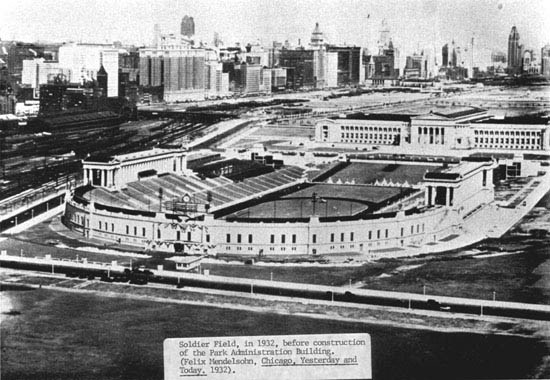
Soldier Field, in 1932, 5 years after the fight
People listening on the radio reported that they couldn't hear any of what happened next, such was the noise from the crowd in the stadium. Talk about the "Roaring Twenties": That term first came about in regard to the rising stock market, but the decade may never have had a louder roar than this one.
But Dempsey did not immediately go to his corner when Tunney went down. As he had usually done in his previous fights, he just stood there. Referee Dave Barry remembered the new rule, and told Dempsey to get to a neutral corner. Dempsey still didn't do so: He just stood there, watching Tunney, waiting for him to get up.
Finally, Barry seemed to give Dempsey a little push, and point, and Dempsey got the hint. Only then did Barry turn back to Tunney, and swing his arm down, with his index finger pointed, and yell, "One!"
The fight was filmed, and, at some point, an early expert in film graphics put a graphic of a stopwatch in the corner of the screen. From the moment Tunney's knee hit the floor until Barry counted, "One!" it was a full 5 seconds. In other words, Tunney got 4 seconds more than he should have.
Tunney was clear-headed and clear-eyed, and he was going to stay down until the count of, "Nine!" so that he could get all the rest to which he was legally entitled. Having done exactly that, Tunney got up before Barry could bring his arm back down and yell, "Ten!" He had spent a total of 14 seconds down, 4 more than the usual limit.
In the 8th round, Tunney managed to knock Dempsey down. Interestingly, Barry began counting without checking that Tunney had reached a neutral corner -- and he hadn't gotten there yet. Dempsey got up, and finished the round and the fight, but it was no contest. When the bell rang to end the 10th and final round, Dempsey knew he'd lost.
Dempsey's fans, and people who may not have liked him much but bet money on him, were furious. It became known as "The Long Count Fight." At the time, there was a federal law prohibiting the transportation of boxing movies across State Lines, meaning that most people never actually saw the fight until years later. People who heard the legend of the Long Count presumed it was true, based solely on hearsay, not on seeing the film.
And people who didn't previously like Dempsey began to sympathize with him. The sense that he may have been treated unfairly actually helped him: He had lost the fight, but won over a lot of fans, many of whom began appreciating him more in hindsight than they did when he was knocking out Jess Willard, Georges Carpentier and Luis Firpo.
Tunney defended his title once more, and retired as Champion, never making a comeback. He and Dempsey, like many other pairs of boxing rivals, became and remained good friends. Tunney lived until 1978, Dempsey until 1983.
In 1950, the Associated Press named Dempsey the greatest boxer of the 1st half of the 20th Century. Their other honorees: Babe Ruth for baseball, George Mikan for basketball, Howie Morenz for hockey, Bill Tilden -- despite his recent scandal -- for men's tennis, Suzanne Lenglen for women's tennis, Man o' War as the greatest racehorse; and Jim Thorpe for football and track and field, and as greatest athlete overall.
*
September 22, 1927 was a Thursday. Tommy Lasorda, the Hall of Fame manager of the Los Angeles Dodgers, was born.
Often a travel day in Major League Baseball, this time, there was a full slate of games:
* The New York Yankees beat the Detroit Tigers, 8-7 at Yankee Stadium -- the old one, but still new. The Yankees led 6-4 going into the 9th inning. The Tigers took a 7-6 lead. Cliché Alert: Walks can kill you, especially the leadoff variety. Mark Koenig drew a walk to lead off the bottom of the 9th, and Babe Ruth hit a walkoff home run.
Herb Pennock was the winning pitcher, in relief of Wilcy Moore. The other way around was much more common. The home run was Ruth's 56th home run of the season. A new record of 60 was within reach.
* The New York Giants split a doubleheader with the Pittsburgh Pirates at Forbes Field. The Pirates won the 1st game, 5-2; and the Giants won the 2nd game, 7-1.
* The Brooklyn Dodgers were swept by the Cincinnati Reds, in a doubleheader at Crosley Field in Cincinnati. In the opener, Chuck Dressen, later to manage the Dodgers to 2 Pennants, and Pid Purdy hit back-to-back doubles to give the Reds a 2-1 win in 12 innings. The Reds won the nightcap, 4-3.
* The Boston Red Sox beat the Chicago White Sox, 2-1 at Fenway Park in Boston. Cleo Carlyle's single won it for the BoSox in the bottom of the 10th.
* The Philadelphia Athletics swept a doubleheader with the Cleveland Indians at Shibe Park in Philadelphia. The A's won the 1st game 4-3, when Jimmie Foxx singled home a run in the bottom of the 13th inning. The A's won the 2nd game 5-2.
* The Washington Senators beat the St. Louis Browns, 10-7 at Griffith Stadium in Washington.
* The Chicago Cubs beat the Philadelphia Phillies, 8-4 at Wrigley Field in Chicago.
* And the St. Louis Cardinals beat the Boston Braves, 6-5 at Sportsman's Park in St. Louis.


No comments:
Post a Comment