Showing posts with label william shakespeare. Show all posts

Wednesday, November 2, 2022

November 2, 1935: Notre Dame vs. Ohio State, "The Game of the Century"

November 2, 1935: For the 1st time, a college football game is given the label "The Game of the Century."

This may have been inspired by the trial, earlier in the year, of Bruno Richard Hauptmann, for kidnapping and killing Charles Lindbergh Jr., the 2-year-old son of famed aviator Charles Lindbergh. That trial, held in Flemington, Hunterdon County, New Jersey from January 3 to February 13, was known as "The Trial of the Century."

Most college football games that have been called "The Game of the Century" were between the teams ranked Number 1 and Number 2 in the national polls. That was not possible this time: The 1st major poll, that of the Associated Press, did not begin until the next season.

At the time, Ohio State University was one of the better programs, having gone 7-1 in both 1933 and 1934. But they weren't yet an iconic team: That would come in the 1950s, under head coach Woody Hayes. For now, the Buckeyes were coached by Francis Schmidt. And they had begun the season by beating Kentucky, Drake (clobbering the Des Moines, Iowa school 85-7), Northwestern and Indiana.

In contrast, the University of Notre Dame, based in South Bend, Indiana, did already have a national following, thanks to their late coach Knute Rockne. They had won the National Championship in 1924, thanks to a backfield known as the Four Horsemen. Now, one of those Horsemen, Elmer Layden, was their head coach.

They had already become the unofficial Catholic university of America. (Not to be confused with The Catholic University of America, an actual school in Washington, D.C.) The a Irish opened their season 5-0, beating Kansas at home, Carnegie Tech (now Carnegie Mellon) away, Wisconsin away, Pittsburgh at home, and Navy in Baltimore.

So these 2 big teams were ready to face each other on November 2, at Ohio Stadium in Columbus. Every major newspaper in the country sent a writer to cover it. It was broadcast on national radio, unusual even then. A crowd of 81,018 poured in, and some people had paid scalpers up to $50 for a ticket -- a little over $1,000 in today's money. And this was during the Great Depression.
Ohio Stadium, as it would have appeared in 1935

Ohio State were heavily favored, and, at first, the game followed that script. Frank Antenucci intercepted Notre Dame quarterback Mike Layden (the coach's younger brother), and lateraled to Frank Boucher (no relation to the New York Rangers hockey star of the same name), resulting in a 65-yard return for a touchdown.

In the 2nd quarter, another interception set up a 3-yard touchdown run by Joe Williams. But, having kicked the extra point on the 1st touchdown, Dick Beltz missed on this one. Still, that 13-0 lead held into the 4th quarter. Notre Dame looked beaten.

Looks can be deceiving. At the end of the 3rd quarter, Andy Pilney returned a punt to the Ohio State 13-yard line. That led to, early in the 4th quarter, Steve Miller running the ball in from 1 yard. It was 13-6 Ohio State. Pilney later threw a touchdown pass to Mike Layden, making it 13-12. Both times, the extra point was missed.

Notre Dame had a legendary name in their backfield: William Shakespeare. Playing off his sharing of a name of the greatest writer in the English language, the New York native was known as the Bard of Staten Island, the Bard of South Bend, and the Merchant of Menace. He had already scored a touchdown for Notre Dame against Army the year before, at Yankee Stadium in his hometown.

Now, Ohio State tried to run out the clock, but fumbled, and the Irish recovered. With less than a minute to go, Pilney ran for 30 yards, getting the ball to the Buckeye 19. But he was injured on the play. Shakespeare entered the game. Once more unto the breach. He threw a pass, and an Ohio State player nearly intercepted it, but dropped it.

Finally, with time for perhaps one more play, fullback Jim McKenna took the snap, and handed it to Shakespeare, who threw an option pass. Wayne Millner, later to make the Pro Football Hall of Fame by catching passes from Sammy Baugh on the Washington Redskins, was down on his knees in the end zone, and caught the ball. Notre Dame had won, 18-13.

Grantland Rice, his column in The New York Herald Tribune syndicated throughout the land, wrote of the game, "This was one of the finest things I've ever seen in football."

But the glory did not last. Just 7 days later, at home no less, Notre Dame lost to Northwestern. Then they went to New York, to again play Army at Yankee Stadium, and only came away with a 6-6 tie. They closed the season at home, beating USC, finishing 7-1-1.

Ohio State bounced back, beating the University of Chicago away, Illinois at home, and Michigan in Ann Arbor. But they didn't play Minnesota. Ohio State and Minnesota were declared Co-Champions of the Big Ten Conference, but it was Minnesota, 8-0, who were named National Champions by most organizations then deciding the thing.

There have been a few "Games of the Century" since, some involving Notre Dame. One in 1993 followed this pattern: Notre Dame stunned Florida State, then blew the National Championship the following week by losing, in that case to Boston College.

Aside from Millner, most of the players on both sides did not play professional football. Shakespeare was drafted by the Pittsburgh Steelers, but made more money than he could have in football at the time by signing with the Cincinnati Rubber Company. He became an executive with them, and still was one when he died in 1974.

Elmer Layden remained at Notre Dame until 1941, when he was offered the job of NFL Commissioner. He held that job for 5 seasons, guiding the League through the difficult days of World War II. He died in 1973.

Francis Schmidt stayed at Ohio State through the 1940 season, winning another Big Ten title in 1939. He was succeeded by Paul Brown, who began his legend by leading the Buckeyes to the 1942 National Championship. Schmidt became head coach at the University of Idaho, but his health began to fail, and he died in 1944.

*

November 2, 1935 was a Saturday. There were a few other big college football games that day.

One was in New York. Fordham University -- coached by another of Notre Dame's former Four Horsemen, Jim Crowley -- played the University of Pittsburgh at the Polo Grounds, and it ended 0-0. Fordham finished 6-1-2 on the year, Pitt 7-1-2. They would play each other at the Polo Grounds again in 1936 and 1937, and those games would also end scoreless. Finally, in 1938, Fordham went to Pitt Stadium, and the Panthers emerged victorious, 24-13.

Manhattan College beat City College (CCNY), 65-0 at Ebbets Field. New York University beat Bucknell, 14-0 at Yankee Stadium. One of NYU's players, Ed Smith, had done some modeling work, and was a high school teammate of sculptor Frank Eliscu. Eliscu asked Smith to pose in his football uniform. In 1982, someone called Smith up and asked him what it was like being the model for the Heisman Trophy, which Eliscu had designed. Smith said he did know he was the model for the Heisman. The Downtown Athletic Club, caretakers of the Trophy, gave him a copy.

Among New Jersey's teams: Rutgers beat Lafayette, 31-6 at Fisher Field in Easton, Pennsylvania; and Princeton beat Navy, 26-0 at Palmer Stadium in Princeton.

The aforementioned Minnesota beat Purdue, 29-7 at Memorial Stadium in Minneapolis. Nebraska beat Missouri, 19-6 at Memorial Stadium (now Faurot Field) in Columbia, and went on to win the Big Six Conference, which later became the Big Eight and formed the bulk of the Big Twelve.

Stanford beat Santa Clara, 9-6 at Stanford Stadium in Palo Alto, California, between San Francisco and San Jose. By beating the University of California 3 weeks later, they won the Pacific Coast Conference, the precursor to today's Pac-12.

Louisiana State beat Auburn, 6-0 at Tiger Stadium in Baton Rouge, and went on to win the Southeastern Conference title. Southern Methodist (SMU) beat Texas, 20-0 at Ownby Stadium in Dallas, and went on to win the Southwest Conference title.

There were no scores in the other sports. The NHL hadn't yet started their season. The NBA hadn't yet started at all. Baseball was done until April. And the NFL waited until the next day, Sunday, to play.    

Tuesday, October 18, 2022

October 19, 1901: Edward Elgar Debuts His "Pomp and Circumstance Marches"

October 19, 1901: Pomp and Circumstance March No. 1 and March No. 2 premiere, at Philharmonic Hall in Liverpool. The marches are conducted by their composer, Edward Elgar. Two days later, he conducts them again at Queen's Hall in London.

Elgar was born on June 2, 1857 in Lower Broadheath, Worcestershire, in the West Midlands of England. By the age of eight, Elgar was taking piano and violin lessons, and his father, who tuned the pianos at many grand houses in Worcestershire, would sometimes take him along, giving him the chance to display his skill to important local figures.

In 1879, he took up the post of conductor of the attendants' band at Powick Hospital, a psychiatric institution outside Worcester. In 1882, he became a violinist with a Birmingham orchestra. He married Alice Roberts in 1886, and they lived in her hometown of Great Malvern, outside Worcester. By 1892, his own compositions began to be performed. In 1899, his Enigma Variations made him world-famous.

Elgar took the phrase "Pomp and Circumstance" from Act 3, Scene 3 of William Shakespeare's tragedy Othello:

Farewell the neighing steed and the shrill trump,
The spirit-stirring drum, th'ear-piercing fife,
The royal banner, and all quality,
Pride, pomp, and circumstance of glorious war!

Pomp and Circumstance was written in 6 "Marches": No. 1 in D major in 1901; No. 2 in A minor, also in 1901; No. 3 in C minor in 1904; No. 4 in G major in 1907; No. 5 in C major in 1930; and No. 6 in G minor, which remained unpublished at his death on February 23, 1934, from colon cancer, at the age of 76.

The five original marches were dedicated to friends of Elgar's: The conductor Alfred E. Rodewald, the composer Granville Bantock, and the organists Ivor Atkins, G.R. Sinclair, and Percy Hull.

Pomp and Circumstance, March No. 1 includes the trio section "Land of Hope and Glory." It is the section that truly popularized the work, since it became the "Coronation Ode" for the Coronation of King Edward VII on August 9, 1902.

It is often known as "The Graduation March," and is played as the processional tune at many high school and college graduation ceremonies. It was first played at such a ceremony on June 28, 1905, at Yale University in New Haven, Connecticut, where the Professor of Music, Samuel Sanford, had invited his friend Elgar to attend commencement, and receive an honorary doctorate of music. Elgar repaid the compliment by dedicating his Introduction and Allegro to Sanford later that year.

*

October 19, 1901 was a Saturday. The only games played in North America that day were college football games. Among them were these:

* Harvard beat Army, 6-0 on The Plain at West Point, New York. Harvard finished 12-0 that season, and were generally regarded as the Champions of the East.

* Yale beat Penn State, 22-0 at Yale Field in New Haven, Connecticut.

* Columbia beat Hamilton College of Kirkland, New York, 12-0 at the Polo Grounds.

* Cornell beat the Carlisle Indian School, 17-0 at the Stadium of the Pan-American Exposition in Buffalo.

* Princeton beat Brown, 35-0 at University Field in Princeton, New Jersey.

* The University of Pennsylvania beat Bucknell, 6-0 at the original Franklin Field in Philadelphia.

* Rutgers lost to Swarthmore, 27-0 at Whittier Field in Swarthmore, Pennsylvania, outside Philadelphia.

* Navy beat Lehigh, 18-0 at Worden Field in Annapolis, Maryland.

* Michigan beat Northwestern, 29-0 at Regents Field in Ann Arbor, Michigan. This was coach Fielding Yost's "Point-a-Minute Team," outscoring 11 opponents 550-0 -- an average of 50-0, not quite a point for every minute, but, given time of possession, considerably more than that. They were generally considered to be what their song "Hail to the Victors" called them: "The Champions of the West," a title they seemed to secure by winning what is generally regarded as the 1st bowl game, beating West Coast champions Stanford on New Year's Day, January 1, 1902, 49-0.

* Notre Dame, not yet the power they would become, beat Chicago Eclectic Medical College, 32-0 at Cartier Field in South Bend, Indiana. Chicago Eclectic Medical changed its name the next year, to the American College of Medicine and Surgery. The school closed in 1917, due to the manpower drain of World War I, and never reopened.

* And Illinois beat the team then generally regarded as their rivals, the University of Chicago, 24-0 at Marshall Field in Chicago, named for Marshall Field, who ran the department store that also bore his name.

And in English soccer, Woolwich Arsenal, the South London team that would later become Arsenal F.C. of North London, traveled to Yorkshire, and lost to Middlesbrough F.C., 3-0 at Linthorpe Road West in Middlesbrough.

In 1979, having had to go to 4 replays in the 3rd Round of the FA Cup against Sheffield Wednesday, the last 3 of them on neutral ground at Filbert Street, home of Leicester City, Arsenal fans -- nicknamed "Gooners," after the team's nickname, "the Gunners" -- adapted Elgar's "Land of Hope and Glory" into this song:

We all follow The Arsenal
over land and sea!
(And Leicester!)
We all follow The Arsenal
on to victory!

The next season, after going to 3 replays of the FA Cup Semifinal against Liverpool, losing the Final to West Ham United, seeing Liverpool win the Football League title, and seeing Nottingham Forest win the European Cup, the Gooners redid the song again:

We hate Nottingham Forest!
We hate Liverpool, too!
(And Tottenham!)
We hate West Ham United!
But Arsenal, we love you!

October 18, 1961: The Film Version of "West Side Story" Premieres

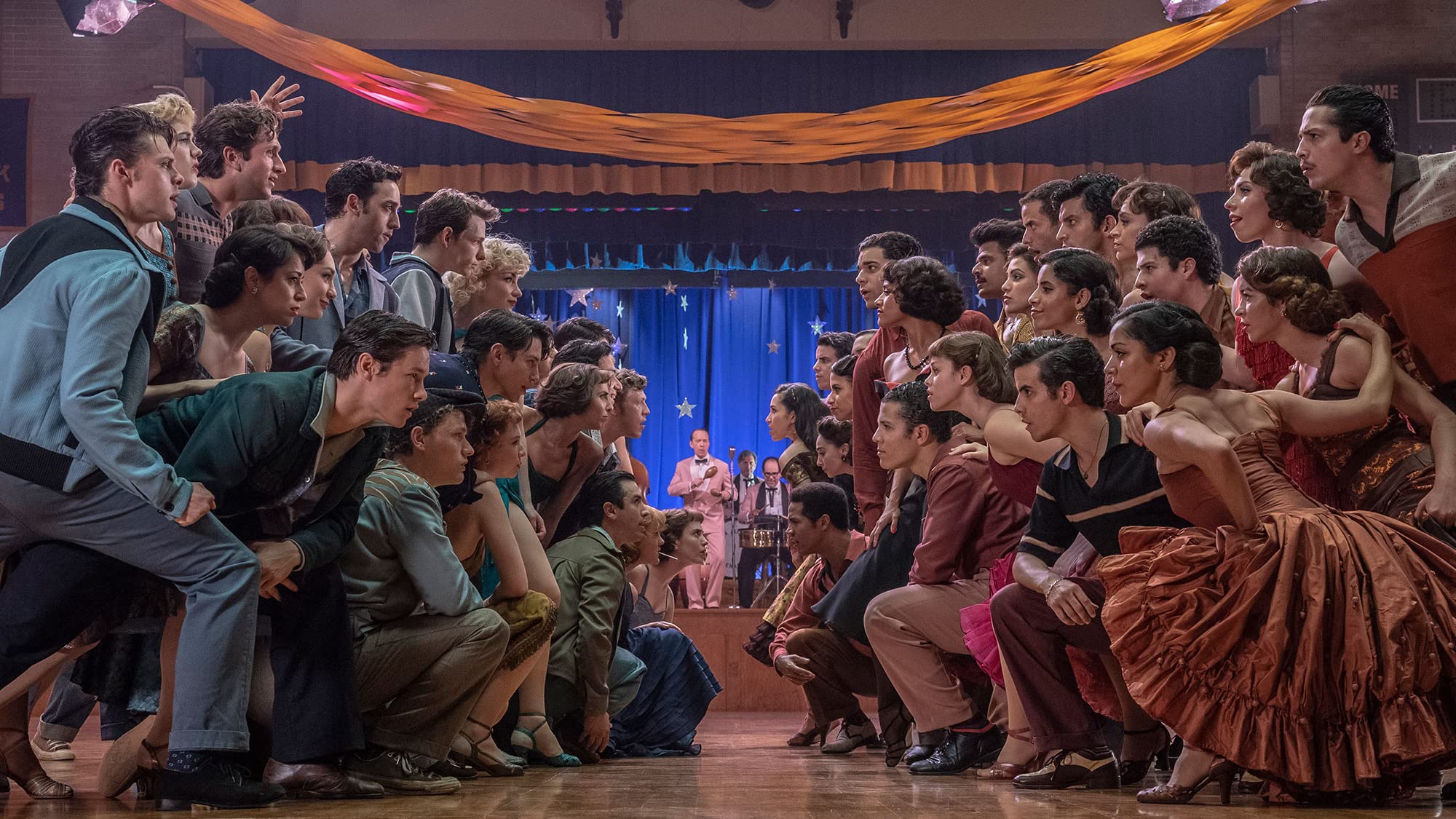
Left: Jets. Right: Sharks.

October 18, 1961: The film version of the 1957 musical West Side Story premieres. It's a modern retelling of William Shakespeare's Romeo and Juliet. In some cases, I'm doing entries for the original stage versions of shows. In some, I'm doing it for the films. West Side Story is the only one truly influential enough to deserve an entry for each version.
In this corner, of various white extractions including Irish, Italian and Polish -- and one kid known by a name that would never fly today, "A-rab" -- is a gang named the Jets: Richard Beymer as Tony (replacing Larry Kert from the original Broadway production, Jimmy Bryant did his singing), Russ Tamblyn as Riff (Michael Callan), and several other guys and girls. Elaine Joyce, already a Broadway performer, made her film debut, as Hotsie, girlfriend of Tiger, one of the Jets, several years before she became a regular panelist on game shows.
And in this corner, the Puerto Ricans, calling their gang the Sharks: Natalie Wood as Maria (with her songs sung by Marni Nixon, replacing Carol Lawrence from Broadway), George Chakiris as Bernardo (replacing Ken LeRoy -- ironically, Chakiris played Riff when the musical first took the British stage in 1958), Jose DeVega as Chino, and Rita Moreno as Anita, Maria's best friend and Bernardo's girlfriend (replacing Chita Rivera). 
The Jets and the Sharks only seem to agree on 3 things: That they're all Catholic, that you gotta be tough to survive in Hell's Kitchen -- Manhattan's West Side, 8th Avenue to the Hudson River, 41st to 59th Streets -- and that they hate the police, who hate them back. William Bramley plays Sergeant Krupke, a.k.a. Officer Krupke. Bramley was the only notable actor from the original show reprising his role.
The film was nominated for 11 Academy Awards (Oscars), winning 10 of them, including Best Picture, Best Director for Wise, Best Supporting Actor for Chakiris, and Best Supporting Actress for Moreno. Oddly, Beymer wasn't nominated for Best Actor. (Maximilian Schell won for Judgment at Nuremberg.) Natalie Wood was nominated for Best Actress, but for Splendor in the Grass rather than for West Side Story. (Sophia Loren won for Two Women, the 1st Oscar for a role in a language other than English.)
In the Spring of 2017, I was babysitting my niece Mackenzie, not yet a full year old. And West Side Story came on TV, with its creditless opening montage showing New York from above, including the pre-renovation original Yankee Stadium in living color. When the camera finally panned down to the finger-snapping Jets, and they started dancing to Jerome Robbins' choreography and Leonard Bernstein's score, Mackenzie was transfixed, going, "Ooh, ooh, ooh." This baby could not take her eyes off a movie that premiered nearly 55 years before she was born.
Steven Spielberg directed a remake in 2021, this time with the characters played by actors of the appropriate ethnicities. Tony was played by Ansel Elgort. Rachel Zegler, Polish on her father's side but Colombian on her mother's, played Maria. David Alvarez, a Montreal-born Cuban, played Bernardo.
It was nominated for 7 Oscars, including Best Picture, making it the 2nd remake of a Best Picture nominee to also be so honored, after the 1935 and 1962 versions of Mutiny on the Bounty. But it only won 1: Ariana DuBose, taking over as Anita from Moreno, who cameoed in the film as the mentor character Valentina. No other actor was nominated, although Spielberg was nominated as Best Director for a record 11th time.
(He's won twice, for Schindler's List and Saving Private Ryan. I guess he's better doing movies set in 1944 than he is with 1957. He shouldn't make a movie about Sputnik, the move of the Brooklyn Dodgers, or the assassination of Albert Anastasia. He wouldn't make those, but he might make a movie about the Little Rock Nine.)
*
October 18, 1961 was a Wednesday. It was a big day in music for another reason: Jazz trumpeter Wynton Marsalis was born.
Baseball season ended 9 days earlier, when the New York Yankees beat the Cincinnati Reds in the World Series. Football was in midweek. The new NBA season started the next day. There was 1 game played in the NHL: The Montreal Canadiens beat the New York Rangers, 5-2 at the old Madison Square Garden.

October 18, 1953: Orson Welles' TV Version of "King Lear"

Orson Welles and Natasha Parry

October 18, 1953: The CBS TV anthology series Omnibus airs a version of William Shakespeare's 1606 play King Lear. Orson Welles directed, and starred. It is heavily abridged, to fit in the broadcast's 90-minute limit, making room for commercials, so it comes in at 73 minutes.

Already having starred in Citizen Kane, in which he played a man whose empire falls apart as he ages, Welles, though just 38 years old, was ideal to play the elderly, senile Lear. The fact that his massive weight gain had begun may have helped.

In the play, Lear decides to divide his kingdom among his 3 daughters: In descending order of age, they are Goneril, Duchess of Albany (played here by Beatrice Straight); Regan, Duchess of Cornwall (Margaret Phillips); and Cordelia (Natasha Parry), who later marries the King of France (a nation which did not exist in Lear's alleged time, but, as he often did, Shakespeare took some dramatic license).

Goneril and Regan make flattering speeches, but Cordelia, who had previously been his favorite daughter, says she loves him according to her duty. Outraged, Lear disowns Cordelia, dividing her inheritance between her two sisters. Lear sets conditions: He retains the title of King, he will reside with Goneril and Regan, and he keeps a retinue of a hundred knights. The Duke of Kent chastises Lear for abdicating and for disowning Cordelia, so Lear banishes him. Lear offers Cordelia without a dowry to her suitors. France accepts, admiring her honesty.

One thing leads to another, and Lear goes mad, and loses control of his kingdom. But he reconciles with Cordelia. Goneril poisons Regan, thinking it will gain her full control of the kingdom. But her plan falls apart, and she commits suicide. The remaining forces of Goneril and Regan hang Cordelia, and leave her body for Lear to find. He dies of grief, and the play leaves the kingdom's fate unresolved.

Supposedly, Lear was a real king, who ruled over part of Britain in the 8th Century BC. But, as with King Arthur centuries later, there seems to be no evidence of his existence except for stories written centuries later.

Pretty much every actor who specializes in Shakespeare's works has played Lear at least once. Paul Scofield played him in a 1971 film, Michael Holden played him in BBC productions in 1975 and 1982, Laurence Olivier for Granada Television in 1983, Ian Holm for the BBC in 1998, and Anthony Hopkins for BBC Two in 2018. The ending of The Godfather Part III, where Mary (Sofia Coppola) dies in the arms of an aging, ailing, screaming Michael Corleone (Al Pacino), has been compared to Cordelia's death.

Omnibus was funded by the Ford Foundation, and filmed at CBS Studio 58, at 851 9th Avenue at 55th Street in Midtown Manhattan. It ran from 1952 to 1961. After canceling it, CBS donated Studio 58's building to Educational Television for the Metropolitan Area, which became the national network NET in 1962 and PBS in 1970. They renamed it Studio 55, and taped Sesame Street and The Dick Cavett Show there. It was torn down in 2002, and the Joan Weill Center for Dance was opened by the Alvin Ailey American Dance Theater on the site.

*

October 18, 1953 was a Sunday. These NFL games were played:

* The San Francisco 49ers beat the Chicago Bears, 35-28 at Wrigley Field in Chicago. Willie Thrower was sent in as a relief quarterback for the Bears, completing 3 of 8 passes, and thus became the 1st black man to play quarterback in the NFL. I have a separate entry for that event.

* The New York Giants beat the Chicago Cardinals, 21-7 at the Polo Grounds.

* The Cleveland Browns beat the Washington Redskins, 30-14 at Griffith Stadium in Washington.

* The Los Angeles Rams beat the Detroit Lions, 31-19 at Briggs Stadium (later Tiger Stadium) in Detroit.

* The Green Bay Packers beat the Baltimore Colts, 37-14 at Green Bay City Stadium in Green Bay, Wisconsin.

* The day before, Philadelphia Eagles beat the Pittsburgh Steelers, 23-7 at Connie Mack Stadium in Philadelphia.

Baseball season had ended 12 days earlier, with the New York Yankees winning the World Series, beating the Brooklyn Dodgers, in 6 games. The NBA season started 12 days later. The NHL's entire "Original Six" was in action:

* The New York Rangers lost to the Boston Bruins, 3-2 at the Boston Garden.

* The Detroit Red Wings beat the Montreal Canadiens, 4-0 at the Olympia Stadium in Detroit.

* And the Toronto Maple Leafs beat the Chicago Black Hawks, 2-1 at the Chicago Stadium.

Monday, September 26, 2022

September 26, 1957: "West Side Story" Premieres

September 26, 1957: West Side Story premieres at the Winter Garden Theatre. It is often called the greatest musical in Broadway history. Arthur Laurents wrote the book, Stephen Sondheim the lyrics, Leonard Bernstein the music, and Jerome Robbins directed the show and ran the choreography. The show ran until June 27, 1959, before going on a U.S. tour.

In 1949, Robbins approached Bernstein and Laurents (all of them Jewish) about collaborating on a contemporary musical adaptation of William Shakespeare's Romeo and JulietHe proposed that the plot focus on the conflict between an Irish Catholic family and a Jewish family living on the Lower East Side of Manhattan, during the Easter–Passover season. The conflict was to be centered on the anti-Semitism of the Catholic "Jets" towards the Jewish "Emeralds."

Laurents wrote a first draft he called East Side Story. Only after he completed it did the group realize it was little more than a musicalization of themes that had already been covered in plays like Abie's Irish Rose, and the project was shelved.

In 1955, Laurents and Bernstein met again in Los Angeles, and talked about the recent rise of youth gangs. They decided to revive East Side Story, with the Irish family replaced by a multi-ethnic white gang, and the Jewish family replaced with a Puerto Rican gang. At this point, in the early days of the Civil Rights Movement, making one of the gangs black would have been too incendiary. Sondheim was brought in, and the title was changed to West Side Story.

In this corner, the Jets: Larry Kert as Tony, Michael Callan as Riff, and several other guys and girls. And in the other corner, the Sharks: Carol Lawrence as Maria, Ken LeRoy as Bernardo, Jamie Sanchez (one of the few actual Hispanics in the cast) as Chino, and Chita Rivera (ditto) as Anita. A character named Francisca is played by an actress named Elizabeth Taylor, but it's not that Elizabeth Taylor.

The only thing the Jets and the Sharks seem to agree on, besides all of them being Catholic and that you gotta be tough to survive in Hell's Kitchen on Manhattan's West Side, is hating the police. William Bramley plays Sergeant Krupke, a.k.a. Officer Krupke.

Tony has been out of the Jets for a while, and has a real job, although it doesn't pay much. He meets Maria, sister of Sharks leader Bernardo. They fall in love instantly, one thing leads to another, and, well, Spoiler Alert: Unlike in Romeo and Juliet, "Juliet" lives, but "Romeo" doesn't. Having a tragic ending was unusual for a Broadway musical. Nevertheless, it was nominated for 6 Tony Awards, including Best Musical. It won 2: Robbins for Best Choreography, and Oliver Smith for Best Scenic Design.

A film version premiered on October 18, 1961, directed by Robbins and Robert Wise. Bramley, as Krupke, was the only notable actor from the original show reprising his role. Richard Beymer played Tony (with Jimmy Bryant doing his singing), Natalie Wood played Maria (with Marni Nixon doing her singing), Russ Tamblyn played Riff, George Chakiris as Bernardo (ironically, he'd played Riff in the 1st British stage version in 1958), Jose DeVega as Chino, Rita Moreno in her Oscar-winning performance as Anita, and Elaine Joyce made her film debut, several years before she became a regular on Match Game. The film was nominated for 11 Academy Awards (Oscars), winning 10 of them, including Best Picture. 

The show has been revived on Broadway several times, and a new film version was made in 2021. This one was written by Broadway icon Tony Kushner, and directed by the one and only Steven Spielberg. Tony was played by Ansel Elgort, Maria by Rachel Zegler, Anita by Ariana DeBose, Bernardo by David Alvarez, Riff by Mike Faist, Chino by Josh Andrés Rivera, and Officer Krupke by Brian d'Arcy James. Rita Moreno, age 89, was brought back, in the newly-created role of Valentina, a general store owner.

In 1969, after winning the Super Bowl with a different group of Jets, Joe Namath got his own TV talk show. The moderator was author Dick Schaap. Schaap was an Ivy Leaguer, having gone to Cornell University. Namath barely got through the University of Alabama. At one point during the run of The Joe Namath Show, Schaap mentioned that he was going to see Romeo & Juliet as part of the Shakespeare in the Park series, and invited Namath. Namath said, "What's it about?" Schaap was shocked that Namath had never heard of it. So he said, "Did you ever see West Side Story?"

In 1972, the World Hockey Association was founded. Two of its teams were the Winnipeg Jets and the Los Angeles Sharks. And the "Jets vs. Sharks" jokes were easy. In 1979, with the Sharks long since disbanded, the Jets were among the WHA teams invited to join the NHL. In 1991, the San Jose Sharks were founded, and the jokes resumed. In 1996, the Jets moved to become the team now known as the Arizona Coyotes. In 2011, the Atlanta Thrashers moved, became the new Winnipeg Jets, and the Jets vs. Sharks jokes started all over again.

In 2007, I was babysitting my niece Mackenzie, not yet a full year old. And the 1961 film of West Side Story came on TV, with its creditless opening montage showing New York from above, including the pre-renovation original Yankee Stadium in living color. When the camera finally panned down to the finger-snapping Jets, and they started dancing to Bernstein's score, Mackenzie was transfixed, going, "Ooh, ooh, ooh!" This baby could not take her eyes off a movie that premiered nearly 55 years before she was born.

In 2019, another version of the story, & Juliet premiered in London. It was a "jukebox musical," produced by Swedish songwriter Max Martin, and featuring hit songs he wrote, worked into a story imagining that Juliet had survived and picked up her life.

Among the songs, which have arguably made Martin the most prolific songwriter of the 21st Century thus far: Backstreet Boys' "I Want It That Way," Britney Spears' "...Baby One More Time" and "Oops!...I Did It Again," Kelly Clarkson's "Since U Been Gone," Ellie Goulding's "Love Me Like You Do," Katy Perry's "I Kissed a Girl," "Teenage Dream" and "Roar," Jessie J's "Domino," and Ariana Grande's "Problem." It is scheduled to open on Broadway on November 17, 2022 -- appropriately enough, at the Stephen Sondheim Theatre.

The Winter Garden Theatre, site of the original Broadway production, still stands at 1634 Broadway, between 50th and 51st Streets. In opened in 1911, and seats 1,600. Among its other original productions: Sky High in 1925, Hellzapoppin in 1938, Wonderful Town in 1953, Peter Pan in 1954, Bus Stop in 1956, Once Upon a Mattress and The Unsinkable Molly Brown in 1960, Funny Girl in 1964, Mame in 1966, Sondheim's musical Follies in 1971, Beatlemania in 1977, and Mamma Mia! in 2001. From 1982 to 2001, it hosted Cats, at the time of its closing the longest-running musical in Broadway history.

In a 2014 episode of the YouTube series Epic Rap Battles of History, "Nice" Peter Shukoff played Romeo, and comedian Grace Helbig played Juliet, against YouTuber Hannah Hart as Bonnie Parker and "Epic" Lloyd Ahlquist as Clyde Barrow.

*

September 26, 1957 was a Thursday. There were only 2 scores on this historic day, both in baseball. The Detroit Tigers beat the Chicago White Sox, 3-2 at Comiskey Park in Chicago, despite Al Kaline going 0-for-4. And the Cleveland Indians beat the Kansas City Athletics, 2-1 at Kansas City Municipal Stadium. For the Indians, rookie Roger Maris went 0-for-1 with 3 walks.

Saturday, June 18, 2022

June 18, 1962: Shakespeare In the Park

June 18, 1962: The Delacorte Theater opens in Central Park in Manhattan, at roughly the midway point between the American Museum of Natural History on the West Side, and the Metropolitan Museum of Art on the East Side, about where the intersection of 81st Street & 7th Avenue would be.

It was the idea of Joseph Papp, a poor Jewish kid from the Lower East Side of Manhattan who fell in love with the works of William Shakespeare. He thought "The Bard" should belong to everybody. He began producing and directing a series of Shakespeare workshops, then moved on to free productions on the Lower East Side. Eventually, the plays moved to a lawn in front of Turtle Pond in Central Park.

In 1959, Robert Moses, whose many City and State government positions included that of the City's Commissioner of Parks, demanded that Papp and his company charge a fee for the performances to cover the cost of "grass erosion." A court battle ensued. Papp continued to fight Moses, winning his enduring respect and the quote, "Well, let's build the bastard a theater."

Following this, Moses requested funds from the city for the construction of an amphitheater in the park. In 1961, the Delacorte was built, as an 1,800-seat amphitheatre. It was named for George T. Delacorte Jr., president of Dell Publishing, a Shakespeare fan who contributed $150,000 to the building's cost. The first performance held in the theater in 1962 was Shakespeare's The Merchant of Venice, starring George C. Scott and James Earl Jones.

Six months earlier, on December 1, 1961, The Death and Life of Great American Cities by Jane Jacobs was published. She was in the process of defeating Moses over his proposed Lower Manhattan Expressway between the Holland Tunnel and the Manhattan Bridge, which would have done to Greenwich Village, Tribeca, SoHo and the Lower East Side what his Cross Bronx Expressway did to The Bronx: Destroyed them.

Papp died in 1991. Since 1962, over 5 million people have attended Delacorte productions, most of them of Shakespeare's plays.

In a 2011 episode of the YouTube series Epic Rap Battles of History, guest performer George Watsky played Shakespeare, opposed by guest performer Mickey Meyer as Theodor "Dr. Seuss" Geisel, "Nice" Peter Shukoff playing the Cat in the Hat, and "Epic" Lloyd Ahlquist playing Thing 1 and Thing 2. This was the 1st time the series had 2 guest stars opposing each other, although Meyer as Seuss did not speak.

UPDATE: The Delacorte closed for renovations on September 4, 2023, and reopened on July 15, 2025.

*

June 18, 1962 was a Monday. There were 5 baseball games played that day:

* The New York Mets lost to the Milwaukee Braves, 7-1 at the Polo Grounds. Hank Aaron went 3-for-5 with 5 RBIs, including his 267th career home run. There would be many more.

* The Cincinnati Reds swept a doubleheader from the Pittsburgh Pirates, 6-5 and 4-2 at Forbes Field in Pittsburgh. Over the 2 games, Frank Robinson went 4-for-9 with a home run and 6 RBIs, and Roberto Clemente went 3-for-7 with a walk.

* The Minnesota Twins beat the Kansas City Athletics, 9-4 at Kansas City Municipal Stadium. Harmon Killebrew went 2-for-5 with an RBI.

* And the Los Angeles Dodgers beat the St. Louis Cardinals, 1-0 at Dodger Stadium in Los Angeles. Thsis was a matchup between perhaps the 2 best pitchers of their generation. For the Dodgers, Sandy Koufax pitched a 5-hit shutout, striking out 9 and walking none. For the Cards, Bob Gibson had a 2-hit shutout with 1 out in the bottom of the 9th inning, striking out 8 and walking 4, before Tommy Davis hit a home run to win it. Stan Musial went 2-for-3.

Wednesday, June 15, 2022

June 15, 1994: "The Lion King" Premieres

June 15, 1994: Disney's animated film The Lion King premieres. This rewrite of William Shakespeare's foremost play, Hamlet, becomes their highest-grossing film ever. (Though, with inflation factored in, it's still topped by the 1937 version of Snow White.)

It's not an exact copy of Hamlet. The father, Mufasa (voice of James Earl Jones) is still alive for the beginning of the film. The usurping uncle, Scar (Jeremy Irons), doesn't marry the widowed queen, Sarabi (Madge Sinclair). The son (Matthew Broderick) doesn't stay, going into exile, before going back. He doesn't taunt his love interest, Nala (Moira Kelly) into insanity and suicide, and she joins him in his crusade. It isn't the son who directly causes the uncle's death. The son is still alive and on the throne at the end. And there's no equivalent to the hyenas in the original.

The film was successful enough to spawn a sequel, a Lion King 1 1/2 with the story told from the perspective of Timon (Nathan Lane) and Pumbaa (Ernie Sabella -- or, if you prefer, Rosencranz and Guildenstern), a live-action version, a live-action prequel about Mufasa, a video game, and an elaborately staged Broadway musical that premiered in 1997 and, as of June 15, 2022, is still running.

Let me close with this: Before we get on the Walt Disney Company for ripping off Shakespeare, let's note that they're far from the only ones:

* West Side Story is Romeo & Juliet, except that Juliet lives.

* Kiss Me Kate and 10 Things I Hate About You are both The Taming of the Shrew.

* Akira Kurosawa's Throne of Blood is Macbeth, moved from Scotland to Japan.

* The 1949 Edward G. Robinson film House of Strangers, set in what was then the present day, and the 1954 Western Broken Lance with Spencer Tracy are adaptations of King Lear.

* The 1983 version of Scarface is Richard III.

* The 1956 science fiction film Forbidden Planet and the Star Trek episode "Requiem for Methuselah" are both The Tempest. And Trek has gone to the well of Shakespeare many times. Star Trek: The Next Generation star Patrick Stewart got his start with England's Royal Shakespeare Company, and among his Shakespearean roles have been Shylock in stage productions of The Merchant of Venice in 1965 and 2011, Oberon in a 1978 stage production of A Midsummer's Night Dream, Claudius in film versions of Hamlet in 1980 and 2009, Prospero in 1995 and 2006 stage productions of The Tempest, the title role in a 1997 stage production of Othello, John Lear in the 2002 TV-movie King of Texas, Mark Antony in a 2006 stage production of Antony and Cleopatra, Malvolio in a 2007 stage production of Twelfth Night, the title role in a 2007 stage production and a 2010 TV-movie of Macbeth, John of Gaunt in a 2012 TV-movie of Richard II, and Shakespeare himself in a 2010 stage production of Bingo: Scenes of Money and Death and the 2011 animated film Gnomeo & Juliet.

And Shakespeare himself ripped off a lot of people. Most of his plays were based on previous writings.

*

June 15, 1994 was a Wednesday. Football was out of season. The Stanley Cup was awarded the night before, when the New York Rangers won Game 7 of the Finals over the Vancouver Canucks.

Game 4 of the NBA Finals was played at Madison Square Garden. The New York Knicks beat the Houston Rockets, 91-82.

And these Major League Baseball games were played:

* The New York Yankees lost to the Baltimore Orioles, 8-4 at Camden Yards in Baltimore. The O's scored 5 runs in the 8th inning to win the game. Don Mattingly went 2-for-4 with 3 RBIs. Cal Ripken went 0-for-3 with a walk.

* The New York Mets beat the Philadelphia Phillies, 1-0 at Shea Stadium. Bobby Jones pitched 8 innings of 4-hit shutout ball, and John Franco pitched a perfect 9th, to outpitch Mike Williams. The only run came in the bottom of the 6th, when Todd Hundley singled Jones himself home.

* The Montreal Expos beat the Pittsburgh Pirates, 13-2 at the Olympic Stadium in Montreal.

* The Minnesota Twins beat the Boston Red Sox, 7-5 at Fenway Park in Boston.

* The Atlanta Braves beat the Colorado Rockies, 4-0 at Atlanta-Fulton County Stadium. John Smoltz pitched 7 1/3rd innings of 4-hit shutout ball, followed by Mike Stanton allowing a hit in finishing the 8th inning, and Steve Bedrosian allowing a hit in the 9th.

* The Cleveland Indians beat the Toronto Blue Jays, 4-3 at Jacobs Field (now Progressive Field) in Cleveland. Jim Thome won it with a home run in the bottom of the 13th inning.

* The Oakland Athletics beat the Chicago White Sox, 7-5 at the new Comiskey Park (now Rate Field) in Chicago. Rickey Henderson went 4-for-5, but had no stolen bases or RBIs.

* The Milwaukee Brewers beat the Detroit Tigers, 11-7 at Milwaukee County Stadium.

* The Florida Marlins beat the St. Louis Cardinals, 13-3 at Busch Memorial Stadium in St. Louis.

* The Kansas City Royals beat the California Angels, 4-3 at Kauffman Stadium in Kansas City.

* The Seattle Mariners beat the Texas Rangers, 5-2 at The Ballpark (now Choctaw Stadium) in the Dallas suburb of Arlington, Texas. Ken Griffey Jr. hit a home run.

* The Chicago Cubs beat the San Diego Padres, 5-0 at Jack Murphy Stadium in Chicago. How many Cubs does it take to pitch a 7-hit shutout? This time, 4: Steve Trachsel, 5 hits over 7; Dan Plesac, 1 over 2/3rd of an inning, José Bautista pitched to 1 batter and got him out, and Jim Bullinger 1 hit in the 9th. Tony Gwynn got 2 of those 7 hits.

* The Cincinnati Reds beat the Los Angeles Dodgers, 4-2 at Dodger Stadium in Los Angeles.

* And the Houston Astros beat the San Francisco Giants, 7-2 at Candlestick Park in San Francisco. Barry Bonds went 2-for-4.

Friday, June 3, 2022

June 3, 1953: Marlon Brando Stars In "William Shakespeare's Julius Caesar"

If you've seen the 1989 film Dead Poets Society, you've seen Robin Williams, as 1959 New Hampshire prep-school English teacher John Keating, imitating Marlon Brando and John Wayne doing Shakespeare.

The John Wayne as Macbeth part was a joke, perhaps to suggest it as the conclusion to the slippery slope of Brando reciting Marc Antony's funeral oration for the title character in William Shakespeare's 1599 play Julius Caesar. But Keating wasn't joking about Brando doing that: It happened:

June 3, 1953: The film William Shakespeare's Julius Caesar premieres. As with Shakespeare's other historical plays, it is titled after who was ruling the country at the time. But Caesar, played in this film by Louis Calhern, dies right in the middle of the story, right after telling the Senate, "I am constant as the Northern Star!"

The film is mostly faithful to the play, if not to actual history. It begins with Caesar in his victory parade after defeating his former ally Pompey the Great, being warned to "Beware the Ides of March," and ignoring it. Cassius (Gaius Cassius Longinus, played by John Gielgud) realizes that Caesar has grown too powerful, and entices Marcus Junius Brutus (James Mason) to join him in a conspiracy to assassinate Caesar, which is done on the Senate floor on the Ides of March: On the calendar used today, March 15, 44 BC.

Cassius recruited Brutus because he was believed by many, including Caesar himself, to be Caesar's most loyal ally. So he is the last to plunge the knife in. At least he did it while facing Caesar, as the others all stabbed him from behind or to the side, the source of the expression. "stab in the back."

Before Brutus does it, a shocked Caesar says, "Et tu, Brute?" Latin for, "You, too, Brutus?" The historian Suetonius had suggested that Caesar had said this, but another, Plutarch, wrote that Caesar said nothing. They are often mistaken for Caesar's last words. In the play, in which Caesar, like many rulers, refers to himself in the third person, he follows being stabbed by Brutus with, "Then, fall, Caesar." And he does.

At Caesar's funeral, Brutus delivers an oration defending his actions, and for the moment, the crowd is on his side. But Antony, Caesar's ally, speaks next. At first, he seems to agree, but he uses sarcasm and innuendo to turn the crowd:

Friends, Romans, countrymen, lend me your ears;
I come to bury Caesar, not to praise him.
The evil that men do lives after them;
The good is oft interred with their bones;
So let it be with Caesar. The noble Brutus
Hath told you Caesar was ambitious:
If it were so, it was a grievous fault,
And grievously hath Caesar answer’d it.
Here, under leave of Brutus and the rest–
For Brutus is an honourable man;
So are they all, all honourable men–
Come I to speak in Caesar’s funeral.
He was my friend, faithful and just to me:
But Brutus says he was ambitious;
And Brutus is an honourable man.
He hath brought many captives home to Rome
Whose ransoms did the general coffers fill:
Did this in Caesar seem ambitious?
When that the poor have cried, Caesar hath wept:
Ambition should be made of sterner stuff:
Yet Brutus says he was ambitious;
And Brutus is an honourable man.
You all did see that on the Lupercal
I thrice presented him a kingly crown,
Which he did thrice refuse: was this ambition?
Yet Brutus says he was ambitious;
And, sure, he is an honourable man.
I speak not to disprove what Brutus spoke,
But here I am to speak what I do know.
You all did love him once, not without cause:
What cause withholds you then, to mourn for him?
O judgment! thou art fled to brutish beasts,
And men have lost their reason. Bear with me;
My heart is in the coffin there with Caesar,
And I must pause till it come back to me.

It works: The common people drive the conspirators out of Rome, weakening their forces. In the resulting civil war, Antony's forces triumph. Following defeat at the Battle of Philippi, in what is now northeastern Greece, on October 23, 42 BC, Cassius has an aide stab him, while Brutus commits suicide the classic Roman way, "Falling on his sword." Antony takes no joy in this, calling Brutus "the noblest Roman of all."

Also of note in the film: Greer Garson as Calpurnia, Caesar's wife; Deborah Kerr as Portia, Brutus' wife; Alan Napier, eventually the butler Alfred on the 1966-68 Batman series, as noted Roman Senator Cicero; John Hoyt as Decius Brutus (an misspelling of Decimus Brutus), a Roman general and a cousin of Marcus Junius Brutus; Ian Wolfe, who specialized in Roman roles, including Septimus in the Star Trek episode "Bread and Circuses," as Ligarius, one of the conspiring Senators; Michael Ansara as Pindarus, another conspirator; and Douglas Watson as Octavius Caesar, a.k.a. Octavian, who initially helps Antony, but later turns against him, and becomes Caesar Augustus, the 1st Emperor of Rome.

The film won just 1 Academy Award, for Best Art Direction. For the 3rd of 4 straight years, Brando was nominated for Best Actor, although he wouldn't win this one, as he did in 1951 for A Streetcar Named Desire and in 1954 for On the Waterfront.

That 1953 Best Actor race was as good as it gets: William Holden won for the World War II film Stalag 17. He defeated Brando; Richard Burton, for another film set in Ancient Rome, The Robe; and Burt Lancaster and Montgomery Clift, each nominated for their roles in From Here to Eternity.

Julius Caesar is a masculine-heavy play, and none of the actresses in this film version was nominated for Best Actress, although Kerr was nominated for her role in From Here to Eternity, losing to Audrey Hepburn of Roman Holiday -- which took place in present-day Rome. From Here to Eternity won Best Picture, defeating William Shakespeare's Julius Caesar, The Robe, Roman Holiday, and the Western Shane.

In 1321, in his Divine Comedy, Dante Aligheri imagined a man being taken through Hell, Purgatory and Heaven. At the bottom of Hell, in its 9th circle, are traitors, as Dante considered betrayal to be the worst sin of all. At the bottom of that, the Devil is eternally chewing on the forms Judas Iscariot, the betrayer of Jesus; and Brutus and Cassius, the betrayers of Caesar.

The Booth brothers, the leading American stage actors of the 19th Century, made their only appearance onstage together in a benefit performance of Julius Caesar on November 25, 1864, at the Winter Garden Theater in New York. Junius Brutus Booth Jr. (1821-1883, named for his father, himself named for an even earlier Brutus in Rome), played Cassius. Edwin Thomas Booth (1833-1893, considered the greatest Hamlet of his time) played Brutus. John Wilkes Booth (1838-1865) played Mark Antony. Ironically, it would be John who became a famous assassin.

On May 29, 1916, commemorating the 300th Anniversary of Shakespeare's death, a production was shown in a natural bowl in Beachwood Canyon in Los Angeles, not far from where the Hollywood Bowl would be built. A crowd of 40,000 people saw Tyrone Power Sr. play Brutus, and Douglas Fairbanks Sr. play Mark Antony. Each man had a namesake son who became a legendary actor as well, and Power Sr. would be surpassed in fame by his son.

In 1937, the Mercury Theatre staged the play on Broadway. Orson Welles directed, and played Brutus. Joseph Holland played Caesar, Greek-English actor George Coulouris played Antony, Joseph Cotten played Publius, Martin Gabel (later better known as the husband of actress Arlene Francis) played Cassius; and Norman Lloyd played Cinna the poet, whose murder scene, rather than Caesar's murder scene or Coulouris' recitation of Antony's eulogy for Caesar, was considered the play's show-stopper. Ironically, Holland outlived most of his castmates, though Lloyd lived to be 106 years old. In 1938, Welles trimmed the play for a one-hour radio broadcast on CBS, with the same cast.

Welles intended the play to be an analogy to the current leader of Italy, the Fascist Il Duce, Benito Mussolini, who was the subject of, among other biographies, one written in 1935 by a friend he had betrayed, the American journalist George Seldes, who titled his book Sawdust Caesar. Likewise, in 1978, historian William Manchester titled his biography of Douglas MacArthur, also a general whose genius was exceeded by his ego, American Caesar.

In 1954, on See It Now, CBS journalist Edward R. Murrow would close his televised exposé of Senator Joseph McCarthy by quoting Cassius' line to Brutus, about how the people of Rome had already let Caesar go too far: "The fault, dear Brutus, is not in our stars, but in ourselves." In 2012, John Green would write a novel for young adult audiences, titled The Fault In Our Stars. It was filmed in 2014.

The 1960 film An Honourable Murder is a reworking of the play, set in present-day London in the world of business, with John Longden (not the American horse-racing jockey) as corporate titan Julian Caesar. The 1963 film Cleopatra fictionalizes the romance between the titular Queen of Egypt (Elizabeth Taylor) and Caesar (Rex Harrison), and the later one between Cleopatra and Mark Antony (Richard Button, whom Taylor soon married). In the film, Cleopatra has a nightmare about Caesar's assassination, and is then told that it has happened. However, she is not mentioned in Shakespeare's play Julius Caesar.

Ted Sorensen, one of President John F. Kennedy's speechwriters, recalled a conversation with JFK's brother and Attorney General, Robert F. Kennedy, after JFK's assassination. Bobby was worried that Jack would be forgotten by history, since he had been President less than 3 full years. Sorensen reminded RFK that Julius Caesar had ruled Rome for only 3 years, and was still remembered. RFK reminded Sorensen that Caesar had Shakespeare writing about him. This led Sorensen to write a biography of JFK, and it won the Pulitzer Prize.

Of course, the real Caesar had an earlier writer to tell his story: Himself. His own writings, about his escapades in war, have survived. They reveal his genius, but also his massive ego.

The Star Trek franchise is loaded with Shakespearean references, and the 1966 original series episode "The Conscience of the King" is about a traveling company of actors, specializing in Shakespeare's works, led by a man who hides his identity as a politician who, many years earlier, had committed a massacre. His daughter tries to protect him, and, threatening Captain Kirk, says, "Caesar, beware the Ides of March!" But her father, tired of it all, steps in between Kirk and her phaser beam, driving her into the last part of madness.

The 1991 film Star Trek VI: The Undiscovered Country takes its title from a line from Hamlet, and the Klingon General Chang is played by Christopher Plummer, who got his start in Shakespearean roles in Montreal, alongside his fellow native of that city, Kirk portrayer William Shatner. Chang quotes Shakespeare throughout, including Caesar's line, "I am constant as the Northern Star," and Antony's line, "Cry havoc! And let slip the dogs of war!"

In a 1970 film version of Julius Caesar, Gielgud played Caesar, with Charlton Heston as Antony and Jason Robards as Brutus. In 1977, Gielgud played Caesar at the Royal National Theatre in London, in what turned out to be his last Shakespearean stage appearance.

In a 1972 episode of The Odd Couple, "A Night to Dismember," Oscar Madison (Jack Klugman) is hypnotized, with a post-hypnotic suggestion: When he hears, "The fault lies not in our stars, but in ourselves," he is to stop being messy as usual, and become as neat as he thinks Felix is -- but it goes too far. In 1973, the BBC aired the TV-play Heil Caesar, set in a present-day Britain that is teetering on the verge of a dictatorship. The BBC did the play straight in 1978, and again in 2012, with an all-black cast led by Paterson Joseph as Brutus and Ray Fearon as Antony. A 1984 Charles Bronson film was titled The Evil That Men Do.

"The Dogs of War" would be used as the titles of a 1974 novel by Frederick Forsyth, a 2017 novel by Adrian Tchaikovsky, a 1999 episode of Star Trek: Deep Space Nine, and a 2003 episode of The West Wing.

The expression "It's Greek to me," to mean a lack of understanding of something, dates back to the play, as Casca tells Cassius of a speech that Cicero made. "Et tu?" has been used by many people, including in popular culture, to suggest that someone has been let down by the last person they expected to do so.

The name "Caesar" was applied to the Emperors of Rome, some of whom adopted it as part of their legal names. The German title for Emperor, "Kaiser," and the Russian title, "Czar" or "Tsar," both come from "Caesar."

I once saw a T-shirt (sadly, I could find no picture of it online) showing a Roman soldier cutting a steak with his sword, saying, "Caesar did not have a salad." But the Caesar salad has nothing to do with the historic Roman. It was created in 1924 by Caesar Cardini, who ran Caesar's restaurant in Tijuana, Mexico. He also created the salad dressing that goes with it, which eventually led to this meme. Note that the bottle has been stabbed in the back:
In a 2012 episode of the YouTube series Epic Rap Battles of History, Angela Trimbur played Cleopatra, against Kimmy Gatewood playing Marilyn Monroe. A 2015 episode featured "Nice" Peter Shukoff as Julius Caesar, against early 19th Century South African Chief Shaka Zulu, played by DeStorm Power. The Cleopatra episode mentioned Caesar, and vice versa.

*

June 3, 1953 was a Wednesday. These baseball games were played:

* The New York Yankees beat the Chicago White Sox, 18-2 at Comiskey Park in Chicago. This was the 6th straight win for the Yankees, in a winning streak that would eventually reach 18. Whitey Ford was the winning pitcher for the Bronx Bombers, while Bob Keegan didn't get out of the 2nd inning for the South Siders.

The Yankees got 19 hits, but only 1 was a home run, by Irv Noren. Mickey Mantle went 1-for-4, but had 4 RBIs: On a single, a groundout, and 2 bases-loaded walks. Joe Collins went 4-for-5 with a walk and an RBI. Gene Woodling went 2-for-5 with a walk and 3 RBIs. Charlie Silvera, filling in at catcher for the injured Yogi Berra, went 3-for-6 with 2 RBIs.

* The New York Giants beat the Cincinnati Reds, 11-3 at the Polo Grounds. Larry Jansen went the distance for the win. Daryl Spencer hit 2 home runs and had 5 RBIs. Davey Williams went 2-for-4 with a home run, a walk, and 3 RBIs. Willie Mays was unavailable for the Giants, as he was serving in the Korean War.

The next day, the Giants won by the exact same score as they scored 7 runs in the bottom of the 8th to come from behind and win. 

* The Brooklyn Dodgers lost to the Milwaukee Braves, 14-9 at Ebbets Field. Vern Bickford didn't get out of the 3rd inning for the Braves, but Carl Erskine didn't get out of the 5th for Dem Bums. Eddie Mathews, Jim Pendleton, and former Dodger Andy Pafko hit home runs for the Braves. Jackie Robinson only appeared as a pinch-hitter, and drew a walk.

* A doubleheader was split at the former Shibe Park, newly renamed Connie Mack Stadium, in Philadelphia. The St. Louis Cardinals won the opener, 5-3. The Philadelphia Phillies won the nightcap, 6-5. Over the 2 games, Stan Musial went 1-for-6 with 2 walks and 2 RBIs. The next day, the Phils again beat the Cards, 6-5.

* The Pittsburgh Pirates beat the Chicago Cubs, 1-0 at Forbes Field in Pittsburgh. Paul LePalme pitched a 7-hit shutout, outpitching Warren Hacker. The only run came in the bottom of the 4th, when Pete Castiglione singled Ralph Kiner home.

The very next day, in a blockbuster deal with the Cubs, Pirate general manager Branch Rickey traded Kiner, Joe Garagiola, George "Catfish" Metkovich and Howie Pollet, for Bob Addis, Toby Atwell, George Freese, Gene Hermanski, Bob Schultz, Preston Ward, and $150,000. Rickey was so cheap (How cheap was he?),  it was once said of him, "He has players and he has money, and he does not like to see the two of them mix." So he valued the cash he was getting from Cubs owner and chewing gum magnate Philip K. Wrigley more than the 6 players he was getting, or the 4 players he was giving up.

One of those players, Kiner, was on his way to the Hall of Fame. But he was also making $75,000, a cut from $90,000 the season before. The Pirates were coming off an atrocious season in which they went 42-112, despite Kiner leading the National League in home runs for a record 7th season in a row. Rickey told Kiner, "We finished 8th with you, and we can finish 8th without you" -- meaning, "...and keep a lot of the money we're paying you."

* The Boston Red Sox beat the Cleveland Indians, 4-3 at Cleveland Municipal Stadium. The Red Sox scored 3 runs off Early Wynn in the top of the 9th inning to come from behind, to make Ellis Kinder a winning pitcher in relief of Sid Hudson. Ted Williams was unavailable for the Red Sox, as he was serving in the Korean War.

* The Philadelphia Athletics beat the Detroit Tigers, 10-7 at Briggs Stadium (later renamed Tiger Stadium) in Detroit. Gus Zernial had 2 home runs and 5 RBIs.

* And the Washington Senators beat the St. Louis Browns, 3-2 at what had been the last ballpark in St. Louis known as Sportsman's Park, but had just been renamed as the first Busch Stadium. Wayne Terwilliger singled Eddie Yost home with the winning run in the top of the 10th inning.

December 31, 1999 & January 1, 2000: The Millennium

December 31, 1999:  The Millennium arrives. The people of planet Earth survived. At a terrible cost. But we hadn't destroyed ourselves. ...