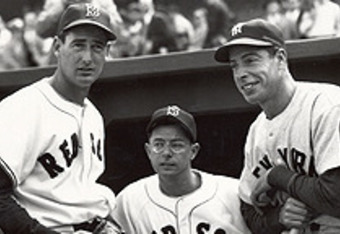
Left to right: Ted Williams, Dom DiMaggio, Joe DiMaggio.
October 2, 1949: Yankee Stadium, Bronx, New York. Regular-season finale. Winner takes the American League Pennant.
The next day, also at Fenway, the Sox lost a playoff for the Pennant to the Cleveland Indians, 8-3, as Tribe shortstop-and-manager Lou Boudreau hit 2 home runs. They went on to beat the Boston Braves in the World Series.
In the off-season, the Yankees Bucky Harris, who had managed them to the 1947 World Series, and hired Casey Stengel, who had just won the Pacific Coast League Pennant with the Oakland Oaks, but had failed as manager of the Brooklyn Dodgers and the Boston Braves. The Sox were managed by Joe McCarthy, who had managed the Yankees from 1931 to 1946, winning 8 Pennants and 7 World Series.
Joe DiMaggio, the best player in baseball since he arrived in the major leagues in 1936, missed the 1st 2 months of the season with a heel spur. In late June, the pain vanished. In a 3-game series at Fenway on June 28, 29 and 30, he went 5-for-9, with 4 home runs and 9 RBIs. The Yankees swept, winning 5-4, 9-7 and 6-3. During the 3rd game, a fan flew a plane over Fenway, trailing a banner reading "THE GREAT DIMAGGIO." The joke was that it had to be for Joe, since Dom was only a very good DiMaggio.
The Yankees jumped out to a 12-game lead, but blew it, mainly due to injuries that kept several players out of the lineup for long stretches. They trailed the Sox by 1 game with 2 to play -- and these 2 were against the Sox at The Stadium.
For the 1st time, the Pennant would come down to the Yankees and the Red Sox. Yes, there was 1904, but that was between the New York Highlanders and the Boston Americans. Not only had the teams not yet adopted their familiar names, but the rivalry tailed off, sparked again by the Red Sox' sale of Babe Ruth and practically their entire starting rotation to the Yankees in the early 1920s.
On October 1, the Yanks held Joe DiMaggio Day, since his brother Dom played for the Sox, and thus the whole family could attend. Joe had been ill with pneumonia, but had kept playing, and says, "I'd like to thank the Good Lord for making me a Yankee." (I guess he didn't have an agent back in 1934.) In the game that followed, the Sox, acting like more recent Red Sox teams, blew a 4-0 lead, Johnny Lindell hit an 8th-inning homer, and the race was tied. Yankees 5, Red Sox 4.
In fact, in the 1901 to 1968 era of 2 single-division leagues, 1949 was the only season in which both leagues' races were unresolved as the final day of the regular season dawned. On the last day of the season, the Brooklyn Dodgers needed a win or a St. Louis Cardinals loss to win the National League Pennant. If they'd gotten neither, there would have been a Playoff.
The Dodgers needed 10 innings, but they got their win, 9-7 over the Philadelphia Phillies at Shibe Park (later renamed Connie Mack Stadium) in Philadelphia. Pee Wee Reese led off the inning with a single. Eddie Miksis sacrificed him to 2nd base. Duke Snider singled him home. Jackie Robinson was intentionally walked to set up the inning-ending double play. But Luis Olmo, one of the earliest Puerto Rican players in the major leagues -- and considered "white" enough to make it before Robinson desegregated the game -- singled Snider home. Jack Banta held the Phils off in the bottom of the 10th, and got the win in relief of Don Newcombe.
1949 Dodger photos. Top row, left to right: Ralph Branca,
Jackie Robinson, Gil Hodges, Roy Campanella.
Bottom row, left to right: Pee Wee Reese,
Duke Snider, a 2nd photo of Hodges, Don Newcombe.
October 2, 1949, Yankee Stadium. This was for the Pennant. A crowd of 68,055 was on hand. Phil Rizzuto led off the bottom of the 1st inning with a triple to left field. Tommy Henrich grounded to 2nd, and "The Scooter" scored. It was 1-0 Yankees.
The Yanks still led 1-0 with 1 out in the top of the 8th, when McCarthy sent Tom Wright up to pinch-hit for his starting pitcher, Ellis Kinder. Big mistake. Wright drew a walk, but Dom DiMaggio grounded into a double play.
Henrich led off the bottom of the 8th with a home run off Mel Parnell, ordinarily the Boston ace. McCarthy removed him, and brought in Tex Hughson, the ace of the Sox' 1946 American League Pennant winners. Yogi Berra, who came into his own this season as both a hitter and a catcher, singled to left. Joe DiMaggio grounded into a double play. But Lindell singled to center, with Hank Bauer pinch-running for him. Billy Johnson singled to left. Hughson, unintentionally, walked Cliff Mapes to load the bases. Jerry Coleman sent a drive down the right field line, clearing the bases, although he was out trying to stretch it from a double to a triple. It was 5-0 Yankees.
Yankee starter Vic Raschi had allowed only 2 hits over the 1st 8 innings, and got the 1st out in the 9th. Then he faltered: He walked Williams, threw a wild pitch, and allowed a single to Vern Stephens. Bobby Doerr lifted a drive to center field. Joe DiMaggio, still sick, dropped an easy fly ball, scoring both runners. Normally so good out there, Joe walked off the field, taking himself out of the game for the good of the team. Stengel moved Bauer from left field to right, moved Mapes from right to center, and put Gene Woodling in left.
Raschi got Al Zarilla to fly to center, where the newly-installed Mapes caught it. But Billy Goodman singled to center, scoring Doerr. It was now 5-3, the tying runs were on, and the run that could win the Pennant was at the plate, in the person of Sox catcher George "Birdie" Tebbetts.
Berra went out to talk to Raschi. "The Springfield Rifle" angrily said, "Gimme the goddamned ball, and get the hell out of here!" Yogi did as he was told, and Raschi got the final out, as Tebbetts popped up to 1st base, where Henrich, normally a right fielder, caught it. Final score: Yankees 5, Red Sox 3. The Yankees had won their 16th American League Pennant.
The Yanks beat the Dodgers in the World Series. In the last 2 seasons, the Sox had won 192 games, and didn't even win a Pennant.
"I won one," a jubilant Stengel said in the locker room. Later, in his weird way of talking that became known as "Stengelese," he said, "I couldn't a-done it without my players."
The following season, the Yankees won it again; while the Dodgers and Phillies again needed 10 innings to settle the race, this time against each other, with no scoreboard-watching. Dick Sisler hit a home run to win it.
UPDATE: The Red Sox have a team Hall of Fame. From their 1948 and 1949 near-misses, they have inductedleft fielder Ted Williams, center fielder Dom DiMaggio, 2nd baseman Bobby Doerr, shortstops Johnny Pesky and Vern Stephens, infielder Billy Goodman; pitchers Tex Hughson, Joe Dobson, Boo Ferris, Mel Parnell and Ellis Kinder; team owner Tom Yawkey, general manager Joe Cronin, scout George Digby, executive Edward F. Kenney, and longtime vendor Arthur D'Angelo.
But from between the 1949 near-miss and the 1967 Pennant, only broadcaster Curt Gowdy, 1st baseman Pete Runnels, 3rd baseman Frank Malzone, center fielder Jimmy Piersall, right fielder Jackie Jensen, and pitchers Frank Sullivan, Bill Monbouquette and Dick Radatz. That should show you how bad the Sox were in the 1950s and most of the 1960s.
*
October 2, 1949 was a Sunday. These other baseball games were played that day:
* The 3rd team in New York -- and, since the Dodgers' 1941 Pennant, they were unquestionably 3rd -- the New York Giants, lost to the Boston Braves, 2-1 at Braves Field in Boston.
* The St. Louis Cardinals beat the Chicago Cubs, 13-5 at Wrigley Field in Chicago. Stan Musial went 3-for-5 with 2 home runs, a walk and 4 RBIs. Once again, Stan was "The Man." But the Dodgers also won, so there would be no Playoff for the Pennant between the teams, as there was in 1946, and there would be between the Dodgers and the Giants in 1951.
* The Washington Senators beat the Philadelphia Athletics, 3-0 at Griffith Stadium in Washington. Dick Weik allowed just 1 hit over the 1st 4 innings, then was replaced by Lloyd Hittle. No indication is given as to why. Hittle allowed only 1 hit over the last 5 innings.
* A doubleheader was split at Forbes Field in Pittsburgh. The Pittsburgh Pirates won the opener, 4-2. The Cincinnati Reds won the nightcap, 6-5.
* The Cleveland Indians beat the Detroit Tigers, 8-4 at Briggs Stadium (later Tiger Stadium) in Detroit. The Tigers scored 4 runs in the 6th to take the lead away from Bob Feller, but the Indians scored 4 in the 8th, to make Feller the winning pitcher.
This would be Bill Veeck's last game as Indians owner. Although he had made the acquisitions necessary to win them the 1948 World Series, he went broke, and had to sell them. Before the last home game of this season, he had a "funeral" for the team's 1948 Pennant, burying it in center field. (Presumably, it was eventually dug up and salvaged.) He would recover, buy and sell the St. Louis Browns, and then later buy and sell the Chicago White Sox -- twice.
* And a doubleheader was split at Sportsman's Park in St. Louis. The White Sox won the 1st game, 4-3. The Browns won the 2nd game, 5-3.
Since it was Sunday, there was NFL action, but only 2 games were played. The Chicago Bears beat the Chicago Cardinals, 17-7 at Comiskey Park in Chicago. And the Los Angeles Rams beat the Green Bay Packers, 48-7 at City Stadium in Green Bay, Wisconsin.
Although Monday Night Football didn't arrive until 1970, there were 2 games the next day, October 3. With Briggs Stadium available, the Detroit Lions lost to the Philadelphia Eagles, 22-14. And with Forbes Field available, the Pittsburgh Steelers lost to the Washington Redskins, 27-14.
The preceding Friday, September 30, at the Polo Grounds, the football version of the New York Giants beat the New York Bulldogs, 38-14. The Bulldogs had been the Boston Yanks (yes, there was actually a team with that name) from 1944 to 1948, playing at Fenway Park, of all places. In 1950, they moved to Yankee Stadium, and used the name "New York Yanks" that year and in 1951. In 1952, they became the original Dallas Texans. In 1953, they became the 2nd, and most familiar version, of the Baltimore Colts.
This was the 4th and final season of the All-America Football Conference. On October 2, the Cleveland Browns, the only Champions the AAFC would ever know, beat the Los Angeles Dons, 42-7 at Cleveland Municipal Stadium; and the original version of the Colts beat the original version of the Buffalo Bills, 35-28 at Civic Stadium (later renamed War Memorial Stadium) in Buffalo.
The preceding Friday, the San Francisco 49ers beat the Chicago Hornets, 42-24 at Soldier Field in Chicago. One AAFC team had the week off, and it was named the New York Yankees. After the season, the Browns, the 49ers and the Colts were admitted to the NFL, but the original Colts flopped and folded, allowing for the newer version in 1953.


No comments:
Post a Comment