Showing posts with label washington nationals. Show all posts

Sunday, October 30, 2022

October 30, 2019: The Washington Nationals Win the World Series

October 30, 2019: Minute Maid Park (now Daikin Park) in Houston is the site of the 1st Game 7 of the World Series in which both starting pitchers had previously won the Cy Young Award: Max Scherzer of the Washington Nationals and Zack Greinke of the Houston Astros.
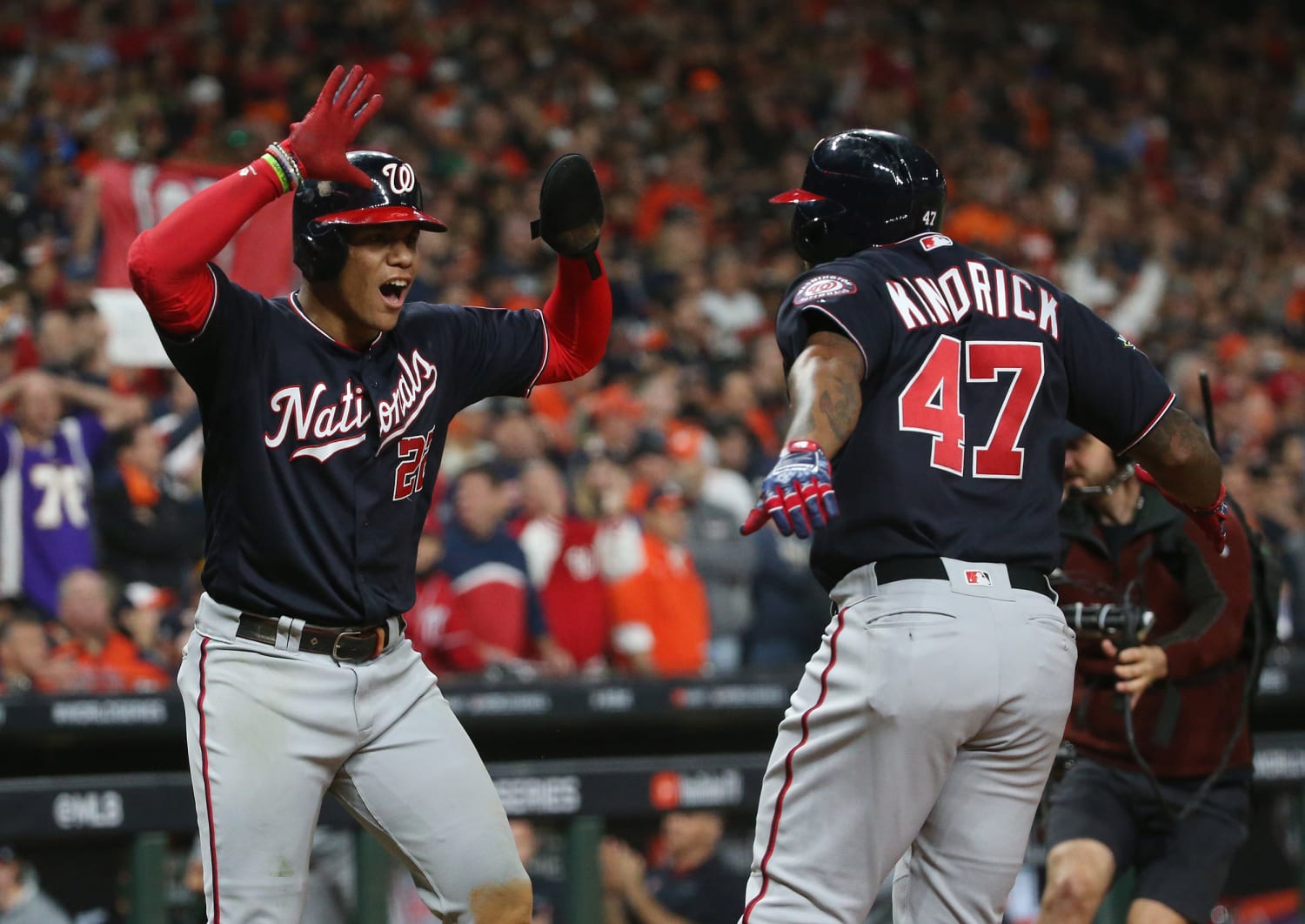
Yuli Gurriel's home run in the bottom of the 2nd and Carlos Correa's single in the bottom of the 5th gave the Astros a 2-0 lead. Greinke cruised into the 7th, but then gave up a home run to Anthony Rendon. He then walked Juan Soto, and was replaced by Will Harris, who gave up a home run to Howie Kendrick.
The Nationals ended up winning 6-2, marking the 1st World Championship for the franchise that had once been the Montreal Expos, in 51 seasons; the 1st World Series win for a Washington baseball team in 95 years, since the 1924 Senators; the 6th straight year that the World Series was clinched by the visiting team, including 4 Game 7s (2014, '16, '17 and '19); and the 1st time in the history of major league sports that the visiting team won all 7 games of a postseason series.
Stephen Strasburg, the injury-prone pitcher whom the Nationals infamously benched for the 2012 postseason to save his arm, resulting in an embarrassing NLDS loss, was named the Series' MVP. He had beaten Justin Verlander in both Game 2 and Game 6. Verlander, 8-1 in Division Series games and 7-4 in League Championship Series games, fell to 0-6 in World Series games.
The Nats' win got more amazing when it was revealed that the Astros were cheating, especially at home, and yet the Nats won all 4 games in Houston. They will always have my thanks for that. Their fans will always have my respect for booing Donald Trump in Game 5 at Nationals Park.

Essentially, the Nats traded a chance at the 2012 title without Strasburg for future chances at a title with him. It worked. But in 2019, they traded a chance at the title with him for the risk of his career. That worked, too, but at a price. Strasburg led led the NL with 209 innings pitched in the 2019 regular season, plus another 36 1/3rd in the postseason. In the 2020, '21 and '22 seasons combined, he pitched just 31 1/3rd innings in the major leagues, plus another 18 in minor-league rehab assignments.

(UPDATE: Strasburg did not pitch at all in 2023. On April 7, 2024, he announced his retirement. He had thrown his last professional pitch at the age of 34. He was 113-62, with 1,723 strikeouts. He should have had twice as many in each of those stats. He finished with a 3.24 ERA, and a 1.096 WHIP.)

As Strasburg has gone, so have gone the Nats: First, mere existence; then, frustration at coming close but falling short; ultimately, the crowning glory; and then pain, physical and emotional. But what achievements he did have were more than most players get.

UPDATE: Scherzer's 161 wins during the 2010s made him the winningest pitcher of the decade. Through the 2024 season, he has won 216 regular-season games, Verlander 262, and Greinke retired after the 2023 season with 225. Verlander finally won a World Series game, when the Astros won in 2022.

*

October 30, 2019 was a Wednesday. Football was in midweek. There were 3 games played in the NBA:

* The Miami Heat beat the Atlanta Hawks, 112-97 at the American Airlines Arena (now the Kaseya Center) in Miami.

* The Dallas Mavericks beat the Denver Nuggets, 109-106 at the Pepsi Center (now the Ball Arena) in Denver.

* And the Los Angeles Lakers beat the Memphis Grizzlies, 120-91 at the Staples Center (now the Crypto.com Arena) in Los Angeles. That's right: Within 1 year, all 3 of these arenas saw their naming rights deals expire, and the rights bought by someone else.

And there were 6 games in the NHL: 

* The New Jersey Devils lost to the Tampa Bay Lightning, 7-6 at the Prudential Center. Tyler Johnson scored the winning goal with 3:44 left in overtime.

* The Edmonton Oilers beat the Columbus Blue Jackets, 4-1 at the Nationwide Arena in Columbus.

* The St. Louis Blues beat the Minnesota Wild, 2-1 at the Enterprise Center in St. Louis.

* The Florida Panthers beat the Colorado Avalanche, 4-3, at the Pepsi Center, a few hours after the Nuggets game there. Jonathan Huberdeau scored the winning goal, 29 seconds into overtime.

* The Montreal Canadiens beat the Arizona Coyotes, 4-1 at the Gila River Arena (now the Desert Diamond Arena) in the Phoenix suburb of Glendale, California.

* And the Vancouver Canucks beat the Los Angeles Kings, 5-3 at the Staples Center, a few hours after the Lakers game there.

Thursday, October 27, 2022

October 27, 2019: Trump Booed at the World Series On His Best Day as President

October 27, 2019: Donald Trump has his best day as President of the United States, with the news of U.S. Special Forces having killed Abu Bakr al-Baghdadi, the leader of "The Islamic State of Iraq and the Levant," or ISIL (often incorrectly called "The Islamic State of Iraq and Syria," or ISIS) in Barisha, Syria.

Born Ibrahim Awad Ibrahim Ali al-Badri al-Samarrai in Samarra, Iraq, al-Baghdadi deserved it. He was a mass murderer, a serial rapist and pedophile, and had waged war against America. He had led ISIL since June 29, 2014. He was 48 years old. 
Of course, as Trump does with everything, he screwed it up. He staged a photograph with generals in the White House Situation Room, with a time-stamp about 2 hours after it happened. When it actually happened, he was engaging in his favorite pastime: Playing golf. And he may not even have been told about it before it happened, so he didn't even get to make the order himself.

Unlike Barack Obama with Osama bin Laden on May 1, 2011. Naturally, Trump's 50-minute speech on the matter made it sound like al-Baghdadi was a bigger kill than bin Laden. Trump had this desperate need to be seen as bigger and better than Obama. Mainly because, the day before bin Laden was killed, Obama both released his birth certificate and humiliated Trump at the White House Correspondents' Dinner.

bin Laden killed a hell of a lot more Americans than al-Baghdadi did. What's more, Trump said that nobody knew who bin Laden was before 9/11. This is a lie. There were news reports about his terrorist activities as early as 1996. In 1998, when al-Qaeda bombed 2 U.S. Embassies in Africa, it was known and publicized that bin Laden ordered it.

In contrast, I never heard of al-Baghdadi until the night he was killed. I literally never knew he was alive until I knew he was dead. ISIL/ISIS, sure, everyone's heard of them. And nearly every American had no problem with our military killing their leader. But ask any American to name their leader before October 27, 2019, and they would draw a blank. Come to think of it, most Americans would have trouble naming their leader after that date.

That would be Abu Ibrahim al-Hashimi al-Qurashi. On February 3, 2022, a U.S. raid on Atme, Syria sealed his fate. Unlike al-Baghdadi, he refused to be taken alive: He set off a bomb, killing himself and 12 others, including members of his family. There were no U.S. casualties. He was 45. He was succeeded by his brother, Abu al-Hasan al-Hashimi al-Qurashi.  

(UPDATE: He lasted 8 months. On November 30, 2022, after this posting, ISIL announced that, like Abu Ibrahim, Abu al-Hasan blew himself up to avoid a sure capture by U.S. forces. His age is not known to the U.S. He was succeeded by Abu al-Hussein al-Husseini al-Qurashi, apparently another brother. On April 29, 2023, Turkish intelligence tracked him down and killed him. His age was also unknown. He was succeeded by yet another brother, Abu Hafs al-Hashimi al-Qurashi.)

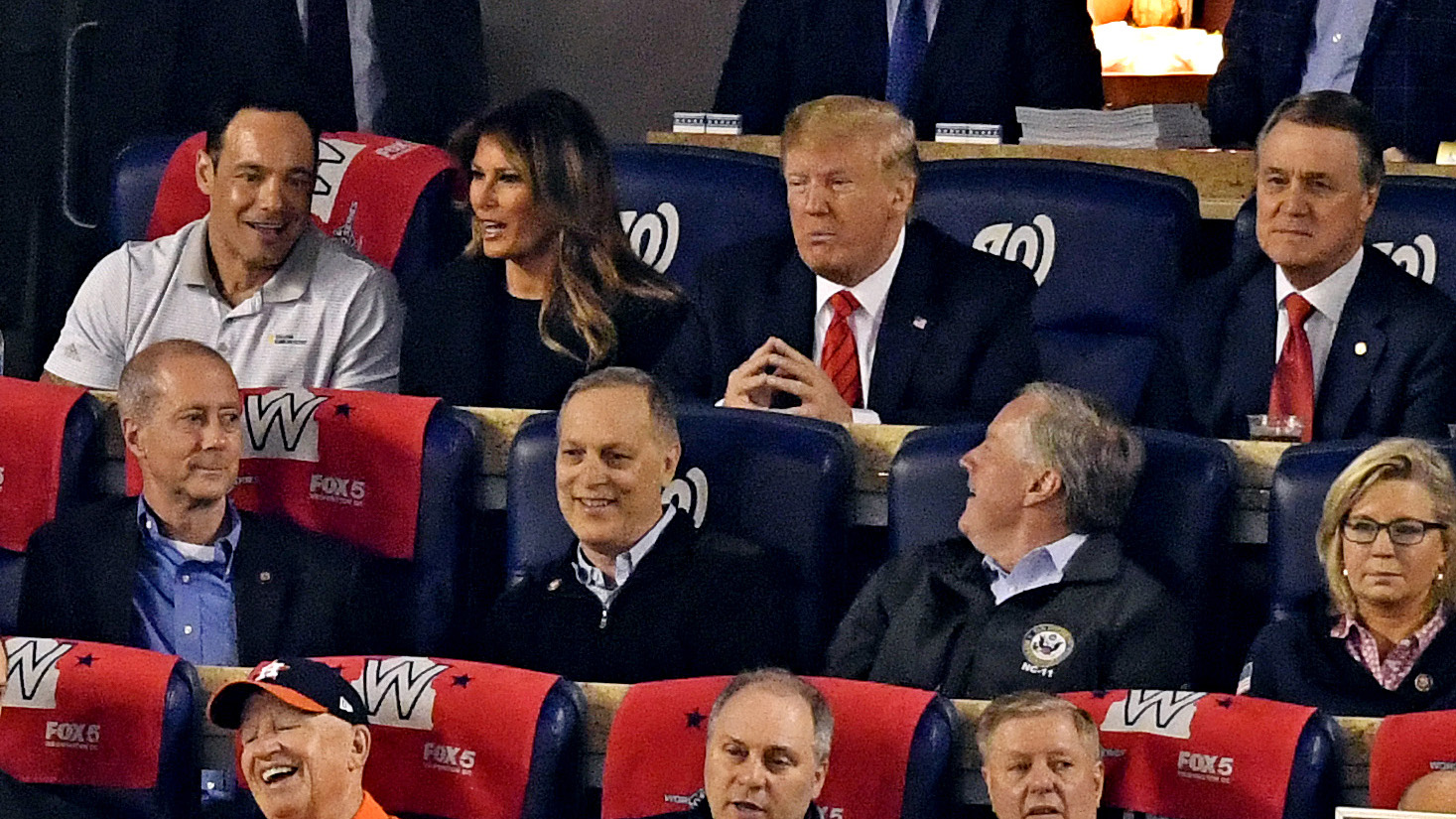
Back to October 27, 2019: That night, Trump went to Game 5 of the World Series, at Nationals Park, 2 miles from the White House. The host Washington Nationals had never asked him to throw out the ceremonial first ball before a game, and this game was no exception. The team's choice was Washington-based celebrity chef José Andrés, an immigrant from Spain whom Obama had once awarded a National Humanities Medal for his charity work.
Trump took Melania to the game. He did not take Barron, his 13-year-old son who is a known sports fan.

The World Series was 2 miles from his house, and he had tickets, and he didn't take his 13-year-old son.

Yeah, sure, it's a school night. I think a note from the President of the United States would carry some weight.

Well, it would, if it were any other President.

When a group of veterans was shown on the scoreboard, the sellout crowd of 43,910 cheered them. When the image shifted to Trump, it was about 60-40 boos, and the boos were louder than the cheers. Fans chanted, "Lock him up!" The scoreboard operator had to switch back to the camera on the veterans, and the crowd went back to cheering.

Nobody booed Franklin Roosevelt on D-Day. Nobody booed John F. Kennedy after he solved the Cuban Missile Crisis. Nobody booed Obama after he ordered the bin Laden raid. Even George W. Bush didn't start getting booed until well after that dumb "MISSION ACCOMPLISHED" stunt.

This was Trump's best day as President, and he got the hell booed out of him, anyway.

The truth hurts, doesn't it, Donald? In fact, on this day, the Number 1 song in America was "Truth Hurts," by Melissa Viviane Jefferson, a.k.a. Lizzo. A strong, outspoken black woman. He's not a fan.

The Nationals, Champions of the National League, lost the game, 7-1, to the American League Champions, the Houston Astros. But the Nationals went on to win the Series in Game 7, in Houston, 3 nights later.

And their fans booed Trump on his best day as President. Washington Nationals fans, you have my thanks forever.

Thirteen days later, in college football, Louisiana State University played the University of Alabama at Bryant-Denny Stadium in Tuscaloosa, Alabama. LSU was ranked Number 2 in the country, 'Bama was Number 3. With his never-ending need for praise, Trump figured, surely, at a football game, in the South, he would get cheered by the fans. So he went. And he was cheered.

Alabama hadn't lost at home in 4 years. They lost, 46-41, but still went on to win the Southeastern Conference and National Championships.

*

October 27, 2019 was a Sunday. Obviously, that was the only baseball game played that day. These were the day's NFL games: 

* The New York Jets lost to the Jacksonville Jaguars, 29-15 at TIAA Bank Field (now EverBank Stadium) in Jacksonvillle.

* The Los Angeles Rams beat the Cincinnati Bengals, 24-10 at Wembley Stadium in London.

* The New England Patriots beat the Cleveland Browns, 27-13 at Gillette Stadium in the Boston suburb of Foxborough, Massachusetts.

* The Seattle Seahawks beat the Atlanta Falcons, 27-20 at Mercedes-Benz Stadium in Atlanta.

* The Tennessee Titans beat the Tampa Bay Buccaneers, 27-23 at Nissan Stadium in Nashville.

* The New Orleans Saints beat the Arizona Cardinals, 31-9 at the Superdome in New Orleans.

* The Houston Texans beat the Oakland Raiders, 27-24 at NRG Stadium (as Reliant Stadium was then known) in Houston.

* The Philadelphia Eagles beat the Buffalo Bills, 31-13 at New Era Field (formerly Rich Stadium and Ralph Wilson Stadium) in the Buffalo suburb of Orchard Park, New York.

* The Pittsburgh Steelers beat the Miami Dolphins, 27-14 at Heinz Field (now Acrisure Stadium) in Pittsburgh.

* The Indianapolis Colts beat the Denver Broncos, 15-13 at Lucas Oil Stadium in Indianapolis.

* The Los Angeles Chargers beat the Chicago Bears, 17-16 at the new Soldier Field in Chicago.

* The Green Bay Packers beat the Kansas City Chiefs, 31-24 at Arrowhead Stadium in Kansas City.

* And the San Francisco 49ers beat the Carolina Panthers, 51-13 at Levi's Stadium in the San Francisco suburb of Santa Clara, California.

(The next day, on ESPN Monday Night Football, the Detroit Lions beat the New York Giants, 31-26 at MetLife Stadium in East Rutherford, New Jersey. The preceding Thursday, the Minnesota Vikings beat the Washington Redskins, 19-9 at FedEx Field -- now Northwest Stadium -- in the Washington suburb of Landover, Maryland. And the Baltimore Ravens and the Dallas Cowboys had a bye.)

There were 5 games played in the NBA that day: 

* The Brooklyn Nets lost to the Memphis Grizzlies, 134-133 in overtime at the FedEx Forum in Memphis. (The New York Knicks were not scheduled.)

* The Minnesota Timberwolves beat the Miami Heat, 116-109 at the Target Center in Minneapolis.

* The Oklahoma City Thunder beat the Golden State Warriors, 120-92 at the Paycom Center in Oklahoma City.

* The Portland Trail Blazers beat the Dallas Mavericks, 121-119 at the American Airlines Center in Dallas.

* And the Los Angeles Lakers beat the Charlotte Hornets, 120-101 at the Staples Center (now the Crypto.com Arena) in Los Angeles.

And there were 7 games played in the NHL:

* In an "Original Six" matchup, the New York Rangers lost to the Boston Bruins, 7-4 at Madison Square Garden.

* The New York Islanders beat the Philadelphia Flyers, 5-3 at the Nassau Coliseum.

* The Ottawa Senators beat the San Jose Sharks, 5-2 at the Canadian Tire Centre in Ottawa.

* The St. Louis Blues beat the Detroit Red Wings, 5-4 at the Little Caesars Arena in Detroit. David Perron scored the winning goal, 1:28 into overtime.

* The Chicago Blackhawks beat the Los Angeles Kings, 5-1 at the United Center in Chicago.

* The Vegas Golden Knights beat the Anaheim Ducks, 5-2 at the T-Mobile Arena in the Las Vegas suburb of Paradise, Nevada.

* And the Florida Panthers beat the Edmonton Oilers, 6-2 at Rogers Place in Edmonton.

Wednesday, October 12, 2022

October 12, 2012: The Game That Stephen Strasburg Didn't Pitch

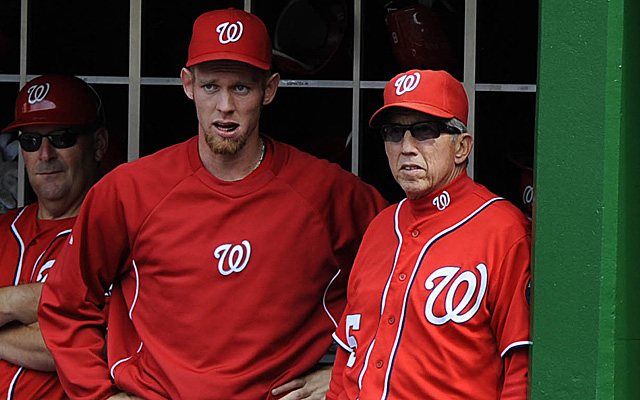
Stephen Strasburg (left) and Davey Johnson

October 12, 2012: The biggest game in Washington baseball in 79 years is Game 5 of the National League Division Series at Nationals Park. The Washington Nationals lead the St. Louis Cardinals, 7-5 going into the 9th inning. But Nats reliever Drew Storen implodes, allowing a double to Carlos Beltrán, a walk to Yadier Molina, another walk to David Freese, a single to Daniel Descalso, a stolen base by Descalso, and a single to Pete Kozma.

The Nats go down 1-2-3 in the bottom of the 9th, and the Cards win, 9-7, and advance to the NL Championship Series. The Nats went from having, according to Baseball-Reference.com, a 93 percent chance of winning the game to losing it.

Concerned about putting too much stress on his arm after coming back from Tommy John surgery at the start of the season, the Nats had shut down ace pitcher Stephen Strasburg for the season after September 7, at which point he had pitched 159 innings. I wonder what Nats management would have given to have Strasburg pitch to just 1 batter: Descalso, when there were 2 outs and the score was still 7-5.

Keeping Strasburg off the postseason roster was a major blunder. It took the Nats another 7 years to get their 1st postseason series win since they were the 1981 Montreal Expos. Nats manager Davey Johnson, who previously managed the New York Mets to win the 1986 World Series, later said that, with Strasburg, the Nats would have gone all the way.

Johnson lasted 1 more season as Nats' manager, ending a managerial career that began with the 1984 New York Mets. Strasburg turned out to be a major reason why the Nats won the World Series in 2019 -- and his subsequent injury turned out to be a major reason why they declined thereafter.

*

October 12, 2012 was a Wednesday. Football was in midweek. The NBA season didn't start until November 1. And the NHL team owners had locked the players out.

The other NLDS was wrapped up the day before, with the San Francisco Giants beating the Cincinnati Reds. 

Earlier in the day, CC Sabathia went the distance for the New York Yankees, allowing just 1 run on 4 hits with 9 strikeouts, and getting out of a bases-loaded, 1-out jam in the 6th inning. A Curtis Granderson home run was the offensive highlight of the Yankees' 3-1 win over the Baltimore Orioles at Yankee Stadium II, giving the Pinstripes the deciding Game 5 of the American League Division Series. The other ALDS had wrapped up the day before, with the Detroit Tigers eliminating the Oakland Athletics.

Saturday, October 1, 2022

October 1, 1961: America's National Stadium

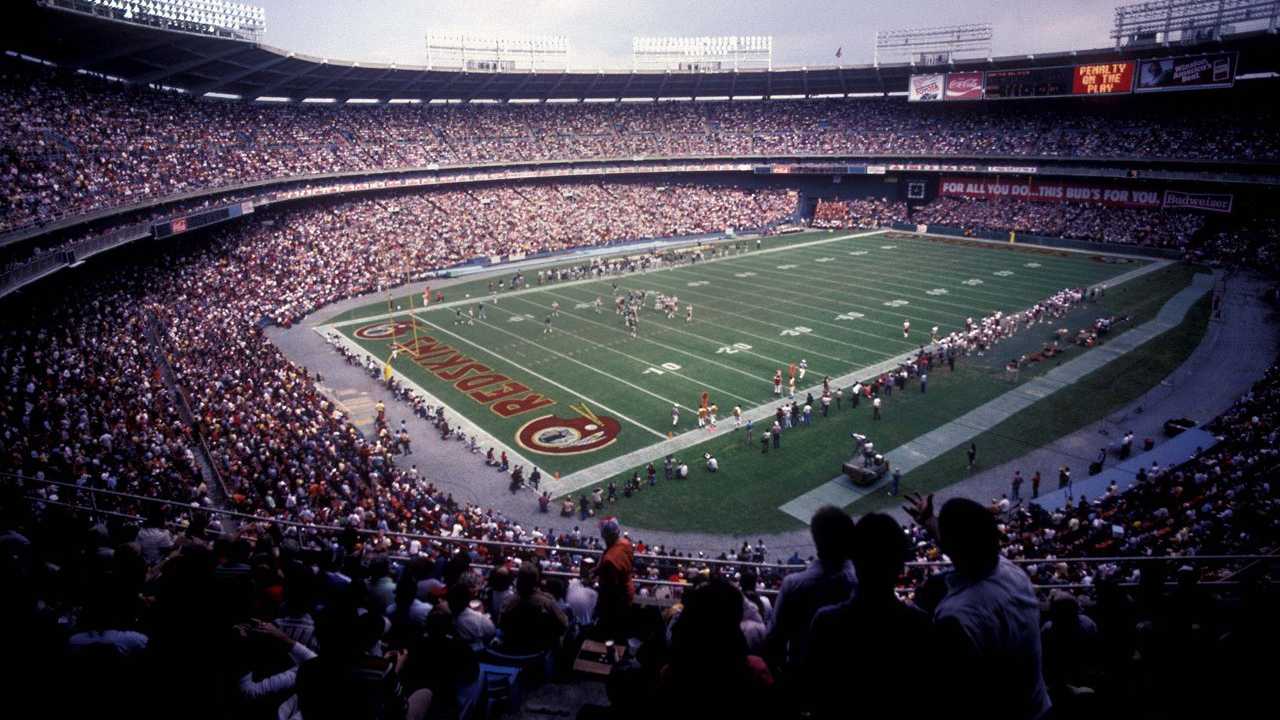
October 1, 1961: District of Columbia Stadium opens in Washington, D.C. The Washington Redskins lose to the New York Giants, 24-21.

As with most major American cities early in the 20th Century, the biggest stadiums were the baseball parks. The biggest stadiums built for football were on the campuses of State universities, which tended to be in or near State capitals, which were not necessarily the biggest city in their State.

In 1916, Representative George Hulbert, a Democrat, proposed the construction of a 50,000-seat "national stadium" -- not in New York City, where the Rochester native had practiced law, but in the nation's capital, Washington, D.C.. The idea was that it would host the 1920 Olympics, the Army-Navy football game, and Davis Cup tennis matches. It wasn't taken seriously.

Later, another Representative from New York, Representative Hamilton Fish III, and D.C.'s Director of Public Buildings and Parks, Ulysses S. Grant III -- the former's grandfather had been Secretary of State under the latter's grandfather -- decided to build a 100,000-seat national stadium, as a memorial to President Theodore Roosevelt, either on the island in the Potomac River that bore TR's name, or on the National Mall, as a bookend to the Lincoln Memorial. In addition to the preceding events, it was thought that Presidential Inaugurations could be held there. But Los Angeles won America's bid to host the 1932 Olympics, and, eventually, the National World War II Memorial became the Lincoln Memorial's bookend.

In 1944, a 9-man National Memorial Stadium Commission was appointed, and a site was chosen for a national stadium, next to the D.C. Armory, which opened in 1941, where East Capitol Street met the Anacostia River. But, with World War II still ongoing, getting Congress to fund a 100,000-seat stadium for the 1948 Olympics was impossible, and the Games were held in London.

In 1956, Representative Charles R. Howell, Democrat of New Jersey (I wasn't born yet, but, had I lived then where I live now, he would have been "my Congressman") proposed legislation funding a national stadium, after the National Capital Planning Commission re-proposed "the East Capitol Site."

Clark Griffith, longtime owner of baseball's Washington Senators, had recently died, leaving the team to his nephew, Calvin Griffith, and he didn't want to play at Griffith Stadium, a 27,000-seat stadium, expandable to only 35,000 for the NFL's Washington Redskins, and in a neighborhood that was growing increasingly black -- to the point where, after the ballpark was demolished, Howard University, the school known as "the Black Harvard," built its hospital on the site. It was thought that a national stadium could not only attract the Olympics and the Army-Navy Game, but save the Senators and Redskins from moving.

This time, Congress passed the District of Columbia Stadium Act, authorizing a 50,000-seat stadium, and President Dwight D. Eisenhower signed it into law on July 29, 1958. It was the 1st stadium built from scratch for both baseball and football -- up the Parkway, Baltimore repurposed the existing Municipal Stadium as Memorial Stadium for both sports in a conversion process from 1950 to 1954 -- and it opened in time for the Redskins to open the 1961 season there. (By a weird coincidence, both that stadium and DC/RFK Stadium would be built across the street from a school named Eastern High School.)

There was a snag, though: The Redskins were the last NFL team that hadn't racially integrated, and the stadium was on federal government property. When John F. Kennedy became President on January 20, 1961, he appointed Representative Stewart Udall of Arizona as Secretary of the Interior, overseeing the site. (Stew's brother, Morris "Mo" Udall, won his seat, and each of them had a son who went on to be elected to the U.S. Senate.) The Secretary told Redskins owner George Preston Marshall, a known racist, that he had to integrate the team, or he couldn't have D.C. Stadium. Marshall caved.

Griffith moved the Senators for the 1961 season, anyway, making them the Minnesota Twins. An expansion franchise was placed at Griffith Stadium for 1961, named the Washington Senators. D.C. Stadium became their home on April 9, 1962, and they beat the Detroit Tigers, 4-1. It hosted the 1962 and 1969 Major League Baseball All-Star Games. JFK threw out the ceremonial first ball at both Opening Day and the All-Star Game in 1962.
JFK is flanked by Vice President Lyndon Johnson
and White House aide Dave Powers. Also identifiable behind him:
Senators Hubert Humphrey, Everett Dirksen and Mike Mansfield;
and White House aide Larry O'Brien, later Chairman of the Democratic Party
(his offices at the Watergate were bugged in 1972) and NBA Commissioner.

On January 18, 1969, having served the entirety of the JFK and Lyndon B. Johnson Administrations, Secretary Udall announced that the stadium had been renamed Robert F. Kennedy Memorial Stadium, for JFK's brother and Attorney General, who had been elected to the Senate in 1964, had run for President in 1968, and, like JFK, had been assassinated. A formal rededication ceremony was held on June 7. (Most people dropped the "Memorial" when talking about it, and called it "RFK Stadium," or even just "RFK.")

On July 1, 1977, the Washington Metropolitan Area Transit Authority opened the Stadium-Armory subway station, serving RFK Stadium and the D.C. Armory on the Blue Line and the Orange Line, with the Silver Line later added. It was a bit of a walk, though: The station was at 19th and A Streets Southeast, a 10-minute walk from the Stadium, whose mailing address was 2400 East Capitol Street Northeast.

Not having subway access hurt the Senators, who left after the 1971 season, and, with a few exceptions such as preseason exhibitions and old-timers' games, baseball did not return until 2005. The Washington Nationals arrived, and remained through the 2007 season, then moved into Nationals Park.

The Redskins played there until 1996, building the NFL's most intimidating home-field advantage, reaching 4 Super Bowls, winning 3. Their last game there was on December 22, 1996, a 37-10 pasting of their arch-rivals, the Dallas Cowboys. Moving out to the far larger stadium in suburban Landover, Maryland turned the 'Skins from the team with the best home-field advantage in the NFL to the worst.
This seat would have been behind home plate
in the stadium's baseball configuration.
You can make out the dugouts.

Unlike most countries, the United States does not have an official "national stadium." RFK is the closest we come to it: Not only is it in the nation's capital, but it has hosted the national soccer team more times than any other venue, 24 times. (The Los Angeles Memorial Coliseum is 2nd, with 20; with the now-demolished Orange Bowl in Miami right behind, with 19.) Which become more amazing when you realize that the 1st such match wasn't until 1977, and the 2nd not until 1991. Why? Interest in the team was too low: RFK Stadium was too big for them until they reached the 1990 World Cup.

In those 24 matches, the U.S. won 15, lost 3, and drew 6. These matches include the 100th Anniversary match of the U.S. Soccer Federation, held on June 2, 2013, a 4-3 U.S. win over Germany. I was there -- it was hot and humid, and it had rained earlier -- and I took this photo.
This seat would have been in center field
in the stadium's baseball configuration.
Again, you can make out the dugouts.
After hosting the Washington Wolves and the Washington Diplomats of the old North American Soccer League, the latter including Dutch superstar Johan Cruyff, in 1996, RFK Stadium became the home of D.C. United, a charter team in Major League Soccer. It continued to be DCU's home through the 2017 season, after which they moved into Audi Field. DCU won the MLS Cup while playing there in 1996, 1997, 1999 and 2004, with the MLS Cup Final being played there in 1997, 2000 and 2007.
The last event at RFK Stadium was on October 22, 2017, a 2–1 D.C. United loss to the New York Red Bulls. It has been announced that RFK Stadium will be demolished in 2021. The 1st of the multi-purpose oval stadiums built in America in the 1960s, '70s and '80s, it is one of the last to still be standing. The only one still in use is the Oakland Coliseum, although the Astrodome is still standing.
In the 2014 film X-Men: Days of Future Past, Erik Lensherr, a.k.a. the supervillain Magneto (played in the flashback sequences by Michael Fassbender, and as an old man by Ian McKellen), ripped the circular stadium off its foundation, levitated it, and moved it across town, surrounding the White House, with the intention of killing President Richard Nixon. He failed. Computer-generated imagery was used to simulate the stadium's appearance in 1973, complete with period-appropriate advertising.
UPDATE: Demolition was delayed until 2025. That year, the District, the NFL, and the renamed Washington Commanders agreed on a deal to built a new stadium on the site, intending to open it in time for the 2030 season.
In "death," RFK Stadium still holds the record for most times hosting the U.S. Men's National Team (USMNT), with 24. The L.A. Coliseum is still 2nd, with 20. But Dignity Health Sports Park, in the Los Angeles suburb of Carson, California, has tied the Orange Bowl for 3rd, with 19. The Landover replacement for RFK Stadium, currently named Northwest Stadium? Only 2.
*
October 1, 1961 was a Sunday. This was also the day that television network CTV went on the air in Canada. I have a separate entry for that event.
These other games were played in the NFL:
* The football version of the St. Louis Cardinals beat the Philadelphia Eagles, 30-27 at Franklin Field in Philadelphia.
* The Baltimore Colts beat the Minnesota Vikings, 34-33 at Memorial Stadium in Baltimore.
* The Cleveland Browns beat the Dallas Cowboys, 25-7 at Cleveland Municipal Staidum.
* The San Francisco 49ers beat the Detroit Lions, 49-0 at Tiger Stadium in Detroit.
* The Green Bay Packers beat their arch-rivals, the Chicago Bears, 24-0 at Green Bay City Stadium (later renamed Lambeau Field).
* And the Los Angeles Rams beat the Pittsburgh Steelers, 24-14 at the Los Angeles Memorial Coliseum.
In the American Football League:
* The New York Titans beat the Boston Patriots, 37-30 at the Polo Grounds. The Titans became the Jets in 1963, and the Patriots became the New England Patriots in 1971.
* The Dallas Texans beat the Houston Oilers, 26-21 at the Cotton Bowl in Dallas. The Texans became the Kansas City Chiefs in 1963, and the Oilers became the Tennessee Titans in 1999.
* The Oakland Raiders beat the Denver Broncos, 33-19 at Candlestick Park in San Francisco. The Raiders wouldn't actually play a game in Oakland until 1962, moved to Los Angeles in 1982, moved back to Oakland in 1995, and moved to Las Vegas in 2020.
* And, the day before, the San Diego Chargers beat the Buffalo Bills, 19-11 at War Memorial Stadium in Buffalo. This was the Chargers' 1st game as a San Diego team, after spending the AFL's founding year of 1960 in Los Angeles. They returned to Los Angeles in 2017.
And it was the last day of baseball's regular season:
* The New York Yankees beat the Boston Red Sox, 1-0 at Yankee Stadium. The only run of the game came in the 4th inning, when Roger Maris hit his record-breaking 61st home run of the season, off Tracy Stallard. Bill Stafford (3 hits over 6 innings), Hal Reniff (a perfect 7th) and Luis Arroyo (1 hit over 2) combined on a 4-hit shutout. I have a separate entry for this game.
* The St. Louis Cardinals beat the Philadelphia Phillies, 2-0 at Connie Mack Stadium in Philadelphia. Bob Gibson pitched a 6-hit shoutout. Stan Musial appeared only as a pinch-hitter, and did not reach base.
* The Pittsburgh Pirates beat the Cincinnati Reds, 3-1 at Forbes Field in Pittsburgh. Roberto Clemente did not play. Frank Robinson went 0-for-2 with a walk. Despite this game, the Reds had dethroned the Pirates as National League Pennant winners, and would face the Yankees in the World Series. The Yankees won in 5 games.
* The Los Angeles Dodgers beat the Chicago Cubs, 8-2 at Wrigley Field in Chicago. Ernie Banks went 1-for-4 with an RBI. Duke Snider drew a walk as a pinch-hitter.
* A doubleheader was split at Milwaukee County Stadium. The San Francisco Giants won the opener, 8-2. The Milwaukee Braves won the nightcap, 3-2. Al Spangler singled Hank Aaron home with the winning run in the bottom of the 10th inning. Over the 2 games, Aaron went 4-for-9, and Willie Mays went 3-for-7 with a home run and 3 RBIs.
* The Detroit Tigers beat the Minnesota Twins, 8-3 at Metropolitan Stadium in the Minneapolis suburb of Bloomington, Minnesota. Norm Cash hit a home run, and Al Kaline had an RBI double as a pinch-hitter. This was the Tigers' 101st win of the year, but the Yankees won 109 to take the American League Pennant.
For the Twins, completing their 1st season after being "the old Washington Senators," Harmon Killebrew went 0-for-3 with a walk, and relief pitcher Pedro Ramos hit a home run, 1 of 3 he hit on the season, and 1 of 15 he hit in a surprisingly powerful career for a pitcher who was mainly a reliever.
* The Kansas City Athletics beat "the new Washington Senators," 3-2 at Kansas City Municipal Stadium.
After providing a venue for the Pacific Coast League's Los Angeles Angels from 1925 through 1957, and the major league expansion team with the same name this season, the West Coast version of Wrigley Field hosts its last professional baseball game. The Halos are defeated by the Cleveland Indians, 8-5 in front of 9,868 fans. Wrigley West will be torn down in 5 years, to make room for an eventual public playground and senior center.
* And the Baltimore Orioles and the Chicago White Sox completed their seasons the day before, against each other, with the O's winning, 4-3 at Memorial Stadium in Baltimore.
Thursday, September 29, 2022

September 29, 2004: The End of the Montreal Expos

September 29, 2004: Although the announcement that the Montreal Expos were moving to Washington, D.C. to become the Washington Nationals next season was not a surprise, the timing of it was: On the morning of the Expos' last home game ever, turning the season finale into a French-Canadian wake.
The Expos went down quietly, losing 9-1 to, of all teams, the Florida Marlins, the team that Expos owner Jeffrey Loria was allowed to buy, and giving the Expos back to Major League Baseball, having stripped the franchise of pretty much its entire front office, and even its broadcast team, including Hall-of-Famer Dave Van Horne.
To make matters worse still, the winning pitcher for the Marlins was an Ex-Expo, Carl Pavano. The last Expos play was Terrmel Sledge, batting against Rudy Seanez, popping up to 3rd baseman Mike Mordecai. A crowd of 31,395 came to say Au revoir.
Just as the Expos' 1st game, on April 8, 1969, was away to the New York Mets at Shea Stadium, an 11-10 win, so, too, were their last 3 games at Shea, winning the 1st 2, but losing the last, 8-1 on October 3, 2004. The last active former Expos was Bartolo Colón, who pitched in the major leagues until 2018.
The Expos began play at Jarry Park, meant to be a temporary stadium only, in 1969. In 1973, despite a 79-83 record, they were only 3 1/2 games out of 1st place in the National League Eastern Division. They moved to the Olympic Stadium in 1977. They had a close call in 1981, losing the clinching Game 5 of the National League Championship Series by 1 run, and staying in the NL East race until the final weekend in 1979, 1980, 1987 and 1993.
They had the best record in MLB when the Strike of '94 hit. But the inadequacy of the Stadium, the U.S.-Canadian exchange rate, and Canada's taxes led (I won't say, "forced") ownership to trade away good players.
As of the 2022 election, there are 9 players in the Baseball Hall of Fame who played, however long, with the Expos. Lee Smith lasted only 1 season; Tony Pérez, 3. Gary Carter, Andre Dawson, Larry Walker and Vladimir Guerrero were traded in their primes; Randy Johnson and Pedro Martínez, just as they were getting into theirs. Only Tim Raines could be called anything like an "Expos Hall-of-Famer," and even he was just 31 when he was let go.
Even in 2002 and 2003, despite the administrative nightmare, they were 83-79. But they couldn't hang on. They were basically a lame-duck team for 5 seasons, 2000 to 2004, awaiting the inevitable. And, while the team, as the Nationals, endured 7 bad seasons, they then had 8 good ones, including 5 trips to the Playoffs, ending that run by winning the 2019 World Series.
The Olympic Stadium has since held preseason games, involving Canada's remaining MLB team, the Toronto Blue Jays. The Tampa Bay Rays and the Oakland Athletics have struggled in their bids to keep their fans and build new ballparks to replace inadequate stadiums. Still, it is unlikely that a new team -- expansion or moved -- will be placed in Montreal until the City, or the Province of Quebec, is will to spend the money to build a new ballpark there. And that's not going to happen anytime soon.
The Expos had a team Hall of Fame. The inductees were:
From their founding era, 1969 to 1980, but not the 1981 Division title: Manager Gene Mauch, 2nd baseman Ron Hunt, right fielder Daniel "Rusty" Staub, pitchers Claude Raymond (a Quebec native) and Bill Stoneman.
From the 1981 National League Eastern Division title: Founding owner Charles Bronfman, catcher Gary Carter, 1st baseman Warren Cromartie, shortstop Chris Speier, 3rd baseman Larry Parrish, left fielder Tim Raines, center fielder Andre Dawson, right fielder Tim Wallach (later mainly a 3rd baseman); pitchers Steve Rogers, Woodie Fryman, Bill Gullickson, Jeff Reardon; manager Jim Fanning, general manager John McHale; and broadcasters Dave Van Horne, Jean-Pierre Roy and Jacques Doucet.
From after that title: 1980s pitcher Tim Burke. They did not honor any players from their 1994 NL Eastern Division Champions, or from after that.
Bronfman, Raymond, Staub, Carter, Dawson, Raines, Rogers, Wallach, Fanning, McHale, Van Horne, Roy, Doucet have also been elected to the Canadian Baseball Hall of Fame. So have pitchers Dennis Martínez, Rhéal Cormier and Pedro Martínez; and outfielders Larry Walker, Matt Stairs and Vladimir Guerrero Sr. Cormier, Walker and Stairs were Canadians.
*
September 29, 2004 was a Wednesday. These other Major League Baseball games were played that day:
* The New York Yankees swept a doubleheader from the Minnesota Twins, 5-3 and 5-4 at Yankee Stadium. The Yanks needed a 4-run 7th inning, including a home run by Hideki Matsui, to win the opener, and Paul Quantrill was the winning pitcher, in relief of Mike Mussina. He was followed in the 8th inning by Tom Gordon, and the 9th by Mariano Rivera. Quantrill, Gordon and "Mo" Rivera: This combination became known as "QuanGorMo." Johan Santana started for the Twins, but J.C. Romero was the losing pitcher.
Matsui homered again in the 2nd game, and Alex Rodriguez also homered. Jon Lieber was the winning pitcher. Over the 2 games, Derek Jeter went 4-for-9 with an RBI.
* The New York Mets lost to the Atlanta Braves, 6-3 at Turner Field (now Center Parc Stadium) in Atlanta.
* The Philadelphia Phillies swept a doubleheader from the Pittsburgh Pirates, 8-4 and 8-3 at Citizens Bank Park in Philadelphia.
* The Baltimore Orioles swept a doubleheader from the Toronto Blue Jays, 7-6 and 4-0 at Camden Yards in Baltimore. In the 2nd game, Rick Bauer -- not to be confused with Rich Dauer, an Oriole 2nd baseman of a previous generation -- pitched 6 innings of 3-hit shutout ball. It took 3 relievers to finish a 4-hit shutout.
* The Tampa Bay Devil Rays beat the Boston Red Sox, 9-4 at Tropicana Field in St. Petersburg, Florida. The winning pitcher was Doug Waechter, and the losing pitcher was Pedro Martínez. David Ortiz went 1-for-4 with an RBI.
* The Chicago White Sox beat the Detroit Tigers, 11-2 at Comerica Park in Detroit.
* The Cincinnati Reds beat the Chicago Cubs, 4-3 at Wrigley Field in Chicago. Austin Kearns hit a home run to win the game in the top of the 12th inning. Ken Griffey Jr. did not play.
* The Cleveland Indians beat the Kansas City Royals, 5-2 at Kauffman Stadium in Kansas City.
* The Anaheim Angels beat the Texas Rangers, 8-7 at The Ballpark (now Choctaw Stadium) in the Dallas suburb of Arlington, Texas. The Angels scored a run in the top of the 9th, then scored 2 runs in the top of the 11th, while the Rangers scored only 1 in the bottom half.
* The Houston Astros beat the St. Louis Cardinals, 6-4 at Minute Mark Park in Houston. Albert Pujols did not play.
* The Milwaukee Brewers beat the Arizona Diamondbacks, 4-1 at Bank One Ballpark (now Chase Field) in Phoenix.
* The San Diego Padres beat the San Francisco Giants, 4-3 at Petco Park in San Diego. Mark Loretta drove Kerry Robinson home with a sacrifice fly to win it in the bottom of the 10th. Barry Bonds went 0-for-3 with a walk.
* The Colorado Rockies the Los Angeles Dodgers, 4-1 at Dodger Stadium in Los Angeles.
* And the Seattle Mariners beat the Oakland Athletics, 4-2 at the Oakland Coliseum (then named the McAfee Coliseum).

Wednesday, September 28, 2022

September 28, 2014: Derek Jeter's Last Major League Game

Left to right: Jim Rice, Mookie Betts,
David Ortiz, Derek Jeter and Carl Yastrzemski

September 28, 2014: The New York Yankees beat the Boston Red Sox, 9-5 at Fenway Park. Michael Pineda outpitches Clay Buchholz. With the game scoreless in the top of the 3rd, Francisco Cervelli leads off with a walk. Chris Young strikes out, but Jose Pirela singles, and Buchholz moves the runners over with a wild pitch. Ichiro Suzuki triples the runners home.
Derek Jeter, the designated hitter on this day -- Stephen Drew is the shortstop -- hits a ground ball to 3rd base. Garin Cecchini fields it, but Jeter beats the throw, and Ichiro scores, to make it 3-0 Yankees.
It is Jeter's 3,465th career hit (which included 544 doubles, 66 triples and 260 home runs), and his 1,311th run batted in. Only Pete Rose, Ty Cobb, Hank Aaron, Stan Musial and Tris Speaker have more career hits -- meaning Jeter had more hits than all but 2 living people (Rose and the since-deceased Aaron), and more hits than anyone born after April 14, 1941 (when Rose was born).
Girardi sends Brian McCann -- perhaps the slowest runner on the team, but whose bat will fill the DH slot -- in to pinch-run, and the Fenway crowd, which despises the Yankees and has long maintained that Jeter and his teammates "suck," gives him a standing ovation as he leaves a major league field for the last time. It is 46 years to the day after Mickey Mantle played his last game for the Yankees, also at Fenway.
Three days earlier, on September 25, Jeter had made his last plate appearance at Yankee Stadium, singling in the winning run in the bottom of the 9th inning, to win, 6-5, after the Yankees had blown a 5-2 top-of-the-9th lead over the Baltimore Orioles. That game, unlike the finale on the 28th, is in regular rotation on the YES Network series Yankees Classics.
Mantle had played in more games, 2,401, and in more seasons, 18, than anyone in Yankee history. Jeter broke both of those records: 2,747 games and 20 seasons. (Mariano Rivera played a 19th season, but not a 20th; and, as a pitcher, appeared in far fewer games.) I didn't get to see Mantle play, but I saw Jeter play many times. I even got to see him hit a home run at Fenway Park, in a 13-3 Yankee demolition of the Red Sox on July 30, 1999. Great memory.
My in-person memories of Mantle are limited to Old-Timers Days, and an appearance (in a suit rather than a uniform) on Phil Rizzuto Day. And while I saw Joe DiMaggio a few times at Yankee Stadium, it was only in a suit, never a uniform, although his 1995 Opening Day first ball ceremony meant that, at the least, I got to see Joe DiMaggio throw a baseball. Which is more than I can say for Mantle. And I never got to see Babe Ruth or Lou Gehrig, who died long before I was born.
But I've seen plenty of legends in person, at various ballparks and at the Baseball Hall of Fame induction ceremony. So I've had some luck -- if not, as Gehrig would say, become the luckiest man on the face of the Earth.
With this game, Jeter became the last active member of the 1996 World Champion New York Yankees.
*
September 28, 2014 was a Sunday. These other Major League Baseball games were played that day:
* The New York Mets beat the Houston Astros, 8-3 at Citi Field.
* The Atlanta Braves beat the Philadelphia Phillies, 2-1 at Citizens Bank Park in Philadelphia.
* The Washington Nationals beat the Miami Marlins, 1-0 at Nationals Park in Washington. Jordan Zimmerman pitched a no-hitter, coming within a 5th-inning walk of Justin Bour, and a 7th-inning dropped 3rd strike on a strikeout of Garrett Jones, of pitching a perfect game. He struck out 10.
* The Baltimore Orioles beat the Toronto Blue Jays, 1-0 at the Rogers Centre in Toronto. How many Oriole pitchers does it take to pitch a 5-hit shutout? Apparently, 6, with starter Miguel González going just 5 innings.
* The Cleveland Indians beat the Tampa Bay Rays, 7-2 at Progressive Field in Cleveland.
* The Cincinnati Reds beat the Pittsburgh Pirates, 4-1 at Great American Ball Park in Cincinnati.
* The Detroit Tigers beat the Minnesota Twins, 3-0 at Comerica Park in Detroit. David Price (7 1/3rd innings) and 2 relievers combined for a 4-hit shutout.
* The Kansas City Royals beat the Chicago White Sox, 6-4 at U.S. Cellular Field (now Guaranteed Rate Field) in Chicago.
* The Chicago Cubs beat the Milwaukee Brewers, 5-2 at Miller Park (now American Family Field) in Milwaukee.
* The Oakland Athletics beat the Texas Rangers, 4-0 at Globe Life Park (now Choctaw Stadium) in the Dallas suburb of Arlington, Texas. Sonny Gray pitched a 6-hit shutout.
* The St. Louis Cardinals beat the Arizona Diamondbacks, 1-0 at Chase Field in Phoenix. Josh Collmenter pitched 8 innings, and Evan Marshall finished the 3-hit shutout.
* The Los Angeles Dodgers beat the Colorado Rockies, 10-5 at Dodger Stadium in Los Angeles.
* The San Francisco Giants beat the San Francisco Giants, 9-3 at AT&T Park (now Oracle Park) in San Francisco.
* The Seattle Mariners beat the Los Angeles Angels, 4-1 at Safeco Field (now T-Mobile Park) in Seattle.
And it was an NFL Sunday. These games were played:
* The New York Jets lost to the Detroit Lions, 24-17 at MetLife Stadium at the Meadowlands.
* The Baltimore Ravens beat the Carolina Panthers, 38-10 at M&T Bank Stadium in Baltimore.
* The Tampa Bay Buccaneers beat the Pittsburgh Steelers, 27-24 at Heinz Field (now Acrisure Stadium) in Pittsburgh.
* The Indianapolis Colts beat the Tennessee Titans, 41-17 at Lucas Oil Stadium in Indianapolis.
* The Green Bay Packers beat their arch-rivals, the Chicago Bears, 38-17 at the new Soldier Field in Chicago.
* The Minnesota Vikings beat the Atlanta Falcons 41-28 at TCF Bank Stadium (now Huntington Bank Stadium) in Minneapolis.
* The Dallas Cowboys beat the New Orleans Saints, 38-17 at AT&T Stadium in the Dallas suburb of Arlington, Texas. This was hours after the A's-Rangers game in the same sports complex, but parking was almost certainly still a mess.
* The Houston Texans beat the Buffalo Bills, 23-17 at NRG Stadium (as Reliant Stadium was then known) in Houston.
* The San Diego Chargers beat the Jacksonville Jaguars, 33-14 at Qualcomm Stadium in San Diego.
* The San Francisco 49ers beat the Philadelphia Eagles, 26-21 at Levi's Stadium in the San Francisco suburb of Santa Clara, California.
* The Miami Dolphins beat the Oakland Raiders, 38-14 at the Oakland Coliseum.
* The preceding Thursday, the New York Giants beat the Washington Redskins, 45-14 at FedEx Field (now Northwest Stadium) in the Washington suburb of Landover, Maryland.
* The night after these games, on Monday Night Football, the Kansas City Chiefs beat the New England Patriots, 41-14 at Arrowhead Stadium in Kansas City.
* And the Arizona Cardinals, the Cincinnati Bengals, the Cleveland Browns, the Denver Broncos, the St. Louis Rams and the Seattle Seahawks had a bye week.

Monday, June 27, 2022

June 28, 1870: Gloves Come to Baseball

Doug Allison

June 28, 1870: Baseball gloves become respectable. In the amateur era, using anything to protect yourself from a moving baseball was considered "unmanly." But when the 1st openly professional baseball team did it, that meant that it was okay.

And it was Doug Allison, the catcher for the Cincinnati Red Stockings, who did it. As a local newspaper, the Cincinnati Commercial, reported, "Allison caught today in a pair of buckskin mittens, to protect his hands." Cincinnati won, 30-10, beating the Washington Nationals at the National Grounds in Washington. (Today, there are teams named the Cincinnati Reds and the Washington Nationals, but they are not the same teams.)

The Red Stockings had gone through the 1869 season undefeated. They were finally beaten 2 weeks before this, by the Brooklyn Atlantics. But they were still, at the least, 1 of the 2 best teams in the world. So other teams were willing to follow them in doing something. 

A report appeared in the Detroit Free Press on August 14, 1867, of a catcher named Ben Delaverage playing for the Victory Club of Troy, across the Hudson River from Albany, New York, using a catcher's glove. In the late 1870s, gloves came into common use. At first, players had to sneak them onto the field.

But star pitcher-turned-1st baseman Al Spalding made it a manly thing in 1877, boldly donning a black glove that was fingerless but padded. Ever the entrepreneur, Spalding envisioned big sales for his mail-order sporting-goods business. Catchers were among his best customers. The 1877 season also saw the debut of the catcher's mask.

By 1885, a padded glove began to be used in baseball. The "pillow style" catcher's mitt made its debut in 1899, and the current design arrived in 1920. In the late 1960s, Randy Hundley of the Chicago Cubs developed a "hinged" mitt that snapped closed on contact with the ball, enabling one-handed catching.

Chest protectors were first worn in 1883, by a star player, Jim "Deacon" White. Shin guards were first used in 1907, again by a star, Roger Bresnahan. Since stars were willing to do it, and no one questioned their toughness, everybody began to use them.

June 28, 1870 was a Tuesday. I have no record of any other baseball games played that day. This was also the day that Congress passed a bill creating the first federal holidays. I have a separate entry for that event.

Thursday, April 14, 2022

April 14, 2005: Major League Baseball Returns to Washington

April 14, 2005: Major League Baseball returns to Washington, D.C. after 33 seasons away. Ironically, the new home team is the Washington Nationals, who had been the Montreal Expos from 1969 to 2004, and played their 1st home game in Montreal exactly 36 years to the day before.

George W. Bush, former owner of the Texas Rangers, recently re-elected but not a particularly popular President, received a decent hand from the 45,596 fans at Robert F. Kennedy Memorial Stadium when he performed the usual Presidential duty of throwing out the ceremonial first ball. Presidents had done this in Baltimore, the next-closest MLB city to Washington, since Ronald Reagan restarted the tradition in 1984. William Howard Taft was the 1st President to do it, in 1910, but none had done it in Washington since Richard Nixon in 1969.
Also throwing out a "first ball" was Frank Howard, the former Los Angeles Dodgers and Washington Senators slugger, the Senators' most popular player in their last few years before they were moved to become the Rangers after the 1971 season, and the player who hit the last home in a regular-season game in Washington. (Exhibition games had been played there in the interim.)

When Nationals Park opened in 2008, there would be statues of Howard, early Senators pitching legend Walter Johnson, and Josh Gibson, Negro Leagues legend who had played home games in D.C. with the Homestead Grays (who split their games between D.C. and Pittsburgh).

The Nationals had a built-in Hall-of-Famer from the very start: The Expos' last manager, and thus the Nats' 1st manager, was Frank Robinson. Slugger of 586 home runs, the only player to win the Most Valuable Player award in both Leagues, and the 1st black manager in each League, he was winding down a half-century in professional baseball.
The Nats' opening opponents were the Arizona Diamondbacks. The game was scoreless until the bottom of the 4th. José Vidro led off with a double, José Guillén was hit with a pitch, Ryan Church popped up, Vinny Castilla tripled home Vidro and Guillén, and Brian Schneider hits a sacrifice fly to bring Castilla home. The Nats led, 3-0.

Castilla hit a home run in the bottom of the 6th, driving in Church, to make it 5-0. Liván Hernández pitched very well for 8 innings, but ran out of gas in the 9th, giving up a 3-run homer to Chad Tracy. Robinson brought Chad Cordero on to get the last 3 outs, and the Nats won, 5-3.
Castilla's home run

It would take the Nats until 2012 to make the Playoffs, and 2019 before they won a postseason series -- and then go all the way and win the World Series.

UPDATE: The Nationals have a Ring of Honor at Nationals Park, based in part of the old "Washington Wall of Stars" at Robert F. Kennedy Stadium:

* From the Homestead Grays of the Negro Leagues, who split their "home games" between Washington and Pittsburgh: 1st baseman Walter "Buck" Leonard, 3rd baseman Ernest Judson "Jud" Wilson, center fielder James "Cool Papa" Bell, catcher Josh Gibson, pitcher Ray Brown; and team owner Cumberland Posey. Gibson, Leonard and Bell have also been elected to the Washington DC Sports Hall of Fame, also based on the Wall of Stars.

* From the "old" Washington Senators, 1901-1960: 1910s and '20s pitcher Walter Johnson, 1920s 2nd baseman and manager Stanley "Bucky" Harris, 1920s right fielder Sam Rice, 1920s and '30s left fielder Leon "Goose" Goslin, 1930s shortstop Joe Cronin, 1930s left fielder Henry "Heinie" Manush, 1940s catcher Rick Ferrell, 1940s pitcher Early Wynn, 1950s 3rd baseman Harmon Killebrew, and longtime owner Clark Griffith.

Johnson, Harris, Rice, Goslin, Cronin, Wynn, Killebrew and Griffith were also elected to the Washington DC Sports Hall of Fame. So were 1910s and '20s 1st baseman Joe Judge, 1920s pitcher Fred "Firpo" Marberry, 1920s and '30s 2nd baseman Clarence "Buddy" Myer, 1920s and '30s 3rd baseman Oswald "Ossie" Bluege, 1930s and '40s 3rd baseman Cecil Travis, 1940s outfielder George Case, 1940s and '50s 1st baseman Mickey Vernon, 1940s and '50s 3rd baseman Eddie Yost, and 1950s broadcaster Bob Wolff.

* From the "new" Washington Senators, 1961-1971: Bucky Harris, as a scout; and 1st baseman Frank Howard. Howard, outfielder Chuck Hinton, manager Gil Hodges and general manager George Selkirk have been honored in the Washington DC Sports Hall of Fame. So has Johnny Holliday, a legendary radio personality in Cleveland, the San Francisco Bay Area, and the Washington area, who has worked with the Senators, the Nationals,  the Bullets/Wizards, the Redskins/Commanders and the Capitals.

* From the Nats' previous incarnation, as the Montreal Expos: Catcher Gary Carter, center fielder Andre Dawson, left fielder Tim Raines, and the man who was already a Baseball Hall-of-Famer when he was named manager of the Expos, staying after the move to Washington, Frank Robinson.

* From the Nationals: Robinson and catcher Iván Rodríguez were inducted due to being members of the Baseball Hall of Fame for their service elsewhere. But for their performance with them, the Nationals have honored 3rd baseman Ryan Zimmerman (whose Number 11 is, so far, their only retired number), right fielder Jayson Werth, and team owner Ted Lerner. So far, Lerner and his son and the team's new owner, Mark Lerner, are the only Nats figures honored in the Washington DC Sports Hall of Fame.

The Nationals have also honored Walter Johnson, Josh Gibson and Frank Howard with statues outside Nationals Park.


*

April 14, 2005 was a Thursday. These other MLB games were played that day:

* The New York Yankees lost to the Boston Red Sox, 8-5 at Fenway Park. Gary Sheffield and Hideki Matsui each got 3 hits, but Randy Johnson did not have a good start, and former Red Sox reliever Tom Gordon blew it in the 8th inning.

* The New York Mets beat the Houston Astros, 4-3 at Shea Stadium.

* The Tampa Bay Devil Rays beat the Baltimore Orioles, 12-7 at Tropicana Field in St. Petersburg.

* The Cleveland Indians beat the Chicago White Sox, 8-6 at Jacobs Field in Cleveland. (It's now named Progressive Field.)

* The Seattle Mariners beat the Kansas City Royals, 10-2 at Kauffman Stadium in Kansas City.

* The Minnesota Twins beat the Detroit Tigers, 10-4 at the Metrodome in Minneapolis.

* And the Toronto Blue Jays beat the Texas Rangers, 2-1 at Ameriquest Field in the Dallas suburb of Arlington, Texas. (It's now named Choctaw Stadium.)

The NFL was out of season. The NHL team owners canceled the 2004-05 season over greed. There were 3 games played in the NBA that day:

* The New York Knicks beat the Cleveland Cavaliers, 95-89 at the Gund Arena in Cleveland. (It's now named the Rocket Arena.) LeBron James scored 27 points and grabbed 18 rebounds, but in a losing effort.

* The Philadelphia 76ers beat the Miami Heat, 126-119 in overtime at the Wachovia Center in Philadelphia. (It's now named the Wells Fargo Center.) Dwyane Wade scored 48 points for the Heat, but the Sixers got 38 from Allen Iverson, 26 from Marc Jackson, and 20 from Kyle Korver.

* And the Dallas Mavericks beat the Portland Trail Blazers, 102-90 at the Moda Center in Portland.

December 31, 1999 & January 1, 2000: The Millennium

December 31, 1999:  The Millennium arrives. The people of planet Earth survived. At a terrible cost. But we hadn't destroyed ourselves. ...