
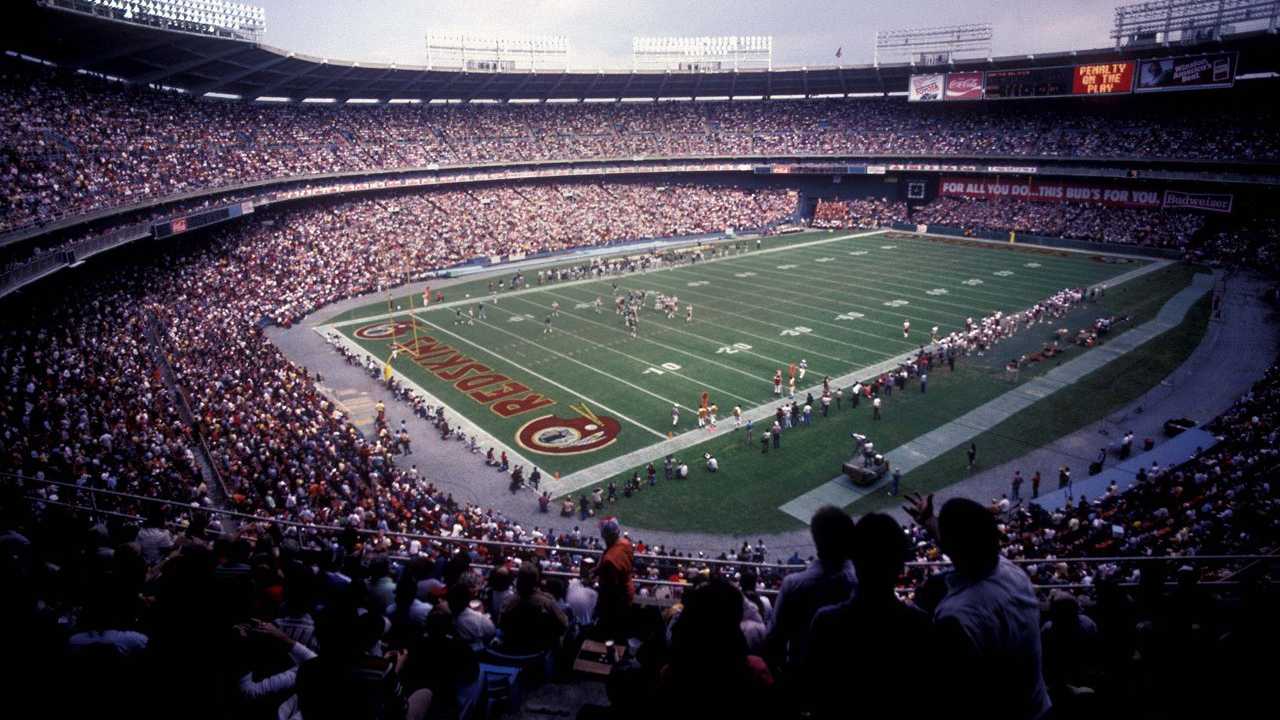
October 1, 1961: District of Columbia Stadium opens in Washington, D.C. The Washington Redskins lose to the New York Giants, 24-21.
As with most major American cities early in the 20th Century, the biggest stadiums were the baseball parks. The biggest stadiums built for football were on the campuses of State universities, which tended to be in or near State capitals, which were not necessarily the biggest city in their State.
In 1916, Representative George Hulbert, a Democrat, proposed the construction of a 50,000-seat "national stadium" -- not in New York City, where the Rochester native had practiced law, but in the nation's capital, Washington, D.C.. The idea was that it would host the 1920 Olympics, the Army-Navy football game, and Davis Cup tennis matches. It wasn't taken seriously.
Later, another Representative from New York, Representative Hamilton Fish III, and D.C.'s Director of Public Buildings and Parks, Ulysses S. Grant III -- the former's grandfather had been Secretary of State under the latter's grandfather -- decided to build a 100,000-seat national stadium, as a memorial to President Theodore Roosevelt, either on the island in the Potomac River that bore TR's name, or on the National Mall, as a bookend to the Lincoln Memorial. In addition to the preceding events, it was thought that Presidential Inaugurations could be held there. But Los Angeles won America's bid to host the 1932 Olympics, and, eventually, the National World War II Memorial became the Lincoln Memorial's bookend.
In 1944, a 9-man National Memorial Stadium Commission was appointed, and a site was chosen for a national stadium, next to the D.C. Armory, which opened in 1941, where East Capitol Street met the Anacostia River. But, with World War II still ongoing, getting Congress to fund a 100,000-seat stadium for the 1948 Olympics was impossible, and the Games were held in London.
In 1956, Representative Charles R. Howell, Democrat of New Jersey (I wasn't born yet, but, had I lived then where I live now, he would have been "my Congressman") proposed legislation funding a national stadium, after the National Capital Planning Commission re-proposed "the East Capitol Site."
Clark Griffith, longtime owner of baseball's Washington Senators, had recently died, leaving the team to his nephew, Calvin Griffith, and he didn't want to play at Griffith Stadium, a 27,000-seat stadium, expandable to only 35,000 for the NFL's Washington Redskins, and in a neighborhood that was growing increasingly black -- to the point where, after the ballpark was demolished, Howard University, the school known as "the Black Harvard," built its hospital on the site. It was thought that a national stadium could not only attract the Olympics and the Army-Navy Game, but save the Senators and Redskins from moving.
This time, Congress passed the District of Columbia Stadium Act, authorizing a 50,000-seat stadium, and President Dwight D. Eisenhower signed it into law on July 29, 1958. It was the 1st stadium built from scratch for both baseball and football -- up the Parkway, Baltimore repurposed the existing Municipal Stadium as Memorial Stadium for both sports in a conversion process from 1950 to 1954 -- and it opened in time for the Redskins to open the 1961 season there. (By a weird coincidence, both that stadium and DC/RFK Stadium would be built across the street from a school named Eastern High School.)
There was a snag, though: The Redskins were the last NFL team that hadn't racially integrated, and the stadium was on federal government property. When John F. Kennedy became President on January 20, 1961, he appointed Representative Stewart Udall of Arizona as Secretary of the Interior, overseeing the site. (Stew's brother, Morris "Mo" Udall, won his seat, and each of them had a son who went on to be elected to the U.S. Senate.) The Secretary told Redskins owner George Preston Marshall, a known racist, that he had to integrate the team, or he couldn't have D.C. Stadium. Marshall caved.
Griffith moved the Senators for the 1961 season, anyway, making them the Minnesota Twins. An expansion franchise was placed at Griffith Stadium for 1961, named the Washington Senators. D.C. Stadium became their home on April 9, 1962, and they beat the Detroit Tigers, 4-1. It hosted the 1962 and 1969 Major League Baseball All-Star Games. JFK threw out the ceremonial first ball at both Opening Day and the All-Star Game in 1962.

JFK is flanked by Vice President Lyndon Johnson
and White House aide Dave Powers. Also identifiable behind him:
Senators Hubert Humphrey, Everett Dirksen and Mike Mansfield;
and White House aide Larry O'Brien, later Chairman of the Democratic Party
(his offices at the Watergate were bugged in 1972) and NBA Commissioner.
On January 18, 1969, having served the entirety of the JFK and Lyndon B. Johnson Administrations, Secretary Udall announced that the stadium had been renamed Robert F. Kennedy Memorial Stadium, for JFK's brother and Attorney General, who had been elected to the Senate in 1964, had run for President in 1968, and, like JFK, had been assassinated. A formal rededication ceremony was held on June 7. (Most people dropped the "Memorial" when talking about it, and called it "RFK Stadium," or even just "RFK.")
On July 1, 1977, the Washington Metropolitan Area Transit Authority opened the Stadium-Armory subway station, serving RFK Stadium and the D.C. Armory on the Blue Line and the Orange Line, with the Silver Line later added. It was a bit of a walk, though: The station was at 19th and A Streets Southeast, a 10-minute walk from the Stadium, whose mailing address was 2400 East Capitol Street Northeast.
Not having subway access hurt the Senators, who left after the 1971 season, and, with a few exceptions such as preseason exhibitions and old-timers' games, baseball did not return until 2005. The Washington Nationals arrived, and remained through the 2007 season, then moved into Nationals Park.
The Redskins played there until 1996, building the NFL's most intimidating home-field advantage, reaching 4 Super Bowls, winning 3. Their last game there was on December 22, 1996, a 37-10 pasting of their arch-rivals, the Dallas Cowboys. Moving out to the far larger stadium in suburban Landover, Maryland turned the 'Skins from the team with the best home-field advantage in the NFL to the worst.
This seat would have been behind home plate
in the stadium's baseball configuration.
You can make out the dugouts.
Unlike most countries, the United States does not have an official "national stadium." RFK is the closest we come to it: Not only is it in the nation's capital, but it has hosted the national soccer team more times than any other venue, 24 times. (The Los Angeles Memorial Coliseum is 2nd, with 20; with the now-demolished Orange Bowl in Miami right behind, with 19.) Which become more amazing when you realize that the 1st such match wasn't until 1977, and the 2nd not until 1991. Why? Interest in the team was too low: RFK Stadium was too big for them until they reached the 1990 World Cup.
In those 24 matches, the U.S. won 15, lost 3, and drew 6. These matches include the 100th Anniversary match of the U.S. Soccer Federation, held on June 2, 2013, a 4-3 U.S. win over Germany. I was there -- it was hot and humid, and it had rained earlier -- and I took this photo.

This seat would have been in center field
in the stadium's baseball configuration.
Again, you can make out the dugouts.
After hosting the Washington Wolves and the Washington Diplomats of the old North American Soccer League, the latter including Dutch superstar Johan Cruyff, in 1996, RFK Stadium became the home of D.C. United, a charter team in Major League Soccer. It continued to be DCU's home through the 2017 season, after which they moved into Audi Field. DCU won the MLS Cup while playing there in 1996, 1997, 1999 and 2004, with the MLS Cup Final being played there in 1997, 2000 and 2007.
The last event at RFK Stadium was on October 22, 2017, a 2–1 D.C. United loss to the New York Red Bulls. It has been announced that RFK Stadium will be demolished in 2021. The 1st of the multi-purpose oval stadiums built in America in the 1960s, '70s and '80s, it is one of the last to still be standing. The only one still in use is the Oakland Coliseum, although the Astrodome is still standing.
In the 2014 film X-Men: Days of Future Past, Erik Lensherr, a.k.a. the supervillain Magneto (played in the flashback sequences by Michael Fassbender, and as an old man by Ian McKellen), ripped the circular stadium off its foundation, levitated it, and moved it across town, surrounding the White House, with the intention of killing President Richard Nixon. He failed. Computer-generated imagery was used to simulate the stadium's appearance in 1973, complete with period-appropriate advertising.
UPDATE: Demolition was delayed until 2025. That year, the District, the NFL, and the renamed Washington Commanders agreed on a deal to built a new stadium on the site, intending to open it in time for the 2030 season.
In "death," RFK Stadium still holds the record for most times hosting the U.S. Men's National Team (USMNT), with 24. The L.A. Coliseum is still 2nd, with 20. But Dignity Health Sports Park, in the Los Angeles suburb of Carson, California, has tied the Orange Bowl for 3rd, with 19. The Landover replacement for RFK Stadium, currently named Northwest Stadium? Only 2.
*
October 1, 1961 was a Sunday. This was also the day that television network CTV went on the air in Canada. I have a separate entry for that event.
These other games were played in the NFL:
* The football version of the St. Louis Cardinals beat the Philadelphia Eagles, 30-27 at Franklin Field in Philadelphia.
* The Baltimore Colts beat the Minnesota Vikings, 34-33 at Memorial Stadium in Baltimore.
* The Cleveland Browns beat the Dallas Cowboys, 25-7 at Cleveland Municipal Staidum.
* The San Francisco 49ers beat the Detroit Lions, 49-0 at Tiger Stadium in Detroit.
* The Green Bay Packers beat their arch-rivals, the Chicago Bears, 24-0 at Green Bay City Stadium (later renamed Lambeau Field).
* And the Los Angeles Rams beat the Pittsburgh Steelers, 24-14 at the Los Angeles Memorial Coliseum.
In the American Football League:
* The New York Titans beat the Boston Patriots, 37-30 at the Polo Grounds. The Titans became the Jets in 1963, and the Patriots became the New England Patriots in 1971.
* The Dallas Texans beat the Houston Oilers, 26-21 at the Cotton Bowl in Dallas. The Texans became the Kansas City Chiefs in 1963, and the Oilers became the Tennessee Titans in 1999.
* The Oakland Raiders beat the Denver Broncos, 33-19 at Candlestick Park in San Francisco. The Raiders wouldn't actually play a game in Oakland until 1962, moved to Los Angeles in 1982, moved back to Oakland in 1995, and moved to Las Vegas in 2020.
* And, the day before, the San Diego Chargers beat the Buffalo Bills, 19-11 at War Memorial Stadium in Buffalo. This was the Chargers' 1st game as a San Diego team, after spending the AFL's founding year of 1960 in Los Angeles. They returned to Los Angeles in 2017.
And it was the last day of baseball's regular season:
* The New York Yankees beat the Boston Red Sox, 1-0 at Yankee Stadium. The only run of the game came in the 4th inning, when Roger Maris hit his record-breaking 61st home run of the season, off Tracy Stallard. Bill Stafford (3 hits over 6 innings), Hal Reniff (a perfect 7th) and Luis Arroyo (1 hit over 2) combined on a 4-hit shutout. I have a separate entry for this game.
* The St. Louis Cardinals beat the Philadelphia Phillies, 2-0 at Connie Mack Stadium in Philadelphia. Bob Gibson pitched a 6-hit shoutout. Stan Musial appeared only as a pinch-hitter, and did not reach base.
* The Pittsburgh Pirates beat the Cincinnati Reds, 3-1 at Forbes Field in Pittsburgh. Roberto Clemente did not play. Frank Robinson went 0-for-2 with a walk. Despite this game, the Reds had dethroned the Pirates as National League Pennant winners, and would face the Yankees in the World Series. The Yankees won in 5 games.
* The Los Angeles Dodgers beat the Chicago Cubs, 8-2 at Wrigley Field in Chicago. Ernie Banks went 1-for-4 with an RBI. Duke Snider drew a walk as a pinch-hitter.
* A doubleheader was split at Milwaukee County Stadium. The San Francisco Giants won the opener, 8-2. The Milwaukee Braves won the nightcap, 3-2. Al Spangler singled Hank Aaron home with the winning run in the bottom of the 10th inning. Over the 2 games, Aaron went 4-for-9, and Willie Mays went 3-for-7 with a home run and 3 RBIs.
* The Detroit Tigers beat the Minnesota Twins, 8-3 at Metropolitan Stadium in the Minneapolis suburb of Bloomington, Minnesota. Norm Cash hit a home run, and Al Kaline had an RBI double as a pinch-hitter. This was the Tigers' 101st win of the year, but the Yankees won 109 to take the American League Pennant.
For the Twins, completing their 1st season after being "the old Washington Senators," Harmon Killebrew went 0-for-3 with a walk, and relief pitcher Pedro Ramos hit a home run, 1 of 3 he hit on the season, and 1 of 15 he hit in a surprisingly powerful career for a pitcher who was mainly a reliever.
* The Kansas City Athletics beat "the new Washington Senators," 3-2 at Kansas City Municipal Stadium.
* After providing a venue for the Pacific Coast League's Los Angeles Angels from 1925 through 1957, and the major league expansion team with the same name this season, the West Coast version of Wrigley Field hosts its last professional baseball game. The Halos are defeated by the Cleveland Indians, 8-5 in front of 9,868 fans. Wrigley West will be torn down in 5 years, to make room for an eventual public playground and senior center.
* And the Baltimore Orioles and the Chicago White Sox completed their seasons the day before, against each other, with the O's winning, 4-3 at Memorial Stadium in Baltimore.


No comments:
Post a Comment