
October 1, 1961: Roger Maris comes to bat for the New York Yankees in the bottom of the 4th inning, against Tracy Stallard of the Boston Red Sox, in the last game of the regular season. The game would seem to be meaningless, as the Yankees had clinched the Pennant on September 20.
It was far from meaningless. Maris had 60 home runs, tying the single-season record set by Babe Ruth in 1927. This game would be his last chance to break the record.
He was born in Hibbing, Minnesota in 1934, and grew up in Fargo, North Dakota. After playing with the Cleveland Indians in 1957 and '58, and then for the Kansas City Athletics, the Yankees acquired him after the 1959 season. In 1960, he hit 39 home runs, 2nd in the American League to teammate Mickey Mantle with 40, and was named the American League's Most Valuable Player, as the Yankees won the Pennant.
Then came 1961. Roger got off to a slow start, and late in April, manager Ralph Houk tinkered with the batting order, putting Roger 3rd and Mickey 4th. That did the trick: Mickey kept hitting well, and Roger, who couldn't be walked (intentionally or "unintentionally") for fear of bringing Mickey up with a man on base, saw better pitches to hit, and did he ever hit them. By the All-Star break, both men had over 30 home runs, and Ruth's record of 60 home runs in a season was in doubt.
This was the 1st season of a 162-game schedule, due to the expansion of the AL from 8 to 10 teams, after over 50 years of a 154-game schedule. Thus, Commissioner Ford Frick, who had been a good friend of the Babe's, said that the record books would have 2 separate entries for single-season records, in the event that such a record needed more than 154 games to be broken.
(This also became an issue the next season, though with much less fuss: Ty Cobb stole 96 bases with the 1915 Detroit Tigers, but Maury Wills of the Los Angeles Dodgers stole 104 -- but didn't get his 97th until after the 154th game.)
All the while, the New York media wouldn't let up, bothering Roger from the moment he walked out of his car as he arrived at the Stadium until the moment he got back into his car after the game. He was being bothered at home. Fans who didn't want to see Ruth's record broken booed him.
They would have preferred Mickey as the record-breaker, since Mickey was a career Yankee. (They must have forgotten that the Babe was not. This may have been the first-ever "True Yankee" debate, symbolized later by Thurman Munson & Reggie Jackson, and more recently by Derek Jeter & Alex Rodriguez.) The point was made that Roger was a .270 hitter, whereas the Babe hit .342 lifetime. They brought up the extra games, and the addition of pitchers due to expansion.
Had the Babe lived, he would have been 66 years old, not a terribly old man. I've got to believe that he would have said, "Anything that's good for baseball, and anything that's good for the Yankees, is good for me. If this kid can break my record, it'll help the Yankees win, and it's getting people talking about baseball, so I'm fine with it." Alas, he had died in 1948, and the writers never figured out that attacking Roger did nothing to protect the Babe's legacy.
It got so bad that Roger was getting death threats in the mail, and at least one telephoned threat to kidnap his children. It got so bad that his hair started falling out. (This sounds like a legend, to exaggerate what really happened, but it has been well-documented.) Still, the media kept treating him like dirt, partly because he was threatening the sacred record of the beloved Babe, partly because, unlike the Babe and the Mick, he wasn't the kind of man who liked a lot of attention.
(When Hank Aaron approached Ruth's career record of 714 home runs in 1973, Roger was the only man who had an understanding of what Hank was going through, although in Roger's 1961 case there wasn't a racial aspect to it. By then living in Florida, where the closest MLB team was Hank's Atlanta Braves, Roger took his kids up there to see Hank play, and praised him for his great career and his courage in standing up to the abuse. Hank, of course, got to 715 early in the 1974 season, and finished with 755, which stood until 2007 when it was broken, with "help," by Barry Bonds, who raised it to the current record of 762.)
In the 154th game, Roger hit his 59th home run, but that was it. He got to 60 on September 26. But, through Game 161 on September 30, no more. He would have one more game, 4 or 5 more at-bats.
The game was scoreless when Maris stepped to the plate against Tracy Stallard in the bottom of the 4th inning. Stallard's 1st pitch was outside, and the Yankee Fans, hoping that Stallard would give Maris something to hit, booed. His 2nd pitch was in the dirt for ball 2, and, as Yankee broadcaster and shortstop legend Phil Rizzuto noted, the boos got louder. Then Stallard threw a fastball down the middle. Maris swung. Rizzuto had the call, on WPIX-Channel 11:
Here's the windup. Fastball, hit deep to right, this could be it! Way back there! Holy cow, he did it! Sixty-one for Maris! And look at the fight for that ball out there! Holy cow, what a shot! Another standing ovation for Roger Maris! Sixty-one home runs, and they're still fighting for that ball out there, people are climbing over each other's back. One of the greatest sights I've ever seen here at Yankee Stadium.
The ball fell into the right-field stands near the Yankee bullpen, about 375 feet. As Maris crossed the plate, a fan who has never been identified was on the field, shook his hand, and slapped him on the back. Maris' teammates kept pushing him out of the dugout to acknowledge the standing ovation that wouldn't end.
That would be the only run of the game. The Yankees won, 1-0. Bill Stafford pitched shutout ball for 6 innings, and was followed by Hal Reniff in the 7th and Luis Arroyo in the 8th and 9th, between them allowing just 4 hits and 1 walk.
Attendance: 23,154. That doesn't sound like much. It becomes more embarrassing when you consider that most of them seemed to be sitting in right field, hoping to catch the ball. Sam Gordon, a restaurant owner in Sacramento, California, had offered $5,000 (about $45,700 in today's money) for the ball, and they were hoping to cash in.
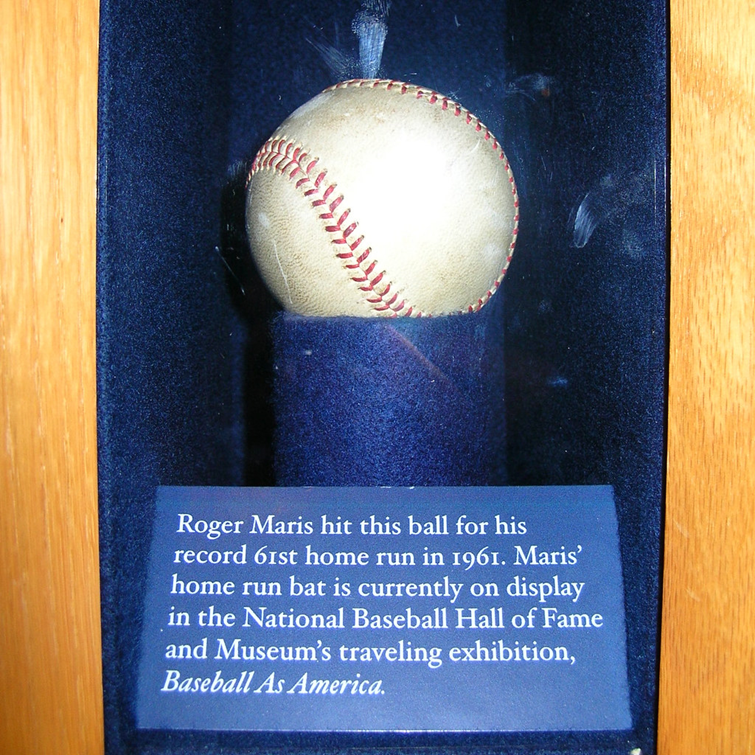
Sal Durante, a 19-year-old truck driver, caught the record-breaking ball. After the game, Durante was invited into the Yankee clubhouse to pose with Maris and the ball. Durante offered Maris the ball, but Maris declined, saying to get what you can for it.
Durante, who had brought his fiancée Rosemary to the game, bought her an engagement ring. Gordon paid for the Durante's honeymoon, put the ball on display in his restaurant for a while, and then gave it back to Maris. In 1973, Maris donated it to the Baseball Hall of Fame in Cooperstown, New York, where it rests today.
Still alive from this game, 61 years later: For the Yankees, Bobby Richardson, Tony Kubek, Héctor López and Jack Reed. For the Red Sox: Only their rookie left fielder, a 22-year-old native of Southampton, Long Island named Carl Yastrzemski.
Also still alive, in the Yankee dugout but not appearing in the game, was a rookie pitcher named Al Downing. In 1974, Downing gave up Hank Aaron's 715th home run. I don't know if anybody else was in the ballpark for both moments, but Downing was definitely the only one in uniform for both.
(UPDATE: López died on September 29, 2002; Reed on November 10, 2022; and Durante on December 1, 2022. Mrs. Durante died in 2014.)
One of my favorite trivia questions is, "Who played right field for the Yankees the day Roger Maris hit his 61st home run in 1961?" The easy answer is, "Roger Maris," but that's wrong. Mickey Mantle was sick, and Roger was playing center field that day. The right fielder? Backup catcher Johnny Blanchard.
Roger batted .269 that season, but his 61 home runs, 141 RBIs and 366 total bases all led the AL. In spite of his relationship with the New York writers, the Baseball Writers Association of America voted him MVP again. The Yankees won the World Series, beating the Cincinnati Reds in 5 games, and Roger hit another homer in the series.
The rest of his career was an anticlimax. How could it not be? He hit 33 home runs in 1962. He helped the Yankees win 5 straight Pennants, including the 1961 and 1962 World Series. He broke his hand early in the 1965 season, one of several injuries that caused the Yankees to fall apart that year and tumble from the top to the middle of the League, and the next year to the bottom. But Yankee management told him the injury was something less severe, and publicly suggested that he was faking the extent of the injury. This caused a breach between Roger and the Yankee management of the time that never healed, even after the hand did.
After the 1966 season, he was traded to the St. Louis Cardinals for 3rd baseman Charley Smith.
Roger helped the Cardinals win the World Series in 1967, and another Pennant in 1968. He finished his career with a .260 batting average, 275 home runs and 851 RBIs. Decent totals, but not those of an all-time great.
After the 1966 season, he was traded to the St. Louis Cardinals for 3rd baseman Charley Smith.
Roger helped the Cardinals win the World Series in 1967, and another Pennant in 1968. He finished his career with a .260 batting average, 275 home runs and 851 RBIs. Decent totals, but not those of an all-time great.
Cardinals owner Gussie Busch gave him an Anheuser-Busch beer distributorship in Gainesville, Florida, and the family still lives there today. In 1978, by which point most people who felt he didn't deserve to break the record had either died or changed their minds, George Steinbrenner invited him back to Yankee Stadium. He appeared on Opening Day 1978, to raise the previous season's World Championship banner with Mantle, and got a standing ovation.

He attended Old-Timers' Day from 1978 to 1984, in the last of those getting his Number 9 retired and a Plaque for Monument Park. But he was beginning to suffer from cancer, and died in 1985. He did not live to see his record raised, through dubious means, to 70 by Mark McGwire in 1998, and then to 73 by Barry Bonds in 2001.
A Roger Maris Museum had also been dedicated in his hometown of Fargo, at the West Acres Regional Shopping Center. Roger said he would allow it as long as admission was free. It still is.
*
October 1, 1961 was a Sunday. It was also the day that District of Columbia Stadium, later renamed Robert F. Kennedy Memorial Stadium, opened in Washington; and broadcast network CTV went on the air in Canada. I have separate entries for those events.
These other games were played on the final day of baseball's regular season:
* The St. Louis Cardinals beat the Philadelphia Phillies, 2-0 at Connie Mack Stadium in Philadelphia. Bob Gibson pitched a 6-hit shoutout. Stan Musial appeared only as a pinch-hitter, and did not reach base.
* The Pittsburgh Pirates beat the Cincinnati Reds, 3-1 at Forbes Field in Pittsburgh. Roberto Clemente did not play. Frank Robinson went 0-for-2 with a walk. Despite this game, the Reds had dethroned the Pirates as National League Pennant winners, and would face the Yankees in the World Series. The Yankees won in 5 games.
* The Los Angeles Dodgers beat the Chicago Cubs, 8-2 at Wrigley Field in Chicago. Ernie Banks went 1-for-4 with an RBI. Duke Snider drew a walk as a pinch-hitter.
* A doubleheader was split at Milwaukee County Stadium. The San Francisco Giants won the opener, 8-2. The Milwaukee Braves won the nightcap, 3-2. Al Spangler singled Hank Aaron home with the winning run in the bottom of the 10th inning. Over the 2 games, Aaron went 4-for-9, and Willie Mays went 3-for-7 with a home run and 3 RBIs.
* The Detroit Tigers beat the Minnesota Twins, 8-3 at Metropolitan Stadium in the Minneapolis suburb of Bloomington, Minnesota. Norm Cash hit a home run, and Al Kaline had an RBI double as a pinch-hitter. This was the Tigers' 101st win of the year, but the Yankees won 109 to take the American League Pennant.
For the Twins, completing their 1st season after being "the old Washington Senators," Harmon Killebrew went 0-for-3 with a walk, and relief pitcher Pedro Ramos hit a home run, 1 of 3 he hit on the season, and 1 of 15 he hit in a surprisingly powerful career for a pitcher who was mainly a reliever.
* The Kansas City Athletics beat "the new Washington Senators," 3-2 at Kansas City Municipal Stadium.
* After providing a venue for the Pacific Coast League's Los Angeles Angels from 1925 through 1957, and the major league expansion team with the same name this season, the West Coast version of Wrigley Field hosts its last professional baseball game. The Halos are defeated by the Cleveland Indians, 8-5 in front of 9,868 fans. Wrigley West will be torn down in 5 years, to make room for an eventual public playground and senior center.
* And the Baltimore Orioles and the Chicago White Sox completed their seasons the day before, against each other, with the O's winning, 4-3 at Memorial Stadium in Baltimore.
These games were played in the NFL:
* The New York Giants beat the Washington Redskins, 24-21 at District of Columbia Stadium in Washington. This was the 1st event at what would be renamed Robert F. Kennedy Stadium in 1969. I have a separate entry for that event. (The opener, not the renaming.)
* The football version of the St. Louis Cardinals beat the Philadelphia Eagles, 30-27 at Franklin Field in Philadelphia.
* The Baltimore Colts beat the Minnesota Vikings, 34-33 at Memorial Stadium in Baltimore.
* The Cleveland Browns beat the Dallas Cowboys, 25-7 at Cleveland Municipal Staidum.
* The San Francisco 49ers beat the Detroit Lions, 49-0 at Tiger Stadium in Detroit.
* The Green Bay Packers beat their arch-rivals, the Chicago Bears, 24-0 at Green Bay City Stadium (later renamed Lambeau Field).
* And the Los Angeles Rams beat the Pittsburgh Steelers, 24-14 at the Los Angeles Memorial Coliseum.
And in the American Football League:
* The New York Titans beat the Boston Patriots, 37-30 at the Polo Grounds. The Titans became the Jets in 1963, and the Patriots became the New England Patriots in 1971.
* The Dallas Texans beat the Houston Oilers, 26-21 at the Cotton Bowl in Dallas. The Texans became the Kansas City Chiefs in 1963, and the Oilers became the Tennessee Titans in 1999.
* The Oakland Raiders beat the Denver Broncos, 33-19 at Candlestick Park in San Francisco. The Raiders wouldn't actually play a game in Oakland until 1962, moved to Los Angeles in 1982, moved back to Oakland in 1995, and moved to Las Vegas in 2020.
* And, the day before, the San Diego Chargers beat the Buffalo Bills, 19-11 at War Memorial Stadium in Buffalo. This was the Chargers' 1st game as a San Diego team, after spending the AFL's founding year of 1960 in Los Angeles. They returned to Los Angeles in 2017.


No comments:
Post a Comment