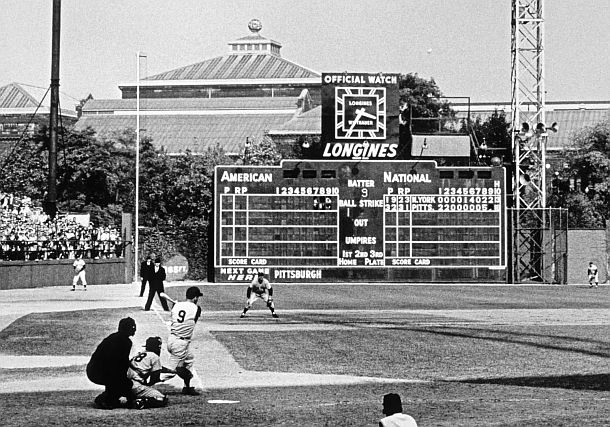
In case you're curious, the building behind the scoreboard
is the Carnegie Library of Pittsburgh.
October 13, 1960: Perhaps the greatest game in the history of baseball is played. But if you are among Yankee Fans age 70 and over, mention it at your peril.
The 1960 World Series may have been the wildest Fall Classic ever. The Pittsburgh Pirates, Champions of the National League for the 1st time in 33 years, faced the New York Yankees, the team they faced in their last appearance. Since that 1927 World Series, the Yankees had appeared in 19 of them, winning 16.
In Pittsburgh, the Pirates won Game 1, 6-4., but the Yankees won Game 2, 16-3. In New York, the Yankees won Game 3, 10-0, but the Pirates won Game 4, 3-2, and Game 5, 5-2. The Series went back to Pittsburgh, and the Yankees won Game 6, 12-0.
And so, on this Thursday afternoon, 36,683 people jammed themselves into Forbes Field for Game 7. Millions more listened to Pirates announcer Bob Prince and Yankees announcer Mel Allen call the game for television on NBC. Still more millions listened to NBC radio, with Baltimore Orioles announcer Chuck Thompson and Chicago Cubs announcer Jack Quinlan.
The game began at Forbes Field, precisely at 1:00 PM, Eastern Daylight Time, as home plate umpire Bill Jackowski said, "Play ball!" The other umpires: at 1st base, Nestor Chylak; and 2nd base, Dusty Boggess; at 3rd base, Johnny Stevens; in left field, Stan Landes; and in right field, Jim Honochick.

Forbes Field
The starting pitcher for the Pirates was Vernon Law, who would be named the winner of the Cy Young Award. Leading off for the Yankees was 2nd baseman Bobby Richardson, who lined out to short. Shortstop Tony Kubek popped up to 2nd. Right fielder Roger Maris closed the inning by popping up to 3rd.
The starting pitcher for the Yankees was Bob Turley, who had won the Cy Young and the World Series Most Valuable Player awards in 1958. He got center fielder Bill Virdon to fly to left, and shortstop Dick Groat, who would be named NL MVP that season, to pop up to his opposite number, Kubek.
Cliché Alert: Walks can kill you. Turley walked left fielder Bob Skinner. Then 1st baseman Rocky Nelson hit a home run to right field. Turley got right fielder Roberto Clemente -- eventually to become the most famous Pirate player who ever lived -- to pop up to 2nd, but after 1 inning, it was Pirates 2, Yankees 0.
Roberto Clemente
Things would get worse for the Yankees in the 2nd inning. Center fielder Mickey Mantle flew to center. Yogi Berra, now playing left field after switching positions with Elston Howard, now the catcher, grounded to 3rd. And 1st baseman Bill "Moose" Skorwon grounded to short.
Pirate catcher Smoky Burgess led off the bottom of the 2nd with a single to right. Perhaps overreacting to a bad 1st inning by Turley, Yankee manager Casey Stengel replaced him with Bill Stafford. This didn't work: Stafford walked 3rd baseman Don Hoak, and 2nd baseman Bill Mazeroski beat out a bunt.
Law grounded back to Stafford, who started a double play, eliminating Burgess at the plate and Law at 1st. But Hoak advanced to 3rd, Mazeroski to 2nd. Virdon singled to right, scoring Hoak. Maris mishandled the ball, allowing Mazeroski to score and Virdon to reach 2nd. Stafford got Groat to ground to 3rd, but after 2, it's Pirates 4, Yankees 0.
It got no better for the Yankees. In the top of the 3rd, Johnny Blanchard, catching in place of the injured Howard, grounded back to Law. The 3rd baseman, Clete Boyer, popped up to 2nd. Stengel sent Hector Lopez up to pinch-hit for Stafford, and he singled to left, but Richardson flied to left.
The new Yankee pitcher was Bobby Shantz, the 1952 AL MVP with the Philadelphia Athletics, whom Stengel put in the bullpen, and was rewarded by Shantz helping to win the 1958 World Series. He got Skinner to ground to 1st, walked Nelson, and got Clemente to ground into a 4-6-3 double play. End of 3, Pirates 4, Yankees 0.
Kubek popped to short. Maris hit a sinking liner to right that Clemente caught. Mantle singled to right, but Berra flew out in that direction. Shantz got Burgess and Hoak to both ground to 2nd, and Mazeroski to pop to short. Maybe Stengel should have started Shantz. After 4, Pirates 4, Yankees 0.
Skowron led off the 5th with a home run, but that's all the Yankees got. Blanchard flied to center, Boyer lined to 2nd, and, allowed to bat for himself, Shantz popped up to 1st. Shantz then got Law to ground to 3rd, Virdon to ground to 2nd, and Groat to hit a line shot right back at him, which he caught. End of 5, Pirates 4, Yankees 1.
Finally, in the top of the 6th, the Yankees woke up. Richardson singled to center. Kubek worked Law for a walk. Pirate manager Danny Murtaugh had seen enough, and replaced Law, bringing his closer, Roy Face, into the game in the 6th inning. Big risk, and it didn't work: He got Maris to pop up to 3rd, but Mantle singled up the middle to score Richardson, and Berra hit one down the right field line, for a 3-run homer, giving the Yankees the lead. Face got Skowron to pop to 3rd and Blanchard to ground to 1st, but the damage was done.
Shantz breezed through the Pirates in the bottom of the 6th, getting Skinner to line to right, Nelson to ground to 1st, and Clemente to ground back to him. Yankees 5, Pirates 4. Now, we had a game worth of Game 7 of the World Series.
The 7th inning was comparatively uneventful. Boyer flied to center. Shantz was again allowed to bat for himself, and rewarded Stengel's confidence by singling to left. Richardson grounded to 3rd, resulting in a force play that eliminated Shantz at 2nd. Kubek lined to right, and the 7th Inning Stretch was on.
Shantz allowed Burgess to single to center. Murtaugh sent Joe Christopher in to run for him. Hoak lined to left, and the fine-fielding Mazeroski got a taste of his own medicine, as he grounded to short, resulting in a Kubek-to-Richardson-to-Skowron double play. End of 7, Yankees 5, Pirates 4.
The 8th inning moved this game from merely interesting to classic. Hal Smith took Burgess' place behind the plate for Pittsburgh, and this would prove crucial. Maris grounded back to Face. Mantle lined to short. But, again, comes the cliche about the danger of walks: Berra drew one, and this was followed by a single by Skowron, and RBI single by Blanchard, and an RBI double by Boyer. Stengel again allowed Shantz to bat for himself, but he lined out to right. However, it was now 7-4 Yankees.
But the Pirates were far from done. Murtaugh sent Gino Cimoli up to bat for Face, and he singled to right. And then came a play that changed baseball history. Forbes Field was known for having the worst infield in the major leagues. And Virdon hit a grounder to short. It should have been an easy play for Kubek, and the start of a double play. But the ball hit a pebble, and jumped up and struck Kubek in the throat. He went down like a ton of bricks.
He had to leave the game. Stengel put Joe DeMaestri in to play short, and got Jim Coates up in the bullpen. The delay in getting Kubek off the field gave Coates time to get ready -- perhaps, a little too much time. Groat singled Cimoli home, to make it 7-5 Yankees. Stengel finally removed the heroic Shantz, and brought in Coates. Skinner bunted the runners over. Nelson flied out to right. But Clemente singled home Virdon, and Smith, batting for the 1st time in the game, hit a home run to left. The Pirates had the lead again.
Stengel brought Ralph Terry in to pitch. He got Hoak to fly to left. But after 8 innings, it was Pirates 9, Yankees 7. The Buccos were just 3 outs away from their 1st World Championship in 35 years.
But the Bronx Bombers refused to go down quietly. Bob Friend, who had been the Pirates ace before Law came into his own that year, was brought in to close it out. But Richardson dunked a single into short left-center. Dale Long, himself a former Pirate, who hit home runs in a record 8 straight games for them in 1956, was sent up to pinch-hit for DeMaestri. Now, Stengel would need his 3rd shortstop of the game. He singled to right, and, just like that, the tying runs were on with nobody out.
Murtaugh brought in Harvey Haddix. The previous year, Haddix had pitched a perfect game against the Milwaukee Braves for 12 innings. But because Lew Burdette, hero of the Milwaukee Braves' 1957 World Series triumph over the Yankees, was also pitching a shutout, the game kept going, and the Braves not only broke up the perfect game, the no-hitter and the shutout in the 13th inning, but won the game. Now, Haddix was being asked to save Game 7 of the World Series.
He got Maris to pop up to Smith. But Mantle, the Yankee superstar of the era, singled to right, scoring Richardson. Gil McDougald, who had announced his retirement and, win or lose, was playing in his last game, pinch-ran for Long. He would go in to play 3rd base, and Boyer would move to short -- if the Yankees could get that 9th run (or more) and send the game to a bottom of the 9th.
Yogi Berra was the batter. He hit a sharp grounder to 1st. Had the Pirates' other 1st baseman been in place, Dick Stuart, this could have been a disaster: Although he hit the ball nearly as far as Mantle, he was an atrocious fielder, eventually earning the nicknames "Stonefingers" and "Dr. Strangeglove." But Nelson grabbed the ball, and ran to 1st for the 2nd out. He should have tagged Mantle for the out that won the World Series.
But Mickey, not the brightest of men off the field, was a genius on it. He executes a head-fake, and makes Nelson think he's going to break for 2nd. That makes Nelson look toward Mazeroski at 2nd, and allows Mantle to get back to 1st base safely, and allows McDougald to score. Tie ballgame. Haddix got Skowron to ground to short for a force play, but the inning ended with the score tied 9-9.
On NBC radio, Thompson said, "Well, a little while ago, when we said this one was going right down to the wire, little did we know." He also mentioned that Art Ditmar was throwing -- but did not specify, "in the Yankee bullpen." That led a lot of Yankee Fans to incorrectly hold Ditmar responsible for what happened next, and he got a lot of nasty mail about it, and he got very bitter about it.
The leadoff batter in the bottom of the 9th was Mazeroski, 24 years old, born in Wheeling, West Virginia, and grown up on the other side of the Ohio River, 14 miles to the north, in Rush Run, Ohio. He grew up as a fan of his home State's Cleveland Indians, but Rush Run is considerably closer to the site of Forbes Field, 53 miles, than it is to that of Cleveland Municipal Stadium, 141 miles.
He had debuted with the Pirates in 1956, and had already become regarded as the best-fielding 2nd baseman in the major leagues. But he wasn't really known as a hitter: He had batted .273 that season, with 11 home runs and 64 RBIs. Those were decent numbers, especially for a righthanded hitter in that ballpark: Similar to Yankee Stadium at the time, Forbes had a 300-foot right field pole, but a 457-foot center field fence and was 360 feet to left. So, Maz was a good hitter, but not the player who would be expected to be the big hitting hero.
Terry's 1st pitch to Mazeroski was high, ball 1. Blanchard didn't like that, and went out to talk to Terry for a moment. Terry threw a 2nd pitch. The time was 3:36 PM. Chuck Thompson's call on radio:
Here's a swing, and a high fly ball, going deep to left, this may do it! Back to the wall goes Berra, it is over the fence, home run, the Pirates win!

Yogi played in 75 World Series games, more than anyone.
This is one he probably wanted back.
After pausing to let the cheering be heard, Thompson started again, and was so excited, he got the score wrong at first:
Ladies and gentlemen, Mazeroski has hit a one-nothing pitch over the left field fence at Forbes Field to win the 1960 World Series for the Pittsburgh Pirates by a score of ten to nothing! Once again, that final score, the Pittsburgh Pirates, the 1960 World Champions, defeat the New York Yankees. The Pirates ten, and the Yankees nine! And Forbes Field is an insane asylum!
Mel Allen, so often accused of being a "homer" for the Yankees, called it this way on TV:
There's a drive into deep left field, look out now! That ball is going, going, gone! And the World Series is over! Mazeroski hits it over the left field fence, and the Pirates win it 10–9, and win the World Series!
The ball went over Berra's head, at around the 406-foot mark in left field, and landed among the cherry trees in Schenley Park. Mazeroski took off his batting helmet and swung it around as he circled the bases.
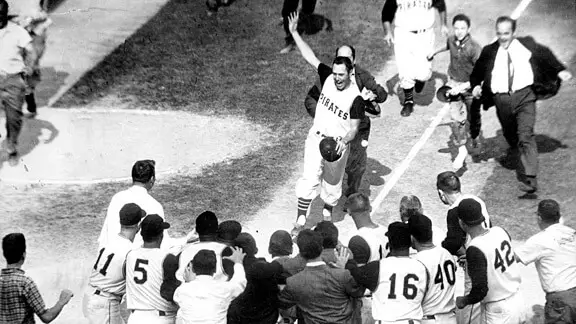
The ball was found by Andy Jerpe, 14 years old. Mazeroski would sign the ball for him, but he foolishly used the ball in a neighborhood game, and it was lost. No one knows where it is now. The Pirates don't have it. Neither does the Baseball Hall of Fame.
The Yankees outscored the Pirates 55-27 during the Series, but the Pirates won it, 4 games to 3. Richardson had a Series record 12 RBIs, and remains the only player from a losing side to be named the MVP of a World Series. Mazeroski? He batted .320 in that Series, and that was his 2nd homer in it, for his 5th RBI in it, and he played his usual good games in the field. He got robbed. But I'm sure he'd rather have the title.
After the game, Berra issued one of his "Yogi-isms," saying, "We made too many wrong mistakes." Mantle would later say that, of the 12 World Series he played in, this was the only time he believed that the better team lost. He also said he cried on the entire flight home, and this was confirmed by multiple teammates.
*
Was Yogi right? Did the Yankees make too many mistakes, "wrong" or "otherwise"? Pirate outfielder Gino Cimoli told Bob Prince, the Pirates' Hall of Fame broadcaster, in the locker room afterward, "They broke all the records, and we won the game! How 'bout that!" (So he closed by invoking the catchphrase of Allen, the Yankees' Hall of Fame broadcaster)
So why did the Yankees lose? How did the Pirates win?
The Yankees were in the process of making changes, including the manager: Team owners Del Webb and Dan Topping had decided that the 70-year-old Stengel, who missed several games that year due to an illness, would be fired even if the Yankees won the World Series.
They made Casey read a statement in which he said he is resigning. When Casey finished reading the statement, he put the paper down, and told the press, "I guess this means they fired me." He later said that they forced him out due to his age: "I'll never make the mistake of being 70 again."
Competitively, firing Casey may have been the right decision: Ralph Houk managed the Yankees to the next 3 American League Pennants, and the next 2 World Championships. Given that 4 new teams were being expanded into existence, and managerial changes are common, the Yankees would have lost Houk if they hadn't made him manager.
Still, Casey was treated shabbily. Topping and Webb could have done something. Casey was rich, having made savvy investments when he was younger, and owning a bank in the Los Angeles suburb of Glendale, California, where he lived in the off-season. They could have sold him a piece of the ownership. They could have made him a well-paid special consultant. They could have let him stay, or walk away, with dignity.
Instead, they canned him. It would be 10 more years, after they sold the team, before new Yankee president Mike Burke invited Casey back, to make peace and to retire his Number 37.
The Bill Mazeroski Game was also the last game as Yankee general manager for George Weiss. For all his cheapness and bigotry, Weiss was an organizational genius. First as farm system director from 1932 to 1947, and then as GM, he helped to build 23 Pennants (counting the 4 won in the 4 years after he left), and 17 World Series.
But he saw the writing on the wall. He knew that the system he used, of trading multiple players, usually a mix of over-the-hill veterans and prospects, for 1 of 2 players who could help the Yankees win the Pennant that year, couldn't work much longer, as the farm system was drying up.
He also knew that Topping and Webb didn't care, as they were planning to sell. At his resignation, Weiss told the press, "I give it 5 years." He was right: 1961, they won the Pennant and the World Series; 1962, they won the Pennant and the World Series; 1963, they won the Pennant but lost the World Series; 1964, they won the Pennant but lost the World Series; 1965, they finished in 6th place, the 1st of 7 straight seasons without even coming close to contending.
The Yankee stars of the 1950s, including the ones that had won 4 straight American League Pennants from 1955 to 1958, were on their way out. As a result, a lot of players -- 1960 AL Most Valuable Player Roger Maris, for one -- may have been good enough to be Yankees, but hadn't yet won the big one as Yankees.
The Yankees had last won the World Series in 1958, and would next win it in 1961, the year after the Mazeroski Game. How many players were on the World Series roster on both sides of this 3-year gap? Only 7: Mickey Mantle, Yogi Berra, Whitey Ford, Bill "Moose" Skowron, Elston Howard, Bobby Richardson and Tony Kubek. Bob Turley could have made it 8, but he was injured, and didn't play in the '61 Series.
The 1960 season was also the 1st in which catcher Yogi Berra and left fielder Elston Howard, whose natural position was catcher, had been switched, which is why Yogi was the left fielder tracking Mazeroski's homer, and it's his head, along with the outfield wall, that it went over.
The Pirates also had a distinct home-field advantage. Although Forbes Field had dimensions very similar to the pre-renovation Yankee Stadium, including a right-field pole 300 feet from home plate and a center field 457 feet away, it had only 35,000 seats, making it about half the size. As a result, while the noise at Yankee Stadium could be overwhelming, the fans were much closer to the field in Pittsburgh. Hence, Thompson's declaration that it was "an insane asylum."
Forbes Field was also known for having the worst infield in the National League. Even by the standards of ballparks that went up before World War II (and there were still 13 of the 16 teams, including the Yankees, playing in such ballparks in 1960), it was known to be bad. Since the Pirates, unlike any other team, played there regularly, they knew how to handle the comparatively high grass, the hard dirt, and the pebbles that were all over the place in said dirt.
Which leads us to the play that knocked Kubek out of the game. If that had happened to any of the the game's legendary losers, -- such as the Boston Red Sox, the Chicago Cubs, the Philadelphia Phillies, the Cleveland Indians, or, even though they didn't exist yet, the Mets -- it would be forever known as The Pebble, Capital T, Capital P, and we would never stop talking about it.
But it happened to the Yankees, so hardly anybody makes a big deal out of it. And, of those who do, most think the Yankees had it coming.
And, of course, we must give due credit to the other team: The Pirates were not a better team than the Yankees, but they were worthy champions. They led the NL in batting average, on-base percentage, OPS, runs, hits and doubles; and were 2nd in slugging percentage and triples. Groat batted .325 in a season that got him named NL MVP. Clemente batted .314. Of their usual 8 starters, 6 had an OPS+ of 109 or higher: Clemente 121, Hoak 120, Dick Stuart 114, Groat 110, Smoky Burgess 110 and Skinner 109.
Only Stuart (23) had more than 16 home runs, a by-product of Forbes Field being a terrible park for righthanded hitters, and the team was 6th in the NL in homers. And none had at least 100 RBIs. But Clemente had 94, Skinner 86, Stuart 83, Hoak 79, and Mazeroski 64. Groat only had 50, a very low total for an MVP. Smith had only half as many plate appearances as you would get in a full season, and still had 45 RBIs.
In spite of Stuart, a born DH if ever there was one, and the bad infield, the Pirates were otherwise good defensively. Mazeroski's defensive prowess was already unquestioned: He did for 2nd base what Brooks Robinson later did for 3rd base. Despite the bad infield, Hoak only made 25 errors, and that was the most on the team. Groat, at shortstop, the most error-prone position, made 24. Stuart made 14 (a bad number for a 1st baseman, especially playing only 108 games, as Nelson was a frequent sub), Mazeroski only 10 in 151 games (an astoundingly low figure for a 2nd baseman).
The Pirates' .979 fielding percentage led the NL, and their 128 errors for their entire team were 3rd in the NL. In other words, this was a team that did not beat themselves.
Then there was the pitching. Between them, Law, Friend, Wilmer "Vinegar Bend" Mizell (later a Congressman from Mississippi) and Harvey Haddix (he of the 1959 game where he pitched 12 perfect innings but lost in the 13th, but was the winning pitcher in 1960 World Series Game 7) made 123 of the Pirates' 155 starts (the standard for the time, 154, plus a rainout makeup). Law went 20-9, Friend 18-12, Mizell 13-5 and Haddix 11-10. ERAs: Friend 3.00, Law 3.08, Mizell 3.12, Haddix 3.97. ERA+: Friend 125, Law 122, Mizell 121, Haddix 95. WHIP: Law 1.126, Friend 1.128, Mizell 1.201, Haddix 1.317.
The Pirates didn't really need a bullpen: Friend completed 37 of his 38 starts, Law all 35 of his, Haddix 28 of his 29, and Mizell all 23 of his. That's 121 complete games out of 123 starts, or 98.4 percent. (Don't show this stat to Brian Cashman.) It was when a 5th starter was needed that relief ace Face was needed, appearing 68 times, all in relief, a record at the time.
And, of course, we must give due credit to the other team: The Pirates were not a better team than the Yankees, but they were worthy champions. They led the NL in batting average, on-base percentage, OPS, runs, hits and doubles; and were 2nd in slugging percentage and triples. Groat batted .325 in a season that got him named NL MVP. Clemente batted .314. Of their usual 8 starters, 6 had an OPS+ of 109 or higher: Clemente 121, Hoak 120, Dick Stuart 114, Groat 110, Smoky Burgess 110 and Skinner 109.
Only Stuart (23) had more than 16 home runs, a by-product of Forbes Field being a terrible park for righthanded hitters, and the team was 6th in the NL in homers. And none had at least 100 RBIs. But Clemente had 94, Skinner 86, Stuart 83, Hoak 79, and Mazeroski 64. Groat only had 50, a very low total for an MVP. Smith had only half as many plate appearances as you would get in a full season, and still had 45 RBIs.
In spite of Stuart, a born DH if ever there was one, and the bad infield, the Pirates were otherwise good defensively. Mazeroski's defensive prowess was already unquestioned: He did for 2nd base what Brooks Robinson later did for 3rd base. Despite the bad infield, Hoak only made 25 errors, and that was the most on the team. Groat, at shortstop, the most error-prone position, made 24. Stuart made 14 (a bad number for a 1st baseman, especially playing only 108 games, as Nelson was a frequent sub), Mazeroski only 10 in 151 games (an astoundingly low figure for a 2nd baseman).
The Pirates' .979 fielding percentage led the NL, and their 128 errors for their entire team were 3rd in the NL. In other words, this was a team that did not beat themselves.
Then there was the pitching. Between them, Law, Friend, Wilmer "Vinegar Bend" Mizell (later a Congressman from Mississippi) and Harvey Haddix (he of the 1959 game where he pitched 12 perfect innings but lost in the 13th, but was the winning pitcher in 1960 World Series Game 7) made 123 of the Pirates' 155 starts (the standard for the time, 154, plus a rainout makeup). Law went 20-9, Friend 18-12, Mizell 13-5 and Haddix 11-10. ERAs: Friend 3.00, Law 3.08, Mizell 3.12, Haddix 3.97. ERA+: Friend 125, Law 122, Mizell 121, Haddix 95. WHIP: Law 1.126, Friend 1.128, Mizell 1.201, Haddix 1.317.
The Pirates didn't really need a bullpen: Friend completed 37 of his 38 starts, Law all 35 of his, Haddix 28 of his 29, and Mizell all 23 of his. That's 121 complete games out of 123 starts, or 98.4 percent. (Don't show this stat to Brian Cashman.) It was when a 5th starter was needed that relief ace Face was needed, appearing 68 times, all in relief, a record at the time.
Face was the apparent inventor of the forkball, the pitch that was the "father" of the split-fingered fastball, and he used it to set a record for highest winning percentage in a season with at least 13 decisions: .947, 18-1, in 1959. A year later, he helped the Pirates win the World Series with a record of 10-8, 24 saves, and a glittering WHIP of 1.064.
Think about this: Baseball-Reference.com, a website which is your friend, whether you know it or not, lists photos of each team, each year, with its Top 12 Players according to WAR. And Clemente, a Hall-of-Famer, one of the Top 25 players of all time, is only 5th in WAR among '60 Bucs, behind Groat, Hoak, Friend and Law.
The Yankees weren't cheated, and they didn't give the Series away. They were simply defeated by a good team.
Think about this: Baseball-Reference.com, a website which is your friend, whether you know it or not, lists photos of each team, each year, with its Top 12 Players according to WAR. And Clemente, a Hall-of-Famer, one of the Top 25 players of all time, is only 5th in WAR among '60 Bucs, behind Groat, Hoak, Friend and Law.
The Yankees weren't cheated, and they didn't give the Series away. They were simply defeated by a good team.
The Baseball Gods were cruel to Ralph Terry that day in Pittsburgh, but they would be kind to him for the next 2 years, allowing him to win 39 regular-season games for back-to-back Yankee World Championship teams, to add the 1962 Cy Young Award to his honors, and to add his own shutout in Game 7 of the 1962 World Series. So, as bad as certain moments of Yankee history, such as the Bill Mazeroski Game, have been, there's usually a sequel that sets it all right, and goats become heroes.

Ralph Terry
Still, this game stands out in the minds of Yankee Fans old enough to remember it. Don't ever ask actor-comedian Billy Crystal, who was 12 years old at the time, about it. You certainly can't ask paleontologist Stephen Jay Gould, then 19 and attending Antioch College in western Ohio, about it, since he died in 2002. But, when interviewed on the subject by Ken Burns for his 1994 miniseries Baseball, Gould said, "The one thing that must never be mentioned in my presence is Game 7 of the 1960 World Series."
In 1993, Joe Carter hit what we would now call a "walkoff home run" to win the World Series for the Toronto Blue Jays over the Philadelphia Phillies. His home run actually took the Jays from behind, 6-5, to win, 8-6. Mazeroski's team was tied when he came to the plate. But the Jays were already up 3 games to 2, and it was Game 6. Mazeroski remains the only player ever to win Game 7 of a World Series with a walkoff home run.
The image of Mazeroski swinging his helmet around in his right hand would later serve as the model for a statue of him that now stands outside the Pirates' current home, PNC Park. After the Pirates moved to Three Rivers Stadium in 1970, playing there until 2000, Forbes Field was demolished, and the University of Pittsburgh built classrooms on the site. The (approximate) location of Forbes Field is preserved under lucite, and it is the same plate (it wasn't moved to Three Rivers, although that stadium's plate was moved to PNC Park), so you can "touch" the plate that Mazeroski touched.
Part of the outfield wall was left standing. A line of bricks marks where the rest of the wall was, and a plaque marks the spot there the ball went over it.

The Pirates would also retire Mazeroski's Number 9, following a career that included 10 All-Star Games and 8 Gold Gloves, and ended in 1972. He and Clemente would be the only 2 players on this 1960 World Series-winning team still with the Pirates when they won their next World Series in 1971.
But it took until 2001 for him to be elected to the Baseball Hall of Fame. Why? Some people think he doesn't deserve it at all, because he doesn't have the hitting stats, and that he's only in because of the home run.
I think it's the exact opposite: I think the home run changed people's perception of him. Think about it: The 1st thing that comes to mind when you hear his name is, "He hit the home run that won the 1960 World Series."
Now, imagine that the Series had ended any other way, even one favorable to the Pirates. Suppose Mazeroski had led the inning off with a single, and scored the title-winning run on somebody else's hit. Then, the 1st thing that would come to mind when you hear his name is, "He's the greatest-fielding 2nd baseman who ever lived." He probably would have gotten in much sooner.
Today, William Stanley Mazeroski is 86 years old, retired and living in Panama City, Florida, and is a spring-training fielding instructor for the Pirates.
At a still-standing, ivy-covered piece of the
Forbes Field outfield wall, October 13, 2010,
the 50th Anniversary of the home run.
One more note: Game 7, for all of its scoring, pitching changes, and other stops in the action, lasted 2 hours and 36 minutes, from first pitch to Mazeroski touching the plate. In fact, except for Game 2 going 3:14, none of these games went longer than 2:41.
In 1981, baseball historian John Thorn published Baseball's 10 Greatest Games. He included this game as one of them. (He also included Haddix' near-perfecto.) For 2 hours and 36 minutes, the New York Yankees and the Pittsburgh Pirates may have provided the greatest game in the history of baseball. And it definitely had the greatest ending in the history of baseball. Even if the team I would one day go on to root for lost it.
UPDATE: The Pirates have a team Hall of Fame. From their 1960 World Champions, they have inducted manager Danny Murtaugh; right fielder Roberto Clemente, 2nd baseman Bill Mazeroski, shortstop Dick Groat; and pitchers Vern Law, Bob Friend and Roy Face.
*
October 13, 1960 was a Thursday during football season, so no NFL or AFL games were played. And the NBA season hadn't started yet. There was one NHL game that day: The Montreal Canadiens beat the Detroit Red Wings, 4-3 at the Montreal Forum.


No comments:
Post a Comment