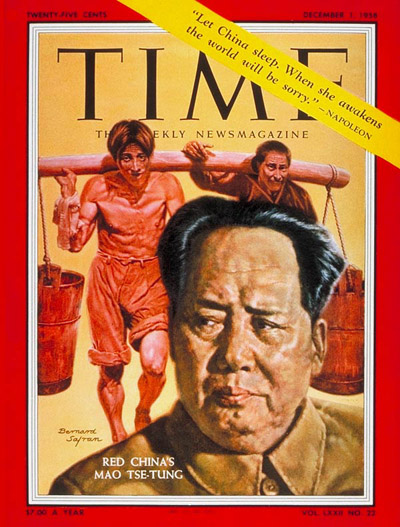
Time co-founder Henry Luce, still alive at this point,
was born in China to Christian missionaries,
and was among the leaders of America's "China Lobby,"
determined to free the mainland from Communism.
January 11, 1958: Mao Zedong, founder of the People’s Republic of China and Chairman of its Communist Party, speaks at a Party conference in Nanjing. He launches a plan to transform the country into a modern industrialized state, a plan he calls "the Great Leap Forward." He thought that establishing "people's communes" in the countryside, focused mostly on producing steel, would be a good way to go about it.
He was basing this on the Five-Year Plans that Joseph Stalin had instituted in the Soviet Union, starting in 1928. He had forgotten that the 1928 plan resulted in a terrible famine that killed millions of people, especially in Ukraine.
Taking people who only knew farming and getting them to leave their fields to become steelworkers had worked in America, earlier in the 20th Century. But that was by those men's own choices, because, whether they were black or white, they believed that packing everything up and leaving the South to go North and learn the necessary skills, however hard it might be, was a better life than living in segregation and rural poverty.
And 1958 China was not 1910 America. Mao was forcing his decision on people who were completely unprepared for it, and over 30 million people starved to death. Anti-Communists in America have suggested that the death toll might be as high as 55 million. Li Jingquan, the Party boss in Sichuan, told Mao that 10.6 million people had died in his province alone by 1961.
In terms of numbers, the Great Leap Forward may have been the greatest blunder in human history. But there's a big difference between a blunder and a crime.
Mao abandoned the program after getting the numbers. Thereafter, moderates in China reversed many of the Great Leap Forward policies, and even began cutting Mao out of economic decision-making. Having an ego as big as his country, Mao didn't like this. In 1964, he saw that the Soviet Union removed Nikita Khrushchev from power, and figured the same thing could happen to him, and he needed to do something about it. So he determined who had questionable loyalty, and secured his position by removing them from powerful positions, replacing them with sycophants.
Then, on May 16, 1966, there was a "notification": Mao declared the beginning of what he called the "Cultural Revolution." He said the moderate approaches that followed the catastrophe of the Great Leap Forward were bad, and that the Communist Party of China had to re-impose Maoism. That also turned out to be a disaster, based less on Mao's desire to improve his country than on his own hurt feelings. This became the crime.
*
January 11, 1958 was a Saturday. Baseball and football were out of season. There were 3 games played in the NBA:
* The Cincinnati Royals beat the Syracuse Nationals, 105-100 at the Cincinnati Gardens.
* The Detroit Pistons beat the Minneapolis Lakers, 129-102 at the Olympia Stadium in Detroit.
* And the St. Louis Hawks beat the Boston Celtics, 102-98 at the Kiel Auditorium in St. Louis. This was a rematch of the previous season's NBA Finals, won by the Celtics; and a preview of this season's Finals, which would be won by the Hawks. They would face each other again in the Finals in 1960 and 1961, with the Celtics winning both times. Although the franchise now known as the Atlanta Hawks has existed since 1946, those are the only times it has ever reached the NBA Finals.
And the NHL's entire "Original Six" were in action:
* The New York Rangers lost to the Montreal Canadiens, 9-3 at the Montreal Forum. Marcel Bonin scored 3 goals, while Bernie "Boom-Boom" Geoffrion and Don Marshall each had 2. Maurice "the Rocket" Richard did not play.
* The Boston Bruins and the Toronto Maple Leafs played to a tie, 2-2 at Maple Leaf Gardens in Toronto.
* And the Detroit Red Wings beat the Chicago Black Hawks, 4-1 at the Olympia Stadium in Detroit. Yes, even in 1958, it was possible for an arena to host a basketball game and a hockey game on the same day.


No comments:
Post a Comment