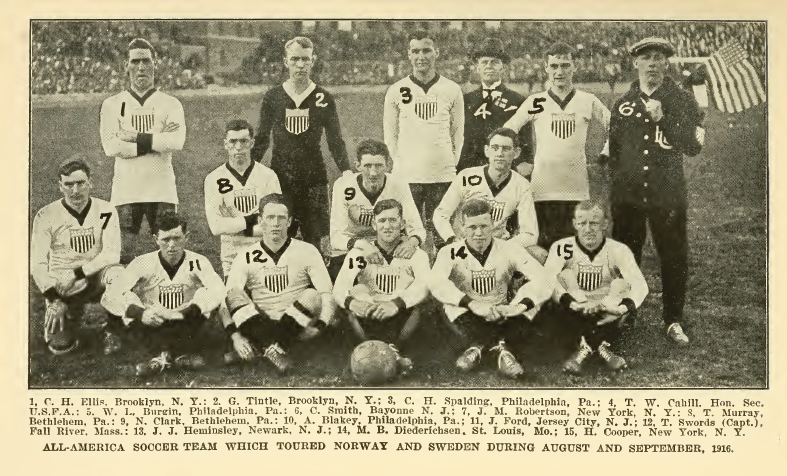
August 20, 1916: The United States of America fields a national soccer team for the 1st time.
Sponsored by the United States Soccer Federation (USSF), founded in 1913, the team took the pitch against Sweden at the Stockholm Olympiastadion, site of the 1912 Olympics, where Jim Thorpe had won the decathlon. A crowd of 16,000 attended. The referee was Hagbard Vestergaard of Denmark.
This was the U.S. team for the game, keeping in mind that uniform numbers were not used in soccer until 1933:
* Goalkeeper: George Tintle of Harrison, New Jersey
* Right Back: Tommy Murray of Bethlehem, Pennsylvania
* Left Back: Jimmy Robertson of New York
* Defender: Dick Spalding of Philadelphia
* Defender: Neil Clarke of Scotland, moved to Paterson, New Jersey
* Defender: Clarence Smith of Bayonne, New Jersey
* Outside Right: Jimmy Ford of Kearny, New Jersey
* Inside Right: Charles Ellis of New York
* Center Forward: John Hemingsley of Newark
* Inside Left: Thomas Swords of Fall River, Massachusetts (Captain)
* Outside Left: Harry "Buck" Cooper of Newark
As you can see, the tradition of soccer in Newark, its across-the-Passaic-River towns of Harrison and Kearny, and its across-Newark-Bay town of Bayonne goes back at least this far. Bethelehem, in the Lehigh Valley of northeastern Pennsylvania, was home to Bethlehem Steel Football Club, a "company team" (or, as the English would have called it, a "works side"), one of the top U.S. teams of the era.
And Fall River and nearby New Bedford, Massachusetts, manned by Portuguese immigrants and their sons, would have strong teams into the 1950s, including the legendary Ponta Delgada, named for an island in the Portugal-controlled Azores Islands. Because of Massachusetts' "blue laws," if these teams wanted to play on Sunday, they would go right across the State Line, and play at St. Mark's Stadium in Tiverton, Rhode Island.
James Robertson is a very common name among soccer players, especially in Scotland. A later Jimmy Robertson was the 1st player ever to score for both Tottenham Hotspur against Arsenal and for Arsenal against Tottenham in the North London Derby.
Konrad Törnqvist scored for Sweden, in only the 7th minute of the game. But Spalding equalized in the 22nd. Ellis scored in the 53rd. Cooper scored in the 68th. Törnqvist brought the Swedes back within 1 in the 81st, but the U.S. defense held on for a 3-2 win.
On September 3, still in Scandinavia, the U.S. team played Norway to a 1-1 draw in Kristiana. Ellis scored the only goal.
History seems to have lost track of some of these players. As far as I can tell, the last survivor was Cooper, who died in 1963.
The stadium still stands. Djurgårdens IF, Sweden's most successful soccer team, played there until the new Tele2 Arena opened, but maintain their offices there.

Due to World War I continuing through 1918, and then for longer for reasons I don't have, the U.S. national team didn't play another game until 1924, and then seemed to play only 2 or 3 games a year until World War II. This may have held them back. The U.S. team didn't play its 1st game on home soil until November 8, 1925, beating Canada 6-1 at Ebbets Field in Brooklyn, thanks to 5 goals from Archie Stark. Like so many early U.S. soccer stars, Stark was born in Glasgow, Scotland but grew up in Kearny, New Jersey.
This period did include reaching the Semifinal of the 1st World Cup in 1930, and reaching the World Cup again in 1934, before failing to qualify in 1938.
*
August 20, 1916 was a Sunday. Because many States still banned professional sports on Sunday, only 3 games were played in what would later be known as Major League Baseball:
* The New York Giants lost to the St. Louis Cardinals, 5-0 at Robison Field in St. Louis. Bob Steele allowed the Giants 8 hits, but kept the shutout. Rogers Hornsby, a rookie, went 2-for-2 with 2 walks for the Cardinals.
* The Boston Braves beat the Cincinnati Reds, 4-3 at Redland Field (renamed Crosley Field in 1934) in Cincinnati.
* The Brooklyn Robins (as the Dodgers were known from 1914 to 1931) beat the Chicago Cubs, 1-0 at Weeghman Park (renamed Cubs Park in 1920 and Wrigley Field in 1926) in Chicago. Jack Coombs allowed only 1 hit, a single by Max Flack. Coombs even got a hit for Brooklyn. So did the man who is still the Dodger franchise's all-time leader in hits, Zack Wheat. So did future managing legend Casey Stengel.


No comments:
Post a Comment