
Truman and Roosevelt at FDR's home in Hyde Park, New York,
after the Convention. The color is real.
Truman was 60 and healthy. FDR was 62 and not.
July 21, 1944: The Democratic Convention is held at Chicago Stadium. 12 years earlier, at the same building, Franklin Delano Roosevelt was nominated for President for the 1st time, and, decided to show his physical vitality (and dampen the rumors polio having rendered him an invalid) by flying there, something that was considered truly daring at the time, and became the 1st nominee of either major party to delivers acceptance speech in person.
This time, his 4th nomination, he became the last major party nominee to not show up, a concession to his worsening health, but use the excuse that World War II was keeping him at home. Instead, a radio hookup was made to the White House, so he could give his acceptance speech remotely.
To make matters worse, the more conservative elements in the party demanded that he dumped Vice President Henry Wallace from the ticket, because he was seen as being too friendly to the Soviet Union, which was still our ally at the time; but also because he was too friendly with both organized labor and the civil rights movement. They thought FDR might be dying, and they didn't want Wallace as President.
The more conservative elements of the Party, especially the Southern wing, wanted James F. Byrnes. On paper, he was definitely qualified to be President, let alone Vice President. He had served South Carolina in both houses of Congress, had briefly been an Associate Justice of the U.S. Supreme Court, and was, at this point, the Director of the Office of War Mobilization. But, like most Southern politicians of the time, he was racist and anti-labor. And both the civil rights movement and the labor movement, both friendly to Wallace, wouldn't allow Byrnes to be nominated.
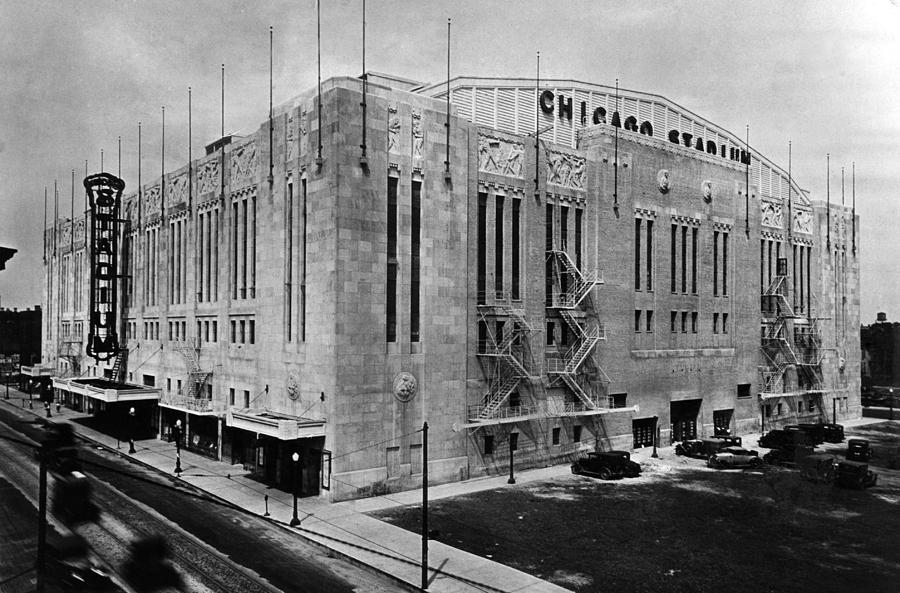
Chicago Stadium
So the Convention was at an impasse. And Party insiders knew what the general public did not: FDR was already ill, and the thought had come to them that he might not survive a full 4th term. Whoever they chose as Vice President to the 32nd President was likely to be the 33rd. That's why civil rights and labor wanted Wallace, and the South wanted Byrnes: They wanted the next President to be one of their guys, and wanted it badly.
FDR -- having once told a reporter, "You know, I'm a juggler, and I have to keep several balls in the air at the same time" -- needed a Vice Presidential nominee was acceptable to both the Byrnes side of the party and the Wallace side. What became known as "The Second Missouri Compromise" was made, and that State's Senator, Harry Truman, was chosen.
(The first "Missouri Compromise" was in 1820, designed to keep the number of free States and slave States even: Missouri would be admitted as a slave State, while Maine was separated from Massachusetts, and added as a free State.)
Truman wasn't a total unknown: He had chaired the Senate committee that exposed war profiteers, and had appeared on the cover of Time magazine the year before. He was in his 2nd term, and was qualified. One thing bugged some people: He had come out of the "political machine" in Kansas City, run by the crooked Thomas Pendergast. But no one ever found any evidence of corruption on Truman's part.
Truman was offered the nomination, but wasn't sure. FDR had to convince him over the phone, and he accepted. But FDR wanted to assure labor leaders that the choice was a good one. Robert Hannegan was the Chairman of the Democratic National Committee, and, as a native of St. Louis, on the other side of Missouri, was an ally of Truman, and key to his nomination. Referring to Sidney Hillman, President of the Congress of Industrial Organizations, "And clear everything with Sidney!"
Founded in 1935 as a more liberal labor group than the American Federation of Labor, the CIO had been assailed as Communist by conservatives. When FDR's demand that Truman's nomination be cleared with Hillman reached the press, Republican-leaning newspapers suggested that Hillman was actually running the Party. Hillman had actually worked hard to keep Communists out of the CIO. Nevertheless, someone wrote a limerick, a Red-baiting smear -- and possibly an anti-Semitic one, as Hillman was Jewish:
Clear it with Sidney, you Yanks.
Then offer Joe Stalin your thanks.
You'll bow to Sid's rule
no matter how cruel
for that's a directive of Frank's.
The Republicans nominated Governor Thomas E. Dewey of New York for President, and Governor John Bricker of Ohio for Vice President. This allowed them to write one of those campaign slogans that occasionally rhymes with the ticket: "Win the war quicker with Dewey and Bricker."
Despite the Republicans' insistence that they could win The War quicker (which was unlikely), and the insinuations that FDR was dying (which he was) and his Administration was loaded with Communists (which it wasn't), Roosevelt and Truman won. It had little to do with Dewey's youth and inexperience (he was just 41, and had been Governor less than 2 years after several years as a crusading District Attorney), and more to do with FDR being the man America knew, and knew it could trust to win The War and avoid another depression after it.
Just 3 months into his 4th term, with the European phase of The War nearly won, FDR died, and Truman became President. After V-E Day, Truman decided that Secretary of State Edward Stettinius was too cozy with the Soviet Union, fired him, and replaced him with Byrnes, who had been a friend in the Senate. But relations between them soured after V-J Day, and Byrnes lasted just a year and a half in the office.
In 1950, he was elected Governor of South Carolina. This was unusual, especially at the time, because it usually worked the other way around: Southern Governors often used their jobs as springboards for the Senate, mainly because their State Constitutions usually prevented Governors from serving consecutive terms. (Most now can, with Virginia the only exception.) In South Carolina, this has since included Strom Thurmond and Ernest "Fritz" Hollings. Unfortunately, Byrnes was a typical Southern politician of his time, and resisted desegregation. After leaving the Governorship after his mandated single term, he never ran for office again.
Byrnes never endorsed another Democrat for President, endorsing Thurmond over Truman in 1948, independent segregationist Harry Byrd Sr. in 1956, and Republicans Dwight D. Eisenhower in 1952, Richard Nixon in 1960 and 1968, and Barry Goldwater in 1964. That year, over the Civil Rights Act, Thurmond, who had returned to the Democratic Party after the 1948 election, became the 1st major Southern politician to switch to the Republican Party, and Byrnes supported him, though himself remaining officially a Democrat.
Byrnes died in 1972, 8 months before Truman did, and 7 years after Wallace. By this point, Byrnes had been mostly forgotten outside his home State, with most Americans being unaware of how close he came to becoming President of the United States. Wallace came even closer. Truman actually made it.
*
July 21, 1944 was a Friday. Paul Wellstone was born, and, like Truman and Byrnes, would be elected to the U.S. Senate, in his case Minnesota. He became one of the most liberal Senators, and many people wanted him to run for President. He never did, dying in a suspicious plane crash while running for re-election in 2002.
These baseball games were played:
* The New York Yankees beat the St. Louis Browns, 8-2 at Sportsman's Park in St. Louis. Atley Donald went the distance for the win. In spite of this, the Browns won their one and only American League Pennant this season, ending the Yankees' run of 3 straight and 7 out of 8.
* The New York Giants lost to the St. Louis Cardinals, 5-0 at the Polo Grounds. Harry "the Cat" Brecheen pitched a 5-hit shutout. Mel Ott, now the Giants' player-manager, got 1 of those hits. So did former Cincinnati catching star Ernie Lombardi, now running out the string with the Giants. Stan Musial, one of the few big stars not yet serving in The War (he would spend the 1945 season in the Navy), went 2-for-5.
* The Brooklyn Dodgers lost to the Cincinnati Reds, 3-2 at Ebbets Field in Brooklyn.
* The Chicago Cubs beat the Boston Braves, 4-2 at Braves Field in Boston.
* And the Pittsburgh Pirates beat the Philadelphia Phillies, 5-3 at Shibe Park in Philadelphia.
* The Cleveland Indians beat the Philadelphia Athletics, 4-1 at Cleveland Municipal Stadium.
* The Detroit Tigers beat the Washington Senators, 6-5 at Briggs Stadium (later Tiger Stadium) in Detroit. Dizzy Trout outpitched Early Wynn.
* The Chicago White Sox beat the Boston Red Sox, 5-3 at Comiskey Park in Chicago.


No comments:
Post a Comment