
July 21, 1959: The Chicago White Sox beat the Boston Red Sox, 2-1 at Comiskey Park in Chicago. For the White Sox, it is one more win in their bid to win their 1st American League Pennant in 40 years, a bid which will turn out to be successful. For the Red Sox, it is the end of a damning distinction.
In the top of the 8th inning, Elijah "Pumpsie" Green enters the game, taking 1st base as a pinch-runner for Vic Wertz, once a great slugger, but always big and slow. Green is stranded there. He moves to shortstop, in place of Don Buddin, who had homered for Boston's only run of the game, and for whom Wertz had pinch-hit. Green does not get a fielding chance, and leaves the game having done little but enter it.
But the fact that he entered the game means that he is the 1st black player to play a regular-season game for the Red Sox. Of the 16 "original" teams in Major League Baseball, they are the last to racially integrate. Granted, somebody had to be the last, but it had been 12 years since the Brooklyn Dodgers, with Jackie Robinson, had become the 1st.
Three teams had brought on a black player in 1947: The Dodgers with Robinson, the Cleveland Indians with Larry Doby, and the St. Louis Browns with Hank Thompson. The New York Giants did so in 1949, also with Thompson, starting in a game in which another black player, Monte Irvin, debuted as a pinch-hitter.
The Boston Braves integrated with Sam Jethroe in 1950. The White Sox did so with Orestes "Minnie" Miñoso, the 1st black Hispanic player, in 1951. In 1953, the Philadelphia Athletics did it with Bob Trice, and the Chicago Cubs did so with Ernie Banks.
Four teams made the move in 1954: The St. Louis Cardinals with Tom Alston, the Pittsburgh Pirates with Curt Roberts, the Cincinnati Reds with Nino Escalera, and the Washington Senators with Carlos Paula.
After a lot of pressure from civil rights groups, the New York Yankees finally did it in 1955, with Elston Howard. The way the schedule worked out, his debut came at Fenway Park against the Red Sox. In 1957, the Philadelphia Phillies, the team that had the most -- and the ugliest -- on-field resistance to Jackie Robinson, became the last National League team to integrate, with a player named John Kennedy. In 1958, the Detroit Tigers brought up Ozzie Virgil Sr., and that left the Red Sox as the last ones.
Ironically, Boston was ahead of the curve in other areas. Earl Wilson of the Red Sox was the 1st black pitcher to throw a no-hitter in an American League game, in 1962. (Sam Jones of the Cubs did it first in the National League, in 1959.) The Celtics made Bill Russell the 1st black head coach in North American major league sports, in 1966. (Fritz Pollard was a player-coach on the 1st NFL Champions, the 1920 Akron Pros, but the NFL could hardly have been called "major league" at the time.) And the Bruins had the 1st black player in the NHL, Willie O'Ree -- on January 18, 1958.
That's right: A hockey team, in Boston no less, had a black player 547 days before the Red Sox did. And the Boston Braves had one 9 years before the Red Sox.
In 1945, 3 Negro League players, Robinson, Jethroe and Marvin Williams, were given a tryout at Fenway, but none of them was offered a contract. Legend has it that someone saw the tryout, and yelled, "Get that (N-word) off the field!" This someone has never been definitively identified, and so there is doubt as to whether it happened at all. But the sham tryout definitely happened.
Supposedly, in 1948, the Red Sox were offered a 17-year-old player from the Birmingham Black Barons, but turned him down: Willie Mays. Think of a single team having both Ted Williams and Willie Mays in its lineup.
Michael "Pinky" Higgins managed the Red Sox starting in 1955. The Dallas native was quoted as saying, "There'll never be a (N-word) on the Red Sox as long as I'm the manager." On July 3, 1959, he was fired -- not for bigotry, but for losing. Just 18 days later, with Billy Jurges as manager (after a few days with Rudy York as interim skipper), Green made his debut.
That's awfully suspicious. But blaming Higgins is also difficult to confirm. For one thing, after Sox owner Tom Yawkey tried Jurges and Pete Runnels as managers, Higgins was brought back as manager in 1960, and stayed until 1962. And, in this 2nd go-round, he managed more black players than either Jurges or Runnels did, including the aforementioned Earl Wilson. So maybe his firing wasn't the reason the Sox finally brought up a black player. Or maybe it was, and Higgins had a change of heart. Or, maybe, he simply bowed to reality. He died in 1968, and never responded to the charge.
Another circumstantial case can be made against Joe Cronin. He was from San Francisco, so not a Southerner. Once the best shortstop in baseball, Cronin managed the Red Sox to the 1946 American League Pennant, then served as the team's general manager from 1948 to 1958. No black players. In 1959, he was named AL President. No more Cronin in the Sox organization. The Sox were then integrated. The case against Cronin is just circumstantial, but it's certainly more suggestive of guilt than is the case against Higgins.
Elijah Jerry Green was born on October 27, 1933 in Boley, Oklahoma. He claimed he did not know the origin of his nickname "Pumpsie." Like the families of fellow Southern blacks Frank Robinson, Curt Flood, Willie Stargell and Joe Morgan, Green's family went west to the San Francisco Bay Area, and he went to El Cerrito High School, as did his brother, Cornell Green, who became a safety for the Dallas Cowboys.
Also El Cerrito graduates: Pitcher Ernie Broglio, basketball player Drew Gooden, Grateful Dead bass guitarist Phil Lesh, and all 4 members of Creedence Clearwater Revival: Guitarists John and Tom Fogerty, bass guitarist Stu Cook, and drummer Doug "Cosmo" Clifford.
Pumpsie was better at basketball than at baseball, but it was in baseball that he was offered a scholarship by Fresno State University. He signed with his (almost) hometown Oakland Oaks of the Pacific Coast League, and played in the minor leagues from 1954 to 1959, before being promoted by the Red Sox.
He got his 1st major league hit in his 4th game, on July 28, which was also Earl Wilson's debut. Over the next 4 seasons, he played 2nd base and shortstop for the Red Sox, but not regularly.
He was involved in a bizarre incident in 1962: After getting swept by the Yankees in New York, the team's bus was stuck in traffic in Manhattan, on its way to Washington to play the Senators. Pitcher Gene Conley wanted to use the bathroom, and there was no toilet on the bus. Green had to go, too, so they got off the bus, walked into a bar, and did what they had to do. Despite being an integrated pair, there was no incident inside the bar. But when they got out, the bus was gone, probably halfway through the Lincoln Tunnel.
They checked into a hotel, and Green took a bus down to Washington the next day. He was not punished. Conley, however, went to Idlewild International Airport (renamed for President John F. Kennedy after his 1963 assassination), and, without a passport or luggage, tried to buy a plane ticket to Jerusalem. Years later, Conley said that Yawkey fined him $1,500, but promised him he would refund the money at the end of the season if Conley rededicated himself to the team. Yawkey kept his word.
In 1963, the Red Sox traded Pumpsie to the Mets, and he played just 17 games with them, playing most of the season for the Class AAA Buffalo Bisons. He played 2 more seasons, all in the minors, and retired with a major league batting average of .246, 13 home runs and 74 RBIs -- which wouldn't be a bad full season.
He returned to El Cerrito, and became a teacher and a coach. In 2009, on the 50th Anniversary of his debut, he was invited to throw out a ceremonial first ball at Fenway Park, and participated in the Sox' celebration of Fenway's 100th Anniversary in 2012. He died on July 17, 2019.
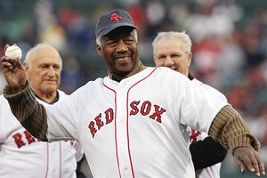
Pumpsie Green was a pioneer. Somebody else should have been that pioneer for the Red Sox, much sooner.
*
July 21, 1959 was a Tuesday. These other baseball games were played that day:
* The Philadelphia Phillies beat the Pittsburgh Pirates, 4-2 at Forbes Field in Pittsburgh. Roberto Clemente went 2-for-4.
* The New York Yankees lost to the Cleveland Indians, 5-1 at Cleveland Municipal Stadium. Tito Francona, father of future Red Sox manager Terry Francona, hit a home run. Mickey Mantle went 0-for-4, and Yogi Berra went 0-for-3.
* The Detroit Tigers beat the Washington Senators, 8-1 at Briggs Stadium in Detroit. (It was renamed Tiger Stadium in 1961.) Al Kaline went 2-for-3 with an RBI.
* The Cincinnati Reds beat the Milwaukee Braves, 12-2 at Milwaukee County Stadium. Former Brooklyn Dodger Don Newcombe was the winning pitcher. Frank Robinson went 2-for-5 with an RBI. Hank Aaron went 2-for-4.
* The Chicago Cubs beat the St. Louis Cardinals, 8-2 at Busch Stadium (formerly Sportsman's Park) in St. Louis. Ernie Banks went 2-for-4 with a home run. Stan Musial did not play.
* The Kansas City Athletics beat the Baltimore Orioles, 8-1 at Kansas City Municipal Stadium. Future manager Dick Williams hit a home run, and Roger Maris had an RBI double. Brooks Robinson went 1-for-4.
* And the Los Angeles Dodgers beat their arch-rivals, the San Francisco Giants, 1-0 at Seals Stadium in San Francisco. Gil Hodges doubled home the winning run in the top of the 9th. Roger Craig pitched a 3-hit shutout.


No comments:
Post a Comment