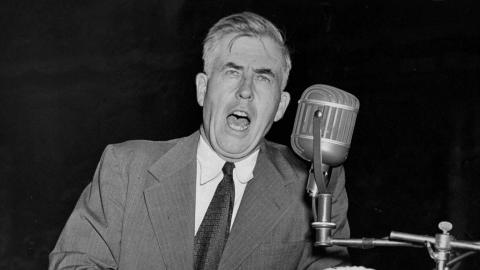
July 23, 1948: As the Democratic and Republican Parties both did this year, the Progressive Party holds its Convention at the Convention Hall of the Philadelphia Civic Center. The left-wing party, with little connection besides name to the Theodore Roosevelt party of that name of 1912 and the Robert LaFollette version of 1924, nominates Henry Wallace for President.
Henry Agard Wallace was born on October 7, 1888 in Orient, Iowa, and grows up in Des Moines, Iowa. In 1923, when his father, Henry Cantwell Wallace, was serving as U.S. Secretary of Agriculture under Presidents Warren Harding and Calvin Coolidge, the younger Henry actually did more to support American farmers and feed people all over the world, developing a hybrid corn he called Copper Cross. It revolutionized corn production.
A split between the Wallaces and U.S. Secretary of Commerce Herbert Hoover, himself an Iowa native, led to the Wallaces leaving the Republican Party and supporting the Progressive Party candidacy of Governor Robert La Follette of Wisconsin in 1924. It may also have hastened the death of the elder Henry, right before the election, which Coolidge won.
When Hoover was elected President in 1928, the stock market Crash of 1929 and the Great Depression followed within a year, devastating the already hard-hit American farmers. In 1932, the younger Henry Wallace worked for the election of Democratic Governor Franklin D. Roosevelt of New York. When FDR won, he appointed Wallace to his father's old post. Historian Arthur Schlesinger Jr. wrote that Wallace was "the best Secretary of Agriculture the country has ever had," but also that he was "an incorrigibly naive politician."
In 1940, FDR ran for a 3rd term, with Wallace as his Vice President. Farmers, labor leaders and civil rights activists were happy with this, but Southerners didn't like his closeness to black leaders, and big business didn't like his openness to the Soviet Union. In 1942, he gave a speech, citing a term coined by Time magazine publisher Henry Luce, saying, "Some of have spoken of the 'American Century.' I say that the century on which we are entering, the century which will come into being after this war, can be, and must be, the Century of the Common Man."
But the Democratic Party's conservative wing, believing (correctly, as it turned out) that FDR was a sick man, and might not survive a 4th term, didn't want Wallace succeeding him. In 1944, for one of the few times in his career, FDR got ganged-up-on, and dropped Wallace from the ticket, in favor of Senator Harry Truman of Missouri.
With some irony, Wallace was appointed to Hoover's old job, Secretary of Commerce. FDR died in 1945, and Truman became President. Wallace split with Truman over Cold War policy, resigned in 1946, and ran for President to Truman's left in 1948.
The Vice Presidential nominee was Senator Glen H. Taylor of Idaho, also normally a Democrat. Just 44 years old, and in his 1st term, he had run for the Senate in 1940 (a special election) and 1942, and finally won in 1944. He was considered the 2nd-most liberal Senator, behind Wayne Morse of Oregon, a Republican who eventually became an Independent, and then a Democrat. In 1945, he submitted a resolution to the Senate, "favoring the creation of a world republic." A one-world government has long been a great fear of conservatives, afraid that it would, by nature, be Communist.

Taylor (left) and Wallace
Before going into politics, Taylor had been recorded singing country music, and his sister was a jazz singer under her married name, Lee Morse. (Her husband, though a supporter of Glen's, was no relation to Wayne.)
Wallace gave his acceptance speech outdoors -- not at nearby Franklin Field, owned by the University of Pennsylvania, and not exactly welcoming to leftists, but halfway across the city, at Shibe Park, then the home of baseball's Athletics and Phillies and football's Eagles.
You talk about your "Hollywood liberals": The Progressives had the support of John Huston, Lee J. Cobb, Uta Hagen, Judy Holliday, Sam Jaffe, and, singing its campaign songs, Paul Robeson.
Also: Writers W.E.B. DuBois, Howard Fast, Dashiell Hammett, Lillian Helman, Garson Kanin, Thomas Mann, Arthur Miller, Clifford Odets, S.J. Perelman, Budd Schulberg, I.F. Stone, Mark Van Doren, and the big new thing in American letters, Norman Mailer, who had published his debut novel, the World War II story The Naked and the Dead, a few weeks earlier. Also: Musical personalities Aaron Copland, Artie Shaw and Burl Ives; scientist Linus Pauling; and architect Frank Lloyd Wright.
However, the Wallace campaign also had big support from the Communist Party, which tainted it in the eyes of average Americans. It was tainted to the point that most conservatives didn't both to attack it. An exception was far-right fanatic Westbrook Pegler, of William Randolph Hearst's newspaper syndicate: He called Wallace a "messianic fumbler" and "off-center mentally." The former charge had some reason, as he had some religious views that were considered unacceptable then, and would even be odd now; the latter charge could have been leveled at Pegler himself.
The fear among Democrats was that the Progressives would pull enough liberal votes -- hard-left, labor and black -- from New York City to cost Harry Truman New York State, Philadelphia to cost him Pennsylvania, Boston to cost him Massachusetts, Detroit to cost him Michigan, Chicago to cost him Illinois, and Los Angeles and San Francisco to cost him California, thus costing him the election. And, of course, Governor Strom Thurmond of South Carolina had temporarily left the Democrats to lead the States' Rights Party, the "Dixiecrats," and Democrats feared that would help cost them the election as well.
In the end, the popular vote was as follows: Truman, a little over 24 million; Dewey, a little under 22 million; Thurmond, 1,176,023; and Wallace, 1,157,328. Percentages: Truman 49.5, Dewey 45.0, Thurmond 2.41, Wallace 2.37. Electoral Votes: Truman 303, Dewey 189, Thurmond 39, Wallace none. Wallace did not win a single State, or even a single County. He couldn't even beat a segregationist, who wasn't even on the ballot in all the States, for 3rd place overall.
Dewey did, indeed, win New York (where he lived), Pennsylvania and Michigan (where he was born). And Wallace did win 60 percent of the votes he would win in New York State and California alone.
Had Wallace also thrown Illinois and California to Dewey, Dewey would have led in Electoral Votes, 252-250, but fallen short of the 269 needed to be elected. The election would have been thrown to the House of Representatives, then controlled by the Republicans, and Dewey would have won. Instead, Truman hung on to Illinois by 33,000 votes, and California by 18,000 votes, and won.
Wallace got 2.37 percent of the popular vote. Openly leftist candidates have struggled to do even that well since. In 2000, Ralph Nader got 2.74 percent. In 2016, Jill Stein got 1.07 percent. Each time, it was enough to cost the Democratic nominee the election, something Wallace was unable to do.
He turned back toward earlier stances after 1948. He repudiated the Soviet Union in 1952, and did not endorse a candidate in that year's election. He endorsed President Dwight D. Eisenhower for re-election in 1956, and refused to endorse a candidate in 1960. Nevertheless, he supported Democratic Presidents John F. Kennedy and Lyndon B. Johnson.
In 1963, as part of a discussion of the 30th Anniversary of FDR's Inauguration and the New Deal in 1933, he appeared on the NET (forerunner of PBS) talk show The Open Mind, hosted by Rutgers University professor Richard D. Heffner. The other guests were James Roosevelt, FDR's son and a close aide, and later a Congressman from California; James A. Farley, FDR's campaign manager and Postmaster General; Thomas G. Corcoran, a.k.a. Tommy the Cork, a New Deal official who had become an advisor to LBJ; and Ernest K. Lindley, who covered the FDR Administration for the New York Herald Tribune and later The Washington Post.
Shortly after that appearance, in which he barely moved and looked stiff and uncomfortable, Wallace was diagnosed with amyotrophic lateral sclerosis. Like the most famous ALS patient, whose name was given to the disease, Lou Gehrig, he consulted numerous specialists and tried various methods of treating the disease, saying, "I look on myself as an ALS guinea-pig, willing to try almost anything." Nothing worked, and he died on November 18, 1965, at the age of 87.
The Henry A. Wallace Beltsville Agricultural Research Center, the largest agricultural research complex in the world, was named for him, and is located in the Washington suburb of Beltsville, Maryland. The visitor center at the Franklin D. Roosevelt Presidential Library and Museum at Hyde Park, New York is named the Henry A. Wallace Visitor and Education Center. It doesn't have a statue of Wallace, but it does have one of what FDR called "my little dog, Fala."
None of Wallace's children entered politics, but his grandson, Scott Wallace, was the Democratic nominee for the U.S. House of Representatives in Pennsylvania's 1st District in 2018, losing a close race with nearly 49 percent of the vote.
Wallace's running mate, Glen Taylor, lost his bid for re-election in the 1950 Democratic Primary, and ran and lost again in 1954 and 1956. Having lost his hair earlier than most men, he wore homemade hairpieces, and began designing and selling them after leaving politics. By 1960, Taylor Topper was America's leading hairpiece company. It is now known as Taylormade Hair Replacement.
He also went back to show business, appearing in 9 episode of The Adventures of Ozzie and Harriet. He died in 1984, at the age of 80.
*
July 23, 1948 was a Friday. These baseball games were played:
* The New York Giants beat the Chicago Cubs, 5-0 at Wrigley Field in Chicago. Larry Jansen pitched a 5-hit shutout. Johnny Mize hit a home run.
* The Brooklyn Dodgers beat the Pittsburgh Pirates, 4-3 at Forbes Field in Pittsburgh. Erv Palica was the winning pitcher. Pee Wee Reese and Tommy Brown hit home runs. Jackie Robinson went 2-for-4 with a stolen base and an RBI. For the Pirates, Ralph Kiner went 0-for-3 with a walk.
* The Boston Red Sox beat the Chicago White Sox, 13-1 at Fenway Park in Boston. Ted Williams went 2-for-4 with a walk and 3 RBIs. The only Boston home run was hit by Bobby Doerr. The best White Sox player of the era, Luke Appling, went 0-for-3 with a walk.
* The Detroit Tigers beat the Washington Senators, 11-5 at Griffith Stadium in Washington.
* The Philadelphia Phillies beat the Cincinnati Reds, 6-1 at Crosley Field in Cincinnati.
* The St. Louis Cardinals beat the Boston Braves, 7-5 at Sportsman's Park in St. Louis. Stan Musial went 3-for-4 with a walk and an RBI.
* The Philadelphia Athletics and the St. Louis Browns were rained out at Shibe Park in Philadelphia. The game was made up as part of a doubleheader on August 27. The A's swept, 6-0 and 9-1. Dick Fowler pitched a 3-hit shutout in the opener.
* And the New York Yankees and the Cleveland Indians were not scheduled.


No comments:
Post a Comment