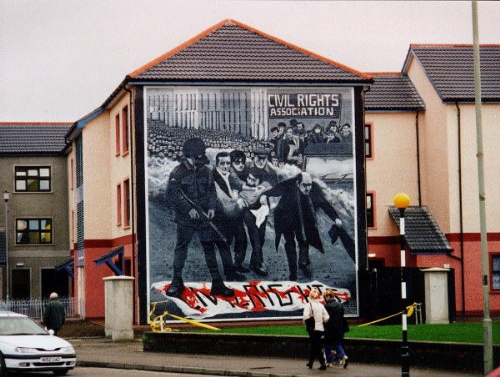
A commemorative mural in Derry
January 30, 1972: The Bogside Massacre occurs in Derry, Northern Ireland. It is one of many events in Ireland's history to be known as "Bloody Sunday."
NOTE: This event should not be confused with the Battle of the Bogside, also in Derry, a 3-day riot in August 1969.
Ireland had been controlled by England since 1649, until the settlement of the Irish War of Independence in 1922 founded the Republic of Ireland, and left only 6 Counties still under British control: Antrim, Armagh, Down, Fermanagh, Londonderry (including the city that the British call Londonderry and the Irish call simply Derry) and Tyrone. The capital of Northern Ireland, Belfast, straddles Antrim and Down.
By 1969, angry at the continued oppression they faced from the Protestant British establishment, and inspired by the Civil Rights Movement for black Americans, the Catholics of Northern Ireland had begun to assert their rights. The government, through the police, known as the Royal Ulster Constabulary (RUC), fought back, and what became known as "The Troubles" began.
An offshoot of the original Irish Republican Army (IRA) began attacking the RUC. In response, paramilitary groups like the Ulster Volunteer Force (UVF) began a campaign of atrocities. Each side kept upping the ante. The IRA had started out as a defensive force, but were, by no means, innocent.
An explosion was destined to happen. Hoping to avoid it, British Prime Minister Edward Heath sent the British Army in to keep the peace. Some Catholics accepted this as better than the RUC and the UVF. Some saw that the Army was every bit as hostile and biased.
On January 18, 1972, Prime Minister Brian Faulkner of Northern Ireland banned all political demonstrations -- Protestant and Catholic alike -- for the rest of the calendar year. But on January 22, a march was made to the internment camp at Magilligan Strand near Derry. The Army blocked the way. The marchers threw rocks, and the soldiers charged and beat people with their batons.
It was decided to hold another march on January 30. The Army decided to allow it to reach the Bogside, a neighborhood outside the old city walls of Derry, but not to reach Guildhall Square. About 15,000 people marched, and the peaceful nature of it was broken when some protestors, again, began throwing rocks at the soldiers.
This time, as with the Boston Massacre of 1770, British soldiers responded to the throwing of rocks by opening fire. There were 26 people wounded, with 13 dying immediately, and a 14th later dying of his injuries.
In April, the Widgery Tribunal issued a report, blaming the protestors, who were not only throwing rocks, which was true; but bombs, and were shooting, which was denounced as a lie.
With his band Wings, Paul McCartney, like the other ex-Beatles an Englishman of Irish descent, released a song: "Give Ireland Back to the Irish." It was banned by the BBC. Ex-Beatle John Lennon released a song titled "The Luck of the Irish," singing, "If you really had the luck of the Irish, you'd wish you were English instead." He wrote another song about the incident, "Sunday Bloody Sunday." Geezer Butler of Black Sabbath followed this by writing "Sabbath Bloody Sabbath." In 1983, the Belfast-based U2 released a different song titled "Sunday Bloody Sunday."
In 1998, the Good Friday Accord finally put an end to The Troubles. In 2010, the Saville Inquiry -- having nothing to do with the notorious English entertainer Jimmy Savile -- released a report saying that none of those shot on Bloody Sunday '72 were armed, no bombs were thrown by the protestors, and that the Army's shooting was "unjustified" and "unjustifiable." Prime Minister David Cameron offered an official apology on behalf of the British government.
*
January 30, 1972 was, as I said, a Sunday. Baseball and football were out of season. There were no games played in the American Basketball Association that day. But there were 6 games played in the NBA:
* The Boston Celtics beat their arch-rivals, the Philadelphia 76ers, 130-114 at the Boston Garden. Billy Cunningham scored 41 in defeat for the Sixers.
* The Milwaukee Bucks beat the Baltimore Bullets, 116-112 at the Baltimore Civic Center (now the CFG Bank Arena). In a rematch of the previous season's NBA Finals, Kareem Abdul-Jabbar socred 39 for the Bucks.
* The Buffalo Braves beat the Cleveland Cavaliers, 99-98 at the Cleveland Arena.
* The Chicago Bulls beat the Detroit Pistons, 109-99 at the Chicago Stadium.
* The Phoenix Suns beat the Atlanta Hawks, 105-103 at the Arizona Veterans Memorial Coliseum in Phoenix.
* And the Los Angeles Lakers beat the Portland Trail Blazers, 153-131 at The Forum outside Los Angeles in Inglewood, California.
There were no games played in the ABA that day. But there were 6 NHL games played:
* The New York Rangers played the Minnesota North Stars to a tie, 1-1 at Madison Square Garden.
* The Boston Bruins beat the St. Louis Blues, 5-2 at the Boston Garden. Yes, the old North End barn hosted the Celtics and the Bruins on the same day.
* The Philadelphia Flyers beat the Pittsburgh Penguins, 4-0 at The Spectrum in Philadelphia.
* The Buffalo Sabres played the Los Angeles Kings to a tie, 2-2 at the Buffalo Memorial Auditorium.
* In an "Original Six" matchup, the Chicago Black Hawks beat their arch-rivals, the Detroit Red Wings, 4-2 at the Chicago Stadium. Yes, the old West Side barn hosted the Bulls and the Hawks on the same day.
* And the California Golden Seals beat the Vancouver Canucks, 2-0 at the Pacific Coliseum in Vancouver.


No comments:
Post a Comment