The starting pitchers were a rematch of the previous year's World Series: Tom Seaver of the New York Mets for the National League, and Jim Palmer of the Baltimore Orioles for the American League. As could be expected, the game was scoreless through the 1st 5 innings.
In the top of the 6th, Carl Yastrzemski of the Boston Red Sox gave the AL the lead, singling home Ray Fosse of the Cleveland Indians. Fosse, a catcher, hit a sacrifice fly to score Brooks Robinson of the Orioles in the 7th, making it 2-0 AL.
In the bottom of the 7th, Willie McCovey of the San Francisco Giants grounded into a double play, but that allowed Bud Harrelson of the Mets to score, closing the gap to 2-1. In the top of the 8th, Brooks Robinson hit a triple that scored Yastrzemski and Willie Horton of the Detroit Tigers, and the AL led, 4-1.
In the bottom of the 9th, Dick Dietz of the San Francisco Giants hit a home run off Jim "Catfish" Hunter of the Oakland Athletics. The NL threatened, and 2 New York Yankee pitchers were brought in to relieve. First, Fritz Peterson was unable to stop McCovey from singling home Harrelson. Then, Mel Stottlemyre was unable to stop Roberto Clemente of the Pittsburgh Pirates from hitting a sacrifice fly that scored Joe Morgan of the Houston Astros -- later to become a Hall-of-Famer with the Reds. But Stottlemyre struck Pete Rose of the Reds out to end the inning, and send the game to extra innings.
Neither team scored in the 10th or 11th inning. In the bottom of the 12th, Clyde Wright of the California Angels got the 1st 2 outs. But Rose and Billy Grabarkewitz of the Los Angeles Dodgers both singled. The next batter was Jim Hickman of the Chicago Cubs. He singled to center. Rose came around 3rd, waved home by the NL's 3rd base coach, Leo Durocher, former Pennant-winning manager of the Dodgers (in Brooklyn) and the Giants (in New York), now managing the Cubs.
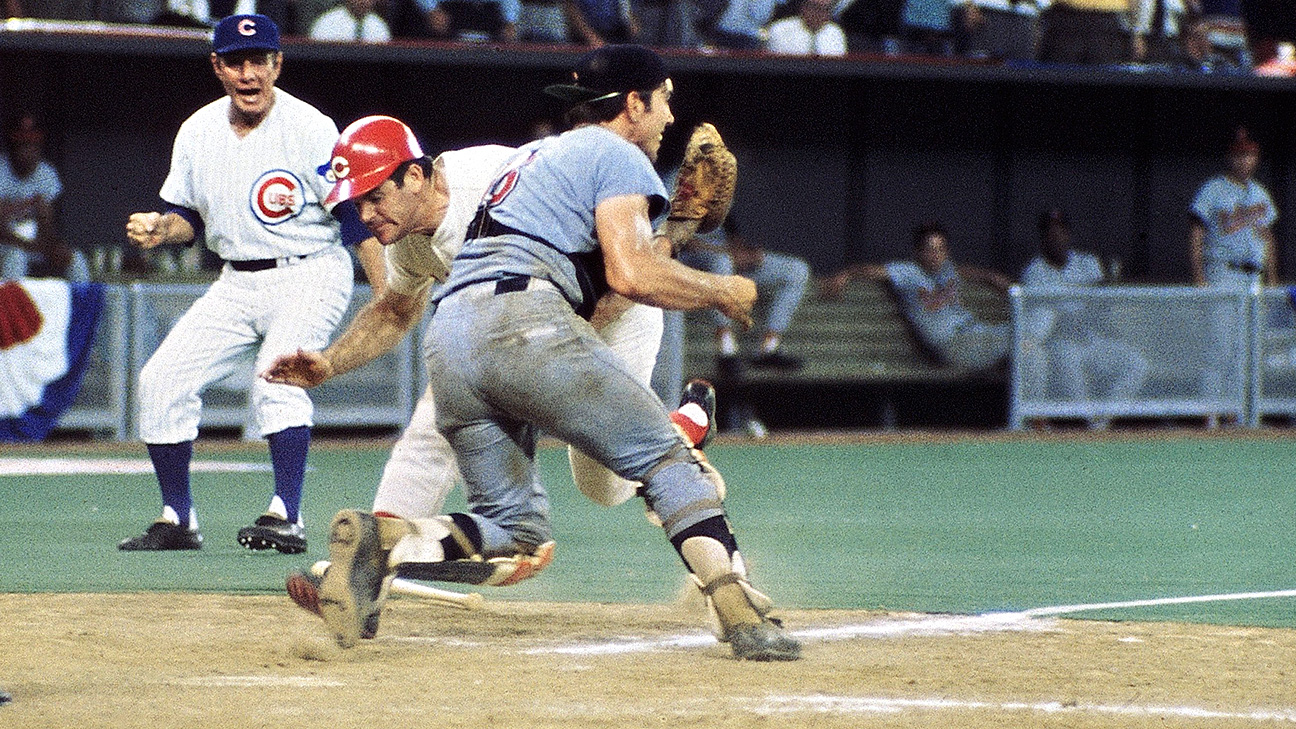
Fosse took the throw from Amos Otis of the Kansas City Royals. Rose crashed into him, causing him to drop the ball. The NL had won, 5-4. Claude Osteen of the Dodgers was the winning pitcher.
The crash not only scored the winning run, it separated Fosse's shoulder. In a meaningless exhibition game.
Contrary to legend, this injury didn't curtail Fosse's career: He had a few more good years, playing on the Athletics' 1973 and 1974 World Champions, before another injury reduced his ability. So it didn't ruin Fosse.
It did, however, mark Rose as a hustler, a man who would do anything to win. That was when a majority of baseball fans liked him. Within 20 years, his reputation would be in tatters, and the crash into Fosse would be seen as an aspect of a very mean son of a bitch who cared more about fame than about the game.
Fosse died in 2021. As of July 14, 2022, Rose is still alive, age 81, and remains unrepentant. The only thing he's ever apologized for is lying about betting on baseball -- not for the act of betting on baseball, and certainly not for what he did to Fosse.
As you can see by the photo of the collision, above, Durocher loved the play. It was his kind of play. He had a lot in common with Rose. He, too, was an ass. And a compulsive liar. And a compulsive gambler. And a compulsive womanizer. Durocher's belief was "Nice guys finish last." (He didn't quite say that, but, once those exact words were attributed to him, they became the title of his memoir, which is full of lies.) Rose shared that ideal.
Durocher was not elected to the Baseball Hall of Fame while he was still alive. It is unlikely that Rose will be elected as long as he's alive. Probably for the same reason: No one wanted to hear Durocher's acceptance speech, and only Rose's apologists want to hear his.
There were, however, differences between Durocher and Rose. Rose had bad hair, while Durocher went bald from an early age. Rose favored wild sports jackets, while Durocher, to his credit, was always a snappy dresser. Rose was a very good player (although only an all-time great due to his compiling of statistics), while Durocher was a serviceable player at best. And Rose was not a good manager. Durocher was. Not as good as he thought he was. But he and Yogi Berra remain the only managers ever to win Pennants while managing 2 different New York teams.
July 14, 1970 was a Tuesday. Since baseball was in its All-Star Break, and the other North American sports were out of season, there were no other scores on this historic day. Actress Nina Siemaszko was born.


No comments:
Post a Comment