
April 2, 1931: Jackie Mitchell strikes out Babe Ruth and Lou Gehrig. Jackie Mitchell was a woman. She was also just 17 years old.
That's the legend. What's the truth?
Virne Beatrice Mitchell was born on August 29, 1913 in Chattanooga, Tennessee. Her father was a doctor and a baseball fan, and a next-door neighbor of Brooklyn Dodgers pitcher Arthur "Dazzy" Vance. Although he was known as Dazzy because he "dazzled" batters with one of the fastest fastballs of his time, his "out pitch" was a breaking ball that he called a "drop ball." He taught it to Jackie.
At the age of 17, Mitchell, a lefthanded, "sidearm"-style pitcher, began playing for the Engelettes, a women's team in Chattanooga, Tennessee, and went on to attend a baseball training camp in Atlanta. In doing so, she attracted the attention of her team's namesake: Joe Engel, the president and owner of the Chattanooga Lookouts of the Class AA Southern Association, named for Lookout Mountain, which overlooks the Tennessee-Georgia State Line, and was the site of a Union victory in the American Civil War.
He had just built Engel Stadium, which became one of the most renowned minor-league ballparks, and would be the Lookouts' home from 1930 to 1999. It still stands today. Like Bill Veeck later would in the major leagues, he was known for using publicity stunts to draw crowds. He signed Jackie on March 25, 1931.
The New York Yankees, with Ruth and Gehrig, were working their way north from their Spring Training complex, which was then in St. Petersburg, Florida. They scheduled a game with the Lookouts for April 1, but it was rained out, and rescheduled for the next day. Had there been no rain, the confluence of April Fools' Day and a female pitcher would have caught some attention. So it was played on April 2, in front of a full house of 4,000 people.
Contrary to legend, Jackie did not start the game. Clyde Barfoot did, having previously pitched in the major leagues for the St. Louis Cardinals and the Detroit Tigers. But now, he was 39 and finished. He gave up a double and a single.
Manager Bert Niehoff, a former 2nd baseman who had won a Pennant with the 1915 Philadelphia Phillies, decided he'd seen enough: He removed Barfoot, and brought in Jackie Mitchell. She thus became only the 2nd woman ever to play in minor-league baseball -- the white side of it, anyway -- following Lizzie Arlington, who pitched 1 scoreless inning for the 1898 Reading Coal Heavers.
The 1st batter that Jackie faced was Babe Ruth. Baseball's preeminent showman recognized the moment as a show. Nevertheless, he graciously tipped his cap to his opponent. He took ball 1, swung and missed for strike 1, swung and missed at strike 2, and took a called strike 3 on the outside corner. He turned around, glared at the umpire, and yelled at him -- in an exhibition game -- before being led away by his teammates. Gehrig was the next batters. Jackie threw him 3 pitches. He swung at all of them. He missed them all.
But that would be it: Jackie walked the next batter, Tony Lazzeri, and Niehoff manager pulled her from the game, which the Yankees went on to win, 14-4. Because the initial runs that scored were charged to Barfoot, he was the losing pitcher. But Jackie was charged with the run that Lazzeri went on to score. For allowing 1 earned run in 2/3rds of an inning, her ERA was 13.50.
Still, Jackie Mitchell became famous for striking out two of the greatest baseball players in history. Were the strikeouts legit? It has been suggested that it was arranged before the game that Ruth and Gehrig would strike out on purpose.
Neither of them ever admitted this. Pitcher Lefty Gomez said the Yankees manager, Joe McCarthy, was so competitive that “he wouldn’t have instructed the Yankees to strike out.” Ben Chapman, who was due to bat when Mitchell was pulled from the mound, said he “had no intention of striking out. I planned to hit the ball.” But he suspected Ruth and Gehrig agreed between themselves to strike out. “It was a good promotion, a good show,” he said. “It really packed the house.” (Given Chapman's later racial abuse of Jackie Robinson, and how he still later waffled over it, he may have been an unreliable narrator.)
Mitchell said the only instruction the Yankees received was to try to avoid lining the ball straight back at the mound, for fear of hurting her. “Why, hell, they were trying, damn right,” she said of Ruth and Gehrig in her later years. “Hell, better hitters than them couldn’t hit me. Why should they’ve been any different?”
Better hitters than Babe Ruth and Lou Gehrig? Name one. Ted Williams? Ty Cobb? Rogers Hornsby? Josh Gibson? Even if you think one of them was a better hitter than Ruth or Gehrig, there is no record of Mitchell ever have faced any of them.
After the game, a Chattanooga newspaper quoted Ruth as follows: "I don't know what's going to happen if they begin to let women in baseball. Of course, they will never make good. Why? Because they are too delicate. It would kill them to play ball every day."
Whether Kenesaw Mountain Landis, the Commissioner of Baseball, agreed with Ruth, or simply used it as an excuse to justify a form of bigotry other than his already-established racism, he voided her contract, and declared that women were unfit to play baseball as the game was "too strenuous."
Jackie signed with a team outside Landis' jurisdiction, the House of David, a "barnstorming" team made up of members of a commune, representing an offshoot of traditional Judaism, where the men let their beards grow, and used baseball as a way to build physical and spiritual strength. Ruth had once played for them, wearing a fake beard. Jackie did the same, but only during games. In one, she pitched against the Cardinals, and the House of David won, 8-6.
She retired in 1937, because she thought she was being used only for publicity. When the All-American Girls Professional Baseball League was formed in 1943, she was just short of turning 30, but chose not to return to the game.
She got married, but had no children. In 1982, the Lookouts invited her to throw out the ceremonial first ball on Opening Day. She died on January 7, 1987, in Oglethorpe, Georgia, at the age of 73, and buried in Chattanooga, a short walk from the grave of her patron, Joe Engel, who died in 1969.
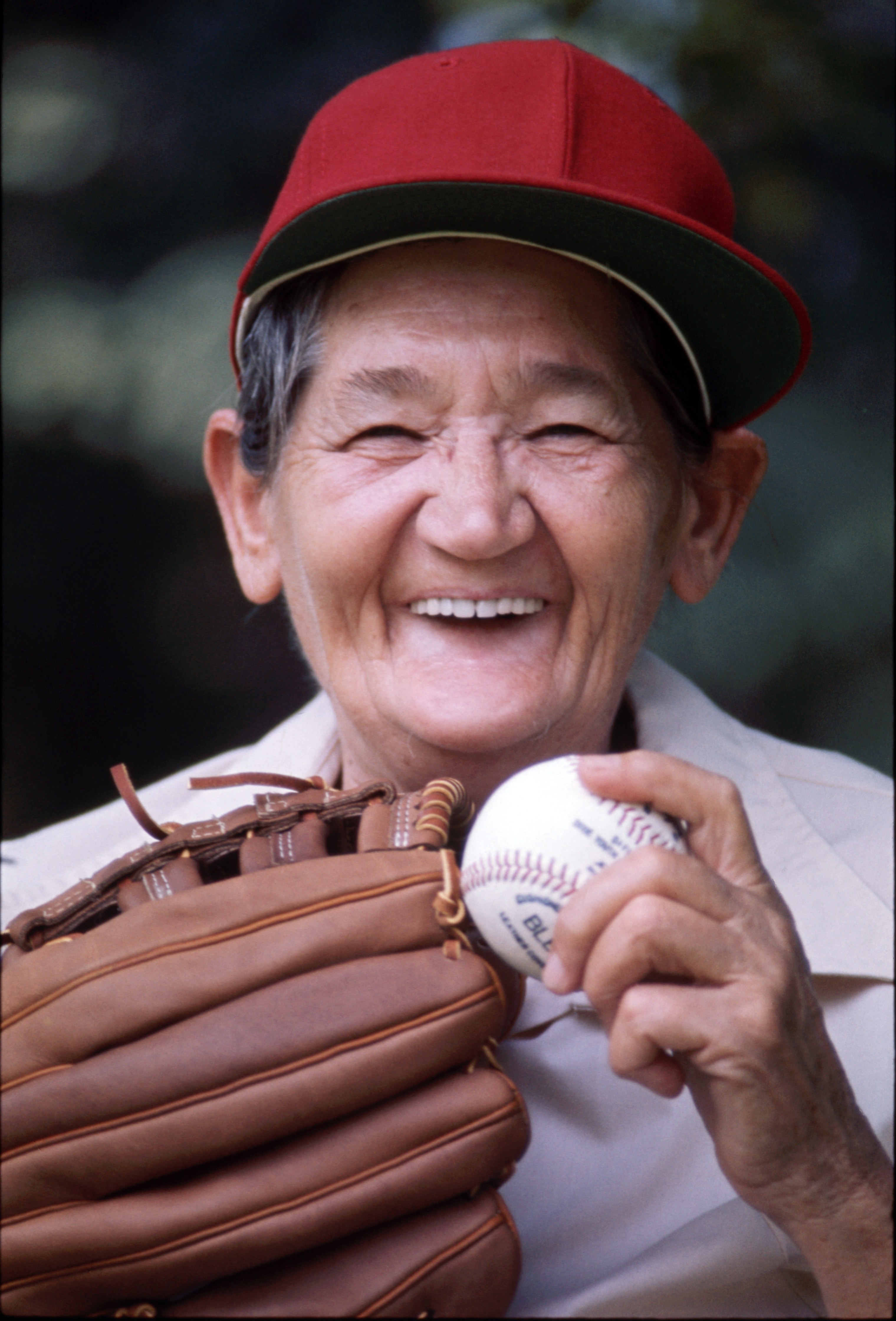
Major League Baseball formally banned the signing of women to contracts on June 21, 1952. Over the next 3 years, 3 women would appear in Negro League games. The MLB ban lasted until 1992. In 1993, Carey Schueler was drafted by the Chicago White Sox -- by their general manager, former White Sox pitcher Ron Schueler, her father. Ila Borders pitched for some "independent" minor-league teams from 1997 to 2000.
In 2016, the Fox network aired Pitch, imagining the 1st woman in MLB. Kylie Bunbury, sister of 2 professional soccer players, played Genevieve "Ginny" Baker of the San Diego Padres, who, like Jackie Mitchell, was a lefty pitcher with an unusual pitch, in her case a screwball. The series showed her struggling in her MLB debut, recovering well enough to make the All-Star Game, and then injuring her arm while pitching a late-season no-hitter. The show was not renewed for a 2nd season, and so it ended on a "permanent cliffhanger," with Ginny getting an MRI to see how bad the injury was, and the viewer never saw the results.
Could Jackie Mitchell have pitched in the major leagues? Given the Great Depression, and the need to bring fans in by any means possible, a team might have given her a chance. But that would have been due to their own desperation, not her talent. Given her age, and America's attitudes toward women at the time, especially in sports, it seems likely that, unlike Robinson, this pioneer named Jackie would not have lasted for very long.
But it would have been nice to find out.
*
April 2, 1931 was a Thursday. Baseball, as stated, was in Spring Training. Football was out of season. The NBA hadn't been founded yet. And the Stanley Cup Finals began the next day. The Montreal Canadiens beat the Chicago Black Hawks, 3 games to 2. But there were no regular-season scores on this historic day.


No comments:
Post a Comment