Showing posts with label western new york. Show all posts

Monday, December 26, 2022

December 26, 1964: The Buffalo Bills Triumphant

December 26, 1964: The American Football League Championship Game is played for the 1964 season.

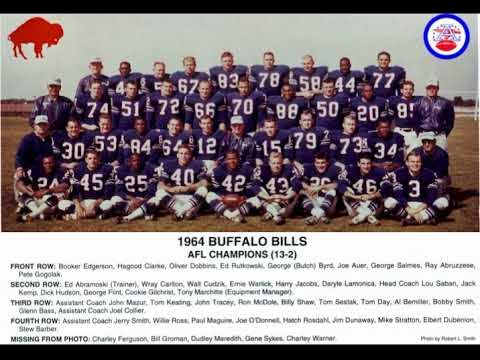
The season before, the San Diego Chargers, coached by Sid Gillman, had won the title, showing football fans that the AFL wasn't just a pass-happy "basketball league": It could feature good defense, too. The Buffalo Bills, coached by Lou Saban, followed the same path, with a defense led by end Ron McDole, tackle Tom Sestak, and linebacker Mike Stratton.

The Chargers would regret letting quarterback Jack Kemp go, as the Bills had acquired him to run their offense. Protected by a future Hall-of-Famer, guard Billy Shaw, he could hand off to running back Carlton Chester "Cookie" Gilchrist, or pass to receiver Elbert Dubenion.

There was once a common trivia question: Name the men wearing Number 32 who won the Most Valuable Player awards in the American League, the National League, the NFL and the AFL in 1963. But the question was no good: Elston Howard, Sandy Koufax, Jim Brown and Gilchrist won their respective awards, but, while the other 3 players wore 32, Gilchrist wore 34.

The Bills went 12-2 in 1964. They dropped 48 points on the Houston Oilers, and scored at least 30 points in 6 other games. Their only losses were on November 15, 36-28 at home to the Boston Patriots; and on December 6, 16-13 away to the Oakland Raiders.

As it was an even-numbered year, it was the Eastern Division winners' turn to host the AFL Championship Game, and the Bills welcomed the defending Champion Chargers into War Memorial Stadium. Built in 1938, it was already dilapidated, known as "The Old Rockpile." Buffalo native Brock Yates, a screenwriter who created the race upon which the Cannonball Run movies were based, said that it "looks as if whatever war it was a memorial to had been fought within its confines." And it was small: At 40,242 seats, its capacity would prove too small when the AFL and the NFL merged in 1970, so the Bills had to build a larger stadium.
In the 1st quarter, Tobin Rote threw a 26-yard touchdown pass to Dave Kocourek, to put the Chargers up, 7-0. But they never scored again. The Bills' defense was symbolized by Stratton hitting Keith Lincoln midway through the 1st quarter, breaking a rib and knocking him out of the game. It was the most famous defensive play in AFL history.
Pete Gogolak and his brother Charley, natives of Hungary, became pro football's 1st "soccer-style kickers," approaching the placement from the side and hitting the ball with the instep of the foot, rather than the traditional straight-on, hit-with-the-toes style. Pete kicked a field goal late in the 1st quarter, and another in the 2nd. In between, Kemp guided the Bills down to where Wray Carlton could score on a 4-yard run. In the 4th quarter, Kemp scored on a quarterback sneak. The Bills won, 20-7.
The Bills won the AFL Championship again in 1965, again beating the Chargers; then lost the 1966 AFL Championship Game to the Kansas City Chiefs. Saban would leave, then return as head coach, and lead the Bills to the AFC Wild Card Playoff berth in 1974.
Like basketball coach Larry Brown, Saban was known, somewhat unfairly, for never staying in the same place for very long, also serving as head coach for the Boston Patriots, the Denver Broncos, and several college teams. He died in 2009. His son, Nick Saban, in junior high school at the time of the Bills' AFL titles, would win 7 National Championships in the college ranks. Unlike many father & son coaching pairs, they never coached together. Indeed, while Lou was head coach at Army in 1979, Nick was an assistant coach at Navy in 1982.
The Bills had won the last 2 AFL Championships before the AFL Champion was allowed to play the NFL Champion for a World Championship, and had lost the game that would have put them in Super Bowl I. It would take until the 1990 season before they finally got into a Super Bowl. And they got into 4 in a row, something no other franchise has done. And yet, they lost all 4, and only the 1st one was all that close (although they were leading the 4th at the half).
The Bills have become to the NFL what the Chicago Cubs once were to baseball, the sport's "lovable losers" with a history of close calls breaking the hearts of some of the most passionate fans in the sport. From 1964 onward, they have been 1 of the last 2 teams standing 6 times, something only 7 other teams have done.
But the fact that the Bills' titles came before the advent of the Super Bowl means that they get discounted: Even before the distance of time became what it is now, NFL fans had come to regard any title won before the Super Bowl, NFL or AFL, as not a "real" championship.
As it stands, through Christmas 2022, no team based in, or near, Buffalo has ever won a major league sports championship. The NHL's Sabres are 0-for-2 in Stanley Cup Finals, and the NBA's Braves, like the Sabres a 1970 expansion team, moved in 1978. Due to Canadian COVID restrictions, the Toronto Blue Jays had to play some "home games" at Buffalo's Sahlen Field in 2020 and '21. Before that, there hadn't been a Major League Baseball team in Buffalo since the 1914-15 Blues of the Federal League; before that, the Bisons of the National League, who folded after the 1885 season. And none of those teams won a Pennant.
Unless you count soccer as a major league sport in North America, with the 1971 Rochester Lancers and the 2016 Western New York Flash, then the last World Championship won by a team that can be considered "Western New York" remains the 1955 NBA Champion Syracuse Nationals. If you don't count Syracuse as "Western," then it's the 1951 NBA Champion Rochester Royals.
In 1998, Vincent Gallo, a Buffalo native, wrote, directed and starred in the film Buffalo '66.. Despite the title, while there are flashbacks, the film took place mostly in the present day. He played Billy Brown, whose mother was going to go to the 1966 AFL Championship Game at War Memorial Stadium, but went into labor, and she has blamed the son's birth for her missing the game, and her missing the game for the Bills' inability to win a title ever since.

The son grew up to become a compulsive gambler, and when Scott Norwood missed his field goal attempt on the last play of Super Bowl XXV, causing the Bills to lose the game, still the closest they've come since 1965, Billy lost a $10,000 bet. Unable to pay up, his bookmaker forced him to clear his debt by confessing to a crime he did not commit, resulting in 5 years in prison.

When he gets out, he decides he wants to get revenge -- not on the bookie, but on Norwood (known as “Scott Wood” in the film), whom he's convinced took a payoff to miss the kick on purpose, a la the Chicago White Sox throwing the 1919 World Series. Have you ever wanted to kill someone who ruined a sporting event for you? Maybe. Would you ever actually attempt it? No. Billy sets out to attempt it. For the record, nobody has ever credibly accused Norwood of missing that kick on purpose.

UPDATE: The Bills have a Wall of Fame, with these members:
* From the 1960s: Quarterback Jack Kemp, running back Chester "Cookie" Gilchrist, receiver Elbert Dubenion, guards Billy Shaw and Bob Kalsu, defensive tackle Tom Sestak, linebacker Mike Stratton, cornerback Booker Edgerson, safety George Saimes; plus founding owner Ralph Wilson, team executive Pat McGroder, head coach Lou Saban, longtime broadcaster Van Miller and trainer Edward Abramoski. Kalsu only played one season before being drafted, and was the only active NFL player killed in action in the Vietnam War. 
* From the 1970s: Quarterback Joe Ferguson, guard Joe DeLamielleure, cornerback Robert James, and running back O.J. Simpson, whose name has never been removed despite his post-playing infamy; plus Wilson, McGroder, Saban, Miller and Abramoski.
* From the 1980s: Quarterback Jim Kelly, receivers Andre Reed and Steve Tasker, center Kent Hull, guard Jim Ritcher, defensive end Bruce Smith, defensive tackle Fred Smerlas, and linebacker Darryl Talley; plus Wilson, Miller and Abramoski.
* From the 1990s: Kelly, Reed, Tasker, Hull, Ritcher, Smith, running back Thurman Thomas and defensive end Phil Hansen; plus Wilson, Miller, Abramoski, head coach Marv Levy and general manager Bill Polian. The Bils have not yet honored whose main contribution was afterward.
In addition, Bills fans have been honored with induction, as "The 12th Man."
And the Greater Buffalo Sports Hall of Fame has honored Kemp, Gilchrist, Dubenion, Saimes, Sestak, Ferguson, DeLamielleure, Simpson, Smerlas, Kelly, Hull, Ritcher, Reed, Smith, Talley, Tasker, Thomas, Wilson, Levy, Saban, Polian, 1960s linebacker and later NBC broadcaster Paul Maguire, 1970s guard Reggie McKenzie, 1990s linebacker Shane Conlan, 1970s defensive tackle Jeff Yeates, 1990s kicker Steve Christie, and 2000s and 2010s defensive tackler Kyle Williams. Yeates and Williams were honored less for what they did with the Bills, and more because they were Buffalo area native who played in the NFL.
*
December 26, 1964 was a Saturday. The game was scheduled for that day, so as not to conflict with the NFL Championship Game being played the next day. One college bowl game was played: Georgia beat Texas Tech, 7-0 at the Sun Bowl, in the stadium of the same name, in El Paso, Texas.
Baseball was out of season. There were 4 games played in the NBA:

* The New York Knicks beat the Baltimore Bullets, 118-116 at the Baltimore Civic Center (now the CFG Bank Arena).

* The Cincinnati Royals beat the Philadelphia 76ers, 135-125 at the Philadelphia Civic Center. Oscar Robertson scored 38 points.

* The Boston Celtics beat the St. Louis Hawks, 97-84 at the Kiel Auditorium in St. Louis.

* And the Los Angeles Lakers beat the San Francisco Warriors, 129-122 at the Los Angeles Memorial Sports Arena. Jerry West scored 44 points.

The NHL's entire "Original Six" were in action:

* The New York Rangers lost to the Boston Bruins, 2-0 at the old Madison Square Garden.

* The Montreal Canadiens beat the Detroit Red Wings, 6-3 at the Montreal Forum.

* And the Chicago Black Hawks beat the Toronto Maple Leafs, 5-3 at Maple Leaf Gardens in Toronto.

And in English soccer, on this day after Christmas, Boxing Day, Arsenal beat Staffordshire team Stoke City, 3-2 at the Arsenal Stadium, a.k.a. "Highbury," in North London.

Sunday, December 4, 2022

December 4, 1921: The Staley Swindle

December 4, 1921: The Chicago Staleys beat the Buffalo All-Americans, 10-7 at Cubs Park in Chicago. The Staleys thus win an NFL Championship that the All-Americans thought they had already won. It becomes known as the Staley Swindle.

The Buffalo All-Stars were a professional football team founded in 1915. They became the Buffalo Niagaras in 1918, the Buffalo Prospects in 1919, and the Buffalo All-Americans in 1920, as charter members of the American Professional Football Association.

The APFA was founded by the owners of the member teams, including George Halas, a former University of Illinois end who was now the head coach, general manager, and starting end on both offense and defense, for the Decatur Staleys, as they were a "company team" (in English sport, they would say "works side") for the A.E. Staley Manufacturing Company of Decatur, Illinois, makers of starchers and sweeteners. And Halas was then employed by them.

After playing the 1920 season in Decatur, Halas got permission to move the team to Chicago for 1921, signing actual football players, not just Staley employees who had once played football. Company owner Gene Staley offered to sell the team to Halas, on the condition that it keep the Staleys name for 1 more season. He agreed.

At the time, not every team played by an APFA team was another APFA team. Nevertheless, the Staleys won their 1st 7 games of 1921, beating non-APFA team the Waukegan Legion (of Illinois) in their opener, and then APFA teams the Rock Island Independents (Illinois) twice, the Rochester Jeffersons (New York State), the Dayton Triangles (Ohio), the Detroit Tigers and the Cleveland Indians (those last 2 named for the baseball teams in their cities).

In contrast, all of the All-Americans' games that season were against APFA teams, and they won their 1st 6, beating the Hammond Pros (Indiana), the Columbus Panhandles (Ohio), the New York Brickley Giants (led by former Harvard star Charley Brickley and failing to get many fans into the Polo Grounds), the Jeffersons, the Tigers and the Indians. This was followed by ties against teams from outside Cleveland, the defending Champion Akron Pros and the Canton Bulldogs.

The Commonwealth of Pennsylvania did not permit professional sports to be played on Sundays, making it difficult for teams from Philadelphia and Pittsburgh to get into the new league while still playing on Saturday, when college football soaked up the market.

So, to make more money -- and, remember, in those days, most football players weren't the 300-pound behemoths of today, or even the 250-pounders of the 1950s -- some men played pro games on Saturdays and Sundays, to make more money. Some were playing for the Philadelphia Quakers on Saturday, then taking a train to Buffalo, where they played for the All-Americans on Sunday.

But in mid-November, the APFA found out about this. It violated league policy, and forced the players to decide. And 5 of the Quakers/All-Americans decided to stick with Philadelphia. Fortunately, the league permitted the All-Americans to hire players from a team that folded in midseason, the Detroit Tigers, so they could have a full roster the rest of the way.

On November 24, Thanksgiving Day, the All-Americans played the Staleys at Cubs Park on the North Side of Chicago. Buffalo emerged victorious, 7-6. Three days later, they beat the Triangles, and had just 1 more game to go, home to Akron. They were 8-0-2. Their fullback, Elmer Oliphant, ended up leading the league in these categories: Field goals (5), points-after-touchdown (26), overall scoring (47 points) and touchdown passes (7 -- it was mostly a running game then).
Elmer Oliphant

Three days after Thanksgiving, the Staleys played a team founded in 1919, but making their league debut in 1921: The Green Bay Packers. Chicago won, 7-0. Now, they were 8-1. And Halas challenged the All-Americans to a rematch.
George Halas. Yes, old "Papa Bear" was a player,
and, by the standards of his time, a very good one.

The All-Americans agreed to play them on December 4, again at Cubs Park, on one condition: That the game would be considered an exhibition game, designed solely to generate gate receipts for the teams, and wouldn't count in the standings. Halas told them that he accepted this.

There was a problem, and, as would happen with Buffalo sports teams in the future, the All-Americans had no one to blame but themselves: They played a game that did count the day before, December 3. They beat Akron again, 14-0 at Buffalo Baseball Park. Then they got on a train to Chicago, to play again the very next day.

They did so knowing that they wouldn't have the former Detroit Tigers players they had signed. Because the Tigers were allowed to reassemble for one last game, to make up some of the money they owed, by playing the Detroit Maroons. That game ended in a 0-0 tie.

So the All-Americans, depleted in terms of manpower and physical energy, took the field at Clark and Addison Streets on the North Side of Chicago, and played the Chicago Staleys in front of a crowd estimated at 12,000. Chicago scored a touchdown in the 1st quarter, when Guy Chamberlin intercepted a pass from Oliphant, and returned the ball 75 yards for a touchdown. Buffalo equalized in the 3rd, when they blocked a punt, and Clarence "Steamer" Horning recovered it in the end zone.

But, later in the 3rd quarter, Dutch Sternaman -- at that point, Halas' co-owner, and brother of another teammate, Joey Sternaman -- kicked a 20-yard field goal to give the Staleys a 10-7 lead, and that lead held to the end of the game.

And then, the other shoe dropped: Halas got in touch with the other team owners, and gained their support, and contacted the league office, arguing that the game should count in the standings. After all, in pro football leagues to that point, the season usually extended past December 4. To make his point further, Halas risked his standing by scheduling 2 more games. They beat the Canton Bulldogs on December 11, then played the Chicago Cardinals on December 18, only gaining a 0-0 tie. So this plan could have backfired on him.

Now, the season was over. Chicago were 9-1-2, and Buffalo were 9-1-1. Each team's only loss was to the other. At the time, ties were not computed as part of winning percentage: Only wins and losses mattered. If ties had been counted, as half a win and half a loss, it would have been Buffalo .864, Chicago .833, and Buffalo would have been declared the Champions.

Frank McNeil, owner of the All-Americans, pointed out the agreement between him and Halas that the game was an exhibition and didn't count in the standings. Halas broke the agreement, telling the league that, under league rules, there was no such thing as an "exhibition game." This was a half-truth: While the league rules did not recognize exhibition games as a thing that could be played, they didn't rule such a thing out.

And then, Halas invoked the tiebreaker which was part of league rules at the time: The 2nd game between a pair of teams counted more than the 1st did. Had the APFA not bought this argument, he was prepared to argue aggregate points, which favored the Staleys, 16-14. But the league did buy the 2nd-game argument, and recognized the Staleys as Champions.

Football historians are split on this. On the one hand, Halas did break his word, and the December 4 game should have been accepted as an exhibition. On the other hand, Halas didn't break the rules: Instead, he used the rules as they then stood, regardless of whether they were fair then, or seem fair now. Halas was perfectly willing to be seen as a smart businessman, even if it affected his reputation as a sportsman.

Jeffrey J. Miller, a Buffalo-based historian who has written several books on Buffalo and pro football -- including a few books about Buffalo-based football -- wasn't born until 40 years later. But the subject bothered him enough to coin a phrase that did not exist at the time: "The Staley Swindle." In 2004, he published a book about the All-Americans: Buffalo's Forgotten Champions.

One way in which Halas did keep his word was to keep the Staley name for the 1921 season -- but no longer: The Staleys became known as the Chicago Bears in 1922. The APFA became the National Football League that year as well. And Cubs Park was renamed Wrigley Field in 1926.

The All-Americans? They became known as the Buffalo Bisons in 1924, the Buffalo Rangers in 1926, the Buffalo Bisons again in 1927, and a team out of business in 1930. Ironically, in their last season, 1929, they avoided a winless season by beating the Bears. The NFL would not return to Buffalo until the merger with the AFL in 1970, admitting the Buffalo Bills.

The Staley company remained in business, long after everybody but people who knew NFL history had forgotten they had anything to do with the Bears, until 2005, when they were bought out by Tate & Lyle Ingredients Americas, LLC.

In 2019, in connection with their 100th Season (not their 100th Anniversary, which was the next year), the Bears did fan balloting for their 100 Greatest Players. From these 1921 NFL Champions, they included end, head coach, general manager and founding owner George Halas; center George Trafton, and tackle Ed Healey. Not on this team, or on their next title team in 1932, but selected for the 100 Greatest Bears, were quarterback Joey Sternaman and halfback John "Paddy" Driscoll.

*

December 4, 1921 was, of course, a Sunday. These other APFA games were played that day, all previously scheduled, thus unwittingly deepening the case for the Staleys:

* The Akron Pros beat the Chicago Cardinals, 7-0 at Normal Field on the South Side of Chicago.

* As mentioned, the Detroit Tigers and the Detroit Maroons (not an APFA team) played to a tie, 0-0 at Navin Field, which would be renamed Briggs Stadium in 1938 and Tiger Stadium in 1961.

* The Columbus Panhandles beat the Louisville Brecks, 6-0 at Eclipse Park in Louisville, Kentucky. What the heck is a "Breck"? The team was founded by the Louisville Breckenridge club, named after (though misspelling) John C. Breckinridge, who served Kentucky in both houses of Congress before becoming President James Buchanan's Vice President -- and, near the end of the Civil War, the Confederate Secretary of War.

* The Evansville Crimson Giants beat the Indianapolis Football Club (not an APFA team), 17-0 at Bosse Field in Evansville, Indiana.

* The Minneapolis Marines played away to Sioux City Football Club (not an APFA team) in Iowa, and lost 10-0.

* And the Green Bay Packers played fellow Wisconsans the Racine Legion to a 3-3 tie, at Hagemeister Park in Green Bay.

Baseball was out of season. The NHL started its season a few days later. And there would be no NBA for another 25 years.

Also on this day, Canadian singer and actress Deanna Durbin was born.

Saturday, March 26, 2022

March 26, 1963: The End of the Syracuse Nationals

March 26, 1963: The Cincinnati Royals defeat the Syracuse Nationals, 131-127, at the Onondaga County War Memorial Auditorium in Syracuse, in Game 5 of an NBA 1st round Playoff series.

The Royals, led by University of Cincinnati stars Oscar Robertson and Jack Twyman, move on to face the defending champion Boston Celtics. Robertson scored 32 points, Twyman 24, while Lee Shaffer scored 45 in defeat for the Nats.

The Nats, led by veteran stars Dolph Schayes and Johnny "Red" Kerr and young sensations Hal Greer and Chet "the Jet" Walker, have played their last game. In the off-season, they will move to fill the void caused by the move of the Philadelphia Warriors to San Francisco. They will be known as the Philadelphia 76ers.

Dante "Danny" Biasone, an Italian immigrant, founded the Nats in the National Basketball League in 1946. In 1949, they were a part of the merger with the Basketball Association of America, which formed the National Basketball Association. They lost the NBA Finals to the Minneapolis Lakers in 1950 and 1954, before winning the title in 1955, beating the Fort Wayne Pistons in the Finals.

Their Hall-of-Famers included guards Greer, Larry Costello and Dick Barnett; forwards Schayes, Walker, Al Cervi and Earl Lloyd; head coach Alex Hannum; and founding owner Danny Biasone, who devised the NBA's 24-second shot clock in 1954.

But, like their neighbors the Rochester Royals, and the Pistons, they found themselves stuck in a market too small to support a major league sports team. Biasone sold the Nats to Irv Kosloff and Ike Richman, who moved them to their hometown of Philadelphia, to fill the void left the year before, when the Philadelphia Warriors moved to San Francisco.

Although it is the seat of a major university, Syracuse is now home to less than 150,000 people, with 660,000 in which can generously be called a "metropolitan area." It might be fairer to say that, like Rochester, it belongs in a single market with Buffalo, 150 miles away.
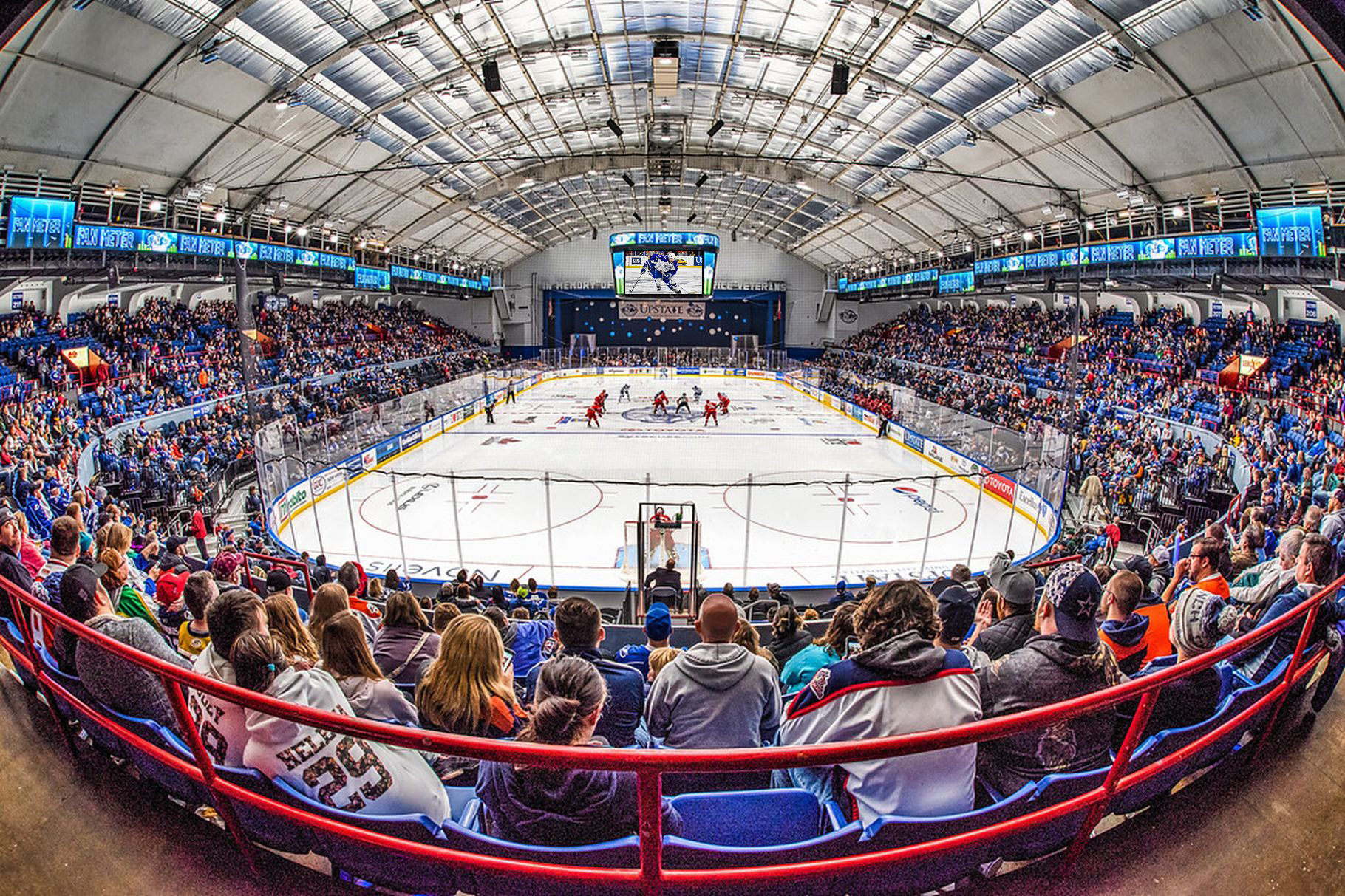
Built in 1951, the Nationals' arena, the Onondaga County War Memorial, still stands, under the name of the Upstate Medical University Arena. Like its relatively close contemporary, the Blue Cross Arena in Rochester, it is now known for hosting minor-league hockey, the American Hockey League's Syracuse Crunch.
With the Buffalo Bills having gone 0-4 in Super Bowls, the Buffalo Sabres having gone 0-2 in Stanley Cup Finals, and the NBA's Buffalo Braves having lasted only 8 seasons, the 1955 Syracuse Nationals remain the last World Championship team from Western New York.

*

March 26, 1963 was a Tuesday. Baseball was in Spring Training. Football was out of season. There was 1 other game in the NBA Playoffs: The St. Louis Hawks beat the Detroit Pistons, 104-100 at Cobo Hall (now Huntington Place) in Detroit. Bob Pettit scored 35 for the Hawks.

And the Stanley Cup Playoffs got underway. The Toronto Maple Leafs beat the Montreal Canadiens, 3-1 at Maple Leaf Gardens in Toronto. And the Chicago Black Hawks beat the Detroit Red Wings, 5-4 at the Chicago Stadium.

Sunday, March 6, 2022

March 6, 1957: The End of the Rochester Royals

The 1956-57 Rochester Royals

March 6, 1957: The Rochester Royals beat the Philadelphia Warriors, 82-79 at the Rochester Community War Memorial Arena. This is their last home game of the season, and they did not qualify for the Playoffs. Therefore, this is the last game they will play in Rochester: They play 3 more games on the road, and move to Cincinnati the next season.
Edgerton Park Arena

The franchise is the oldest continuously operating team in professional basketball. They began play in 1923, as the Rochester Seagrams. In 1944, they joined the Midwest-based National Basketball League (NBL), changed their name to the Rochester Royals (based on Seagram's crown logo) in 1945, and won the NBL Championship in 1946. In 1948, it joined the East-based Basketball Association of America. In 1949, the BAA and the NBA merged to form the National Basketball Association. In 1951, the Royals won the NBA Championship. In 1955, they moved from the Edgerton Park Arena to the War Memorial.
The Rochester War Memorial, now the Blue Cross Arena

But Rochester proved too small a "market" for a major league sports team. In 1957, the team became the Cincinnati Royals. Their best performance in Cincinnati was a pair of trips to the Eastern Division Finals in 1963 and 1964. Cincy is a bigger market than Rochester, but it was still one of the smallest in the NBA. In 1972, they moved again, to Kansas City. Since that city already had a baseball team named the Royals, they became the Kansas City Kings. K.C. also isn't a big market, and they moved again, in 1985, to another not-so-big market, becoming the Sacramento Kings.

Only once in K.C., and once in Sacramento, have they been to the Western Conference Finals. So that 1951 title, for which they do hang a banner, remains their only trip to the NBA Finals.
From the Royals/Kings' Rochester period, guards Bobby Wanzer and Bob Davies, forwards Maurice Stokes and Jack Twyman, center Arnie Risen, and coach team owner Les Harrison are in the Basketball Hall of Fame. Hall of Fame Knicks coach Red Holzman was also a superb player for the Royals. The Kings have retired Davies' Number 11, Stokes' 12 and Twyman's 27.
Today, Rochester -- the city of Port Charles on the ABC soap opera General Hospital is based on it -- is a city of 210,000 people, making it the 3rd-largest in New York State, after New York City and Buffalo. Its metropolitan area has a little over 1 million. The War Memorial still stands, under the name of the Blue Cross Arena at the War Memorial. It seats 10,662. Despite having one of the best-known minor-league hockey teams, the Rochester Americans, still playing at the Blue Cross Arena, the city remains too small to support a major league team.

*

March 6, 1957 was a Wednesday. There was 1 other game played in the NBA that night, and it was by the team that would no longer be the Royals' geographic rivals. The New York Knicks beat the Syracuse Nationals, 100-93 at the Onondaga County War Memorial Arena (now named the Upstate Medical University Arena) in Syracuse, New York.

Baseball was in Spring Training. Football was out of season. One game was played in the NHL: The Toronto Maple Leafs beat the Montreal Canadiens, 3-1 at Maple Leaf Gardens in Toronto.

Sunday, January 30, 2022

January 30, 1994: The Fourth Fall of Buffalo

January 30, 1994: The Dallas Cowboys beat the Buffalo Bills in Super Bowl XXVIII, 30-13 at the Georgia Dome in Atlanta. That's 2 straight wins for the Evil Ones, and 4 straight losses for the Bills. At this point, the people of Western New York have got to be thinking, "What does a team have to do?"

Actually, they looked for a while like they might do it. Early in the 2nd quarter, Thurman Thomas scored a touchdown, to take a 10-6 lead. On the last play of the 1st half, Steve Christie kicked a field goal. The Bills went into the locker room up 13-6. They were 30 minutes away from victory, from a championship, from redemption.

But less than a minute into the 3rd quarter, Thomas had the ball stripped from him by Leon Lett. There's the redemption for the day: Lett had made a fool of himself against the Bills in the previous year's Super Bowl, though the Cowboys still won big; and had also blundered on national TV on Thanksgiving Day 2 months earlier, costing the Cowboys a game against the Miami Dolphins. James Washington picked the fumble up, and ran it 46 yards for a game-tying touchdown.

It was still only 20-13 Dallas after 3 quarters, but the Bills never scored again. They had 4 more possessions, the 1st 3 ending in punts, and the last with them turning the ball over on downs deep in Dallas territory, and if they had scored, they still would have needed 2 more scores.

The Bills had been to 4 straight Super Bowls. That had never been done before -- although the Cleveland Browns went to 6 straight NFL Championship Games from 1950 to 1955, winning 3. Through the 2021 NFL season, it hasn't been done since.

In 2015, as part of its 30 for 30 documentary series, ESPN premiered The Four Falls of Buffalo, telling of the Bills' history, focusing on those 4 AFC Championship seasons of 1990, 1991, 1992 and 1993, and how they each ended with a Super Bowl loss.

The Bills won the AFL Championship in 1964 and 1965, the last 2 before the AFL Champion would face the NFL Champion in the Super Bowl. They lost the 1966 AFL Championship Game, and didn't get to face the Green Bay Packers in what was retroactively named Super Bowl I.

They're still looking. No Buffalo-based team has ever won a World Championship, and the last team from Western New York to do so remains the 1955 NBA Champions, the Syracuse Nationals.

*

January 30, 1994 was, like all Super Bowl days, a Sunday. Baseball was out of season. Bowing to the likelihood of poor TV ratings, the NBA scheduled only 2 games for the day. The New York Knicks beat the Portland Trail Blazers, 103-93 at the Portland Memorial Coliseum. And the Boston Celtics beat the Phoenix Suns, 106-94 at the Boston Garden.

There were 3 games in the NHL:

* The Montreal Canadiens beat the Philadelphia Flyers, 5-4 at the Montreal Forum. Guy Carbonneau scored the winning goal with 2:31 left in overtime.

* The Washington Capitals beat the Detroit Red Wings, 6-3 at the USAir Arena (formerly the Capital Centre) in the Washington suburb of Landover, Maryland.

* And the Florida Panthers beat the Buffalo Sabres, 3-2 at the Buffalo Memorial Auditorium.

December 31, 1999 & January 1, 2000: The Millennium

December 31, 1999:  The Millennium arrives. The people of planet Earth survived. At a terrible cost. But we hadn't destroyed ourselves. ...