
The 1937 Fordham offense.
Back row, left to right: Joe Granski, Dom Principe, Steve Kazlo.
Middle: Angelo Fortunato.
Front, left to right: Johnny Druze, Al Babartsky, Vince Lombardi,
Alex Wojciechowicz, Mike Kochel, Ed Franco, Harry Jacunski.
Pitt were coached by Dr. John "Jock" Sutherland. He was a Scottish immigrant, hence "Jock"; and a licensed dentist, hence he was usually called "Doctor Jock." On the field, the Panthers were led by two-way back Marshall "Biggie" Goldberg, later a star for the Chicago Cardinals.
Fordham were coached by Jim Crowley, who had been one of the Four Horsemen of Notre Dame in 1924, and were led by the most famous offensive line in college football history, "The Seven Blocks of Granite." (The Four Horsemen's line had been called the Seven Mules.)
This line featured 2 future Pro Football Hall-of-Famers. Center Alex Wojciechowicz would star in the NFL for the Detroit Lions and the Philadelphia Eagles, but it was one of the guards who would make a bigger impact, though not as a player: Vince Lombardi. A 3rd future Hall-of-Famer, future Giants owner Wellington Mara, was then a student at Fordham.
The Blocks were: Center, Wojciechowicz; guards, Lombardi and Mike Kochel; tackles, Al Babartsky and Ed Franco; and ends, Leo Paquin, replaced in 1937 by Harry Jacunski, and Johnny Druze. Druze lived until 2005, and was the last survivor.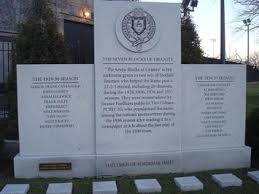
This line featured 2 future Pro Football Hall-of-Famers. Center Alex Wojciechowicz would star in the NFL for the Detroit Lions and the Philadelphia Eagles, but it was one of the guards who would make a bigger impact, though not as a player: Vince Lombardi. A 3rd future Hall-of-Famer, future Giants owner Wellington Mara, was then a student at Fordham.
The Blocks were: Center, Wojciechowicz; guards, Lombardi and Mike Kochel; tackles, Al Babartsky and Ed Franco; and ends, Leo Paquin, replaced in 1937 by Harry Jacunski, and Johnny Druze. Druze lived until 2005, and was the last survivor.
Monument to the Seven Blocks of Granite,
on the Fordham campus
Both teams finished the season undefeated, Pitt ranked Number 1 in the country, Fordham Number 3. Neither team accepted a bowl bid, though it should be kept in mind that the bowls were still, for the most part, a new idea. The Rose Bowl had been played since 1902, and continuously since 1916; however, the Orange Bowl and the Sugar Bowl only started in 1935, and the Cotton Bowl in 1937.
This was the 3rd season in a row that these teams played each other at the Polo Grounds, and it was the 3rd time in a row that the game ended 0-0. The teams would face each other again in Pittsburgh on October 29, 1938. Fordham weren't so lucky this time: Pitt beat them, 24-13. It was the only game Fordham lost all season. From 1935 to 1938, Fordham went 24-3-7, while Pitt went 32-4-4.
*
October 16, 1937 was a Saturday. Baseball season had ended 6 days earlier, also at the Polo Grounds, with the New York Yankees beating the New York Giants in Game 5 to clinch the World Series. The NHL season wouldn't start for another 19 days. There was a professional basketball league at this time, the National Basketball League, but results of individual games are not readily available.
But there were other college football games that day, including the following:
* Alabama beat Tennessee, 14-7 at Shields-Watkins Field (now Neyland Stadium) in Knoxville, Tennessee.
* The University of California beat the College of the Pacific, 20-0 at California Memorial Stadium in the San Francisco suburb of Berkeley. Cal finished Number 2 in the national rankings, between Pitt and Fordham, and beat Alabama in the Rose Bowl.
As for Pacific: From 1933 to 1946, the Stockton, California-based school was coached by "The Grand Old Man of Football," Amos Alonzo Stagg, now 75 years old. For 41 seasons before coming to Stockton, he had coached at the University of Chicago. He last coached at Stockton College in 1958, at the age of 96, and lived to be 103. The school's name was changed to the University of the Pacific in 1961, but it dropped its football program in 1995.
* Auburn beat Mississippi State, 33-7 at Legion Field in Birmingham, Alabama.
* Michigan State beat Missouri, 2-0 at Memorial Stadium (now Faurot Field) in Columbia, Missouri. Auburn beat Michigan State in the Orange Bowl.
* Louisiana State beat Mississippi, 13-0 at Tiger Stadium in Baton Rouge, Louisiana.
* Rice University and the University of Tulsa played to a tie, 0-0 at Rice Field in Houston.
* Colorado beat Brigham Young University, 14-0 at Colorado Stadium (now Folsom Field) in the Denver suburb of Boulder, Colorado. They were led by running back Byron White, so fast he was nicknamed "Whizzer."
Rice beat Colorado in the Cotton Bowl. In 1939, the NCAA held its 1st basketball tournament, and Colorado were 1 of the last 4 teams in it. Whizzer White played on this team as well. Through the 2022 NCAA Tournament, he is the only person ever to play in both a bowl game and what we now call the Final Four. He played 3 seasons in the NFL. He served in U.S. Naval Intelligence in World War II, and was awarded 2 Bronze Stars. As if that wasn't enough, he went into law, then into politics. From 1962 to 1993, he was a Justice of the Supreme Court of the United States.
* Texas Tech beat Arizona, 20-0 at Tech Field in Lubbock.
* West Virginia beat Xavier, 13-7 at Corcoran Stadium, Xavier's home field, in Cincinnati. West Virginia went on to beat Texas Tech in the Sun Bowl in El Paso, Texas.
* Oklahoma and Nebraska, eventually to be arch-rivals, played to a 0-0 tie at Memorial Stadium in Lincoln, Nebraska.
* Washington and Washington State, arch-rivals, played to a 7-7 tie at Rogers Field in Pullman, Washington. The rivalry's trophy, the Apple Cup, would not be introduced until 1963.
* Army lost to Yale, 15-7 at Michie Stadium in West Point, New York. Navy played Harvard to a 0-0 tie, at Thompson Stadium in Annapolis, Maryland.
* Carnegie Tech, whose campus was pretty much next-door to Pitt's, beat Notre Dame, 9-7 at Pitt's facility, named Pitt Stadium. In 1967, Carnegie Institute of Technology merged with the nearby Mellon Institute of Industrial Research, to form Carnegie-Mellon University. They now compete in NCAA Division III. Also in Pittsburgh, Duquesne University now competes in NCAA Division I FCS (formerly known as Division I-AA).
* Among New York City teams other than Fordham, Columbia beat Penn, 26-6 at Baker Field in Manhattan. New York University beat St. John's -- not the University in Queens, but the College in Annapolis, Maryland -- 59-0 at Ohio Field in The Bronx. I can't find a reference to when St. John's dropped football, but NYU did so after the 1952 season.
City College of New York beat Susquehanna University, 8-6 in Selinsgrove, Pennsylvania. CCNY dropped football after the 1950 season, while Susquehanna now competes in NCAA Division III.
Manhattan College lost to Villanova, 20-0 at Ebbets Field in Brooklyn. So you have a school named Manhattan, whose campus is in The Bronx, and playing football in Brooklyn. After the 1942 season, the manpower drain of World War II led Manhattan to suspend its program, and it has never been restarted.
* Among New Jersey teams, Princeton beat the University of Chicago, 16-7 at Stagg Field in Chicago. And Rutgers beat Springfield College, 26-0 at Pratt Field in Springfield, Massachusetts. Springfield, formerly the Springfield YMCA, birthplace of basketball, now competes in NCAA Division III.
* The day after these games, Santa Clara University beat the University of Portland, 27-0 at Kezar Stadium in San Francisco. Santa Clara went on to beat LSU in the Sugar Bowl. Portland shut down their football program after the 1949 season, and should not be confused with Portland State University, who compete in NCAA Division I FCS. Santa Clara eventually dropped to NCAA Division II, and shut their program down after the 1992 season.


No comments:
Post a Comment