Although Jackie always revered Branch Rickey, the Brooklyn Dodger team president who brought him into the organization to reintegrate the game in 1945, after the 1950 season Rickey was forced out by one of the other co-owners, Walter O'Malley, who concentrated his control. And, as much as O'Malley loved money and control, he hated Rickey and anything to do with him. Including Jackie Robinson.
So on the date listed above, with Jackie's weight going up, his once-great speed reduced, and his 38th birthday approaching, O'Malley traded him to, of all teams, the Dodgers' arch-rivals, the New York Giants, for Dick Littlefield, a lefthanded pitcher already with a reputation for being less than mediocre, and $30,000.

Jackie knew this was done not so much to improve the team (after all, they'd just won their 2nd straight Pennant, their 6th in the 10 years he was with them), but for spite. So he refused to report to the Giants, retiring instead. The trade was voided, and Littlefield was returned to the Giants, who ended up trading him to the Chicago Cubs instead.
So on the date listed above, with Jackie's weight going up, his once-great speed reduced, and his 38th birthday approaching, O'Malley traded him to, of all teams, the Dodgers' arch-rivals, the New York Giants, for Dick Littlefield, a lefthanded pitcher already with a reputation for being less than mediocre, and $30,000.

A Topps 1957 baseball card that never was
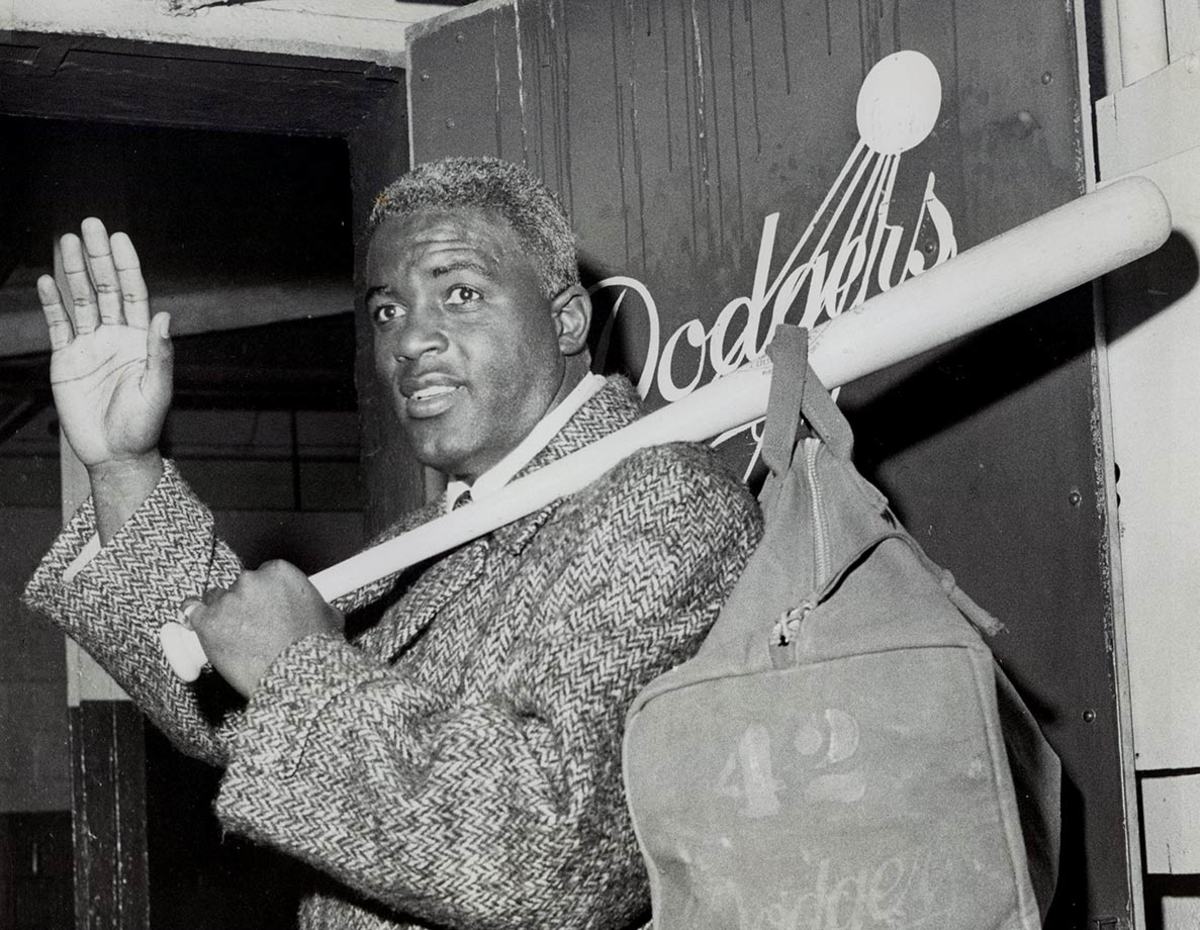
Jackie formally announced his retirement on January 5, 1957. A photo was taken of him, leaving the Dodger clubhouse at Ebbets Field. The contrast with the photo of him arriving is stark: In 1947, wearing his Montreal Royals uniform, he was 28 but looked 18; now, he was about to turn 38, but with his hair going gray and his face filled out, he looked 50. He was soon diagnosed with diabetes.
He became an executive with Chock full o'Nuts, then known more for their chain of lunch counters, a precursor to fast food, than for selling their coffee packs in supermarkets. The company had gone out of its way to hire black employees at good wages. He was later one of the founders of the black-owned Freedom National Bank. He died in 1972, only 53 years old.
In 1953, in between his hostile takeover of Rickey's stock (for which Rickey found a way to make him pay a lot more than he'd intended) and his exile of Robinson, O'Malley drove broadcaster Red Barber away, into the hands of the Yankees. Rickey, Barber, Robinson: Three of the most honorable and influential people in the history of American sport, and O'Malley drove them all away, all in a span of 6 years.
All this before he greedily moved the Dodgers to Los Angeles. In other words, had O'Malley gotten his new stadium where he originally wanted it, and were the Dodgers now preparing to play a 2012 season in Brooklyn, Walter Francis O'Malley would still have been a dirty filthy greedy bastard.
*
December 13, 1956 was a Thursday. Baseball was out of season. Football was in midweek. The NBA had no games scheduled. But the NHL's entire "Original Six" were in action:
* The New York Rangers lost to the Detroit Red Wings, 2-1 at the Olympia Stadium in Detroit.
* The Montreal Canadiens beat the Toronto Maple Leafs, 6-2 at the Montreal Forum.
* And the Boston Bruins beat the Chicago Black Hawks, 3-2 at the Boston Garden.


No comments:
Post a Comment