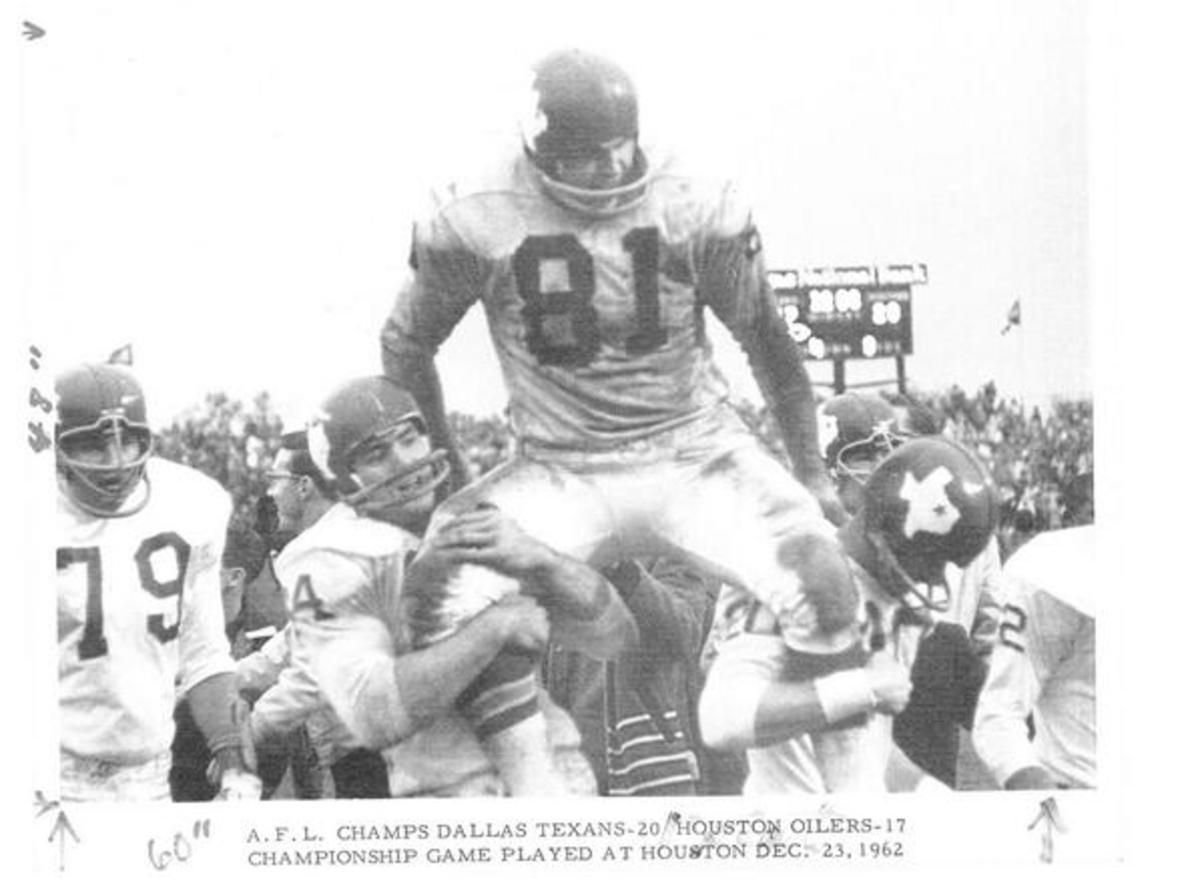
Tommy Brooker
December 23, 1962: The longest game in professional football history, to that point, is played. But not in the National Football League. This Championship Game is often given credit for boosting interest in the American Football League.
Like the NFL, the AFL was split into geographic Divisions, East and West. Also like the NFL, the AFL's Divisions didn't make as much sense as geography would make fans think. Putting the New York Titans, the Boston Patriots and the Buffalo Bills in the East made sense. Putting the Denver Broncos, the Oakland Raiders and the San Diego Chargers in the West made sense.
But there were 2 teams in Texas, and while Texas is the country's 2nd-biggest State by area after Alaska, both were in the eastern half of Texas. And yet, they were in different divisions: The Dallas Texans, founded and owned by AFL founder Lamar Hunt, were in the West, while the Houston Oilers were in the East.
The Cotton Bowl, then home to both the Texans and the NFL's Dallas Cowboys, is at 96 degrees, 45 minutes West longitude. Jeppesen Stadium, then home to the Oilers, was at 95 degrees, 20 minutes West. So the Texans were slightly to the west of the Oilers. This wasn't as bad as the NFL, putting the Cowboys in the Eastern Division and the East Coast's Baltimore Colts in the Western.
The Oilers won the AFL East in 1960, and beat the Los Angeles Chargers in the 1st AFL Championship Game. The Chargers moved to San Diego for 1961, and the Oilers beat them in the Championship Game again. The Oilers again won the East in 1962. This time, the Texans won the West Division. Both teams finished the regular season with a record of 11-3. They had played each other in back-to-back weeks of the regular season. On October 28, at Jeppesen, the Texans had won, 31-7. That was the last regular-season game the Oilers lost. Just 7 days later, they played again at the Cotton Bowl. Again, the visiting team won: The Oilers, 14-6.
Since the AFL followed the NFL's pattern of alternating the site of its Championship Game, the Oilers would host the Texans at Jeppesen. The facility was built in 1942, as Public School Stadium, but the University of Houston campus expanded toward it, and their football team made it their home field in 1946. In 1958, it was renamed for Holger Jeppesen, a school official who had lobbied for its construction. A crowd of 37,981, roughly a sellout, came for the Championship Game.
While the AFL had a reputation for emphasizing the passing game -- people who liked the more conservative NFL called the rebel league a "basketball league" -- both Texas teams relied on the running game. They played it mostly safe, and the only score of the 1st quarter was a field goal by the Texans' Tommy Brooker, a rookie who had been a member of the University of Alabama's National Championship team the year before. At the end of the quarter, George Blanda, the Oilers' quarterback and kicker, missed a 47-yard field goal, keeping the score 3-0 in the Texans' favor.
The Texans extended their lead in the 2nd quarter, as Abner Haynes scored on a 28-yard pass from Len Dawson, and later on a 2-yard run. The Texans led, 17-0, and any thoughts of this game being regarded as a classic had faded away.
But the Oilers weren't 2-time defending champions for nothing, and fought back. In the 3rd quarter, Blanda threw a touchdown pass to Willard Dewveall, to make it 17-7. Blanda kicked a field goal in the 4th quarter, to get the Oilers within a touchdown.
He then used the passing game to creep closer, throwing passes to Charley Hennigan, whose AFL receiving totals had surpassed the longtime NFL records of Don Hutson, and former Louisiana State Heisman Trophy winner Billy Cannon. Later, Blanda handed the ball to Charlie Tolar, a fullback known as "the Human Bowling Ball," and he barreled in the 1-yard line, tying the game at 17. The Oilers had 1 more shot, as Blanda tried a 42-yard field goal to win it on the last play of regulation, but Dave Grayson blocked his kick. The game went to overtime.
As with the opening of games, the captains met with the officials at midfield to start the overtime. The Texans won the toss. Haynes said, "We'll kick to the clock." He thought that would give the Texans the wind advantage. But by saying, "We'll kick," the referee, Harold Bourne, gave the Oilers the choice of which goal to defend, and thus whether to start with or against the wind.
This could have cost the Texans the championship, and it could have made Haynes the biggest goat in the history of Texas professional sports. As it turned out, it didn't matter: The entire "5th quarter" was played without either team scoring.
Early in the 2nd overtime, the 6th quarter, Dawson threw a 10-yard pass to Jack Spikes. Spikes then rushed for 19 yards. The Texans were in position for a title-winning field goal. Dawson ran a couple of more rushing plays to get Brooker a better kicking position. At 2:54 of the 2nd overtime, Brooker split the uprights, and the Texans won, 20-17. The team that founded the AFL had won its 1st Championship.
But, before the next season, realizing that, despite their title, they were never going to have more fans in Dallas than the NFL's Cowboys, the Texans moved, becoming the Kansas City Chiefs. The Oilers moved to Memphis in 1997 and Nashville in 1998, becoming the Tennessee Oilers, and the Tennessee Titans in 1999. In 2002, to replace the Oilers, the NFL added an expansion team -- and named it the Houston Texans.
The Tennessee team could take the Titans name because the New York team abandoned it in 1963, becoming the Jets. The New England moved to the Boston suburbs in 1971, and changed their name to the New England Patriots. The San Diego Chargers moved back to Los Angeles in 2017. The Raiders moved to Los Angeles in 1982, back to Oakland in 1995, and to Las Vegas in 2020.
The AFL Championship was won by the Oilers in 1960 and 1961; the Texans/Chiefs in 1962, 1966 and 1969; the Chargers in 1963; the Buffalo Bills in 1964 and 1965; the Raiders in 1967; and the Jets in 1968.
The fact that the Texans' title came before the advent of the Super Bowl means that it gets discounted: Even before the distance of time became what it is now, NFL fans have come to regard any title won before the Super Bowl, NFL or AFL, as not a "real" championship.
In 1980, Jeppesen Stadium was renamed Corbin J. Robertson Stadium, after a University of Houston regent who had funded renovations. In 1996, it was renamed John O'Quinn Field at Corbin J. Robertson Stadium. O'Quinn was a Houston attorney who had donated to the latest round of renovations. The Houston Dynamo of Major League Soccer moved in for the 2006 season, and won back-to-back MLS Cups.
Robertson Stadium was demolished following the 2012 season, and John O'Quinn Field at TDECU Stadium opened on the site in 2014. UH plays football there, while in 2012, the Dynamo moved to a new soccer-specific stadium, currently named Shell Energy Stadium. (UPDATE: For 2026, UH's stadium will be renamed Space City Financial Stadium, due to TDECU's merger with another company.)
Tommy Brooker, who kicked the winning field goal, remained with the Chiefs through the 1966 season, and died in 2019.
*
December 23, 1962 was a Sunday. The NFL was in the off-week between the end of its regular season and its Championship Game. That game was played 1 week later. The Green Bay Packers beat the New York Giants, 16-7 at Yankee Stadium.
Baseball was out of season. The NBA was in season, but no games were scheduled for that day. But the NHL's entire "Original Six" were in action:
* The New York Rangers lost to the Chicago Black Hawks, 3-1 at the original Madison Square Garden.
* The Toronto Maple Leafs beat the Boston Bruins, 5-4 at the Boston Garden.
* And the Montreal Canadiens and the Detroit Red Wings played to a tie, 2-2 at the Olympia Stadium in Detroit.


No comments:
Post a Comment