
September 24, 1921: The University of Tennessee opens a new football season, and a new football venue, then named Shields-Watkins Field. The opponent is Emory and Henry University, of Emory, in the western panhandle of Virginia. Tennessee win, 27-0. Attendance: About 3,200, which was all that would fit at the time. The stadium would get considerably bigger.
The Emory and Henry Wasps dropped to Division III in the NCAA's reorganization of 1976, and rose to Division II in 2022. The Tennessee Volunteers, or "Vols," however, would become one of the leading programs in college football.
Built on the shore of the Tennessee River, it was named for Colonel W.S. Shields, president of Knoxville's City National Bank and a University of Tennessee trustee, who provided the initial capital to prepare and equip an athletic field; and his wife, Alice Watkins-Shields.
From most of the seasons between 1926 and 1952, the head coach at UT was Robert Neyland (pronounced NEE-land, not NAY-land), who was, concurrently, in the U.S. Army Reserve, having been a West Point graduate and a former Army assistant coach. His tenure there included Army's 1924 loss to Notre Dame at the Polo Grounds, the game where sportswriter Grantland Rice named the Notre Dame backfield "The Four Horsemen."
In 1935, the Army called him back into service, for a command within the Panama Canal Zone. He returned to UT for the 1936 season, and was named athletic director as well as head coach. But he was called away again during World War II, rising to the rank of Brigadier General.

He returned in 1946, remained head coach through 1952, and athletic director until his death in 1962. At that time, the stadium was renamed Neyland Stadium, although the playing surface remains Shields-Watkins Field to this day.
He told his players, "Gentlemen, touchdowns follow blocking just as surely as night follows day." They must have listened well, because they played to a record of 173-31-12 during his tenure.
Before the opening of what became Neyland Stadium, Tennessee won the Championship of the Southern Intercollegiate Athletic Association (SIAA) in 1914. Neyland led them to the Southern Conference title in 1927 and 1932. He led them to the Southeastern Conference title in 1938, 1939, 1940, 1946 and 1951.
Bowden Wyatt coached them to the SEC title in 1956. Doug Dickey led them to the SEC title in 1967 and 1969. Johnny Majors, who nearly won the Heisman Trophy as a running back on their 1956 titlists, coached them to the SEC title in 1985, 1989 and 1990. And Phillip Fulmer coached them to the SEC title in 1997 and 1998. Total: 16 Conference Championships, 13 of them in the SEC.
They won the SEC Championship Game in 1997 and 1998, and won the SEC Eastern Division, but lost the Championship Game, in 2001, 2004 and 2007. They tied for the Division title in 2003, but lost a tiebreaker for the Championship Game bid to Georgia.
Tennessee were recognized as National Champions in 1951, and won the Bowl Championship Series to win the National Championship in 1998. They have also been selected as National Champions by secondary sources, other than the Associated Press (AP, the writers' poll) or United Press International (UPI, the coaches' poll) in 1938, 1940, 1950 and 1967.
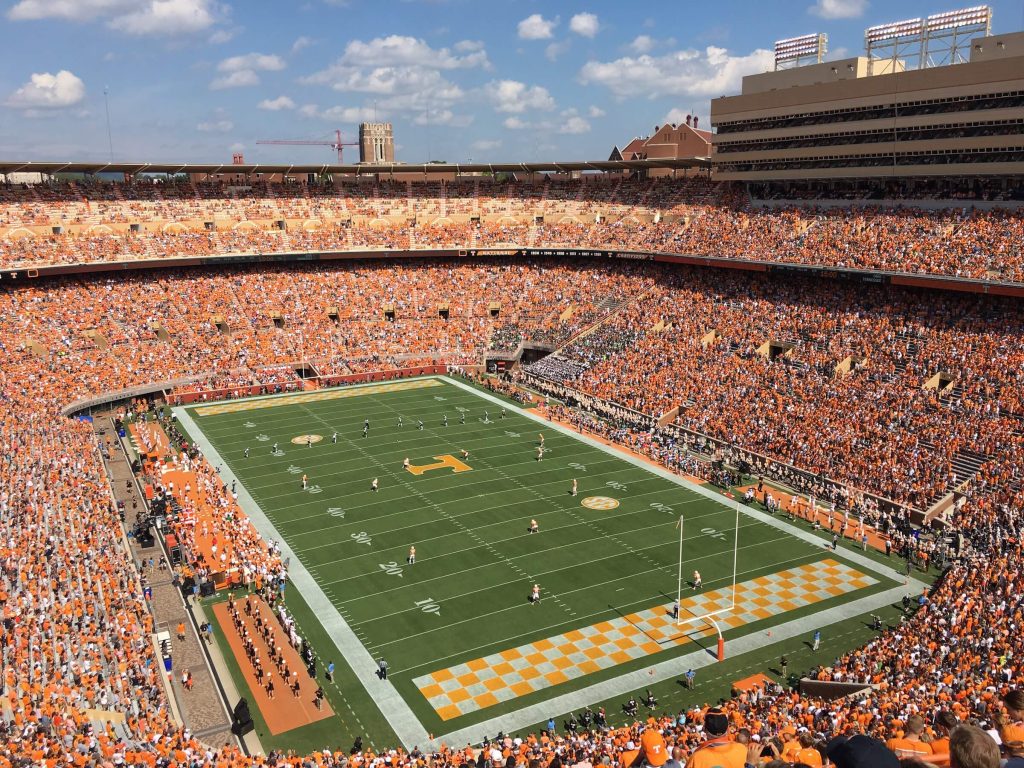
In 1964, the orange-and-white checkerboard end zones were added. This was one of the many changes initiated by Dickey, who also added the "T" logo to the football helmet and initiated the tradition of the team running onto the field through the "Power T" formed by the Pride of the Southland Band. In 1968, Neyland Stadium became the 1st major-college stadium to switch from natural grass to artificial turf, but switched back to grass in 1994.
In 1967, country group The Osborne Brothers had a hit with "Rocky Top," a song written by Felice & Boudleaux Bryant, best known for hits written for The Everly Brothers. In 1972, the Pride of the Southland Band began playing it, and, while it is not the official UT fight song -- the official one is titled "Down the Field" -- it is more identified with the school than any other song. That 1972 season was also the one in which lights were added to Neyland Stadium.
But beyond "Rocky Top" and the checkerboard end zones, the biggest feature of Neyland Stadium is simply how big it is. In 1926, it was expanded to 17,860; in 1938, to 31,390; in 1948, to 46,290. The West Stands were double-decked in 1962, and the East Stands in 1968. Capacity became 64,429. The South Stand was double-decked in 1972, and the North Stand in 1976, making for 80,250.
There was another expansion in 1980, to 91,902; and another in 1996, to 102,544, making it, at the time, the largest on-campus stadium in the country. The addition of luxury boxes made it 104,037 in 2000. Adjustments over the next 10 years have led to the current capacity of 102,455. The record attendance is 109,061, on September 18, 2004, a nationally-televised night game in which they beat Florida, with both teams ranked in the Top 20, 30-28.
The street to the south is named Neyland Drive. The street to the west is named for a later title-winning UT coach, Philip Fulmer Way.
*
September 24, 1921 was a Saturday. Sportscaster Jim McKay and actress Sheila MacRae were born on this day.
Most of the country's college football teams opened their seasons the next week, including Army, Navy, Columbia and NYU in New York City, and Princeton in New Jersey. But these other notable college football games were played:
* Notre Dame beat Kalamazoo College, 56-0 at Cartier Field in South Bend, Indiana.
* Fordham beat the University of Maine, 25-14 at Fordham Field in The Bronx.
* And Rutgers beat Ursinus, 33-0 at Patterson Field in Collegeville, Pennsylvania.
These baseball games were played:
* The New York Yankees lost to the Cleveland Indians, 9-0 at the Polo Grounds. George Uhle pitched a 4-hit shutout, outpitching Harry Harper. Babe Ruth went 1-for-2 with a walk before leaving the game. Tris Speaker, the Indians' center fielder and manager, went 0-for-4 with a walk.
As a result of this game, the Yankees and the Indians were tied for 1st place, although the Yankees, having played 2 fewer games, were ahead on winning percentage. They got their act together, and won their 1st American League Pennant, beating the Indians by 4 1/2 games.
* The New York Giants lost to the St. Louis Cardinals, 8-4 at Sportsman's Park in St. Louis. Emil "Irish" Meusel went 4-for-4 with an RBI for the Giants.
* The Brooklyn Robins (as the Dodgers were known while Wilbert Robinson was their manager from 1914 to 1931) beat the Cincinnati Reds, 4-2 at Redland Field (later Crosley Field) in Cincinnati. Jimmy Johnston doubled home the winning runs in the top of the 10th innings.
* A doubleheader was split at Fenway Park in Boston. The Boston Red Sox won the opener, 2-1. The St. Louis Browns won the nightcap, 11-0. Frank "Dixie" Davis pitched a 6-hit shutout.
* A doubleheader was split at Shibe Park in Philadelphia. The Philadelphia Athletics won the 1st game, 7-4. The Chicago White Sox won the 2nd game, 18-1.
* The Washington Senators beat the Detroit Tigers, 5-1 at Griffith Stadium in Washington. Walter Johnson went the distance for the win. Ty Cobb went 2-for-5 with an RBI.
* The Pittsburgh Pirates beat the Philadelphia Phillies, 4-3 at Forbes Field in Pittsburgh.
* And the Boston Braves and the Chicago Cubs were rained out at Cubs Park (later Wrigley Field) in Chicago. The game was made up as part of a doubleheader the next day. The Cubs swept, 4-3 and 8-7.


No comments:
Post a Comment