Showing posts with label woody hayes. Show all posts

Thursday, December 29, 2022

December 29, 1978: Woody Hayes Punches Out

December 29, 1978: An era comes to an end for the football program at The Ohio State University. An ignominious end.

Football coaches had been abusing their own players for as long as there had been football. And Wayne Woodrow Hayes was no exception.

"Woody" was born on February 14, 1913, the exact same day as Yankee broadcaster Mel Allen and Teamsters union president Jimmy Hoffa. He came to Ohio State in 1951 after success at 2 smaller schools in Ohio, Denison University and Miami University. At Miami, one of his players was Glenn Edward Schembechler Jr. -- "Bo." Bo later served as Woody's assistant at Ohio State, and then as head coach at Miami.

Hayes led Ohio State to 13 Big Ten Conference Championships: 1954, 1955, 1957, 1961, 1968, 1969, 1970, 1972, 1973, 1974, 1975, 1976 and 1977. However, some of these were ties: Only the titles of 1954, 1955, 1957, 1961, 1968, 1970 and 1975 were won outright. In the seasons of 1954, 1957, 1961, 1968 and 1973, he led Ohio State to win the Rose Bowl. In 1954, 1957, 1961 and 1968, the Buckeyes were declared National Champions.

Notable college or pro head coaches who had played or coached under him included Schembechler, Ara Parseghian, Lou Holtz, Joe Bugel, Bill Mallory, Bill Arnsparger, Dick LeBeau, and the man who succeeded him as Ohio State head coach, Earle Bruce.

His players included Pro Football Hall-of-Famer Jim Parker; All-Pros Jim Otis, Jack Tatum, John Brockington, John Hicks, Randy Gradishar and Tom Cousineau; and Heisman Trophy winners Howard Cassady and Archie Griffin.

In 1969, Schembechler became head coach at Michigan. What followed was "The Ten-Year War" between the master and the apprentice. Always the last game of the regular season, Ohio State and Michigan treated 364 consecutive days as if they were nothing but preparation for "The Game." It reached the point where you couldn't think of Woody without thinking of Bo, and vice versa.

Woody was a tyrant. It was his way, or the highway. His preferred method of offensive football was having his linemen open a hole in the enemy's defensive line, and sending a big fullback storming through that line. It's not clear who first described it as "Three yards and a cloud of dust." Nor is it clear what the man who thought of that line thought when Ohio Stadium switched from natural grass to AstroTurf in 1971.

Woody hated the passing game. He said, "There are three things that can happen when you throw the football, and two of them are bad," meaning an incompletion and an interception. He had nothing against quarterbacks, as long as they properly directed his running game.

If you didn't buy into Woody's system, he treated you like crap. If you did buy into his system, he would go to war for you. He was always willing to help out a former player. He not only coached football at OSU, he taught history there. He told his players the best thing they could do after graduating -- and they damn well would graduate on time -- was not play pro football, but go to law school.

And he was conservative as hell. He was pro-Nixon, pro-war, anti-long hair, anti-rock and roll, and anti-"New Hollywood," well past the point where such stands were no longer held by a majority of Americans.

But he was not racist: He gave black players a fair chance. In 1961, he coached running back Bob Ferguson, who nearly became the 1st black player to win the Heisman Trophy. He finished 2nd, to Ernie Davis of Syracuse, who did become the 1st black player to win it. He also coached running back Archie Griffin, who became the only 2-time Heisman winner, in 1974 and '75.

The only colors that mattered to Woody Hayes were the colors of the uniforms: If you wore Scarlet & Gray, you were his man; if you wore the other colors, he was coming for you.

And Ohio loved him. While most States have at least 2 major universities playing top-level college football, Ohio had OSU and several smaller schools. Cleveland and Cincinnati might have hated each other, but on Woody and his Buckeyes, they were in complete agreement.

That, and they hated Michigan, or, as Woody called them, "That school up north." The abbreviation "tsun" (never capitalized) began appearing around campus. This was before the era of social media, when Ohio State fans would use a red X in place of the letter M: "Going to Ohio StadiuX to watch the Bucks kick Xichigan ass."

But there was a dark side to Woody. There were always whispers of him hitting his players in practice, but most of those stories were kept quiet until after he was gone. In 1959, following a loss to USC, he wanted to hit Al Bine of the Los Angeles Examiner. He missed, and hit someone else instead. In 1965, at a meeting of Big Ten coaches and athletic directors, he got into a shouting match with Iowa's AD, Forest Evashevski, and lunged at him, with the others separating them before a fight could happen.

In 1971, Woody thought a Michigan player had committed pass interference, and that the officials had missed it. He ran onto the field, yelled at the referee, went back to the sideline, and began tearing up the sideline markers. He was assessed a 15-yard penalty for unsportsmanlike conduct. He picked up the penalty flag, and threw it into the crowd. He was assessed an additional penalty, and thrown out of the game. So instead of being +15 yards, he was -30 and out of the game.

Unlike those earlier incidents, this was seen on TV, and couldn't be covered up. He was suspended for 1 game, and fined $1,000 -- about $6,700 in today's money.

In 1973, he took the field at the Rose Bowl, but saw an NBC camera get too close. He shoved the camera, and a news photographer was hit in the face with it. This, too, was caught on TV. He was suspended for 3 games, and was fined $2,000. In 1977, they lost to Michigan, with a late fumble clinching it. An ABC camera got too close, and he charged. The cameraman got out of the way. He was thrown out of the game even before the kickoff, fined $2,000, and put on probation by the Big Ten.

In 1978, he finished the regular season 7-3-1, finishing 4th in the Big Ten, the team's worst performance in 12 years. They still made it to a bowl game, the Gator Bowl in Jacksonville, Florida. The opponent was Clemson University.

With 2:30 left in regulation, Clemson led 17-15, but the Buckeyes were driving -- to Woody's ironic surprise, thanks to the passing of a freshman, the best quarterback he ever had, Art Schlichter. (Schlichter's pro career was derailed by injury, and his personal life was devastating by the gambling addiction he already had on the Columbus campus.) The Buckeyes got to the Clemson 24, and it was 3rd & 5.

Woody went against his instincts, and called for a pass. Schlichter threw the ball, but it was intercepted by Clemson noseguard Charlie Bauman. He took the ball toward the sideline -- the Ohio State sideline. Enraged, Woody threw a punch at him. It bounced off Bauman's left shoulder pad, causing no damage. But it was still an egregious, unacceptable act.
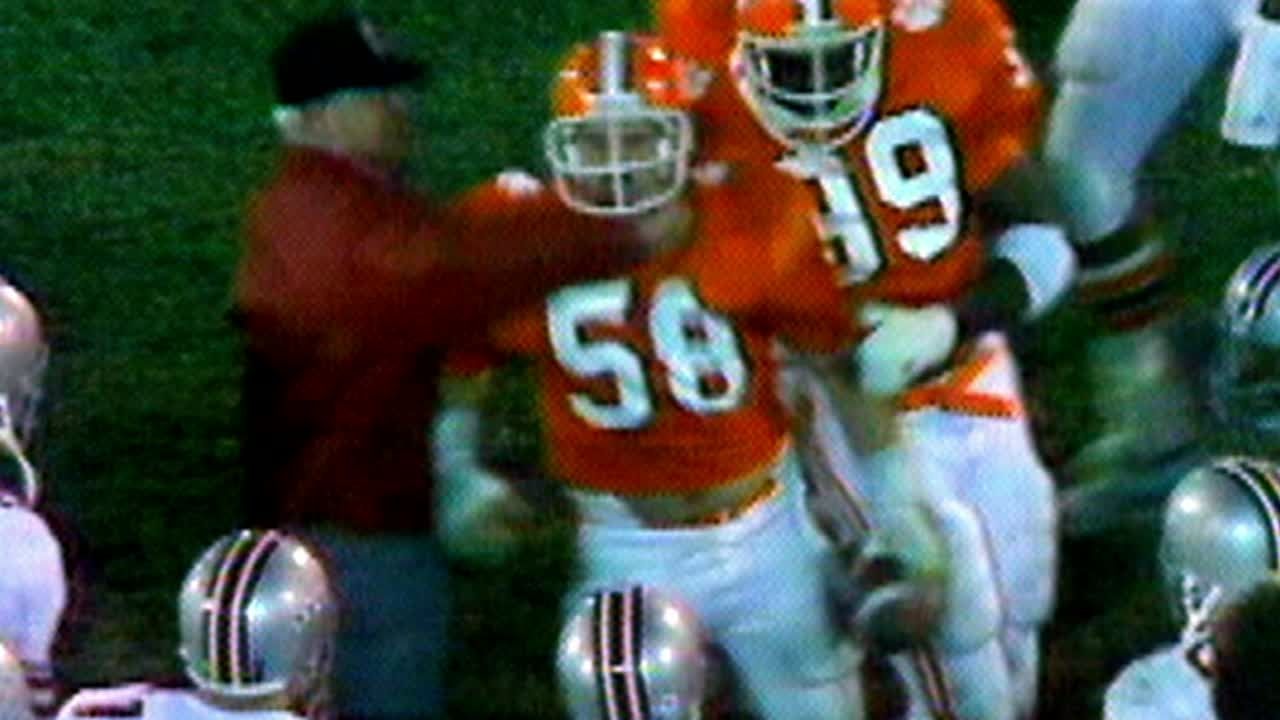
ABC commentators Keith Jackson and the aforementioned Ara Parseghian (who had coached under him at Miami before building his own legend at Notre Dame) never saw the punch. They saw the play as it happened, and the punch happened in a jumble. The instant replay that was shown was from an angle that did not clearly show the punch.

But the Clemson players saw it, and they came toward Woody. The Ohio State players stepped up to defend the old man -- he was 65, but looked older -- and a bench-clearing brawl resulted. As in the 1973 incident, Ohio State was assessed 2 15-yard penalties for unsportsmanlike conduct. Clemson held its 17-15 lead.

After the game, Woody was approached by his athletic director, Hugh Hindman. Hindman had played for him at Miami, and had been an assistant under him at Ohio State. He told Woody that he was going to recommend to University President Harold Enarson that he be fired, and gave him a chance to resign with whatever dignity he had left. According to Hindman, Woody said, "That would make it too easy for you. You had better go ahead and fire me."

The next day, Hindman fired Woody. His career record was finalized at 238-72-10, 205-61-10 of it at Ohio State, 152-37-7 of that in Big Ten Conference games. He had gone 6-6 in bowl games.

He lived until March 12, 1987, at age 74. He never apologized for the punch. And yet, he is still honored at The Ohio State University. The mailing address of Ohio Stadium is 411 Woody Hayes Drive.

Bobby Knight was a student at Ohio State, and a reserve player on their basketball team that won the 1960 National Championship. He was a great admirer of Woody. That frequently showed in his tenure as head basketball coach at Indiana University: He ran a clean program where his players not only excelled, but graduated on time.

Unfortunately, Knight was a lot like Hayes in another way. He hit his players, kicked them, and was even once caught on video choking one. Despite winning more games than any college basketball coach before him, and winning 11 Big Ten titles and 3 National Championships, he, too, was fired in disgrace. 
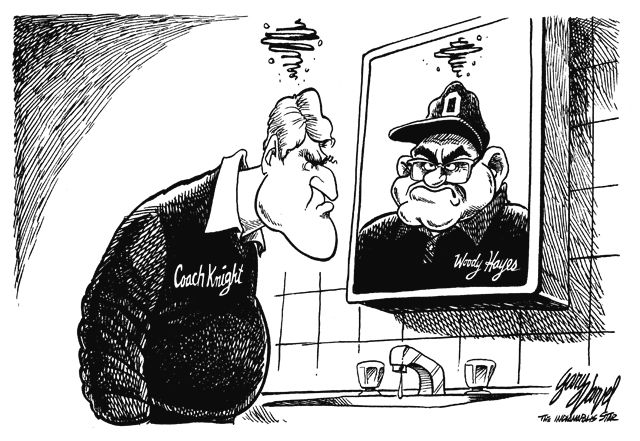
Somewhere, there must be a photograph of Knight and Hayes together.
Until I find it, I'll have to settle for this editorial cartoon.

*

December 29, 1978 was a Friday. This was the only bowl game played that day. There were no NFL games, either regular-season or Playoff. Baseball was out of season. But 8 games were played in the NBA that night:

* The New Jersey Nets lost to the Kansas City Kings, 137-126 at the Rutgers Athletic Center in Piscataway, New Jersey. (It's now the Louis Brown Athletic Center.)

* The Philadelphia 76ers beat the Atlanta Hawks, 113-107 at The Spectrum in Philadelphia.

* The San Diego Clippers beat the Detroit Pistons, 111-107 at the Silverdome in the Detroit suburb of Pontiac, Michigan.

* The Chicago Bulls beat the Denver Nuggets, 123-117 at the Chicago Stadium.

* The Houston Rockets beat the Milwaukee Bucks, 106-103 at The Summit in Houston. (This arena still stands. It's now the Lakewood Church Central Campus, the mega "church" of Dr. Joel Osteen.)

* The Los Angeles Lakers beat the Portland Trail Blazers, 118-95 at The Forum outside Los Angeles in Inglewood, California.

* The Golden State Warriors beat the New Orleans Jazz, 118-106 at the Oakland Coliseum Arena.

* And the Seattle SuperSonics beat the Phoenix Suns, 119-92 at the Seattle Center Coliseum.

There were no games played in the NHL that night, but 1 game was played in the World Hockey Association: The New England Whalers beat the Birmingham Bulls, 5-0 at the Springfield Civic Center in Springfield, Massachusetts. (Now known as the MassMutual Center, the Whalers played here for 2 years while the Hartford Civic Center was rebuilt following the 1978 collapse of its roof.) 

Friday, November 25, 2022

November 25, 1950: The Michigan-Ohio State "Snow Bowl"

November 25, 1950: Although they'd been playing each other since 1897, this was the game that set the course for turning the University of Michigan and the Ohio State University into the Midwest's  -- some would even say America's -- greatest college football rivalry.

Despite Ohio State winning a National Championship in 1942, and having another undefeated season in 1944, Michigan had dominated the rivalry. Michigan had won the National Championship in 1947 and 1948.

In 1950, they were set to play each other at Ohio Stadium in Columbus. Ohio State, defending Big Ten Champions, coached by Wes Fesler, came in 6-2, and ranked Number 8 in the country; while Michigan, coached by Bennie Oosterbaan, came in at 4-3-1. Each head coach was a star player for his school in the 1920s, but neither played in the pros.
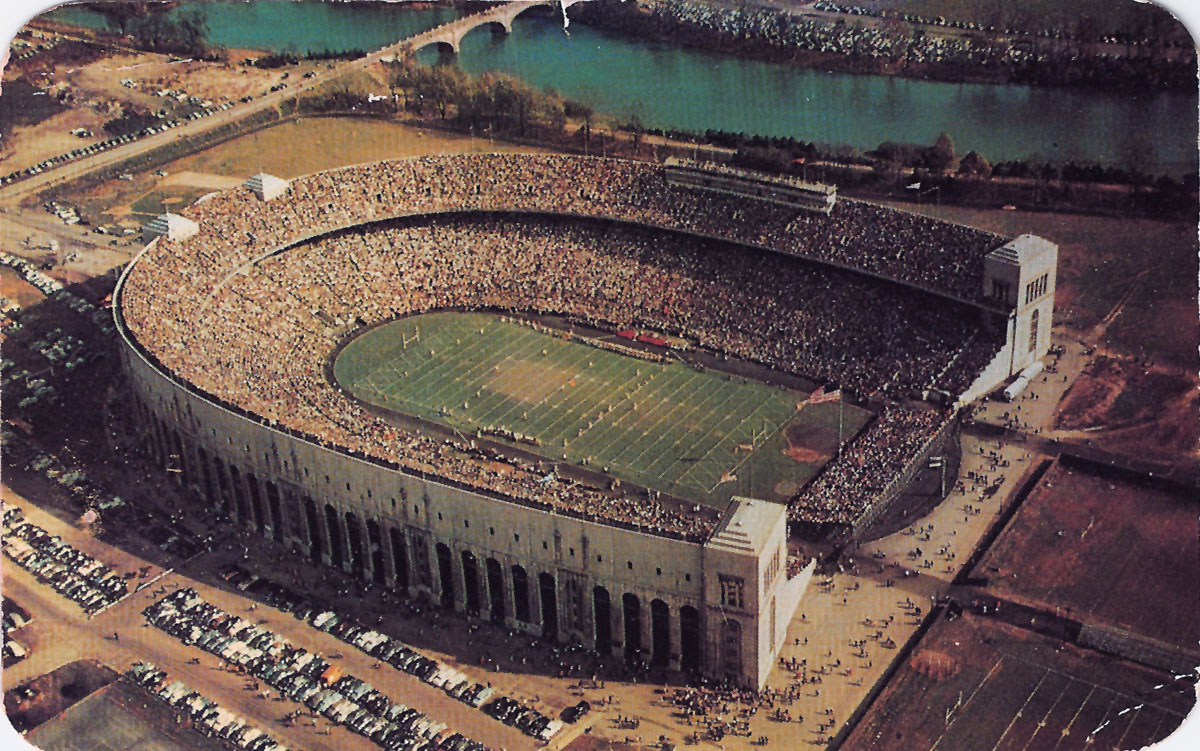
Ohio Stadium, possibly around 1950

The Big Ten title was on the line, so the Buckeyes were going for back-to-back titles. However, until 1975, the Big Ten had 2 dumb rules: That the Rose Bowl was the only bowl game to which any of their teams could accept bids; and that no team could go to it in back-to-back years. In other words, if a team won back-to-back titles, in the 2nd year, the 2nd place team could accept the Rose Bowl bid. The Wolverines had to win in order to accept that bid. In the event of their defeat, they would have fallen behind Wisconsin in the league standings, and Wisconsin would have been offered the bid.

Columbus is 185 miles south of Ann Arbor, and as far south as Philadelphia. And it was the Saturday of Thanksgiving weekend. It was a little early for them to get hit with a snowstorm. But they got hit with one. It remains the worst weather this rivalry has ever had: A temperature of 10 degrees, wind gusts up to 28 miles per hour, and snow falling at 2 inches per hour. The snow was falling so hard, neither set of goalposts could be seen from midfield. 

There was a meeting before the game. Oosterbaan and Fesler agreed that the game should not be played. Oosterbaan's predecessor as Michigan's head coach, now their athletic director, Herbert "Fritz" Crisler, was willing to forfeit and not reschedule the game. But Ohio State A.D. Dick Larkins would not accept the forfeit: He was willing to postpone only, not cancel.

The fans were not willing to postpone: A crowd of 79,868 filled Ohio Stadium to what was then its capacity. Eyewitness reporters said that some fans built small bonfires to keep warm, and others put boxes over the heads as protection from the cold, with eyeholes cut out. This was before fans began wearing paper bags over their heads to show that they didn't want their faces shown at games played by their bad teams. Local Boy Scouts helped the grounds crew remove the snow from the tarp, and then remove the tarp from the field.

It's worth noting that this rivalry wouldn't really be possible if Michigan hadn't spent the last 100+ years recruiting players from Ohio. There have been brothers on both sides, and even fathers and sons. In this game, Bob Momsen played for Ohio State, and his brother Tony Momsen played for Michigan. Good thing for the Momsen household that this game was being played 2 days after, rather than on, Thanksgiving.

In the 1st quarter, Michigan's Chuck Ortmann tried to punt, but Bob Momsen blocked his kick, then recovered the punt on the 8-yard line. Three straight Buckeye run plays lost yardage. Running back Vic Janowicz, soon to be awarded the Heisman Trophy, attempted a 38-yard field goal in the horrible weather, and made it. The Buckeyes led, 3-0, and, at the time, it was easy to believe that the score would hold for the rest of the game.

But Janowicz, the beneficiary of the blocked punt, had his own punt blocked deep in his own territory, by Al Wahl. The ball went through the end zone, and Michigan closed to within 3-2 with the safety. That swung the momentum, and, with 20 seconds left in the 1st half, Janowicz attempted to punt again. But his kick was blocked by Tony Momsen, who fell on the ball as it drifted into the end zone. The extra point was good, and it was 9-3 Wolverines.

That would be the final score. Michigan won without ever getting a first down in the slippery conditions; Ohio State got only 3 first downs. The Buckeyes had 4 out of 21 punts blocked, the Wolverines 1 of 24, punting for 1,408 yards between them. The Buckeyes attempted 9 passes, completing none of them.

This was Ohio State's 4th straight loss to Michigan. Fesler saw the writing on the wall, and resigned. Ohio State hired the head coach at nearby Miami University: Wayne Woodrow "Woody" Hayes. As one of his assistants, he brought one of his Miami players: Glenn Edward "Bo" Schembechler.

Hayes turned Ohio State into one of the top programs in the country, based in part on making beating Michigan -- or, as he called it, "That School Up North" -- a must. Michigan won again in 1951, but, from 1952 to 1968, the Buckeyes went 12-4 against the Wolverines.

After a few years as Hayes' assistant, Schembechler returned to Miami University as their head coach. In 1969, he was hired as head coach at Michigan, and he used Hayes' tactics as well as he did, and made beating Ohio State Michigan Mission Number 1. Ohio State went into the 1969 Michigan game undefeated and defending National Champions, with a 22-game winning streak, but Michigan won, in a game nationally televised by ABC, starting what became known as "The Ten-Year War" between Woody and Bo, and making the rivalry one that takes on national attention every November.

Through the 2021 season, Michigan lead the rivalry, 59-51-6.

*

November 25, 1950 was a Saturday. Among the other college games played this day were the following:

* Not yet a big rivalry, but it would become one: Number 1 Oklahoma beat Number 16 Nebraska, 49-35 at Owen Field in Norman, Oklahoma. Oklahoma were awarded the National Championship, in an era when it was awarded before the bowl games. But they lost the Sugar Bowl to Kentucky.

* Number 2 Army were off. So were their arch-rivals, Navy. The following week, Nayv upset Army at Municipal Stadium (later John F. Kennedy Stadium) in Philadelphia.

* Rivalry: Number 3 Kentucky were upset by Number 9 Tennessee, 7-0 at Shields-Watkins Field (now Neyland Stadium) in Knoxville, Tennessee. Kentucky beat Oklahoma in the Sugar Bowl, which, given that Army didn't go to bowl games in those days, should have made Kentucky the National Champions. It would have been the 1st as a head coach for Paul "Bear" Bryant, later to win them at the University of Alabama. Tennessee went on to beat Texas in the Cotton Bowl.

* Rivalry: Number 4 University of California were held to a tie by Stanford, 7-7 at the old California Memorial Stadium in Berkeley. Cal went on to lose the Rose Bowl to Michigan.

* Rivalry: Number 6 Illinois were upset by Northwestern, 14-7 at Dyche Stadium (now Ryan Field) in the Chicago suburb of Evanston, Illinois.

* Number 7 Princeton beat Dartmouth, 13-7 at Palmer Stadium in Princeton.

* Number 13 University of Pennsylvania were upset by Cornell, 13-6 at Franklin Field in Philadelphia.

* Number 15 Southern Methodist University (SMU) were upset by Baylor, 3-0 at the Cotton Bowl in Dallas.

* Number 17 Alabama beat Florida, 41-13 at Florida Field in Gainesville.

* Rivalry: Number 18 Washington beat Washington State, 52-21 at Memorial Stadium (later Joe Albi Stadium) in Spokane, Washington.

* Number 20 Loyola University were upset by Santa Clara, 28-26 at Gilmore Stadium in Los Angeles. Now named Loyola Marymount, the school no longer plays football. This was the only game they lost that season.

* The night before, Number 14 University of Miami beat Iowa, 14-6 at Burdine Stadium (the stadium later known as the Orange Bowl) in Miami. Despite playing it on their home field, Miami ended up losing the Orange Bowl to Clemson.

* Rivalry: Fordham beat New York University, 13-0 at the Polo Grounds.

* Rivalry: Yale beat Harvard, 14-6 at Harvard Stadium in Boston.

* Rivalry: George Washington University beat Georgetown, 7-6 at Griffith Stadium in Washington.

* Rivalry: Duke beat North Carolina, 7-0 at Kenan Stadium in Chapel Hill.

* Rivalry: Penn State beat Pittsburgh, 21-20 at Forbes Field in Pittsburgh.

* Rivalry: Purdue beat Indiana, 13-0 at Ross-Ade Stadium in West Lafayette, Indiana.

* Rivalry: Wisconsin beat Minnesota, 14-0 at Camp Randall Stadium in Madison, Wisconsin.

* Rivalry: Colorado beat Colorado A&M (now Colorado State), 31-6 at Colorado Field in Fort Collins.

* Rivalry: Oregon State beat Oregon, 14-2 at Multnomah Stadium (now Providence Park) in Portland.

* Rivalry: UCLA beat USC, 39-0 at the Los Angeles Memorial Coliseum.

* Rutgers had finished its season the week before, losing to Penn State, and finishing 4-4.

Baseball season was over. There were 4 games played in the NBA:

* The Syracuse Nationals beat the Washington Capitols, 77-67 at the Uline Arena in Washington (now the Washington Coliseum).

* The Rochester Royals beat the Boston Celtics, 90-82 at the Edgerton Park Arena in Rocheter, New York.

* The Indianapolis Olympians beat the Baltimore Bullets, 92-81 at the Butler Fieldhouse (now the Hinkle Fieldhouse) in Indianapolis.

* And the Tri-Cities Blackhawks beat the Fort Wayne Pistons, 85-71 at the Wheaton Field House in Moline, Illinois.

The NHL's entire "Original Six" were in action. The New York Rangers and the Boston Bruins played to a tie, 3-3 at the Boston Garden. The Toronto Maple Leafs beat the Montreal Canadiens, 4-1 at Maple Leaf Gardens in Toronto. And the Detroit Red Wings beat the Chicago Black Hawks, 4-1 at the Olympia Stadium in Detroit.

And in English soccer, Arsenal beat West London team Fulham, 5-1 at Highbury in North London. 

Thursday, November 24, 2022

November 24, 1973: The Ohio State-Michigan Tie

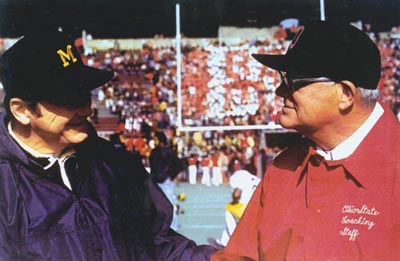
Glenn Edward Schembechler Jr. (left) and Wayne Woodrow Hayes

November 24, 1973: The football teams of Ohio State University and the University of Michigan play each other at Michigan Stadium in Ann Arbor. This was intended as the 30th time that the winner of this game would win the Big Ten Conference Championship. (And there have been many more since.)

Wayne Woodrow Hayes, known as Woody, had coached at Ohio State since 1951, and had already won the Big 10 title 7 times, and the National Championship in 1954, 1957, 1961 and 1968. Glenn Edward Schembechler Jr., known as Bo, had played for him at Miami University in Ohio, and had coached under him there and at Ohio State, before becoming head coach at Miami and then at Michigan in 1969.

Ohio State was going for back-to-back National Championships in 1969, with a supposedly unbeatable team, but Bo's Wolverines shocked Woody's Buckeyes in Ann Arbor, re-establishing Michigan as a national football power, and beginning what would eventually be known as "The Ten-Year War" between not just the two programs, but between the two men. Ohio State won in 1970, Michigan in 1971 and Ohio State in 1972.

Ohio State came into the game at 9-0, having been ranked Number 1 for most of the season. The closest any team had come to beating them was Wisconsin, and they lost 24-0. The Buckeyes had hung 60 points on Northwestern, 56 on Minnesota, 55 on Iowa, 37 on both Texas Christian and Indiana, and 35 on Michigan State. With sophomore running back Archie Griffin, on his way to becoming the only 2-time Heisman Trophy winner, and future All-Pro linebacker Randy Gradishar, they looked unbeatable -- just as they were in 1968, and just as they looked in 1969.

Michigan came into the game 10-0, and ranked Number 4. They'd had some closer calls, only beating Navy by 14 points and Illinois by 15. But they scored 49 on Indiana, 47 on Stanford, 35 on Wisconsin, and 34 on both Minnesota and Purdue. And they had a strong defense, shutting out Navy, Oregon and Michigan State. Only Stanford and Indiana reached double figures against them. Cornerback Dave Brown, defensive tackle Dave Gallagher, tight end Paul Seal and placekicker Mike Lantry were named All-Americans.

A crowd of 105,223 plowed into the enormous bowl in Ann Arbor, nicknamed The Big House. Millions more watched Chris Schenkel and former Michigan State coach Duffy Daugherty call the game on ABC. It was Ohio State vs. Michigan. It was "The Game."

It rained before the game. Coupled with both coaches' distaste for the forward pass -- Hayes famously said, "There are three things that can happen when you throw the football, and two of them are bad," meaning an incompletion and an interception -- this game was destined to remain mostly on the ground. Michigan passed for only 90 yards, and Ohio State attempted only 4 passes.

The game was scoreless after the 1st quarter. Early in the 2nd quarter, Blair Conway kicked a field goal to put Ohio State up 3-0. Michigan struggled, and Ohio State gained a lot on the ground through Griffin. But it was the other big back, Pete Johnson, who ended up scoring the Buckeye touchdown, putting them up 10-0 just before halftime.

Midway through the 3rd quarter, Ohio State got to the Michigan 34-yard line, but on 4th and 2, Hayes, that most conservative of football coaches, refused to gamble on a 51-yard field goal attempt, and went for the 1st down, and couldn't convert it. That gave the Wolverines new life, and they drove 11 plays, and Lantry got them on the board with a field goal.

Midway through the 4th quarter, Michigan was able to drive down to the Ohio State 10-yard line, but the Buckeyes held them, and it was 4th and inches. Hayes put 9 men on the line of scrimmage, making a "goal-line stand" on the 10, because he had predicted that Wolverine quarterback Dennis Franklin would once again hand off to Ed Shuttlesworth.

But Schembechler, unlike Hayes, was willing to gamble: He had Franklin fake the handoff to Shuttlesworth, and got himself through the line for a touchdown. It was 10-10.

With 6 minutes left, Michigan got the ball on their 10. Franklin drove into Buckeye territory, but with 2:23 to go, he was injured and had to leave the game. Schembechler decided to gamble again, and had Lantry try a 58-yard field goal. It had the distance, but was just wide left.

Ohio State couldn't do anything with their opportunity, and quarterback Greg Hare threw an interception that must have driven Hayes up the wall. The Wolverines got the ball to the Buckeye 28, and Lantry attempted a game-winning 45-yard field goal. But he missed, and 10-10 was the final score.
So now, there was a tie not just in the game, but for the Big 10 title. And, at the time, the Big 10 had a rule that now seems ridiculous: Only the league's Champion could go to a bowl game, the Rose Bowl. Until 1971, they had another ridiculous rule: No team could go to the Rose Bowl 2 years in a row. In other words, if a team won back-to-back titles, the 2nd place team would go to the Rose Bowl instead.

With that rule having gone by the wayside, and the title being tied, the Big 10's representative to play the University of Southern California (USC) in the Rose Bowl would be up to a vote the next day, held in a telephone conference call of the league's athletic directors. Since Ohio State had gone to the Rose Bowl the year before, it seemed simple enough: It was Michigan's turn.

Even Hayes agreed. He hated Michigan as much as any coach has ever hated his school's arch-rival. You approached him with great care during "Michigan Week." And he usually referred to them as "that school up north." Ohio State fans began referring to them by the initials of that epithet: "TSUN." But as competitive as Woody was, this time, he admitted, "We had to win this one to go, and we didn't. If they vote Michigan, Michigan deserves to go." And if the vote were a 5-5 split, then the old rule would be observed, and Michigan would go.

The vote was 6-4 for Ohio State. The Buckeyes voted for themselves, of course; and also got the votes of Illinois, Northwestern, Purdue, Wisconsin and Michigan State. The Wolverines voted for themselves, and also got the votes of Indiana, Iowa and Minnesota.

Bo blew his stack. He would have blown it again if he had lived long enough to hear a recording released in connection with the 2013 Big Ten Network documentary Tiebreaker, of Michigan State athletic director J. Burt Smith, 4 days after the game and 3 days after the vote, that he had voted for Ohio State, because they "best met the definition of the most representative team."

Another rumor came out that MSU voted for Ohio State in retaliation for Michigan's "No" vote on their admittance to the Big Ten in 1949. (The University of Chicago had dropped out in 1940, and so the league was a Big Nine for a few years.) Granted, Michigan State hates Michigan as much as Ohio State does, but 24 years is a long time to hold a grudge, especially over a move that didn't even work.

In his 1989 memoir, Schembechler said that Illinois coach Bob Blackman was told by his athletic director, Cecil Coleman, that he would vote for Michigan, but that Coleman voted for Ohio State anyway.

Bo also suggested in that memoir that the Big Ten knew that Franklin's injury would make it problematic for Michigan, and they'd already lost the last 4 Rose Bowls to the league then known as the Pacific-Eight, and they thought Ohio State would have a better chance to win. As it turned out, that was correct: Ohio State won the 1974 Rose Bowl, beating USC 42-21.

But the tie ended up hurting Ohio State, if not as much as it hurt Michigan. Notre Dame, ranked Number 3, upset the new Number 1, Alabama, in the Sugar Bowl, and were awarded the National Championship. Ohio State ended up Number 2 in both the Associated Press poll (AP, the football writers) and the United Press International poll (UPI, the football coaches). Michigan finished Number 6 in both polls.

In 1972, '73 and '74 combined, Michigan went 30-2-1, their only non-wins being the '72 loss to Ohio State, 14-11; the '73 tie with Ohio State, 10-10; and the '74 loss to Ohio State, 12-10. Three non-wins, by a combined total of 5 points. And yet, they didn't go to a bowl game in any of those seasons. Even fans of the other 9 schools in the league at the time, used to hating Michigan and wanting them to suffer, had to admit that this was a bit unfair.

Finally, in 1975, the Big Ten voted to open postseason bids to as many as 4 teams, which has since been expanded to 6. Fittingly, Michigan became the 1st team to benefit, going 8-0-2 in 1975 before losing to Ohio State, and then going to the Orange Bowl, where they lost to Oklahoma.

*

November 24, 1973 was a Saturday. And there were other big games in college football that day, some of them rivalries, besides Number 1 Ohio State vs. Number 4 Michigan:

* Number 2 Alabama had already played 2 days earlier, on Thanksgiving, beating Number 7 Louisiana State, 21-7 at Tiger Stadium in Baton Rouge, Louisiana.

* Number 3 Oklahoma played the day before, the day after Thanksgiving, beating Nebraska, 27-0 at Memorial Stadium in Norman, Oklahoma. This clinched them the Big Eight title. However, they were on probation, and couldn't accept the Big Eight Champions' bid to the Orange Bowl.

* Number 5 Notre Dame had also played on Thanksgiving, beating the Air Force Academy, 48-15 at Notre Dame Stadium in South Bend, Indiana.

* Number 6 Penn State beat Number 20 Pittsburgh, 35-13 at Beaver Stadium in State College, Pennsylvania. Led by Heisman Trophy-winning running back John Cappelletti, Joe Paterno's Nittany Lions went on to beat LSU in the Orange Bowl, and finished undefeated. But they only finished Number 5 in the polls, behind fellow undefeated Notre Dame, undefeated-but-one-tie Ohio State, undefeated-but-one-tie Oklahoma, and one-loss Alabama.

* Number 9 USC beat Number 8 UCLA, 23-13 at the Los Angeles Coliseum. This clinched the Pac-8 title. But, as I said, USC lost the Rose Bowl to Ohio State.

* Number 11 Texas played on Thanksgiving, beating Texas A&M, 42-13 at Kyle Field in College Station, Texas. That clinched the Southwest Conference title. But they lost the Cotton Bowl to Nebraska.

* In a rare Sunday game for college football in those days, Number 13 Arizona State played arch-rival Arizona the next day, November 25, and won, 55-19 at Sun Devil Stadium in the Phoenix suburb of Tempe, Arizona. This clinched the title of the Western Athletic Conference. In 1978, Arizona and Arizona State left the WAC, and made the Pac-8 a Pac-10.

* Number 16 North Carolina State, then coached by Lou Holtz in his 2nd season of his 1st NCAA Division I-A head coaching job, beat Wake Forest, 52-13 at Carter Stadium in Raleigh. (It's now named Carter-Finley Stadium.) This game won N.C. State the Atlantic Coast Conference title.

* Dartmouth beat Princeton, 42-24 at Palmer Stadium in Princeton, New Jersey, to wrap up the Ivy League title.

* New York City's only remaining major-college football team, Columbia, lost to Brown, 37-14 at Brown Stadium in Providence, Rhode Island.

* And Rutgers got pasted by Colgate, 42-0 at Rutgers Stadium in Piscataway, New Jersey.

There were 5 games played in the NBA that day:

* The New York Knicks lost to the Golden State Warriors, 107-99 at Madison Square Garden. Walt "Clyde" Frazier scored 34 points, but it wasn't enough.

* The Buffalo Braves beat the Kansas City-Omaha Kings, 143-131 at the Buffalo Memorial Auditorium. Bob McAdoo had 43 points and 17 rebounds for the Braves, who became the San Diego Clippers in 1978 and the Los Angeles Clippers in 1984.

* The Milwaukee Bucks beat the Atlanta Hawks, 112-91 at The Omni in Atlanta.

* The Chicago Bulls beat the Detroit Pistons, 114-112 in overtime at the Chicago Stadium.

* And the Los Angeles Lakers beat the Portland Trail Blazers, 113-108 at the Portland Memorial Coliseum.

There were also 5 games played in the ABA:

* The New York Nets beat the Utah Stars, 119-113 at the Salt Palace in Salt Lake City. Julius "Dr. J" Erving scored 38 points for the Long Island club.

* The Virginia Squires beat the Indiana Pacers, 108-102 at The Scope in Norfolk, Virginia.

* The Denver Rockets beat the Carolina Cougars, 127-122 in overtime at the Greensboro Coliseum. The Rockets became the Denver Nuggets in 1974.

* The Kentucky Colonels beat the San Diego Conquistadors, 124-121 at Freedom Hall in Louisville.

* And the San Antonio Spurs beat the Memphis Tams, 121-118 in double overtime at the HemisFair Arena in San Antonio.

There were 6 games played in the NHL:

* The New York Rangers played the Los Angeles Kings to a tie, 5-5 at The Garden.

* The New York Islanders lost to the Detroit Red Wings, 6-4 at the Olympia Stadium in Detroit.

* The Montreal Canadiens beat the Pittsburgh Penguins, 5-2 at the Civic Arena in Pittsburgh.

* The Chicago Black Hawks beat the Toronto Maple Leafs, 3-1 at Maple Leaf Gardens in Toronto.

* The Minnesota North Stars beat the California Golden Seals, 6-3 at the Metropolitan Sports Center in the Minneapolis suburb of Bloomington, Minnesota.

* The Philadelphia Flyers beat the St. Louis Blues, 1-0 at the St. Louis Arena.

* The Atlanta Flames, the Boston Bruins, the Buffalo Sabres and the Vancouver Canucks were not scheduled.

And there were 2 games played in the World Hockey Association. The Cleveland Crusaders beat the Toronto Toros, 2-1 at the Cleveland Arena. And the Houston Aeros beat the Chicago Cougars, 5-3 at the Sam Houston Coliseum in Houston. 

Tuesday, November 22, 2022

November 22, 1969: The Michigan Wolverines Return to Glory

November 22, 1969: The most famous game in the history of the Midwest's greatest college football rivalry is played in front of 103,588 fans at Michigan Stadium in Ann Arbor.

Glenn Edward Schembechler Jr. had played for Wayne Woodrow Hayes at Miami University of Ohio, and coached under him at Ohio State, before becoming Miami's head coach, and was now in his 1st year at Michigan. "Bo" had the Wolverines ranked Number 12 in the nation. But "Woody" had won the previous year's National Championship at Ohio State, his Buckeyes had won 22 straight games, and were still ranked Number 1.

Michigan had long been the leading football power in the Big Ten, but the 1950s saw the rise of Woody's Buckeyes, and of Duffy Daugherty's Michigan State University, and the Wolverines fell back. From 1950 to 1968, Big 10 football titles had been won (some of these races ending in ties) by Illinois in 1951, 1953 and 1963; Wisconsin in 1952, 1959 and 1962; Purdue in 1952 and 1967; Michigan State in 1953, 1965 and 1966; Iowa in 1958 and 1960; Minnesota in 1960, 1962 and 1967; Indiana in 1967 (a 3-way tie with Purdue and Minnesota); Ohio State in 1954, 1955, 1957, 1961 and 1968; and Michigan only in 1964. Only Northwestern had failed to win a title.

Chalmers "Bump" Elliott, a former Michigan star, coached them to that 1964 Conference Championship. Over the next 4 years, Michigan went 4-6, 6-4, 4-6 and 8-2. Elliott was fired, and Schembechler was hired away from Miami. Just as Woody had made beating Michigan -- or, refusing to say the name, calling it "That school up north," or TSUN for short -- Bo made beating Ohio State, and Woody, the Wolverines' priority.

The Wolverines came in at 7-2, having lost a non-conference game to then-Number 9 Missouri at home, and away to Michigan State. That was their only Big 10 loss, so this game would be for the title. And the Buckeyes were looking to win another National Championship, with fellow undefeateds Texas, Arkansas and Penn State keeping an eye on them. Which they could do, because it was televised nationally on ABC.

Ohio State had quarterback Rex Kern, running backs Jim Otis and John Brockington, and nose tackle Jim Stillwagon, and safety Jack Tatum. Michigan had offensive tackle Dan Dierdorf, guard Reggie McKenzie, receiver Glenn Doughty and tight end Jim Mandich. In other words, both teams were loaded.

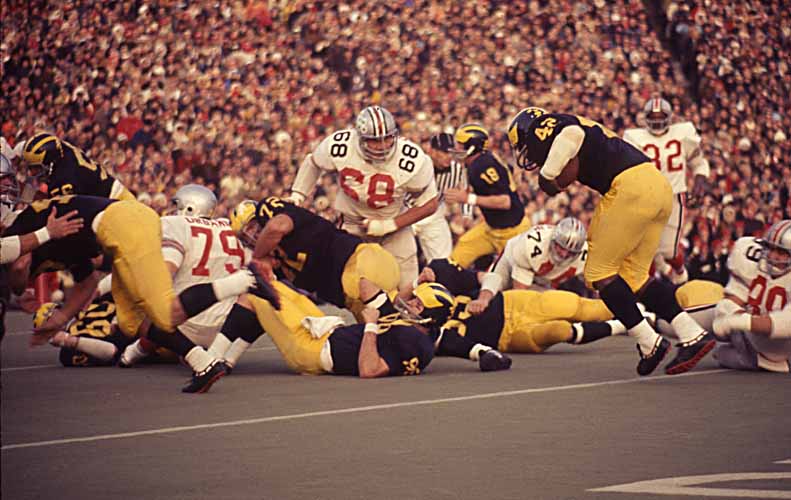
But while Michigan had a great offensive line, it was their defense that told the story. Ohio State scored the 1st touchdown, but missed the extra point. Michigan scored a touchdown, and made their extra point, and the 1st quarter ended with Michigan up, 7-6. Ohio State scored another touchdown, but Michigan stopped him on the two-point conversion attempt. But Michigan came right back, scored another touchdown, then another, and then a field goal. At the half, it was Michigan 24, Ohio State 12.

Bo remembered his defensive coordinator, Jim Young, telling his players that Ohio State would not score in the 2nd half. He bounded the blackboard with the formations written on it with each word: "They! Will! Not! Score! Again!" Young went on to become the head coach at Arizona, Purdue and Army.

He was right: Neither team scored again. Michigan missed a field goal, then ended the next 2 Ohio State drives with interceptions. Woody hated the passing game, saying, "Three things can happen when you throw the football, and two of them are bad," meaning an incompletion and an interception. The Ohio State defense got better in the 4th quarter, but their offense didn't, and it remained 24-12. Michigan forced 6 interceptions and a fumble, and had ended Ohio State's streak, and become the Big Ten Champions.
As the fans rushed onto the field, and the Wolverines carried Bo off their shoulders, ABC announcer Bill Flemming said, "There it is! What has to be the upset of the century!" He had forgotten about Army losing to Carlisle in 1912, Notre Dame in 1913, and Army in 1947; and Centre College beating Harvard in 1921.

Michigan's upset of Ohio State was the 1st of 10 games between Woody and Bo, from Bo's arrival in Ann Arbor in 1969 until Woody had to be fired in 1978, were known as The Ten-Year War, with Bo "winning," 5-4-1. Michigan won in 1969, '71, '76, '77 and '78. Ohio State won in 1970, '72, '74 and '75. The '73 game was a tie.
Bo (left) and Woody

Woody and Bo remained friends until Woody's death in 1987. Bo lived on until 2006, dying the day before that year's game, which became one of college football's periodic "Games of the Century."

*

November 22, 1969 was a Saturday. These other noteworthy games were played that day:

* Number 2 Texas were idle. The next week, they beat arch-rival Texas A&M. Number 3 Arkansas were idle. The next week, they beat Texas Tech, setting up the "Game of the Century" showdown. Texas won it, winning the Southwest Conference title, and its automatic berth in the Cotton Bowl. Arkansas fell to Number 3,

* Rivalry: Number 4 Penn State beat the University of Pittsburgh, 27-7 at Pitt Stadium in Pittsburgh. A win the next week over North Carolina State gave Penn State, an independent with no conference title available to them, an undefeated regular season, and an invitation to the Orange Bowl.

* Rivalry: Number 5 University of Southern California (USC) beat Number 6 University of California at Los Angeles (UCLA), 14-12 at the Los Angeles Memorial Coliseum. USC thus won the Pacific-Eight Conference title. They went on to beat Michigan in the Rose Bowl.

* Rivalry: Number 7 Missouri beat Kansas, 69-921 at Memorial Stadium in Lawrence, Kansas. This gave "Mizzou" the Big Eight Conference title, and an automatic berth in the Orange Bowl. Penn State beat them, to complete an undefeated season, and make a claim for the National Championship.

* Number 8 Notre Dame beat Air Force, 13-6 at Notre Dame Stadium in South Bend, Indiana. For the 1st time since their "Four Horsemen" season of 1924, 45 years, the Fighting Irish accepted a bowl berth, taking on Number 1 Texas in the Cotton Bowl. Texas won, and were awarded the National Championship. Penn State fans have whined about being bypassed for that title ever since.

* Rivalry: Number 9 Tennessee beat Kentucky, 31-26 at McLean Stadium in Lexington, Kentucky. The next week, Tennessee beat Vanderbilt, and won the Southeastern Conference title. They had only lost 1 SEC game, to the University of Mississippi, who had lost 2 of them. By rights, the Sugar Bowl should have invited Tennessee, as both SEC Champions and the higher-ranked team. Instead, they invited Arkansas and "Ole Miss," as neighbors with an established inter-conference rivalry.

Ole Miss won the Sugar Bowl, and so, in the span of 64 minutes of football, Arkansas went from a good shot at the National Championship to a 2-loss team with nothing to show for it.

* Rivalry: Number 10 Louisiana State University beat Tulane, 27-0 at Tiger Stadium in Baton Rouge, Louisiana. Stuck behind Tennessee and Ole Miss in the SEC, LSU were not invited to any bowl game.

* Rivalry: Number 14 Stanford beat the University of California, 29-28 at the old Stanford Stadium in the San Francisco suburb of Palo Alto, California.

* Rivalry: Number 16 Nebraska beat Oklahoma, 44-14 at Owen Field in Norman, Oklahoma.

* Rivalry: Number 17 Purdue beat Indiana, 44-21 at Seventeenth Street Stadium (now Memorial Stadium) in Bloomington, Indiana.

* Rivalry: Boston College beat the University of Massachusetts, 35-30 at Alumni Stadium just outside Boston in Chestnut Hill, Massachusetts.

* Rivalry: Yale beat Harvard, 7-0 at the Yale Bowl in New Haven, Connecticut. It did not make up for the previous year's famous 29-29 tie.

* Rivalry: Maryland beat Virginia, 17-14 at Byrd Stadium (now SECU Stadium) in the Washington suburb of College Park, Maryland.

* Rivalry: The University of Richmond beat the College of William & Mary, 28-17 at Cary Field in Williamsburg, Virginia.

* Rivalry: Duke beat North Carolina, 17-13 at Duke Stadium (now Wallace Wade Stadium) in Durham, North Carolina.

* Rivalry: South Carolina beat Clemson, 27-13 at Carolina Stadium (now Williams-Brice Stadium) in Columbia, South Carolina.

* Rivalry: Miami University beat the University of Cincinnati, 36-20 at Nippert Stadium in Cincinnati.

* Rivalry: Minnesota beat Wisconsin, 35-10 at Memorial Stadium in Minneapolis.

* Rivalry: New Mexico beat New Mexico State, 24-21 at Aggie Memorial Stadium in Las Cruces, New Mexico.

* Rivalry: Oregon State beat Oregon, 10-7 at Autzen Stadium in Eugene, Oregon.

* Rivalry: Washington beat Washington State, 30-21 at the old Husky Stadium in Seattle.

* And in New Jersey, Rutgers beat Colgate, 48-12 at Rutgers Stadium in Piscataway; while Princeton beat Dartmouth, 35-7 at Palmer Stadium in Princeton. Earlier in the season, these 2 Jersey teams, who had played in the 1st college football game 100 years earlier, played at Rutgers, and Rutgers won, 29-0. Both teams finished the Centennial season at 6-3.

The other major rivalries were played the next week. On Thursday, November 27, Thanksgiving Day, Texas beat Texas A&M, Virginia Tech beat Virginia Military Institute (VMI -- Virginia were not yet Tech's biggest rival), and Ole Miss beat Mississippi State.

On the Saturday, November 29, Army beat Navy, Georgia Tech beat Georgia, Florida beat the University of Miami, Tennessee beat Vanderbilt, Auburn beat Alabama, Oklahoma beat Oklahoma State, and Arizona State beat Arizona.

Pro football was played the next day. Baseball was out of season. There were 5 games played in the NBA:

* The New York Knicks beat the Phoenix Suns, 128-114 at Madison Square Garden. Willis Reed scored 37 points.

* The Philadelphia 76ers beat the Atlanta Hawks, 132-116 at the Alexander Memorial Coliseum (now the McCamish Pavilion) in Atlanta.

* The Chicago Bulls beat the Milwaukee Bucks, 125-106 at the Chicago Stadium.

* The San Diego Rockets beat the Boston Celtics, 125-116 at the San Diego Sports Arena (now the Pechanga Arena). Elvin Hayes scored 41 points and grabbed 22 rebounds.

* And the Los Angeles Lakers beat the team that was supposed to be their arch-rivals, the San Francisco Warriors, 106-98 at the Cow Palace outside San Francisco in Daly City, California. Jerry West scored 40 points.

There was 1 game in the American Basketball Association: The Los Angeles Stars beat the Carolina Cougars, 120-117 in overtime at the J.S. Dorton Arena in Raleigh, North Carolina.

And there were 5 games in the NHL:

* The New York Rangers beat the St. Louis Blues, 5-0 at the St. Louis Arena.

* The Montreal Canadiens beat the Oakland Seals, 4-2 at the Montreal Forum.

* The Toronto Maple Leafs beat the Detroit Red Wings, 4-0 at Maple Leaf Gardens in Toronto.

* The Pittsburgh Penguins beat their arch-rivals, the Philadelphia Flyers, 5-3 at the Civic Arena in Pittsburgh.

* The Minnesota North Stars beat the Los Angeles Kings, 4-1 at the Metropolitan Sports Center in the Minneapolis suburb of Bloomington, Minnesota.

* And the Boston Bruins and the Chicago Black Hawks were not scheduled.

December 31, 1999 & January 1, 2000: The Millennium

December 31, 1999:  The Millennium arrives. The people of planet Earth survived. At a terrible cost. But we hadn't destroyed ourselves. ...