November 25, 1950: Although they'd been playing each other since 1897, this was the game that set the course for turning the University of Michigan and the Ohio State University into the Midwest's -- some would even say America's -- greatest college football rivalry.
Despite Ohio State winning a National Championship in 1942, and having another undefeated season in 1944, Michigan had dominated the rivalry. Michigan had won the National Championship in 1947 and 1948.
In 1950, they were set to play each other at Ohio Stadium in Columbus. Ohio State, defending Big Ten Champions, coached by Wes Fesler, came in 6-2, and ranked Number 8 in the country; while Michigan, coached by Bennie Oosterbaan, came in at 4-3-1. Each head coach was a star player for his school in the 1920s, but neither played in the pros.
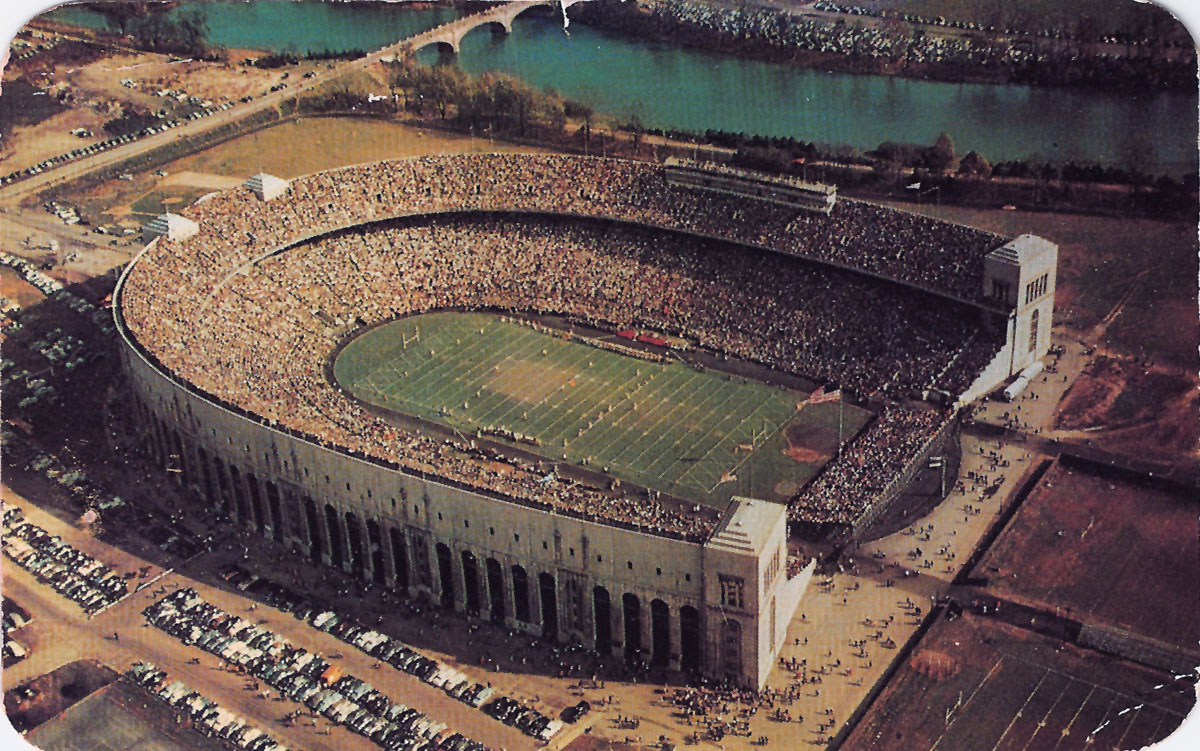
Ohio Stadium, possibly around 1950
The Big Ten title was on the line, so the Buckeyes were going for back-to-back titles. However, until 1975, the Big Ten had 2 dumb rules: That the Rose Bowl was the only bowl game to which any of their teams could accept bids; and that no team could go to it in back-to-back years. In other words, if a team won back-to-back titles, in the 2nd year, the 2nd place team could accept the Rose Bowl bid. The Wolverines had to win in order to accept that bid. In the event of their defeat, they would have fallen behind Wisconsin in the league standings, and Wisconsin would have been offered the bid.
Columbus is 185 miles south of Ann Arbor, and as far south as Philadelphia. And it was the Saturday of Thanksgiving weekend. It was a little early for them to get hit with a snowstorm. But they got hit with one. It remains the worst weather this rivalry has ever had: A temperature of 10 degrees, wind gusts up to 28 miles per hour, and snow falling at 2 inches per hour. The snow was falling so hard, neither set of goalposts could be seen from midfield.
There was a meeting before the game. Oosterbaan and Fesler agreed that the game should not be played. Oosterbaan's predecessor as Michigan's head coach, now their athletic director, Herbert "Fritz" Crisler, was willing to forfeit and not reschedule the game. But Ohio State A.D. Dick Larkins would not accept the forfeit: He was willing to postpone only, not cancel.
The fans were not willing to postpone: A crowd of 79,868 filled Ohio Stadium to what was then its capacity. Eyewitness reporters said that some fans built small bonfires to keep warm, and others put boxes over the heads as protection from the cold, with eyeholes cut out. This was before fans began wearing paper bags over their heads to show that they didn't want their faces shown at games played by their bad teams. Local Boy Scouts helped the grounds crew remove the snow from the tarp, and then remove the tarp from the field.
It's worth noting that this rivalry wouldn't really be possible if Michigan hadn't spent the last 100+ years recruiting players from Ohio. There have been brothers on both sides, and even fathers and sons. In this game, Bob Momsen played for Ohio State, and his brother Tony Momsen played for Michigan. Good thing for the Momsen household that this game was being played 2 days after, rather than on, Thanksgiving.
In the 1st quarter, Michigan's Chuck Ortmann tried to punt, but Bob Momsen blocked his kick, then recovered the punt on the 8-yard line. Three straight Buckeye run plays lost yardage. Running back Vic Janowicz, soon to be awarded the Heisman Trophy, attempted a 38-yard field goal in the horrible weather, and made it. The Buckeyes led, 3-0, and, at the time, it was easy to believe that the score would hold for the rest of the game.
But Janowicz, the beneficiary of the blocked punt, had his own punt blocked deep in his own territory, by Al Wahl. The ball went through the end zone, and Michigan closed to within 3-2 with the safety. That swung the momentum, and, with 20 seconds left in the 1st half, Janowicz attempted to punt again. But his kick was blocked by Tony Momsen, who fell on the ball as it drifted into the end zone. The extra point was good, and it was 9-3 Wolverines.
That would be the final score. Michigan won without ever getting a first down in the slippery conditions; Ohio State got only 3 first downs. The Buckeyes had 4 out of 21 punts blocked, the Wolverines 1 of 24, punting for 1,408 yards between them. The Buckeyes attempted 9 passes, completing none of them.
This was Ohio State's 4th straight loss to Michigan. Fesler saw the writing on the wall, and resigned. Ohio State hired the head coach at nearby Miami University: Wayne Woodrow "Woody" Hayes. As one of his assistants, he brought one of his Miami players: Glenn Edward "Bo" Schembechler.
Hayes turned Ohio State into one of the top programs in the country, based in part on making beating Michigan -- or, as he called it, "That School Up North" -- a must. Michigan won again in 1951, but, from 1952 to 1968, the Buckeyes went 12-4 against the Wolverines.
After a few years as Hayes' assistant, Schembechler returned to Miami University as their head coach. In 1969, he was hired as head coach at Michigan, and he used Hayes' tactics as well as he did, and made beating Ohio State Michigan Mission Number 1. Ohio State went into the 1969 Michigan game undefeated and defending National Champions, with a 22-game winning streak, but Michigan won, in a game nationally televised by ABC, starting what became known as "The Ten-Year War" between Woody and Bo, and making the rivalry one that takes on national attention every November.
Through the 2021 season, Michigan lead the rivalry, 59-51-6.
*
November 25, 1950 was a Saturday. Among the other college games played this day were the following:
* Not yet a big rivalry, but it would become one: Number 1 Oklahoma beat Number 16 Nebraska, 49-35 at Owen Field in Norman, Oklahoma. Oklahoma were awarded the National Championship, in an era when it was awarded before the bowl games. But they lost the Sugar Bowl to Kentucky.
* Number 2 Army were off. So were their arch-rivals, Navy. The following week, Nayv upset Army at Municipal Stadium (later John F. Kennedy Stadium) in Philadelphia.
* Rivalry: Number 3 Kentucky were upset by Number 9 Tennessee, 7-0 at Shields-Watkins Field (now Neyland Stadium) in Knoxville, Tennessee. Kentucky beat Oklahoma in the Sugar Bowl, which, given that Army didn't go to bowl games in those days, should have made Kentucky the National Champions. It would have been the 1st as a head coach for Paul "Bear" Bryant, later to win them at the University of Alabama. Tennessee went on to beat Texas in the Cotton Bowl.
* Rivalry: Number 4 University of California were held to a tie by Stanford, 7-7 at the old California Memorial Stadium in Berkeley. Cal went on to lose the Rose Bowl to Michigan.
* Rivalry: Number 6 Illinois were upset by Northwestern, 14-7 at Dyche Stadium (now Ryan Field) in the Chicago suburb of Evanston, Illinois.
* Number 7 Princeton beat Dartmouth, 13-7 at Palmer Stadium in Princeton.
* Number 13 University of Pennsylvania were upset by Cornell, 13-6 at Franklin Field in Philadelphia.
* Number 15 Southern Methodist University (SMU) were upset by Baylor, 3-0 at the Cotton Bowl in Dallas.
* Number 17 Alabama beat Florida, 41-13 at Florida Field in Gainesville.
* Rivalry: Number 18 Washington beat Washington State, 52-21 at Memorial Stadium (later Joe Albi Stadium) in Spokane, Washington.
* Number 20 Loyola University were upset by Santa Clara, 28-26 at Gilmore Stadium in Los Angeles. Now named Loyola Marymount, the school no longer plays football. This was the only game they lost that season.
* The night before, Number 14 University of Miami beat Iowa, 14-6 at Burdine Stadium (the stadium later known as the Orange Bowl) in Miami. Despite playing it on their home field, Miami ended up losing the Orange Bowl to Clemson.
* Rivalry: Fordham beat New York University, 13-0 at the Polo Grounds.
* Rivalry: Yale beat Harvard, 14-6 at Harvard Stadium in Boston.
* Rivalry: George Washington University beat Georgetown, 7-6 at Griffith Stadium in Washington.
* Rivalry: Duke beat North Carolina, 7-0 at Kenan Stadium in Chapel Hill.
* Rivalry: Penn State beat Pittsburgh, 21-20 at Forbes Field in Pittsburgh.
* Rivalry: Purdue beat Indiana, 13-0 at Ross-Ade Stadium in West Lafayette, Indiana.
* Rivalry: Wisconsin beat Minnesota, 14-0 at Camp Randall Stadium in Madison, Wisconsin.
* Rivalry: Colorado beat Colorado A&M (now Colorado State), 31-6 at Colorado Field in Fort Collins.
* Rivalry: Oregon State beat Oregon, 14-2 at Multnomah Stadium (now Providence Park) in Portland.
* Rivalry: UCLA beat USC, 39-0 at the Los Angeles Memorial Coliseum.
* Rutgers had finished its season the week before, losing to Penn State, and finishing 4-4.
Baseball season was over. There were 4 games played in the NBA:
* The Syracuse Nationals beat the Washington Capitols, 77-67 at the Uline Arena in Washington (now the Washington Coliseum).
* The Rochester Royals beat the Boston Celtics, 90-82 at the Edgerton Park Arena in Rocheter, New York.
* The Indianapolis Olympians beat the Baltimore Bullets, 92-81 at the Butler Fieldhouse (now the Hinkle Fieldhouse) in Indianapolis.
* And the Tri-Cities Blackhawks beat the Fort Wayne Pistons, 85-71 at the Wheaton Field House in Moline, Illinois.
The NHL's entire "Original Six" were in action. The New York Rangers and the Boston Bruins played to a tie, 3-3 at the Boston Garden. The Toronto Maple Leafs beat the Montreal Canadiens, 4-1 at Maple Leaf Gardens in Toronto. And the Detroit Red Wings beat the Chicago Black Hawks, 4-1 at the Olympia Stadium in Detroit.
And in English soccer, Arsenal beat West London team Fulham, 5-1 at Highbury in North London.


No comments:
Post a Comment