July 27, 1936: The Democratic National Convention is held at the Philadelphia Civic Center's Convention Hall. (A hospital is on the site now.) President Franklin D. Roosevelt and Vice President John Nance Garner are nominated for a 2nd term.
For the 1st time, the Democrats needed only a majority of their Delegates to officially nominate a President and a Vice President. The previous rule required two-thirds of the Delegates, and basically gave Southern States a veto over a potential nominee.
One candidate whose Convention bid was derailed by the 2/3rds rule was Champ Clark of Missouri, Speaker of the House, who ran in 1912. His son, Senator Bennett Champ Clark, said at the 1936 Convention that the abolition of the rule meant that "the Democratic Party is no longer a sectional party, it has become a great national party."
But Southern Democrats considered it a slap in the face, and while FDR managed to keep them as part of his coalition, they began to break away, starting with the "Dixiecrat" walkout in 1948. At this convention Senator Ellison Smith of South Carolina walked out when he saw that a black minister, Rev. Marshall L. Shepard, was going to deliver the invocation.
That was all indoors. Outdoors, at the University of Pennsylvania's Franklin Field (which is still in use), FDR was being led to the podium to give his acceptance speech. He "walked" by using a can in one hand, and having his other arm held by an aide, usually his son, James. With people packed around him, it looked from a distance like he was walking, and that, while it was known that he once had polio, it hadn't affected him much. In fact, he was, for the most part, paralyzed from the waist down, so this illusion of walking was necessary.

Franklin Field
Among those in attendance on this day was poet Edwin Markham, best known for his 1898 poem "The Man With the Hoe," making him popular with farmers and other working men. In 1914, his contribution to the nonfiction book Children In Bondage helped to end child labor in America. As an editor, he popularized for the 20th Century the works of John Keats, Edgar Allan Poe, John Greenleaf Whittier and Henry Wadsworth Longfellow. In 1922, he published the poem "Lincoln, Man of the People," and a recording of him reciting it became one of the earliest sound film.
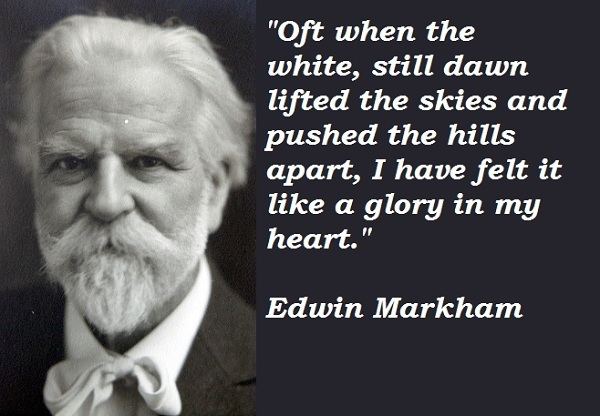
Markham was a great fan of FDR's, and walked up to shake his hand. But, 84 years old, he tripped, and knocked FDR over.
Markham was terribly embarrassed. FDR was not hurt, and was quickly picked up so that the audience couldn't really see what has happened. But the pages of his speech were scattered. (No teleprompters in those days.) So he had to put them back together. He said:
Here, and in every community throughout the land, we are met at a time of great moment to the future of the Nation. It is an occasion to be dedicated to the simple and sincere expression of an attitude toward problems, the determination of which will profoundly affect America.
I come not only as a leader of a party, not only as a candidate for high office, but as one upon whom many critical hours have imposed and still impose a grave responsibility...
America will not forget these recent years, will not forget that the rescue was not a mere party task. It was the concern of all of us. In our strength we rose together, rallied our energies together, applied the old rules of common sense, and together survived.
In those days we feared fear. That was why we fought fear. And today, my friends, we have won against the most dangerous of our foes. We have conquered fear.
But I cannot, with candor, tell you that all is well with the world. Clouds of suspicion, tides of ill-will and intolerance gather darkly in many places. In our own land we enjoy indeed a fullness of life greater than that of most Nations. But the rush of modern civilization itself has raised for us new difficulties, new problems which must be solved if we are to preserve to the United States the political and economic freedom for which Washington and Jefferson planned and fought...
Out of this modern civilization, economic royalists carved new dynasties. New kingdoms were built upon concentration of control over material things. Through new uses of corporations, banks and securities, new machinery of industry and agriculture, of labor and capital, all undreamed of by the fathers, the whole structure of modern life was impressed into this royal service...
Throughout the Nation, opportunity was limited by monopoly. Individual initiative was crushed in the cogs of a great machine. The field open for free business was more and more restricted. Private enterprise, indeed, became too private. It became privileged enterprise, not free enterprise.
An old English judge once said: "Necessitous men are not free men." Liberty requires opportunity to make a living—a living decent according to the standard of the time, a living which gives man not only enough to live by, but something to live for.
For too many of us the political equality we once had won was meaningless in the face of economic inequality. A small group had concentrated into their own hands an almost complete control over other people's property, other people's money, other people's labor, other people's lives. For too many of us life was no longer free; liberty no longer real; men could no longer follow the pursuit of happiness.
Against economic tyranny such as this, the American citizen could appeal only to the organized power of Government. The collapse of 1929 showed up the despotism for what it was. The election of 1932 was the people's mandate to end it. Under that mandate it is being ended...
These economic royalists complain that we seek to overthrow the institutions of America. What they really complain of is that we seek to take away their power. Our allegiance to American institutions requires the overthrow of this kind of power. In vain they seek to hide behind the Flag and the Constitution. In their blindness, they forget what the Flag and the Constitution stand for. Now, as always, they stand for democracy, not tyranny; for freedom, not subjection; and against a dictatorship by mob rule and the over-privileged alike.
The brave and clear platform adopted by this Convention, to which I heartily subscribe, sets forth that Government in a modern civilization has certain inescapable obligations to its citizens, among which are protection of the family and the home, the establishment of a democracy of opportunity, and aid to those overtaken by disaster...
We are poor indeed if this Nation cannot afford to lift from every recess of American life the dread fear of the unemployed that they are not needed in the world. We cannot afford to accumulate a deficit in the books of human fortitude...
Governments can err. Presidents do make mistakes. But the immortal Dante tells us that divine justice weighs the sins of the cold-blooded and the sins of the warm-hearted in different scales. Better the occasional faults of a Government that lives in a spirit of charity than the consistent omissions of a Government frozen in the ice of its own indifference.
There is a mysterious cycle in human events. To some generations much is given. Of other generations much is expected. This generation of Americans has a rendezvous with destiny.
In this world of ours in other lands, there are some people, who, in times past, have lived and fought for freedom, and seem to have grown too weary to carry on the fight. They have sold their heritage of freedom for the illusion of a living. They have yielded their democracy.
I believe in my heart that only our success can stir their ancient hope. They begin to know that here in America we are waging a great and successful war. It is not alone a war against want and destitution and economic demoralization. It is more than that; it is a war for the survival of democracy. We are fighting to save a great and precious form of government for ourselves and for the world.
I accept the commission you have tendered me. I join with you. I am enlisted for the duration of the war.
FDR knew what he was doing with that closing: Within the last year, Italy's Fascist dictator Benito Mussolini had invaded and annexed Ethiopia, Somaliland and Eritrea, and created the colony of Italian East Africa, as the start of a new version of the Roman Empire; Fascists led by Francisco Franco began the Spanish Civil War, to overthrow the leftist Second Republic; Nazi Germany's Fascist dictator Adolf Hitler had occupied the Rhineland, violating the terms of the Treaty of Versailles that finalized the results of World War I; and Japan had increased its aggressiveness toward China. The clouds of war were forming.
But that phrase, "a rendezvous with destiny," would echo through the ages. Later Presidents John F. Kennedy and Ronald Reagan would use it. And in his speech announcing the independence of India in 1947, Prime Minister Jawaharlal Nehru would say that his new nation's people had "a tryst with destiny."
*
July 27, 1936 was a Monday. These 4 baseball games were played:
* The New York Yankees lost to the Detroit Tigers, 9-1 at Navin Field (later renamed Briggs Stadium and Tiger Stadium) in Detroit. Lynwood "Schoolboy" Rowe not only outpitched Vernon "Lefty" Gomez, but, in his own cause, went 2-for-4 with a home run and 4 RBIs. Hank Greenberg had been injured early in the season, and missed the rest, including this game.
* The Brooklyn Dodgers beat the Pittsburgh Pirates, 6-3 at Ebbets Field. Paul Waner went 0-for-4. Lloyd Waner went 1-for-5 with an RBI.
* The Philadelphia Athletics beat the Chicago White Sox, 15-8 at Comiskey Park in Chicago. All the A's got at least 1 hit, including pitcher Harry Kelley; and all but Kelley got at least 2 hits. Lou Finney went 5-for-6 with an RBI. Pinky Higgins went 4-for-6 with 2 RBIs. Frankie Hayes went 3-for-5 with a walk and 2 RBIs. Wally Moses went 3-for-6 with 2 RBIs. Chubby Dean (no relation to Dizzy and Daffy) went 3-for-6 with 1 RBI. Bob Johnson went 2-for-6 with 4 RBIs.
Zeke Bonura went 4-for-5 with 2 RBIs for the South Siders. In spite of a combined 23 runs, no home runs were hit by either team.
* And the St. Louis Browns beat the Boston Red Sox, 7-5 at Sportsman's Park in St. Louis. Jimmie Foxx went 3-for-4 with an RBI.


No comments:
Post a Comment