Showing posts with label woodie fryman. Show all posts

Friday, December 16, 2022

December 16, 1976: The Trade That Broke the Big Red Machine

December 16, 1976: The Cincinnati Reds of the 1970s were one of the greatest baseball teams of all time. They included the game's all-time hits leader, Pete Rose; one of its greatest catchers ever, Johnny Bench; and perhaps the best all-around player in the game at the time, Joe Morgan. Between them, those 3 men won the National League Most Valuable Player award 5 times in a span of 7 years.

What few people, including the Reds' organization until it was too late, realized at the time was that none of those men was the most important player on the team.

Those Reds, also known as the Big Red Machine, were one of the most dominant teams in baseball history. Playing their home games on the artificial turf of Riverfront Stadium, they won 5 National League Western Division titles, 4 NL Pennants and 2 World Series in a span of 6 years, with a lineup of Hall of Famers and All-Stars, that became known as "The Great Eight":

3rd Base, Number 14: Pete Rose
2nd Base, Number 8: Joe Morgan
Catcher, Number 5: Johnny Bench
1st Base, Number 24: Tony Pérez
Left Field, Number 15: George Foster
Shortstop, Number 13: Dave Concepción
Right Field, Number 30, Ken Griffey (Sr.)
Center Field, Number 23, César Gerónimo
Pitcher (No Designated Hitter in the National League until 2022)

But after their 2nd World Series win in 1976, they made a trade that changed everything.

Atanasio Pérez Rigal, who had fled Cuba just after the 1959 revolution, had been a cornerstone of the Reds' offense, driving in at least 90 runs every year since 1967. He was also a leader in the clubhouse and a fan favorite, earning the nickname "The Mayor of Riverfront" for his popularity. His teammates called him "Big Doggie."

But, as they did after the 1965 season, when they traded Frank Robinson to the Baltimore Orioles for Milt Pappas, the Reds needed more pitching, and they had a young 1st baseman in Dan Driessen waiting in the wings. So, the Reds' front office decided that Pérez was expendable.

They sent Pérez and relief pitcher Will McEnaney to the Montréal Expos for pitchers Woodie Fryman and Dale Murray. It was supposed to make the Reds stronger over the long haul, but it had the opposite effect. Instead, it broke the heart and the spirit of the team.

And despite the argument in favor of better pitching, it was really over money. The Reds were perennially a cheap organization. Pérez agreed to waive his no-trade clause as a 10-and-5 player (10 years in the major leagues, 5 years with the same team), and accepted a lucrative 3-year contract from the Expos.

Although Driessen was a good hitter and a good 1st baseman, he was not as productive as Pérez. Without his bat in the lineup, they finished 2nd in 1977, 10 games behind the Los Angeles Dodgers. In 1978, they finished 2 1/2 games behind the Dodgers. In 1979, they won the NL West, but were swept in the NL Championship Series by the Pittsburgh Pirates, whom they had beaten in the NLCS in 1970, '72, '74 and '75.

Pérez, meanwhile, thrived in Montreal. In his 3 seasons with the team, his home run totals were 19, 14 and 13, compared to Driessen's 17, 16 and 18; and his RBI totals were 91, 78 and 73, compared to 91, 70 and 75. Based on stats alone, it seems like it wasn't a downgrade. But the Reds' lost Pérez's leadership, which was now mentoring not their young players, but young Expos like Gary Carter and Andre Dawson, which led to them nearly winning the NL Eastern Division in 1980, and winning it in 1981. And both Murray and Fryman were shaky for the Reds. It took them until 1990 to win another Pennant, and that's the only Pennant and World Series they've won since this trade.

Pérez would rejoin his former Reds teammates Rose and Morgan on the Philadelphia Phillies in 1983, and, together with Mike Schmidt and Steve Carlton, they won another Pennant. Pérez was inducted into the Hall of Fame in 2000, joining Bench, Morgan, Schmidt, Carlton, and Reds manager Sparky Anderson. He also would have joined Rose, had Rose not been banned from baseball in 1989. Carter and Dawson were later elected as well.

Murray returned to the Expos in 1979, and in 1981, he signed with the Toronto Blue Jays. After the 1982 season, he would be involved in another lopsided trade involving a power-hitting 1st baseman: With Don Mattingly waiting in the wings, the New York Yankees sent 1st base prospect Fred McGriff to the Jays for Murray. Murray was a bust for the Yankees, while McGriff went on to hit 493 career home runs.

*

December 16, 1976 was a Thursday. Baseball was out of season. Football was in midweek. There were 3 games in the NBA:

* The New York Nets lost to the Kansas City Kings, 100-90 at the Kemper Arena (now the Hy-Vee Arena) in Kansas City.

* The Cleveland Cavaliers beat the Indiana Pacers, 111-105 at The Coliseum in the Cleveland suburb of Richfield, Ohio.

* And the Houston Rockets beat the Atlanta Hawks, 118-107 at The Summit in Houston. Rudy Tomjanovich, later to coach the Rockets to 2 NBA Championships, led all scorers on the night with 36 points. (The arena has since been converted into the Central Campus of the Lakewood Church, Dr. Joel Osteen's "megachurch.")

There were no games in the NHL, but there were 2 in the World Hockey Association. The Minnesota Fighting Saints beat the Indianapolis Racers, 5-3 at the Market Square Arena in Indianapolis. And the San Diego Mariners beat the Edmonton Oilers, 3-0 at the San Diego Sports Arena (now the Pechanga Arena).

Monday, June 6, 2022

June 6, 1972: Turn It Around Night In Philadelphia

Steve Carlton

June 6, 1972: The Philadelphia Phillies, having lost 18 of their last 19 games, hold Turn It Around Night at Veterans Stadium. It was one of many promotional ideas, some of them sillier than others, that came from the mind of Bill Giles.

The son of former National League President Warren Giles, for whom the NL's championship trophy is named, Bill had been, as had his father before him, an executive with the Cincinnati Reds. In 1962, he and 2 other former Reds executives, Gabe Paul and Tal Smith, were a part of the inaugural front office of the Houston Astros. In 1965, he became their director of promotions.

In 1969, he was named a vice president of the Phillies, and focused on promotions. His biggest promotion was the last game at Connie Mack Stadium, formerly Shibe Park, in 1970, and it was a disaster: He gave each fan a ceremonial seat slat, and they used the wooden slats as clubs as they tore what was then the oldest active ballpark apart.

The move to The Vet led to all kinds of promotions. The 1st game there, April 10, 1971, featured the ceremonial first ball dropped out of a helicopter hanging over the artificial turf field, caught by Phillies catcher Mike Ryan, who scurried like crazy trying to catch it, but did. On another occasion, Giles tried a ceremonial first ball delivered by Rocketman, a man wearing a jet-pack. A ceremonial first ball delivered by Kiteman, which was tried 4 times, crashing the 1st time. A high-wire walk across the middle of the stadium by the legendary circus performer Karl Wallenda. He made it.

Everything was going wrong for the Phillies in 1972 -- except for the pitching of the newly-acquired Steve Carlton. It seemed as though he couldn't lose. On days he was starting, he would tell his teammates, "It's Win Day."

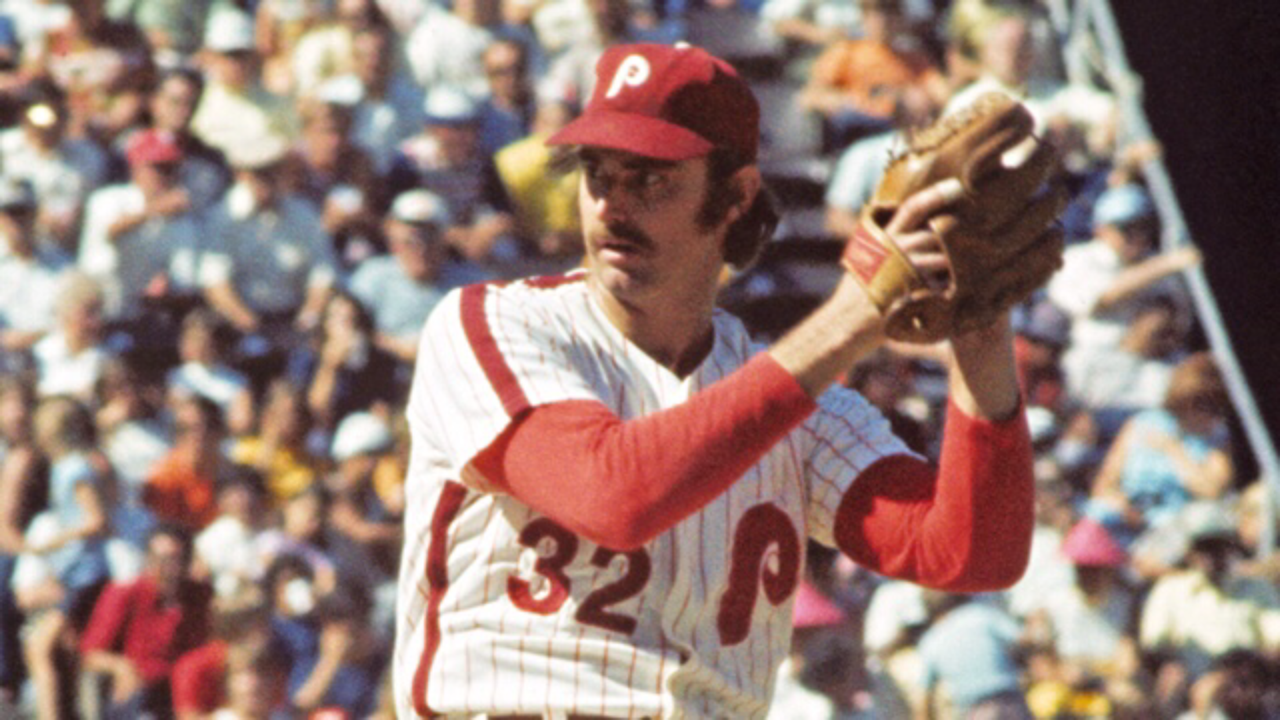
On June 6, 1972, for the Phillies against the Astros, the scheduled starting pitcher was Woodie Fryman. He was a decent pitcher, who had gone 10-7 the previous season, and would eventually win 141 games in the major leagues. But this was an unlikely Win Day. So Giles scheduled a promotion: Turn It Around Night.

The lineup was announced in reverse order, with last names first. Instead of the 1st name being the leadoff hitter: "The shortstop, Number 10, Larry Bowa"; it was "The pitcher, Number 35, Fryman, Woodie." The 7th inning stretch was held in the 3rd inning. The ushers wore their hats backwards and their name tags on the backs of their shirts. And the scoreboard welcomed groups that were not in attendance.

How many people were in attendance? Not many: 8,237, meaning that there were about 50,000 empty seats. (To be fair, it was a Tuesday night, not a weekend.) Did they, at least, see a good game? It didn't start out that way: The Astros scored 2 runs in the 1st inning, and 2 more in the 4th.

The Phillies made a go of it in the bottom of the 9th. Bowa led off with a single. Terry Harmon grounded into a force play that eliminated Bowa. Don Money drew a walk, Greg Luzinski doubled, scoring Harmon. The Astros made a pitching change. Tommy Hutton singled, scoring Money and Luzinski.

The Phils had closed to within 4-3, and had the tying run on 1st and the winning run at the plate, with only 1 out. The next batter was Deron Johnson, who would hit 245 home runs in his career. After him, it was Willie Montañez, who would hit 145. There was hope. But Johnson popped to short, and Montañez struck out, ending the game.

How far should the Phillies have taken this pre-George Costanza "Do the Opposite" Day? Given that it was Philadelphia, they should have served pastrami sandwiches instead of cheesesteaks, listened to music without any soul, and cheered somebody in a Santa Claus suit.

When the 1972 season came to an end, the Phillies were 29-12 in games that Carlton, named the Cy Young Award winner, started; and 30-85 in games that he didn't start.

But hope was on the way. Before the season started, Ruly Carpenter -- Robert Ruliph Morgan Carpenter III -- had already told his father, Bob Carpenter, the team's owner, to give him the keys to the kingdom. Ruly and Giles hired Paul Owens to be the team's general manager, and former pitcher Dallas Green to be the team's scouting director. It wasn't yet visible in wins and losses, but these moves were already beginning to pay off.

They already had Carlton, Bowa and Luzinski. On September 12 of that season, Mike Schmidt made his major league debut. A team that would make the Playoffs 6 times in an 8-year stretch, including 2 Pennants and the 1980 World Championship, managed by Green, was on the way. And the promotions kept coming, including the 1978 creation of baseball's most popular mascot, the Phillie Phanatic.

After winning the World Series, the Carpenters decided to sell the team the next season. Giles led the group that bought the team. He remained the controlling owner until 1997, when he began selling his shares to David Montgomery. Since 2001, he has held his father's old post of President of the National League.

*

June 6, 1972 was a Tuesday. These other Major League Baseball games were played that day:

* The New York Yankees lost to the Texas Rangers, 6-3 at Arlington Stadium in the Dallas suburb of Arlington, Texas. Dick Bosman outpitched Fritz Peterson. Rusty Torres hit a home run.

* The New York Mets beat the Cincinnati Reds, 3-2 at Shea Stadium. John Milner hit a home run. Although he was on the Mets' roster, Willie Mays did not play. For the Reds, Johnny Bench hit a home run, and Pete Rose went 0-for-3 with a walk.

* The Atlanta Braves beat the Montreal Expos, 3-2 at Jarry Park in Montreal. Hank Aaron went 0-for-4.

* The Minnesota Twins beat the Baltimore Orioles, 5-4 at Memorial Stadium in Baltimore. The Orioles led 4-0 going into the 9th inning, but Jim Palmer ran out of gas, and the game went to extra innings. Steve Brye singled home Rod Carew with the winning run in the top of the 15th inning. Carew went 4-for-7. Harmon Killebrew went 0-for-4 with a walk. Brooks Robinson went 1-for-5 with 2 walks and an RBI.

* The Oakland Athletics beat the Cleveland Indians, 7-2 at Cleveland Municipal Stadium. The A's trailed 2-1 going into the 8th inning, but scored 2 runs in the 8th and 4 in the 9th to win it. Reggie Jackson went 3-for-5 with a home run and 3 RBIs.

* A doubleheader was split at Tiger Stadium in Detroit. The Detroit Tigers won the opener, 8-6. The California Angels won the nightcap, 4-0. Clyde Wright pitched a 4-hit shutout. After not playing in the 1st game, Al Kaline went 0-for-3 with a walk in the 2nd.

* The Boston Red Sox beat the Chicago White Sox, 2-0 at Comiskey Park in Chicago. Sonny S

* The Kansas City Royals beat the Milwaukee Brewers, 4-2 at Kansas City Municipal Stadium.

* The Los Angeles Dodgers beat the Chicago Cubs, 5-0 at Dodger Stadium in Los Angeles. Al Downing pitched a 5-hit shutout. Frank Robinson, in his only season with the Dodgers, went 2-for-3 with a walk and an RBI.

* The St. Louis Cardinals beat the San Francisco Giants, 5-3 at Candlestick Park in San Francisco. Lou Brock went 2-for-4 with 2 stolen bases. Joe Torre hit a home run.

* And in a rare rainout at San Diego Stadium, the San Diego Padres and the Pittsburgh Pirates had their game rescheduled as part of a doubleheader on August 20. The Pirates swept, 9-3 and 5-2. Roberto Clemente was injured, and did not play in either game. But Willie Stargell went 3-for-7 with a walk and 3 RBIs over the 2 games.

December 31, 1999 & January 1, 2000: The Millennium

December 31, 1999:  The Millennium arrives. The people of planet Earth survived. At a terrible cost. But we hadn't destroyed ourselves. ...