Brooks Robinson and his 16 Gold Gloves
October 15, 1970: Ed Hurley, one of the umpires in the World Series, speaks of Brooks Robinson, the 3rd baseman of the victorious Baltimore Orioles, saying, "He came down from a higher league."
Born on May 18, 1937 in Little Rock, Arkansas, he reached the major leagues with the Orioles in 1955. In 1960, he made his 1st All-Star Game, and won the 1st of 16 consecutive Gold Gloves. In 1964, the Orioles nearly won the American League Pennant, and Robinson was named the AL's Most Valuable Player.
In 1966, the Orioles acquired right fielder Frank Robinson -- black, and, together, he and the white Brooks Robinson joked about the differences in things like their uniform numbers -- and he led them to their 1st Pennant and 1st World Series with with a Triple Crown season. In 1969, the Orioles won another Pennant, but lost the World Series to the New York Mets. Brooks nearly won Game 4 in the bottom of the 9th, but, in one of baseball's great ironies, he lost what would have been his greatest moment at the bat by an opponent's great fielding, a catch by Met right fielder Ron Swoboda.
So when the Orioles won the Pennant again in 1970, they had something to prove. Brooks might not have felt like he had anything to prove. But Frank Robinson was one of the biggest stars in baseball, and another teammate, 1st baseman John "Boog" Powell, was the odds-on favorite to win that season's AL MVP (and he did). It's hard to say that Brooks was forgotten, but he certainly wasn't the first player anyone thought about when they thought of the Orioles.
At the time, the title of the greatest third baseman in baseball history was pretty much up for grabs. Late 19th Century Baltimore Oriole John McGraw, early 20th Century Boston Red Sock Jimmy Collins, 1920s and '30s Pittsburgh Pirate Harold "Pie" Traynor, and Milwaukee Brave star Eddie Mathews were among the best hitters at the position, although only Mathews was known as a power hitter. Collins and Traynor were hailed as the best fielders at the position.
The Boyer brothers, Ken of the St. Louis Cardinals, and Clete, the former New York Yankee 3rd sacker then still active with the Atlanta Braves, also got some accolades, Ken mainly as a hitter, and Clete mainly as one of the few who fielded the position as slickly as Robinson.
But Robinson was not usually considered an all-time great 3rd baseman, despite already having won 10 Gold Gloves. So the 1970 World Series against the Cincinnati squad already known as "The Big Red Machine," would lift him to superstar status.
Game 1, at Cincinnati's Riverfront Stadium. This was the 1st World Series game ever played on artificial turf, and the 1st in which both teams wore names on the backs of their uniforms. And it was the 1st World Series with a black umpire, Emmett Ashford, who had become MLB's 1st black umpire in 1966, and was retiring at the end of the season: At the time, 55 was a mandatory retirement age for umpires, but he was allowed to come back for one more season and officiate in a World Series. The Jackson 5 sang the National Anthem.
Brooks, Powell, and catcher Elrod Hendricks hit home runs. Brooks made a backhanded stop of a grounder by Lee May, spinning, and firing a throw that bounced into Boog's glove, getting May out. Jim Palmer outpitched Gary Nolan. Orioles 4, Reds 3.
Game 2, in Cincinnati. Boog hit another homer in the 4th inning, and the O's tacked 5 runs on in the 5th. As with Game 1, Brooks went 1-for-4 with an RBI, but the hit was a single, not a homer. Orioles 6, Reds 5. With fans seeing vacuum cleaners being used on the artificial turf, they began calling Brooks "The Human Vacuum Cleaner," and "Mr. Hoover," after the brand of vacuum cleaner.
Game 3, back on the natural grass and dirt infield of Memorial Stadium in Baltimore. Brooks took over the game immediately. In the top of the 1st, he snared a Tony Pérez grounder, and started a double play. In the bottom of the 1st, the Orioles loaded the bases, and Brooks doubled home 2 runs. In the top of the 2nd, he made a tough play to throw out Tommy Helms. In the 6th, Johnny Bench hit a liner that should have gone through the hole, but Brooks snared it on the fly.

Dave McNally pitched a complete game, and became the 1st pitcher ever to hit a grand slam in a World Series game. (Through 2022, he's still the only one.) Frank Robinson and Don Buford added home runs. Orioles 9, Reds 3. What had been predicted as a tight Series was now in danger of becoming a dominating sweep, as with the Orioles over the defending Champion Los Angeles Dodgers in 1966.
Game 4, in Baltimore. The Orioles came in with a 17-game winning streak: Their last 11 of the regular season, 3 straight in the ALCS, and the 1st 3 of the Series. Brooks went 4-for-4, taking Nolan deep on a home run. But the Reds showed up, scoring 3 runs in the 8th inning, and saved some face. Reds 6, Orioles 5.
Game 5, in Baltimore, on October 15. The Reds scored 3 runs in the top of the 1st, and, for a moment, the greatest comeback in sports history seemed possible. But Baltimore put a stop to that, scoring 2 runs in each of their 1st 3 innings, allowing Mike Cuellar to settle down and keep Cincinnati off the scoreboard until next April. Brooks went 1-for-5, and robbed Bench again. Orioles 9, Cincinnati 3.
Brooks Robinson had shown the world the peak of fielding at 3rd base. He was awarded the Series' Most Valuable Player award. With it came a new car. Bench said, "If we had known he wanted a car that badly, we'd all have chipped in and bought him one."
He helped the Orioles win another Pennant in 1971, as part of the "Leather Curtain" that gave Baltimore the best infield defense in the sport, with shortstop Mark Belanger, 2nd baseman Davey Johnson, and 1st baseman Boog Powell. But the O's lost that World Series to the Pittsburgh Pirates. He would help them win the AL East again in 1973 and 1974, losing the ALCS to the Oakland Athletics both times.
A thumb injury in 1975 was the beginning of his end, and he lost his starting job to Doug DeCinces in 1976. In 1977, at 42, he played only 24 games, the last on August 13. With catcher Rick Dempsey coming off the Disabled List, and a roster spot necessary, Brooks announced his retirement on August 21. Brooks Robinson Day was held on September 18, 1977, and his Number 5 became the 1st number ever retired in Baltimore sports.
He finished with a lifetime batting average of .267; 2,848 hits including 482 doubles, 68 triples and 268 home runs, decent totals for a man who spent 23 seasons in a pitcher's park like Memorial Stadium. Those 23 seasons were the most that any player had spent with any one team, a record tied by Carl Yastrzemski of the Boston Red Sox in 1983, but never broken.
Jim Murray, the great sports columnist of The Los Angeles Times, wrote during Robinson's career that "In the future, Brooks Robinson will be the standard every third baseman will be measured by." In his 2015 biography Brooks: The Biography of Brooks Robinson, Doug Wilson said, "That statement has withstood the test of time."
Since then, there has been Mike Schmidt, Graig Nettles, George Brett, Wade Boggs, Chipper Jones, Adrián Beltré, and, for the 2nd half of his career, Alex Rodriguez. Most baseball observers still rank Brooks as the greatest 3rd baseman in American League history, behind only Schmidt overall.
In 1983, Brooks was elected to the Baseball Hall of Fame. When the Orioles established their team Hall of Fame, he and Frank Robinson were the 1st 2 honorees. He was also elected to the Arkansas Sports Hall of Fame. When the Orioles played their last game at Memorial Stadium on October 6, 1991, he and Colts quarterback legend Johnny Unitas threw out ceremonial first balls -- in Unitas' case, a football. In 2012, a statue of Brooks was dedicated outside their new home, Oriole Park at Camden Yards.
In 1999, The Sporting News ranked their 100 Greatest Baseball Players. Brooks was ranked 80th, trailing Traynor (70th), Mathews (63rd) and Schmidt (28th) among 3rd basemen. That year, fans voted Brooks and Schmidt as the 3rd basemen on the Major League Baseball All-Century Team. In 2022, 23 years after TSN did their rankings, ESPN ranked their 100 Greatest Baseball Players, and Brooks came in 67th, trailing Mathews (64th), Boggs (45th), Brett (43rd), A-Rod (26th) and Schmidt (18th).
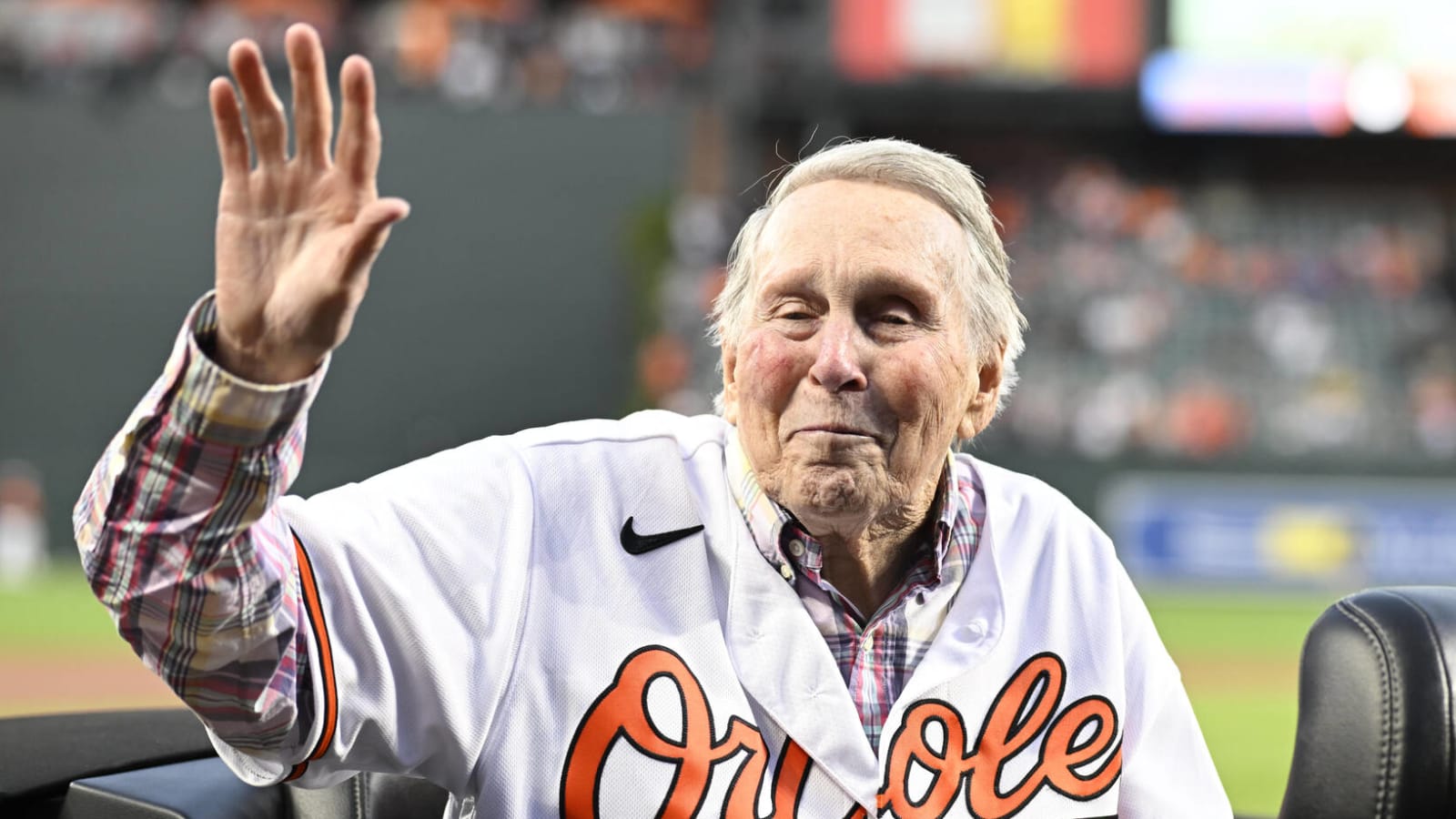
Brooks broadcast for the Orioles from 1978 to 1993. He formed a group that ran several minor-league teams, including the York Revolution, in York, Pennsylvania, where he had once played minor-league ball for the York White Roses. Their ballpark, WellSpan Park, has the address of 5 Brooks Robinson Way. That ballpark also has a statue of him. A 3rd statue is in downtown Baltimore, on Washington Boulevard. As of October 15, 2022, he is still alive.
UPDATE: He died on September 26, 2023, at the age of 86.
The Orioles have a team Hall of Fame. From this 1970 World Championship team, they have inducted Brooks Robinson, right fielder Frank Robinson, 1st baseman John "Boog" Powell, 2nd basemen Davey Johnson and Bobby Grich, shortstop Mark Belanger, left fielder Don Buford, center fielder Paul Blair, outfielder Terry Crowley, catcher Elrod Hendricks; pitchers Jim Palmer, Mike Cuellar, Dave McNally, Dick Hall, Eddie Watt; manager Earl Weaver, and coaches Billy Hunter and George Bamberger.
The Reds also have a team Hall of Fame. From their 1970 Pennant winners, they have inducted catcher Johnny Bench, 1st basemen Lee May and Tony Pérez, 2nd baseman Tommy Helms, shortstop Dave Concepción, left fielder Pete Rose; pitchers Jim Maloney, Gary Nolan, Wayne Granger, Don Gullett, Pedro Borbón and Clay Carroll; manager George "Sparky" Anderson, general manager Bob Howsam and broadcaster Joe Nuxhall. Dave Bristol, who had managed the team from 1966 to 1969, has also been inducted.
*
October 15, 1970 was a Thursday. Singer Eric Benét and rapper Elgin Baylor Lumpkin, named for a basketball star but renaming himself Ginuwine, were born on this day.
This was also the day that President Richard Nixon signed the Organized Crime Control Act of 1970 into law. I have a separate entry for that event.
Football was in midweek. There was 1 game played in the NBA: The Phoenix Suns beat the Boston Celtics, 119-100 at the Arizona Veterans Memorial Coliseum in Phoenix. There were 3 games in the American Basketball Association:
* The New York Nets lost to the Pittsburgh Condors, 105-102 at the Civic Arena in Pittsburgh.
* The Miami Floridians beat the Carolina Cougars, 105-97 at the Miami Beach Convention Center.
* And the Indiana Pacers beat their arch-rivals, the Kentucky Colonels, 127-95 at the Indiana State Fairgrounds Coliseum (now the Corteva Coliseum) in Indianapolis.
And there were 4 games in the NHL:
* The Montreal Canadiens beat the expansion Buffalo Sabres, 3-0 at the Buffalo Memorial Auditorium. This was the Sabres' 3rd regular-season game, and their 1st home game at "The Aud." They'd debut by beating Pittsburgh on October 10, before losing to Los Angeles on October 14.
* The Philadelphia Flyers beat the Vancouver Canucks, 5-4 at The Spectrum in Philadelphia. This was the expansion Canucks' 5th regular-season game, and, although they had had a tighter schedule than the Sabres, so far, they'd won 2 of their 1st 4. Their opener, on October 9, was a 3-1 loss to Los Angeles, at home at the Pacific Coliseum.
* The Chicago Black Hawks beat their arch-rivals, the Detroit Red Wings, 2-1 at the Olympia Stadium in Detroit.
* The Minnesota North Stars beat the Pittsburgh Penguins, 4-2 at the Metropolitan Sports Center in the Minneapolis suburb of Bloomington, Minnesota.
* And the New York Rangers, the Toronto Maple Leafs, the Boston Bruins, the Los Angeles Kings, the California Golden Seals and the St. Louis Blues were not scheduled.


No comments:
Post a Comment