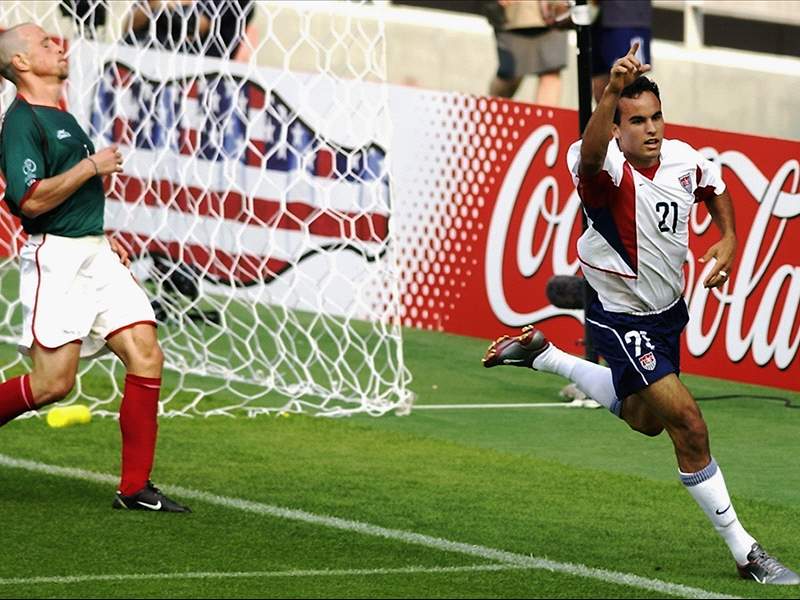
June 17, 2002: The
World Cup, the 1st ever held in 2 separate nations, moves on to the Round of 16. At Kobe, Japan, Brazil beat Belgium,
2-0. And the U.S. team has its most famous victory -- yes, more famous than the
1-0 win over England at the 1950 World Cup. At Jeonju, Korea, it's "Dos a Cero."
The United States of America and the United States of Mexico -- Mexicans call their country "Mexico," and ours "Los Estados Unidos," or "El Norte" (The North) -- have a rough rivalry in soccer. Mexican fans have been known to throw things at American players and fans, and use homophobic slurs.
Competitively, the rivalry is one-sided. The 1st match between the teams was a play-in game for the 1934 World Cup, and the U.S. won it. Mexico won the next 10 games, between 1937 and 1957; and went on a 21-0 run with 3 draws before the U.S. finally beat them again, in 1980, in a qualifier for the 1982 World Cup, at Lockhart Stadium in Fort Lauderdale, Florida. Over the next 22 years, the rivalry evened out a bit, 7-7 with 6 draws, but that included Mexico beating the U.S. in the 1991 and 1998 CONCACAF Gold Cup Finals.
The U.S. team went into the 2002 World Cup with some hope, with a young team that had succeeded the one that had rebuilt the program and gotten them into the 1990 World Cup (then considered a huge accomplishment) but playing poorly in it, and into the Knockout Stage of the 1994 World Cup on home soil, before flopping in the 1998 World Cup.
But Mexico have never done well at the World Cup. Only twice have they ever reached the Quarterfinal, in 1970 and 1986 -- the 2 times they've hosted it. A Scot recently wrote a book about soccer, saying in the introduction that, if success in the World Cup were based on the most frustrated fans, the Final would be between Scotland and Mexico. The Mexican team -- known as El Tricolor, for their 3-colored (green, white & red) flag, or El Tri for short -- could have as their motto, "We ain't much, but at least we're better than the Americans."
But in the 2002 World Cup, they won Group G. Playing on the Japan side of the tournament, they beat Croatia, 1-0 in Niigata; beat Ecuador, 2-1 at Miyagi; and drew with Italy, 1-1 at Ōita.
The U.S. were put on the Korea side of the tournament, in a tough Group D: Hosts South Korea, plus European mainstays Portugal and Poland. But they beat Portugal, 3-2 at Suwon. At the time, it was considered a major upset. At Daegu, they played South Korea to a 1-1 draw, securing advancement to the Knockout Stage. They played their Group Stage finale against Poland as if it was meaningless, losing 3-1.
It was meaningless: Poland finished last in the Group, and the U.S. would still have needed to win by 2 goals to beat South Korea for 1st place in the Group. And then the Round of 16 would have been the U.S. vs. Italy, and South Korea vs. Mexico.
If that had happened, the tournament would have lost its 2 best-remembered games. South Korea trailed Italy 1-0 in the 88th minute, but scored, and then won it 2-1 in extra time. The Italian fans immediately believed, and still do, that the officials were fixing the game in favor of the hosts. This was probably because they'd seen so many games in their league, Serie A, fixed for Turin team Juventus. But the Koreans were the better team on the night, and Francesco Totti was rightly sent off for a dive in extra time.
And so, on June 17, 2002, before a crowd of 36,380 at Jeonju World Cup Stadium, home of one of the more successful teams in South Korea's K League, Jeonbuk Hyundai Motors, the U.S. and Mexico kicked off at 3:30 PM local time -- 1:30 AM, U.S. Eastern Time, making it 10:30 PM, June 16, U.S. Pacific Time.

Jeonju World Cup Stadium
(Time zones are an issue with the World Cup, and that's why it usually gets awarded to countries in Europe or the Americas. This was the 1st one in Asia, and it wasn't sent to Asia again until Qatar for 2022, and that's only a 2-hour difference with most of Europe and an 8-hour difference with U.S. Eastern.)
Mexico wore green, their usual home color. That enabled the U.S. to wear their usual home kit as well, white with red and blue trim. Bruce Arena, then 50 years old, who previously coached one of the great U.S. soccer programs at the University of Virginia, sent the U.S. out on the pitch with this lineup, in a 3-5-2 formation:
* GK 1 Brad Friedel, 31, from the Cleveland area, then playing in England with Blackburn Rovers.
* RB 22 Tony Sanneh, 31, from the Twin Cities of Minnesota, playing in Germany with 1. FC Nürnberg.
* CB 23 Eddie Pope, 28, from High Point, North Carolina, and D.C. United.
* LB 3 Gregg Berhalter, 28, from outside New York in Tenafly, New Jersey, and London's Crystal Palace.
* RM 10 Claudio Reyna, 28, team Captain, from outside New York in Springfield, New Jersey, a teammate of Berhalter's at St. Benedict's Prep in Newark, and England's Sunderland.
* CM 4 Pablo Mastroeni, 25, born in Argentina but raised in Phoenix, with the Colorado Rapids.
* CM 21 Landon Donovan, 20, from outside Los Angeles, and German team Bayer Leverkusen.
* CM 5 John O'Brien, 24, from outside Los Angeles, and Dutch team Ajax Amsterdam. Donovan called him "the best soccer player in the U.S.A."
* LM 7 Eddie Lewis, 28, from the San Francisco Bay Area, and London's Fulham.
* CF 15 Josh Wolff, 25, from the Atlanta area, and the Chicago Fire.
* CF 20 Brian McBride, 29, from the Chicago area, and the Columbus Crew.
So, 4 players then in Major League Soccer, 4 in England's Premier League, 2 in Germany's Bundesliga, and 1 in the Netherlands' Eredivisie.
Mexico also played a 3-5-2. It didn't matter: McBride stunned the Western Hemisphere by scoring in only the 8th minute of the game. That woke the Mexicans up, and they unleashed a furious attack. But there was nothing they could do, as Friedel made save after save, some of them spectacular.
In the 59th minute, with the score still one-nil to the Stars & Stripes, Arena took Wolff off, and switched to a 3-6-1, putting in Number 8, midfielder Earnie Stewart, age 33. Born and raised in the Netherlands as the son of a U.S. Air Force airman, under the rules he still qualified for the U.S. team. At the time, he was playing his club football in the Eredivisie, for NAC Breda.
In the 65th, minute, Donovan signaled that this was a new era for American soccer, putting a header past Óscar Pérez, the legendary goalkeeper for Mexico City team Cruz Azul (Blue Cross), known for his quickness as El Conejo (The Rabbit). This time, he wasn't quick enough, and it was 2-0. Two-nil. Two to nothing. Two to zero. In Spanish, "dos a cero."
Donovan went on to become perhaps the greatest soccer player America has yet seen, and he scored a lot of goals, including the one that sent America to the Knockout Stage of the 2010 World Cup. But he never scored a bigger goal than this one.
It was no longer enough for El Tri to catch a lucky break to tie it, and then hope for another, or to hold the line and win on penalties. They needed 2 goals just to send it to extra time. From Donovan's goal onward, the referee, Vitor Melo Pereira of Portugal, assigned 5 cards to Mexico, and only 1 to the U.S. -- oddly, to Friedel in the 81st.
In the 79th minute, Arena made another substitution, for defensive purposes. He took off McBride, and was now playing a 3-7-0. The new player was Number 13, midfielder Cobi Jones, born in Detroit but grew up in Los Angeles, and playing for his hometown team, the LA Galaxy.
In the 88th minute, the Mexican Captain, Rafael "Rafa" Márquez, went too far. The midfielder saw Jones leap for an airborne ball, and jumped himself. He literally kicked Jones's ass, head-butted him, and threw his shoulder into him, American football style, all in one move. Pereira saw no choice but to issue a straight red card, and Mexico were down to 10 men. (FC Barcelona must have liked what they saw from Márquez, and figured he'd fit in perfectly with their system of cheating, because they bought him from AS Monaco a year later.)
During the break in the action, Arena made his last allowable substitution. He took Mastroeni off for a defender, Carlos Llamosa, 32, born in Colombia but raised in Queens, and working at the World Trade Center at the time of the 1st terrorist attack there, in 1993, now playing with MLS' Boston team, the New England Revolution. So now, the U.S. was playing a 4-6-0, and Mexico a 2-4-3.
Given the Mexican shenanigans, there was a lot of stoppage time. Given the 2-goal lead, it didn't matter much. The game ended, 2-0 to the U.S.
On The Tonight Show, host Jay Leno made a lot of jokes about the World Cup, mostly about how it was boring. He said, "It's all nothing-nothing! It's like the Spice Girls on Jeopardy!" Then he mentioned the Dos a Cero game, citing the English-Spanish split in the show's home State, and America's level of interest in the sport: "Half the State of California went
into mourning! And the other half said, 'There was a game?'"
But that game did wonders for America's level of interest in the sport. Not just because we had decisively beaten our arch-rivals, but because it was the 1st time the U.S. had ever won a Knockout Stage game at the World Cup.
Yes, we had advanced to the Semifinals of the 1st World Cup, in 1930, but that was by topping our Group. That time, there were no knockout rounds before the Semifinals. Yes, we had beaten England in 1950. But we didn't advance out of our Group that time. Nor did we advance out of our Group in 1990 or 1998. We lost in the Round of 16 in 1934 and 1994. And we didn't even qualify in 1938, 1954, 1958, 1962, 1966, 1970, 1974, 1974, 1978, 1982 and 1986. And, of course, the 1942 edition was canceled due to World War II, and the 1946 edition was canceled because too many European nations were still rebuilding.
The joy from beating Mexico didn't last. The Quarterfinal was on June 21, at Ulsan, Korea, against Germany. A valiant effort was not enough, as Michael Ballack scored in the 39th minute, and that was enough to give Germany the 1-0 win.
But, ever since, American fans have taunted Mexico with a chant of "Dos a Cero! (Clap, clap, clap-clap-clap!)" The U.S. has the edge since then, at 12-8 with 7 ties. Those wins include "Dos a Cero II," a World Cup Qualifier in Columbus in 2005; "Dos a Cero III," a friendly outside Phoenix in 2007; "Dos a Cero IV," a World Cup Qualifier in Columbus in 2009; "Dos a Cero V," a World Cup Qualifier in Columbus in 2013; "Dos a Cero VI," a friendly in San Antonio in 2015; and "Dos a Cero VII," a World Cup Qualifier in, yes, Ohio, but, no, not Columbus, rather, in Cincinnati, in 2021.
The run also includes a 2-1 win in the 2007 CONCACAF Gold Cup Final at Soldier Field in Chicago; and a 1-0 win in a friendly at the Estadio Azteca in 2012, the U.S.' 1st win on Mexican soil after 23 losses and 1 draw; and a 1-0 win in the 2021 CONCACAF Gold Cup Final, at Allegiant Stadium outside Las Vegas.
But it also includes Mexico's 5-0 humiliation of the U.S. in the 2009 CONCACAF Gold Cup Final at Giants Stadium in the Meadowlands, their 4-2 win in the 2011 CONCACAF Gold Cup Final at the Rose Bowl, their 1-0 win in the 2019 CONCACAF Gold Cup Final at Soldier Field.
As of June 17, 2022, Mexico have won 36 games, the U.S. 22, with 16 draws.
Gregg Berhalter, who played in the original Dos a Cero game, will manage the U.S. team at the 2022 World Cup.
UPDATE: The U.S. went out of the 2022 World Cup in the Round of 16, losing to the Netherlands. The 2026 World Cup was a joint hosting of the U.S., Canada and Mexico. This time, the U.S., managed by Mauricio Pochettino, reached the Round of 16, but lost to Belgium; and Mexico reached the same round, but lost to England. The U.S. and Mexico could only have met in the Final, which was won by Spain over Argentina.
As of the conclusion of that tournament, the head-to-head rivalry is Mexico 38, U.S. 24, with 17 draws.
Jeonju World Cup Stadium, a.k.a. Fort Jeonju, remains the home of Jeonbuk Hyundai Motors, the most successful team in the country: 10 K League titles, 6 Korea Cups, and 2 AFC Champions League titles.
*
June 17, 2002 was a Monday. One other Round of 16 match was played in the World Cup that day: Brazil beat Belgium 2-0 at Kobe Wing Stadium in Kobe, Japan. Rivaldo and Ronaldo -- the real Ronaldo, not Cristiano the hair-gelled diver -- scored the goals. Brazil went on to beat Germany in the Final.
American-style football was out of season. Hockey season had ended 4 days earlier, when the Detroit Red Wings won Game 5 of the Stanley Cup Finals against the Carolina Hurricanes. Basketball season ended the day before that, when the Los Angeles Lakers completed an NBA Finals sweep over the New Jersey Nets.
And only 1 game was played in Major League Baseball: The Milwaukee Brewers beat the Houston Astros, 5-2 at Miller Park (now American Family Field) in Milwaukee. Lance Berkman and Richard Hidalgo hit home runs for the Astros, but they were solo homers. Jose Hernandez homered for the Brewers. In a twist of fate, Houston was partly beaten by a Milwaukee player named Tyler Houston, who went 3-for-4. Jose Cabrera was the winning pitcher, Roy Oswalt the losing pitcher.
Oddly, these are the 2 teams that have switched Leagues. The Brewers moved to the National League in 1998, and the Astros would move to the American League in 2014.


No comments:
Post a Comment