
The First Game, painted in 1968 by Arnold Friberg,
commissioned for the 1969 College Football Centennial
November 6, 1869: What is generally recognized as the 1st college football game -- and the 1st game of what is usually, outside the United States, called "American football" -- is played. Rutgers College plays the College of New Jersey, on Rutgers' campus in New Brunswick.
Legend has it that the impetus for the game was Rutgers wanting to redeem its honor after losing the 1st-ever baseball game between the schools, on May 2, 1866, 42-0 on CNJ's campus in Princeton, 18 miles down the road that would become the Lincoln Highway and then New Jersey Route 27 -- known as Albany Street, French Street and Somerset Street in New Brunswick, and Nassau Street in Princeton.
The game is essentially a very large soccer game, with a round leather ball, and 25 men on a side. As agreed upon before the game, by Captains William Leggett of Rutgers and William Gummere of CNJ, there was no clock, and the 1st team to 6 goals would win.
The men of Old Queens must have had less trouble telling team from team than did the men of Old Nassau, as Rutgers won, 6-4 -- that's 6 goals to 4, or 42-28 under today's scoring system.
The next week, the CNJ men returned the favor in Princeton. As before, the home team set the rules, with 8 goals to win. They also wanted "fair catches," which Rutgers had denied them the week before. This played to the Nassau men's strength, and they won, 8-0. There was supposed to be a 3rd game, but the colleges' presidents got together, and decided that too much emphasis was being placed on athletics, and forbade it.
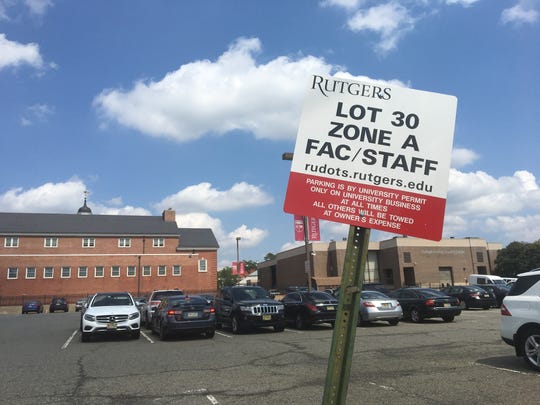
The field where "the first football game" was played is now the parking lot for Rutgers' College Avenue Gym. Rutgers played at College Field until 1891, then opened Neilson Field across the street, playing there until 1938, when Rutgers Stadium opened across the River in Piscataway. The Alexander Library, the school's main library, was built on the site of Neilson Field in 1953. Rutgers Stadium was replaced on the same site by what's now named SHI Stadium in 1994, while they played their 1993 home games, and many others from 1976 to 2009, at Giants Stadium.
George Large of Rutgers was the last surviving player from this game, living until August 15, 1939, age 88. The native of Readington, Hunterdon County played on the Rutgers side, and in 1888 served as President of the State Senate, making him the Acting Governor on a few occasions.

In 1874, Harvard University would accept a challenge from McGill University in Montreal, and discover on the McGill men's arrival that by "football," McGill meant "rugby," not "soccer." Adjustments were made, Harvard liked the results, and convinced the other "football"-playing schools to join them in this adaptation of "football." In 1906, the forward pass was legalized and hashmarks prevented dangerous scrimmages close to the sideline. "Football" as America knows it now was on its way.
In 1896, the College of New Jersey changed its name to Princeton University, while a nearby school would later be founded as Trenton State College, and change its name to The College of New Jersey. Rutgers College would become, and remains, the centerpiece of the larger system of Rutgers, The State University of New Jersey.
Princeton's nickname, the Tigers, would inspire 2 professional team names: Baseball's Detroit Tigers and the Canadian Rugby Union's Hamilton Tigers, now the Canadian Football League's Hamilton Tiger-Cats.
Rutgers was known as "The Queensmen" until 1925, when they became the Chanticleers, after a fighting rooster. The school's literary magazine was already called The Chanticleer. But this carried the connotation of "chicken" -- and, as the University of South Carolina has found out with their similarly-named Gamecocks, they can be called "Cocks." In 1955, head coach Harvey Harman recommended the change to the Scarlet Knights, and such they have been ever since.
Rutgers continues to bill itself as "The Birthplace of College Football," or simply "The Birthplace." You know the joke: Rutgers invented football in 1869, and they haven't done a damn thing since. It's not completely true -- they had undefeated seasons in 1961 and 1976, won 6 bowl games between 2006 and 2014, and shared the Big East Conference Championship in 2012 -- but it sure feels like it at times.

The Rutgers men, finding the color inexpensive to obtain, wrap scarlet red cloth around their heads like turbans, so that they can tell each other apart on the field. Thus did they invent school colors and, in a way, the football helmet.
The men of Old Queens must have had less trouble telling team from team than did the men of Old Nassau, as Rutgers won, 6-4 -- that's 6 goals to 4, or 42-28 under today's scoring system.
The next week, the CNJ men returned the favor in Princeton. As before, the home team set the rules, with 8 goals to win. They also wanted "fair catches," which Rutgers had denied them the week before. This played to the Nassau men's strength, and they won, 8-0. There was supposed to be a 3rd game, but the colleges' presidents got together, and decided that too much emphasis was being placed on athletics, and forbade it.
The field where "the first football game" was played is now the parking lot for Rutgers' College Avenue Gym. Rutgers played at College Field until 1891, then opened Neilson Field across the street, playing there until 1938, when Rutgers Stadium opened across the River in Piscataway. The Alexander Library, the school's main library, was built on the site of Neilson Field in 1953. Rutgers Stadium was replaced on the same site by what's now named SHI Stadium in 1994, while they played their 1993 home games, and many others from 1976 to 2009, at Giants Stadium.
The site of College Field today. In the background,
College Avenue Gym (left) and the Rutgers Student Center.
George Large of Rutgers was the last surviving player from this game, living until August 15, 1939, age 88. The native of Readington, Hunterdon County played on the Rutgers side, and in 1888 served as President of the State Senate, making him the Acting Governor on a few occasions.
Plaque inside the Gym
In 1874, Harvard University would accept a challenge from McGill University in Montreal, and discover on the McGill men's arrival that by "football," McGill meant "rugby," not "soccer." Adjustments were made, Harvard liked the results, and convinced the other "football"-playing schools to join them in this adaptation of "football." In 1906, the forward pass was legalized and hashmarks prevented dangerous scrimmages close to the sideline. "Football" as America knows it now was on its way.
In 1896, the College of New Jersey changed its name to Princeton University, while a nearby school would later be founded as Trenton State College, and change its name to The College of New Jersey. Rutgers College would become, and remains, the centerpiece of the larger system of Rutgers, The State University of New Jersey.
Princeton's nickname, the Tigers, would inspire 2 professional team names: Baseball's Detroit Tigers and the Canadian Rugby Union's Hamilton Tigers, now the Canadian Football League's Hamilton Tiger-Cats.
Rutgers was known as "The Queensmen" until 1925, when they became the Chanticleers, after a fighting rooster. The school's literary magazine was already called The Chanticleer. But this carried the connotation of "chicken" -- and, as the University of South Carolina has found out with their similarly-named Gamecocks, they can be called "Cocks." In 1955, head coach Harvey Harman recommended the change to the Scarlet Knights, and such they have been ever since.
The West Stand of what's now named SHI Stadium
Rutgers continues to bill itself as "The Birthplace of College Football," or simply "The Birthplace." You know the joke: Rutgers invented football in 1869, and they haven't done a damn thing since. It's not completely true -- they had undefeated seasons in 1961 and 1976, won 6 bowl games between 2006 and 2014, and shared the Big East Conference Championship in 2012 -- but it sure feels like it at times.
Statue outside the stadium's North End
After that 1st game, Rutgers did not beat Princeton again until the dedication game for the original Rutgers Stadium in Piscataway, in 1938, going 0-33 in between. But, starting in 1958, Rutgers won 4 straight, before Princeton then won 6 straight.
Rutgers began to dominate the rivalry in 1968. They wanted "bigger-time football" in the 1970s, and started recruiting better, to the point where Princeton, wanting to stay in the Ivy League, couldn't keep up. Rutgers won the last 5 games before Princeton decided to stop playing them, including the finale, on September 27, 1980, a 44-13 win in Piscataway. Nevertheless, Princeton still leads the all-time rivalry, 53-17-1, despite Rutgers going 9-3-1 from 1968 onward.
The rivalry remains intense in other sports, including basketball.
*
November 6, 1869 was a Saturday. You might think that there were no other scores on this historic day. But you'd be wrong. The 1st openly professional baseball team wrapped up its season that day: The Cincinnati Red Stockings beat the Mutual Base Ball Club of New York, 17-8 at the Union Grounds in the Williamsburg section of Brooklyn.


No comments:
Post a Comment