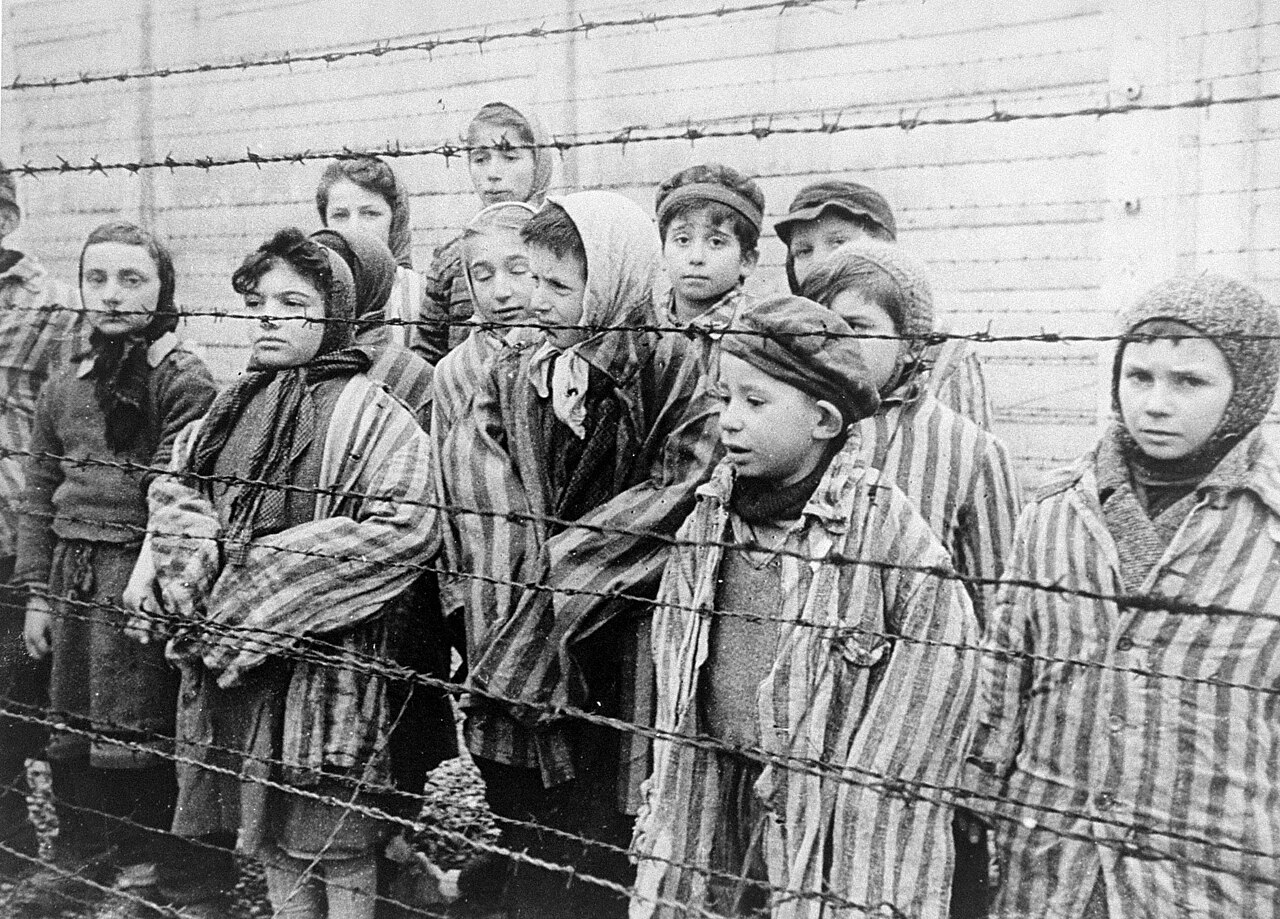
January 27, 1945: The Soviet Union's Red Army discovers the Auschwitz concentration camp, saving the lives of the 8,100 prisoners still alive there. As Auschwitz was the camp with the most deaths in the Holocaust, January 27 has been commemorated as Holocaust Remembrance Day ever since.
I have titled this entry "The End of Auschwitz," not "The Liberation of Auschwitz," because the Soviet Union never "liberated" anything. Most of the survivors returned to a Poland that would be under Communist rule until 1989.
The camp opened in May 1940. Prisoners were beaten, tortured, and executed for the most trivial of reasons. The first gassings took place in August 1941. The freight trains kept on coming in, under the gate with the lettering ARBEIT MACHT FREI -- "Work Makes Free." As far as the outside world knew, such places were slave labor camps, which was true, and was bad enough.

But few outside the Third Reich knew about the genocide. Over 1.3 million people were sent there, and 1.1 million were murdered, 960,000 of those being Jews, and 865,000 of those gassed on arrival. Those not gassed were murdered via starvation, exhaustion, willful ignorance of disease, individual executions, beatings, or during medical experiments that the SS carried out with sadistic glee. There were 802 prisoners known to have tried to escape, 144 successfully. An uprising was launched on October 7, 1944, but it was doomed to failure.
The trains kept coming. Generals begged Chancellor Adolf Hitler to make trains available to send soldiers to the fronts, to stop the Soviets to the East, and the Americans, British, Canadians and French to the West. He told them, "No! I need the trains to kill the Jews!" He seemed to have accepted that the war was lost, but, always determined to exterminate Europe's Jews, he also seemed to have adopted a policy of, "If I'm going down, I'm taking as many of the enemy as I can with me."
As the Red Army approached Auschwitz in January 1945, the SS sent most of the camp's population west on a death march to camps inside Germany and Austria. Those 8,100 remaining prisoners were essentially left to fend for themselves.
Georgii Elisavetskii, a Soviet soldier who entered one of the barracks, said in 1980 that he could hear other soldiers telling the inmates: "You are free, comrades!" But they did not respond, so he tried in Russian, Polish, German, Ukrainian. Then he used some Yiddish: "They think that I am provoking them. They begin to hide. And only when I said to them: 'Do not be afraid. I am a Colonel of Soviet Army, and a Jew. We have come to liberate you.'... Finally, as if the barrier collapsed... they rushed toward us, shouting, fell on their knees, kissed the flaps of our overcoats, and threw their arms around our legs."
The Soviets had first encountered a Nazi concentration camp on August 16, 1944, in Treblinka, Poland. A folk song would later commemorate Treblinka as "the biggest grave in the world."
In Germany itself, on April 11, 1945, American troops under the command of General George S. Patton liberated the Buchenwald camp in Weimar, Thuringia. On April 15, British troops liberated the Bergen-Belsen camp in Bergen, Lower Saxony. On April 22, the Red Army reached the Sachsenhausen camp in Oranienburg, outside Berlin.
On April 29, American troops under the command of General Dwight D. Eisenhower liberated the camp at Dachau, outside Munich. When Eisenhower saw the emaciated prisoners, many of them within days of death if they didn't receive medical treatment, he ordered photographers and film crews to come in and document it, because he knew that if no one did, then, one day, people would deny that the Nazis ever did such things. People have denied it, but "Ike" and the other Allied commanders got the proof.
Over 11 million people died in the Holocaust -- about as many as died from combat in all of World War I. Of those 11 million, over 6 million had been imprisoned for the reason that they were Jewish. Others were killed because they were of Slavic descent, and therefore of "an inferior race" to the German "Aryans"; or because they were Communists; or because they belonged to labor unions; or because, despite not fitting any of those other categories, they resisted the Nazis.
Martin Niemöller, a Lutheran pastor from Lippstadt, Westphalia, had supported the Nazis at first. But when the Nazis began enforcing their ideology on Protestant churches, he led a resistance movement, and was imprisoned in 1938, first at Sachsenhausen, then at Dachau.
On January 6, 1946, in a speech in Frankfurt, he gave a speech whose exact wording has varied over the years, possibly losing something in translation. The most common version is this: "First, they came for the socialists, and I did not speak out, because I was not a socialist. Then, they came for the trade unionists, and I did not speak out, because I was not a trade unionist. Then, they came for the Jews, and I did not speak out, because I was not a Jew. Then, they came for me, and there was no one left to speak for me." He became an antiwar activist, and lived until 1984.
Auschwitz -- with the changing of national borders after The War, now in Oświęcim, in southern Poland -- is maintained as a museum and a UNESCO World Heritage Site.
UPDATE: On the 80th Anniversary, January 27, 2025, the Auschwitz-Birkenau State Museum released a statement:
Auschwitz was at the end of a long process. It did not start from gas chambers.
This hatred was gradually developed by humans. From ideas, words, stereotypes & prejudice through legal exclusion, dehumanization & escalating violence... to systematic and industrial murder.
Auschwitz took time.
This is true. It also took thought. Careful consideration that should have resulted in the idea of, "There is a group of people that is not doing as well as us, so we should help them, and raise them to our level." Instead, it resulted in the idea of, "There is a group of people that is less than us, and, for that reason, they must be eliminated."
And that kind of evil can never be tolerated.
*
January 27, 1945 was a Saturday. That same day, at another German camp, at Ziegeghain, in Germany's Rhineland, U.S. Army Master Sergeant Robbie Edmunds stood up for the Jewish soldiers under his command. I have a separate entry for that event.
Baseball and football were out of season. The NBA hadn't been founded yet. All of the NHL's "Original Six" teams were in action:
* The New York Rangers lost to the Toronto Maple Leafs, 3-0 at Maple Leaf Gardens in Toronto.
* The Montreal Canadiens beat the Boston Bruins, 11-3 at the Montreal Forum. Maurice "The Rocket" Richard, on his way to the NHL's 1st 50-goal season, scored his 34th, and had 2 assists. Dutch Hiller had 2 goals and an assist. Ray Getliffe had 2 goals. Elmer Lach had a goal and 4 assists.
* And the Detroit Red Wings beat the Chicago Black Hawks, 5-1 at the Olympia Stadium in Detroit.
And while England's Football Association had shut Football League and FA Cup competition down for the duration of the war, there was Football League South play. Arsenal beat Fulham, 8-3 at White Hart Lane in Middlesex. Stan Mortensen, on loan to Arsenal during the war, scored 4 goals.
Yes, The Arsenal used the ground of their arch-rivals, Tottenham Hotspur, because their home, Arsenal Stadium, a.k.a. Highbury, in North London was appropriated by the government for defense purposes. The London Government Act 1963 redrew the boundaries of the city of London (not to be confused with "The City of London") so that White Hart Lane was inside the city for the first time.


No comments:
Post a Comment