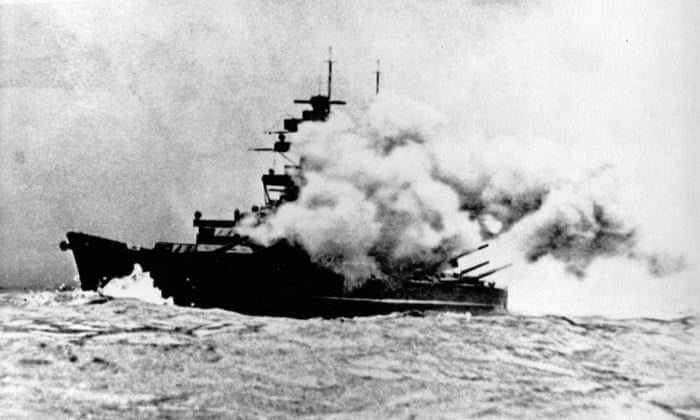
May 27, 1941: Britain's Royal Navy sinks the Bismarck, Germany's biggest battleship, a rare notable victory for the Allies in World War II before America got into it.
Named for Otto von Bismarck, the "Iron Chancellor" who defeated France in the Franco-Prussian War of 1870, and united the many small German states into the German Empire -- the Second Reich -- the Kriegsmarine, the navy of Nazi Germany, the Third Reich, planned the Bismarck class of battleships to defeat France's Richelieu class battleships. But by June 1940, at which point the class ship, the Bismarck, was nearing completion, the German Army, the Wehrmacht, made dealing with the French Navy unnecessary.
But Britain's Royal Navy, now alone, and waiting for America to enter the war, would have to deal with the thing. C.S. Forester, already the author of 3 novels in the Horatio Hornblower series by 1941 (the series would eventually stretch to 17 books), published The Last Nine Days of the Bismarck in 1959. The following year, it was made into the film Sink the Bismarck!
American singer Johnny Horton co-wrote and sang an accompanying song, though it was only used in American trailers for the film, and not used in the film itself. In the song, Horton wrote, "The Bismarck was the fastest ship that ever sailed the sea. On her deck were guns as big as steers, and shells as big as trees."
It was under the command of Admiral Günther Lütjens, known as "the Black Devil," yet a man opposed to the Nazis' anti-Semitic policies. He refused to give the Nazi salute, instead giving a traditional naval salute -- even to Chancellor Adolf Hitler himself.
On May 24, 1941 -- the day that singer Bob Dylan was born in Duluth, Minnesota -- the Battle of the Denmark Strait was fought. The Bismarck and its escort, the heavy cruiser Prinz Eugen, were caught by the Admiral class battlecruiser HMS Hood and the King George V class battleship HMS Prince of Wales in the Denmark Strait, between Greenland and Iceland.
(At the time, Britain had no Prince of Wales: King George VI had only daughters, no sons. The ship was named after the most recent Prince of Wales, the son of George V, who became King Edward VIII and then the Duke of Windsor -- who was seen by many as pro-Nazi.)
The song said that the Bismarck started firing from 15 miles away. That may have been dramatic license. Nevertheless, the Hood was sunk, and the Prince of Wales had to retreat. (For this role, the Hood became better known than its namesake, Admiral Samuel Hood, who commanded ships in the Wars of the American and French Revolutions.) However, the Prince of Wales managed to damage Bismarck enough that its mission was called off, and it sailed for occupied France for repairs.
The Royal Navy went after the wounded ship. The aircraft carrier HMS Ark Royal got close enough to send Fairey Swordfish "torpedo bombers" after it. On May 26, a hit rendered its steering gear inoperable. That night, Lütjens ordered a message radioed back to Germany: "Ship unmaneuverable. We will fight to the last shell. Long live the Führer."
The next morning, off the western coast of France, the Ark Royal, the King George V, and the cruiser HMS Sheffield caught up with Bismarck. Knowing that the battle damage would lead to its sinking anyway, Lütjens ordered that the ship be scuttled. Out of a crew of over 2,200 men, only 114 survived. Lütjens went down with the ship.
With the sinking of the Bismarck, the Kriegsmarine ended up building only 2 ships in that class, the other being the Tirpitz. That ship was sunk by Britain's Royal Air Force on November 12, 1944.
On August 7, 1941, HMS Prince of Wales hosted the 1st meeting between President Franklin D. Roosevelt and Prime Minister Winston Churchill, which produced the Atlantic Charter alliance. On December 9, 1941, 2 days after the Japanese attack on Pearl Harbor and several other American and British installations, Prince of Wales was sunk by the Japanese off the coast of Singapore. Although some men got off alive, 327 died.
On November 13, 1941, a German U-boat got revenge on the Ark Royal, sinking her in the Mediterranean Sea, off the coast of Spain, not far from the British naval base at Gibraltar. Two subsequent aircraft carriers have served the Royal Navy under the name, from 1950 to 1979, and from 1981 to 2011.
HMS Sheffield remained in Royal Navy service until being decommissioned in 1967. In 1971, a destroyer with that name was launched. In 1982, it was sunk by Argentina, becoming the most notable British loss of the Falkland Islands War.
HMS King George V remained in service until 1947. No new ship has been given the name. In 2017, a Queen Elizabeth II class aircraft carrier was launched, named HMS Prince of Wales. No new Royal Navy ships have been named Hood, although the TV series Star Trek: The Next Generation showed a starship of the Excelsior class named USS Hood.
In 1956, the Federal Republic of Germany (West Germany) was permitted by NATO to form a new Bundesmarine (Federal Navy). In 1990, it took on the Volksmarine (People's Navy) of the former German Democratic Republic (East Germany). In 1995, the Bundesmarine was renamed the Deutsche Marine (German Navy).
This Navy has never had a ship named Bismarck. But it had a ship named for the previous Bismarck's captain, the destroyer Lütjens, launched in 1967, and retired and decommissioned in 2003.
*
May 27, 1941 was Tuesday. These baseball games were played that day:
* The New York Yankees beat the Washington Senators, 10-8 at Griffith Stadium in Washington. Red Ruffing was the winning pitcher. Joe DiMaggio went 4-for-5 with a home run and 3 RBIs. Nobody noticed it yet, but it was his 12th straight game with at least 1 hit. There would be more.
* The New York Giants beat the Boston Braves, 2-1 at the Polo Grounds. Mel Ott went 2-for-4. Both Waner brothers had been traded to the Braves by the Pittsburgh Pirates. Paul went 0-for-4 in this game, but Lloyd singled as a pinch-hitter.
* The Brooklyn Dodgers beat the Philadelphia Phillies, 6-0 at Shibe Park in Philadelphia. Hugh Casey, who would become better known as a reliever, pitched a 7-hit shutout.
* A doubleheader was split at Fenway Park in Boston. The Boston Red Sox won the opener, 5-2. The Philadelphia Athletics won the nightcap, 11-1. Over the 2 games, Jimmie Foxx went 0-for-6 with a walk, and Ted Williams went 2-for-6 with a home run, a walk, and 2 RBIs.
* The Detroit Tigers beat the Cleveland Indians, 9-6 at League Park in Cleveland. Bruce Campbell -- no relation to the later Evil Dead actor of the same name -- hit 2 home runs. Hank Greenberg was already serving in the U.S. Army, and unavailable for the Tigers.
* The St. Louis Browns beat the Chicago White Sox, 5-2 at Comiskey Park in Chicago.
* The St. Louis Cardinals beat their arch-rivals, the Chicago Cubs, 3-2 at Sportsman's Park in St. Louis.
* And the Pittsburgh Pirates and the Cincinnati Reds were not scheduled for this day.


No comments:
Post a Comment