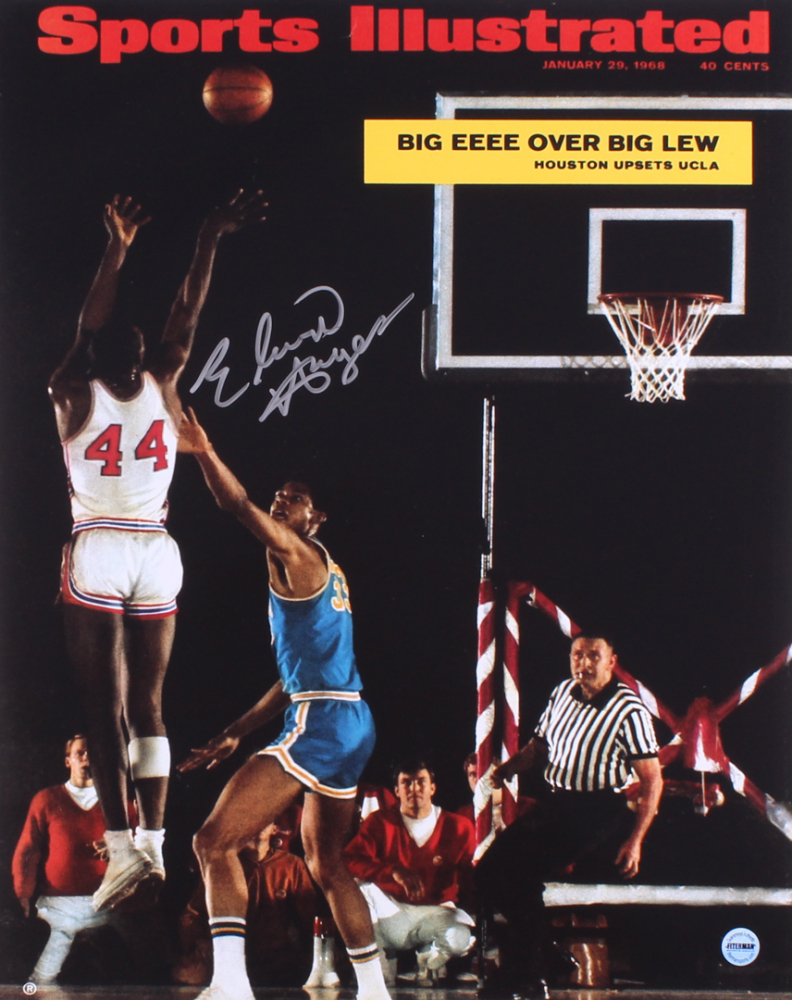
Elvin Hayes signed this SI cover,
even though his back was to the camera.
January 20, 1968: College football had experienced a few games with the "Game of the Century" label, including in both the 1966 and 1967 seasons. Now, it was college basketball's turn.
The University of California at Los Angeles -- UCLA -- had won the National Championship in 1964 and 1965. Then, Lew Alcindor -- who would later convert to Islam and change his name to Kareem Abdul-Jabbar, and I'll refer to him as "Kareem" hereafter -- arrived on campus from New York City. Until 1972, the NCAA prohibited freshmen from competing in varsity sports. But in his 1st appearance of any kind for UCLA, Kareem led the freshman team to victory over the varsity.
Head coach John Wooden knew he could bide his time until Kareem was eligible. Sure enough, in 1966-67, with sophomore Kareem leading the way, the Bruins went 30-0 and won the National Championship. Going into January 20, 1968, they had won 47 straight games, the 2nd-longest streak in college basketball history, behind the 60 straight of the University of San Francisco, 1955-57, mostly with Bill Russell.
The team the Bruins beat in the NCAA Final was the University of Houston. Coach Guy Lewis had his own big man, Elvin Hayes, known as the Big E. With Hayes and Don Chaney, Lewis had bravely integrated not just his own team, but basketball in the Southwest Conference.
Ted Nance was UH's sports information director. He talked to his counterpart at UCLA, J.D. Morgan, about putting together a nationally televised showcase game, a prime-time matchup with UCLA, using the "Game of the Century" label that had been applied to the 1966 football game between Michigan State and Notre Dame. Morgan talked Wooden into it. The label was cited in UH's football programs. And when UCLA's football team played USC in a "Game of the Century," it helped promote the basketball version -- even though UCLA lost the football version.
The problem was selling the game to a network willing to televise it. The Big Three -- NBC, CBS and ABC -- all passed on it. Basketball was far behind baseball and football in popularity. At this point, it probably wasn't even as popular as boxing and horse racing. The fact that it was "a black sport," with racial strife around the country, didn't help its image, although there had never been a racist incident on the court in either the NBA or in the college game.
Enter Eddie Einhorn. Later to be a co-owner of the Chicago White Sox, he founded TVS, a network that specialized in televising college basketball games, and syndicating them to "independent" stations (stations not affiliated with any network -- for example, in New York at the time, Channels 5, 9 and 11).
Morgan offered Einhorn the use of UCLA's announcer, Dick Enberg, who also called games for the NFL's Los Angeles Rams. Einhorn paid $27,000 for the rights to the game, and signed up 120 stations, some of them affiliated with networks, pre-empting the regularly scheduled national programming. In New York, the game was broadcast on WPIX-Channel 11.
"Einhorn was a visionary," Enberg said, decades later, after becoming NBC's lead announcer for the NFL and college basketball, and adding baseball's California Angels and San Diego Padres to his grand record. "He was so far ahead of anyone in television at the time. He saw how truly big college basketball could be, and had a major hand in making all that happen. The networks were way, way behind Eddie Einhorn."
Instead of UH's 5,000-seat Delmar Fieldhouse, the game would be moved into the Astrodome. A compromise was reached when UH agreed to have the floor from the Los Angeles Memorial Sports Arena shipped in as the game's playing surface, although the center-court decal was customized, with the words "ASTRO DOME."
It was all set up. All that was necessary now was for the teams to remain undefeated, and to keep their preseason Number 1 (UCLA) and Number 2 (Houston) rankings intact. They got what they wanted: The Bruins won their 1st 13 games of the 1967-68 season, and the Cougars won their 1st 14.
A crowd of 52,693, the largest ever to see a basketball game in America at that point, saw a game that lived up to the hype. UCLA had a notable disadvantage: Kareem had sustained an eye injury, and was not at his best. This injury would recur, and lead to the familiar image of him wearing goggles on the court during his professional career.

Another check against Kareem, and therefore against UCLA: Because he had made so many dunk shots in 1966-67, the NCAA banned it. The fact that Hayes had also done a lot of dunks seemed to have escaped the press, who called it "The Lew Alcindor Rule." The rule was retracted in 1976, leading to the University of Louisville's 1980 "Doctors of Dunk" and UH's early 1980s "Phi Slamma Jamma" team. But that didn't help either the Bruins or the Cougars on this night.

$5.00 in 1968 would be roughly $40 in 2022.
Not a bad price for a "Game of the Century."
Tipoff was 8:00 PM Central Time -- 9:00 Eastern, and 6:00 Pacific (in other words, on the UCLA campus). At the half, Houston led, 46-43. Lewis did not have Hayes set to cover Kareem, but he did block 3 of Kareem's shots, and the fans at the Astrodome chanted, "Big E! Big E! Big E!"
Lucius Allen, later to be Kareem's teammate on the 1971 NBA Champion Milwaukee Bucks, sank 2 free throws with 2 minutes left, tying the game 69-69. Hayes had 4 fouls, but played as if this was his night, the game that would show the world what he could do. He took a shot, and was fouled by Jim Nielsen. He sank his free throws to put the Cougars up 71-69. They were his 38th and 39th points of the game, to lead all players on both sides. Kareem scored only 8.
With time running out, Allen put up a shot that couldn't go in. On UCLA's next possession, he looked for forward Lynn Shackelford, the team's best shooter. He found Shackelford, in the corner, unguarded. But All-American guard Mike Warren -- later to use the name Michael Warren as he played a policeman on Hill Street Blues -- thought the pass was for him, and he deflected it out of bounds.
With 10 seconds left, Hayes took an inbounds pass, and Kareem and Allen converged on him, hoping to force a turnover. He tried dribbling out the clock, but the 2 big Bruins wouldn't give up. Finally, with 3 seconds left, he managed to get off a pass to George Reynolds, and that was the ballgame. Houston was Number 1.
Earlier in the day, there was a news report about a U.S. Marine action in Vietnam. Most people at the game had already heard about it. So when Enberg interviewed Wooden after the game, he told Enberg, "Compared to what is happening worldwide, this is just another basketball game. We were defeated. We go on. But there are much more important things happening in our world to be concerned about."
"That was typical Wooden," Enberg said.
Also typical Wooden was picking his team up, and properly preparing them for the rest of the season. They didn't lose again. What would now be called the Final Four was held, interestingly enough, at the L.A. Sports Arena, on the exact same floor. UCLA played Houston in the Semifinal, and, with Kareem's eye injury cleared up, it was no contest: UCLA 101, Houston 69. The Bruins went on to beat North Carolina, coached by 37-year-old Dean Smith, in the Final, 78-55.
UCLA won the National Championship again in 1969, losing just 1 regular-season game, away to crosstown USC -- again, on the Sports Arena floor -- after the Pacific-Eight Conference title had already been decided. UCLA went 88-2 with Kareem playing, won the National Championship all 3 seasons, and Kareem was named the NCAA Tournament's Most Outstanding Player all 3 times.
College basketball got a huge boost from the "Game of the Century." It got another boost in 1974, when UCLA, having also won the National Championship in 1970, 1971, 1972 and 1973, set a new record with an 88-game winning streak, then lost to Notre Dame, and then to North Carolina State in the NCAA Semifinal. UCLA won one more title in 1975, and then Wooden retired, having won 10 titles.
Another boost to college basketball came in 1979, with a Final matchup between Earvin "Magic" Johnson of Michigan State, soon to be Kareem's teammate on the Los Angeles Lakers, and Larry Bird of Indiana State. Michigan State's win remains the most-watched college basketball game ever, and, while the term had been used before, the words "March Madness" became familiar.
Let Enberg have the final word: “Just for historical reference, I did what amounted to be the very first national telecast of the NCAA Finals and that was in 1961, when Cincinnati played Ohio State in Kansas City. That national telecast went to two cities; Cincinnati and Columbus, Ohio. That was it. We’re talking 1961 and this UCLA-Houston game is only seven years later, so I say that only to confirm the baby was delivered in the Astrodome on that night when Houston played UCLA.”
*
January 20, 1968 was a Saturday. Baseball and football were out of season. Almost unnoticed that day were 5 games played in the NBA:
* The Baltimore Bullets beat the Boston Celtics, 118-115 at the Baltimore Civic Center (now the CFG Bank Arena). The Bullets got 33 points from Gus Johnson, and 32 from Earl "the Pearl" Monroe. In defeat, Sam Jones scored 38, and John Havlicek 29.
* The Cincinnati Royals beat the Detroit Pistons, 128-120 at the Cincinnati Gardens. Oscar Robertson scored 32.
* The Philadelphia 76ers beat the Chicago Bulls, 135-111 at the Chicago Stadium. Bob Boozer led all scorers with 27, but, for the Sixers, Hal Greer had 26, Chet "the Jet" Walker had 24, and Wilt Chamberlain had 18 and 21 rebounds. That is not a misprint, children: Twenty-one rebounds in one game.
* The St. Louis Hawks beat the Seattle SuperSonics, 120-115 at the Kiel Auditorium in St. Louis. Lenny Wilkens scored 39 for the Hawks.
* And the Los Angeles Lakers beat the San Francisco Warriors, 151-122 at The Forum outside Los Angeles in Inglewood, California. Fred Hetzel scored 36 for the Warriors, but the Lakers got 30 from Elgin Baylor, 25 from Jerry West, and 20 from Darrall Imhoff.
And there was one game in the newly-founded American Basketball Association: The New Jersey Americans beat the Indiana Pacers, 106-96 at the Teaneck Armory. The Americans moved to Long Island the next season, and became the New York Nets.
There were 5 games played in the NHL:
* The New York Rangers beat the Oakland Seals, 3-0 at the Oakland Coliseum Arena.
* The Montreal Canadiens beat the Chicago Black Hawks, 3-1 at the Montreal Forum.
* The Boston Bruins beat the Philadelphia Flyers, 4-2 at the Boston Garden.
* The Toronto Maple Leafs beat the Minnesota North Stars, 5-1 at Maple Leaf Gardens in Toronto.
* The Pittsburgh Penguins beat the Detroit Red Wings, 8-5 at the Civic Arena in Pittsburgh.
* And the St. Louis Blues and the Los Angeles Kings were not scheduled.
Also, a North London Derby was held. Tottenham Hotspur hosted and beat Arsenal, 1-0.


No comments:
Post a Comment