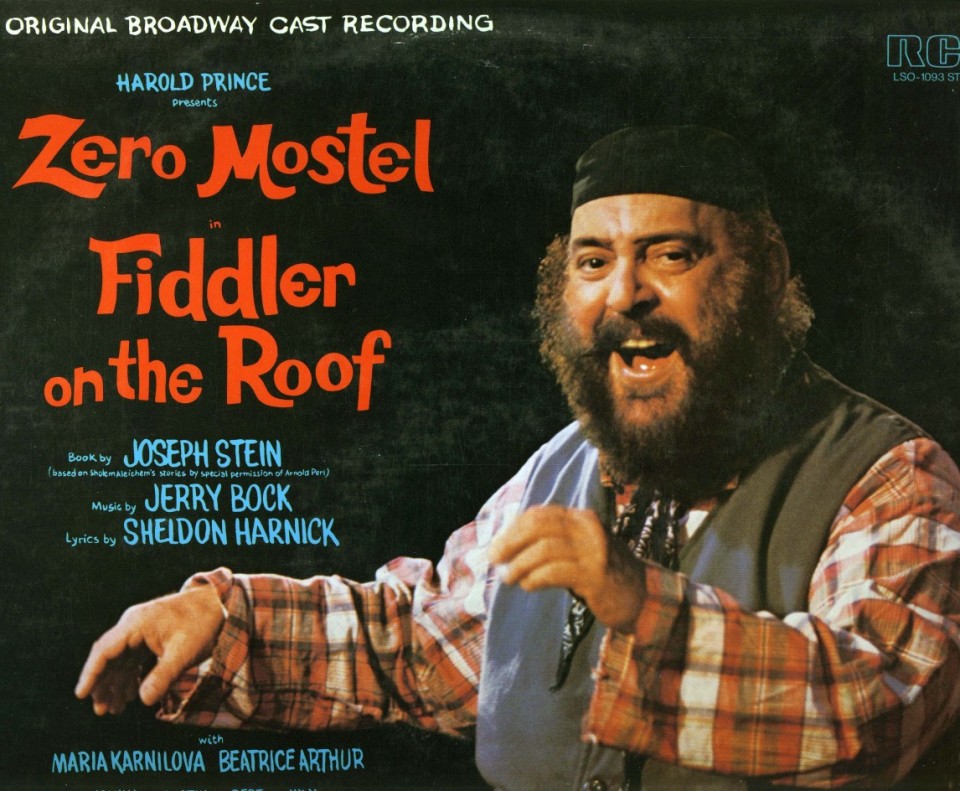
September 22, 1964: Fiddler On the Roof premieres at the Imperial Theatre in New York. It becomes the longest-running musical in Broadway history, a record long since broken.
Jerry Bock wrote the music, and Sheldon Harnick wrote the lyrics. They had previously collaborated on the 1959 musical Fiorello! about former New York Mayor Fiorello La Guardia. Joseph Stein wrote the "book," based on Tevye and His Daughters, a 1905 collection of short stories by Ukrainian-born Jewish writer Solomon Naumovich Rabinovich, who wrote under the pen name Sholem Aleichem.
The story takes place in Anatevka, a shtetl (a Yiddish word for a small town made up mostly of Jews) in the Russian Empire in 1905, a year of a failed revolution. The narrator is Tevye, a middle-aged milkman with a wife and 5 daughters, but no sons. This is key, because, traditionally -- and not just in Judaism -- it is the father of the bride who pays for a wedding. And, as Tevye says, "I realize, of course, that it's no shame to be poor. But it's no great honor, either."
(In Rabinovich's original story, the character's full name is Tevye ben Shneur Zalman. "Tevye" is a Yiddish form of "Tuyva," meaning "God is good." In Greek, "Tuvya" becames "Tobias"; in the English-speaking world, it is often shortened to "Toby." Neither Rabinovich nor Alex Haley -- who allegedly had an ancestor named Kunta Kinte, forced to accept the slave name Toby Waller, or Toby Reynolds in the TV version of Roots -- ever commented publicly on that.)
He begins the play with talk of tradition, and a song titled "Tradition," and says that, for the people there, in their poverty, where they have little freedom due to the impressive regime of Czar Nicholas II, their lives are as precarious as the perch of a fiddler on a roof. Someone asks the local rabbi if there is a blessing for the Czar. He says, "May the Lord bless and keep the Czar... far away from us!"
Like everyone else in Anatevka, Teyve is poor. How poor is he? He has to deliver milk himself, since he can't afford to replace his lame horse. He begins the song "If I Were a Rich Man" in a good mood, imagining what it would be like, but ends it in sadness, asking God if it would "spoil some vast eternal plan." (The song was based on Rabinovich's monologue in his book, "If I Were a Rothschild," with the Rothschilds, a banking family, being a byword for rich Jews to this day.)
One of his daughters is supposed to marry the richest man in town ("rich" being relative there), a butcher who is even older than Tevye. But she loves a tailor instead, and the tailor talks Tevye into allowing their marriage. But another daughter loves a Christian boy who had protected her from an attack by his people, and Tevye refuses to cross the line of allowing his daughter an interfaith marriage, so they run off and elope. Tevye laments the passage of time, singing of his children, "I don't recall growing older. When did they?"
Finally, a constable arrives, and tells the town that it must be abandoned in 3 days, so that native Russians can take it over. Tevye decides to take his wife and remaining daughters to America, while the married ones and their husbands go to Poland, then also still under Russian (and, partly, German) control. The fiddler plays one last song, and then leaves the stage as well.
In the original production, Tevye was played by Brooklyn-born Jewish comedian Samuel Joel "Zero" Mostel, a triumph for him after having been blacklisted during the Red Scare of the 1950s. Calling his former film studio "18th Century Fox," he said, "What did they think I was going to do, sell acting secrets to the Russians?" Maria Karnilova played Tevye's wife Goldie. Beatrice Arthur and future game show host Bert Convy were also in the original cast.
Mostel also played Tevye in a 1976 Broadway revival. In 1969, folksinger Theodore Bikel, founder of the Newport Folk Festival, succeeded Mostel in the role. He had previously starred in a nonmusical version, Tevye the Milkman, and ended up playing the part more nights than any other actor, even Mostel.
When the musical first played in the West End, London's version of Broadway, in 1967, Tevye was played by Israel-born actor Chaim Topol. He would also star in the 1971 film version, revivals in the West End in 1983 and 1994, and a Broadway revival in 1990. Herschel Bernardi starred in a 1981 Broadway revival. The most recent Broadway revival, in 2015, starred Danny Burstein.
Norman Jewison, the perhaps aptly-named director of the 1971 film, chose Topol because he though Mostel's version relied too heavily on comedy, and he wanted to lean on the serious side of the story. He had previously told the story of a black hero in a white racist place in directing In the Heat of the Night, and later directed Moonstruck, about Italian-Americans.
In 2004, Gwen Stefani adapted a 1993 rewrite of "If I Were a Rich Man," "Rich Girl," and hit Number 1 with it. That same year, a Broadway revival starred Alfred Molina, who would play Tevye by night, and, by day, still in New York, would film scenes as the villainous Dr. Otto Octavius, a.k.a. Doctor Octopus, a.k.a. Doc Ock, for the film Spider-Man 2. He even filmed a scene of himself in costume as Doc Ock, singing "If I Were a Rich Man," resulting in the character's mechanical arms dancing along with him.
Molina was succeeded the following year by Harvey Fierstein, better known as a playwright. He told an interviewer that someone asked him how, as one of America's most prominent openly gay men, he could play the role of a husband and father. His response was that, when he was cast as Edna Turnblad in the musical version of Hairspray, he had never been, or played, a woman before. In contrast, Tevye was a Jewish man, and he had been a Jewish man his whole life. Of course, his famously gravelly voice wasn't made for singing on Broadway. But it worked just fine for the scatting in "If I Were a Rich Man."
Mostel died in 1977, Bernardi in 1986, Karnilova in 2001, Bock and Stein in 2010. As of September 22, 2022, Harnick, Topol, Jewison, Molina, Feirstein and Burstein are still alive. (UPDATE: Topol died on March 8, 2023. Harnick died on June 23, 2023, 10 months short of what would have been his 100th birthday. Jewison died on January 20, 2024.)
The Imperial Theatre is still in operation, at 249 West 45th Street, between 8th Avenue and Broadway. Among the other shows that have premiered there are Babes in Toyland in 1930, On Your Toes in 1936, Annie Get Your Gun in 1946, Call Me Madam in 1950, The Most Happy Fella in 1956, Oliver! in 1963, Pippin in 1972, They're Playing Our Song in 1979, and Dreamgirls in 1981.
One day, when I was about 12 or so, the film version of Fiddler On the Roof was on TV, and my parents told me, "This is your heritage." I had grown up with the idea that my father's ancestors were Polish and from a city like Warsaw, while my mother's ancestors were Jewish and from a little shtetl in the Russian Empire, like Anatevka.
It was many years before I found out that the truth was the other way around: My mother's ancestors came from a good-sized city, Vilnius, the capital of Lithuania (although also controlled by Russia at the time), while my father's ancestors came from Borki Wielkie, in a part of northeastern Poland that was then part of East Prussia in the German Empire, and barely more than a village.
Oh well. As Tevye might have said, It's no shame to be wrong, but it's no great honor, either.
*
September 22, 1964 was a Tuesday. The TV show The Man from U.N.C.L.E. premiered on this day. I have a separate entry for this event.
These baseball games were played that day:
* The New York Yankees swept a doubleheader from the Cleveland Indians, 5-3 and 8-1 at Cleveland Municipal Stadium. Mel Stottlemyre won the opener, Whitey Ford the nightcap. Home runs were hit by Mickey Mantle, Roger Maris, Joe Pepitone and Phil Linz.
* The New York Mets lost to the St. Louis Cardinals, 2-1 at Shea Stadium. Curt Simmons outpitched Tracey Stallard.
* The Cincinnati Reds beat the Philadelphia Phillies, 9-2 at Connie Mack Stadium in Philadelphia. This was the 2nd game of the 10-game "Phillie Phlop" that cost Philadelphia the National League Pennant. Frank Robinson went 2-for-4 with a home run, a walk, and 2 RBIs. Pete Rose also went 2-for-4 with a walk.
* The Boston Red Sox beat the Washington Senators, 3-0 at District of Columbia Stadium in Washington. (It was renamed Robert F. Kennedy Memorial Stadium in 1969.) Bill Monboquette pitched a 5-hit shutout, and Carl Yastrzemski went 1-for-3 with a walk.
* The Milwaukee Braves beat the Pittsburgh Pirates, 2-0 at Forbes Field in Pittsburgh. Bob Veale pitched a 7-hit shutout. Roberto Clemente went 3-for-4. Hank Aaron went 1-for-4.
* The Detroit Tigers beat the Baltimore Orioles, 2-1 at Tiger Stadium in Detroit. Al Kaline went 2-for-4 with a home run and 2 RBIs. Brooks Robinson went 0-for-4 with a walk.
* The Chicago Cubs beat the Los Angeles Dodgers, 1-0 at Wrigley Field in Chicago. Lew Burdette pitched a perfect 1st inning for the Cubs, then had to leave the game due to an injury. Cal Koonce pitched a 7-hit shutout the rest of the way, outpitching Don Drysdale. Ernie Banks went 0-for-3.
* The Kansas City Athletics beat the Minnesota Twins, 10-9 at Kansas City Municipal Stadium. Harmon Killebrew went 1-for-4 with a walk.
* The San Francisco Giants beat the Houston Colt .45s, 7-1 at Colt Stadium in Houston. Willie Mays went 1-for-4 with a walk and an RBI. The Colts became the Houston Astros the next season.
* And The Los Angeles Angels beat the Chicago White Sox, 1-0 at Dodger Stadium in Los Angeles, where the Angels were groundsharing while waiting for their stadium in suburban Anaheim to be ready. Fred Newman pitched a 5-hit shutout.


No comments:
Post a Comment