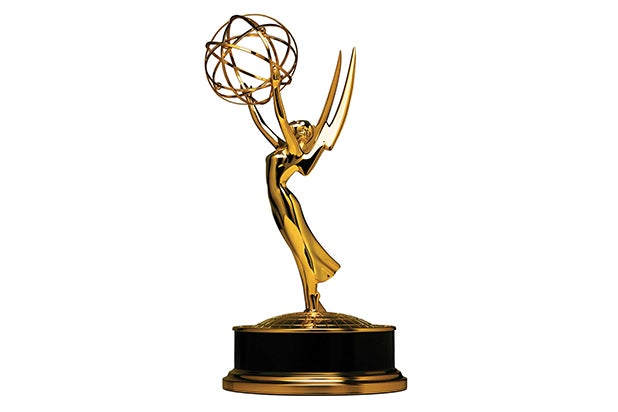
January 25, 1949: The 1st Emmy Awards ceremony is held at the Hollywood Athletic Club in Los Angeles, under the auspices of the National Academy of Television Arts and Sciences.
The name "Emmy" is not a derivative of "Emma" or any other feminine name. Nor is the award named after a person, as the Tony Awards were named for Broadway actress and director Antoinette Perry. Rather, it is a corruption of "immy," short for "image orthicon tube," which was common in early TV cameras. So it's a technical term, just as "Grammy" is short for "gramophone," an early term for a record player.
The host was supposed to be Rudy Vallée, already a superstar since the 1920s, but he had to leave town at the last minute, so Walter O'Keefe, host of the NBC game show Double Or Nothing, and the popularizer of the song "The Daring Young Man On the Flying Trapeze," substituted. (He lived until 1983.)
On this occasion, only TV shows produced in Los Angeles County and aired in the Los Angeles metropolitan area were eligible to win. And only 6 awards were given out:
* Most Popular Television Program: Pantomime Quiz, a game show on KTLA-Channel 5, then on the Paramount Television Network, an independent station from 1955 to 1995, on The WB from then until 2006, and on The CW ever since. The show later became Stump the Stars, and lasted from 1947 to 1959, on ABC for most of its run.
* Best Film Made for Television: The Necklace. Unfortunately, there seems to be no surviving footage.
* Most Outstanding Television Personality: Shirley Dinsdale, host of a KTLA show titled Judy Splinters, which was also the name of her ventriloquist's dummy. This made her the 1st woman to win an Emmy. As 2 of the other 4 nominees were Rita LeRoy and Patricia Morison, the chances of a woman winning at the 1st Emmy ceremony were better than you might have thought. By the way: Shirley managed to do this show while attending classes at UCLA.

In 1953, she got married, and, except for a 1958 appearance as a panelist on the game show To Tell the Truth, she retired from show business. In 1970, with her kids now teenagers, she went back to school, and became a pulmonary therapist on Long Island. She lived until 1999.
* Outstanding Overall Performance by a Television Station: KTLA. I'm beginning to notice a pattern.
* Technical Award: Charles Mesak, of Don Lee Television, for his innovation, Phasefader, an improvement for TV cameras.
* And a special award, to the man who designed the Emmy statue, Louis McManus. Instead of his own Emmy, they gave him a plaque. (At least Ed Smith, the NYU football player and male model who modeled for the Heisman Trophy in 1985, eventually got his own copy.)
In 1974, the NATAS (now just "the Academy of Television Arts and Sciences," or ATAS) held the 1st Daytime Emmy Awards. All subsequent broadcasts of the primetime Emmy Awards are called just that: The Primetime Emmy Awards. All previous ceremonies have been retroactively given that name, so that the 1949 ceremony is "The 1st Primetime Emmy Awards." The 2022 edition will be the 74th.
The show with the most Emmy Awards is Saturday Night Live, with 74, but that's understandable, as it's been on the air for 47 years. Number 2 is Game of Thrones, which was on the air for 8 years, and won 59 Emmys.
The actor with the most Emmy wins is Julia Louis-Dreyfus, with 11, in 24 nominations. Angela Lansbury has been nominated 17 times, and has never won. This has attracted far less attention than Susan Lucci got for being nominated for a Daytime Emmy 18 times and never winning, before she finally got hers in 1999. She is now 1-for-21.
The 1st black person to win, in any category (performing or behind the scenes) was Harry Belafonte, in 1960, for his special The Revlon Revue: Tonight With Belafonte. The 1st Hispanic person to win was -- no, not Desi Arnaz for I Love Lucy -- Rita Moreno, in 1977, for Best Supporting Actress for her participation in The Muppet Show. The 1st Asian person to win was Archie Panjabi, in 2010, for Outstanding Supporting Actress in a Drama Series, for The Good Wife. And the 1st openly gay person to win was Ellen Degeneres, in 1997, for "The Puppy Episode," the episode of Ellen when her character came out -- but she won for writing it, not for acting in it.
In 1962, songwriter Richard Rodgers won an Emmy, making him not only the 1st person to win one of those and an Oscar, but the first "EGOT": A winner of an Emmy, a Grammy, an Oscar and a Tony.
Venues for the ceremonies:
|
* 1949: Hollywood Athletic Club |
|
* 1950-51: Ambassador Hotel |
|
* 1952, 1957: Cocoanut Grove |
|
* 1953: Hotel Statler |
|
* 1954, 1962-66, 1968, 1971-72, 1975: Hollywood Palladium |
|
* 1955, 1959, 1961: Moulin Rouge Nightclub |
|
* 1956: Pan-Pacific Auditorium |
|
* 1957, 1960: NBC Studios |
|
* 1967, 1970: Century Plaza Hotel |
|
* 1969: Santa Monica Civic Auditorium |
|
* 1973, 1976, 2001: Shubert Theatre |
|
* 1974: Pantages Theatre |
|
* 1977-97: Pasadena Civic Auditorium |
|
* 1998-2000, 2002-07: Shrine Auditorium |
|
* 2008-19, 2022: Peacock Theater |
|
* 2020: Staples Center (Crypto.com Arena) |
|
* 2021: The Event Deck at L.A. Live |
*
January 25, 1949 was a Tuesday. Baseball and football were out of season. There were no games scheduled for the NHL. But there were 3 games scheduled for the Basketball Association of America, the league that was renamed the NBA the next season:
* The Providence Steam Rollers beat the Boston Celtics, 69-54 at the Boston Garden.
* The Indianapolis Jets beat the St. Louis Bombers, 65-53 at the Butler Fieldhouse (now the Hinkle Fieldhouse) at Butler University in Indianapolis.
* And the Philadelphia Warriors beat the Chicago Stags, 86-77 at the Chicago Stadium.


No comments:
Post a Comment