September 14, 1923: A fight for the Heavyweight Championship of the World is held at the Polo Grounds in New York. It is one of the most spectacular prizefights in American history.
Jack Dempsey had been Heavyweight Champion since July 4, 1919. He was enormously popular with many people, but hated by others, for the accusation that he was a "slacker" in World War I. But he was still the most devastating puncher that boxing had ever seen.
He was one of the people who made the 1920s "the Roaring Twenties." Even at the time, the 1920s was called "The Golden Age of Sports." It was Babe Ruth in baseball, Red Grange in football, Howie Morenz in hockey, Paavo Nurmi in track, Bill Tilden in tennis, Bobby Jones in golf, and Man o' War in horse racing. In boxing, it was the Manassa Mauler, Jack Dempsey. (Manassa was his hometown, in Colorado.)

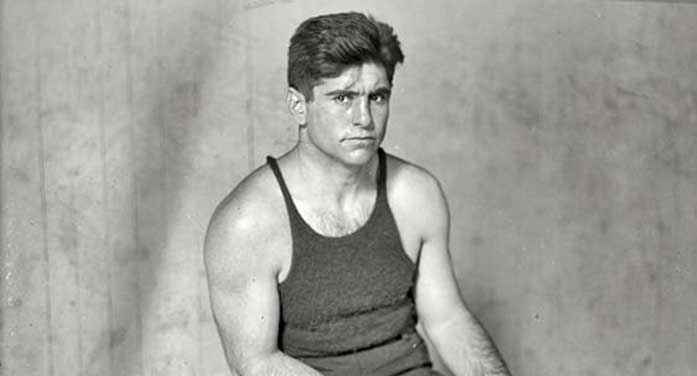
Luis Ángel Firpo was the heavyweight champion of South America, and the 1st native of that continent, and the 1st fighter of Spanish descent, to get a shot at the title. Known as the Wild Bull of the Pampas, the Argentine had already faced contenders Edward "Gunboat" Smith and Bill Brennan, and had ended the career of the man from whom Dempsey brutally took the title, Jess Willard. He seemed like the obvious next opponent for Dempsey.
And it would be held in New York City. Boxing had just been legalized in the State of New York, and both the Polo Grounds, newly-expanded to 56,000 seats, and the brand-new Yankee Stadium, with 67,000, had already hosted professional prizefights. For this fight, the crowd, including in seats on the field, was 80,000. In terms of pre-fight hype, this would be the biggest fight ever held in the Empire State, and would remain so even after the old Madison Square Garden was built in 1925, and after the new Garden was built in 1968, possibly until the 1st fight between Muhammad Ali and Joe Frazier in 1971.

The 1923-64 edition of the Polo Grounds
Firpo came in with a record of 25-2, with 2 no-contests. Dempsey was 61-4, with 9 draws. (Don't be shocked by that last statistic: In those days, some States' athletic commissions had rules that any fight that didn't end with a knockout was classified as a draw.) It was one of the earliest prizefights to be broadcast nationwide on radio.
And the bell had barely rung to begin the fight when Dempsey lunged at Firpo, and left himself undefended, and Firpo threw a right hand that knocked him down. Dempsey was one of those fighters with whom the worst thing you could do was make him mad. With no knockdown rule, and no neutral-corner rule, Dempsey was able to pound away at Firpo, knocking him down 7 times. That's not a typographical error: Dempsey knocked Firpo down seven times in one round.
But the round still wasn't over. Firpo came back, trapped Dempsey against the ropes, and slammed a right into Dempsey's chin. It knocked Dempsey out of the ring. As he fell, he hit the back of his head against a sportswriter's typewriter. He could have been knocked unconscious, but wasn't.
According to the rules, when a fighter is knocked out of the ring, he gets 20 seconds to get back in, instead of the 10 he gets if he's merely knocked down inside the ring. It took Dempsey 14 seconds to get back in. There were those who believed that the writers had given Dempsey help in getting back in, which should have disqualified him. But he was not disqualified, and survived the round.
In the 2nd round, Dempsey knocked Firpo down twice more, and Firpo was counted out at the 57-second mark of the round. It was 4 minutes unlike any that boxing had ever seen, or has since. Bert Sugar, a sportswriter who was boxing's foremost historian, called it the greatest fight in the history of the sport. Did I mention that it wasn't even 4 minutes? Seriously: Roger Bannister's mile run that was the 1st in less than 4 minutes took 2 seconds longer than this fight.
George Bellows, one of the leading American painters of that generation, produced Dempsey and Firpo, one of the most famous paintings ever made of a sporting event. Showing Dempsey falling out of the ring, copies of it seem to appear in every saloon in America.

Firpo retired with a career record of 31-4-2, his last fight in 1936, a defeat by another South American who would challenge for the Heavyweight Championship: Arturo Godoy of Chile, who twice fought Joe Louis, losing both times.
Firpo invested his boxing winnings in a ranch in Argentina, becoming one of the most successful ranchers in the country. He managed Abel Cestac, who became South America's Heavyweight Champion, and later fought Archie Moore for the Light Heavyweight Championship, but lost. Firpo lived until 1960.
Dempsey didn't fight again for 3 years, and when he did, he lost to Gene Tunney. He fought Tunney again, losing the "Long Count Fight." He became more popular in defeat than he ever had in victory. He ran a restaurant at the northern end of Times Square, a block from the old Madison Square Garden, from 1934 to 1974, and died in 1983.
*
September 14, 1923 was a Friday. Football was in midweek. Basketball and hockey were out of season. These baseball games were played that day:
* The New York Yankees lost to the Chicago White Sox, 7-4 at the brand-new original Yankee Stadium. Babe Ruth went 1-for-4, but Eddie Collins hit a home run off Bob Shawkey.
* The New York Giants lost to the Chicago Cubs, 7-1 at Cubs Park in Chicago. (It was renamed Wrigley Field in 1926.)
* The Boston Red Sox beat the Cleveland Indians, 4-3 at Fenway Park. Tris Speaker went 2-for-6, but Ira Flagstead singled home the winning run in the bottom of the 12th inning.
* The Detroit Tigers beat the Washington Senators, 8-3 at Griffith Stadium in Washington. Ty Cobb went 1-for-3.
* The Brooklyn Robins -- as the Dodgers were known under the managing of Wilbert Robinson, from 1914 to 1931 -- and the Pittsburgh Pirates were supposed to play each other at Forbes Field in Pittsburgh. The game was postponed -- due not to rain, but to cold. The game was played the next day, as part of a doubleheader. The Pirates won the 1st game, 4-1; and the Robins won the 2nd game, 13-2.
* The Philadelphia Athletics and the St. Louis Browns were supposed to play each other at Shibe Park in Philadelphia. This game was also postponed due to cold. The game was played the next day, as part of a doubleheader. The A's won the opener, 8-1; and the Browns won the nightcap, 3-2.
* A doubleheader was played at Redland Field in Philadelphia. (It was renamed Crosley Field in 1934.) The Cincinnati Reds won the 1st game, 9-1. The Boston Braves won the 2nd game, 4-0. Jesse Barnes allowed 11 hits, but only 1 walk, and pitched a shutout.
* And the St. Louis Cardinals beat the Philadelphia Phillies, 3-2 at Sportsman's Park in St. Louis.


No comments:
Post a Comment