
November 28, 1966: Author Truman Capote hosts "The Black and White Ball" at the Plaza Hotel, off Grand Army Plaza, at the southeastern corner of Central Park, at 59th Street and 5th Avenue in Manhattan, New York City.
Supposedly, it was meant to honor Katharine Graham, publisher of The Washington Post. Historian Deborah Davis, who wrote a biography of Graham, also wrote a book about the ball, titling it Party of the Century.
Truman Streckfus Persons was born on September 30, 1924 in New Orleans. After his parents divorced, his mother took him to her hometown of Monroeville, Alabama, where one of his childhood friends was another author-to-be, Harper Lee. In To Kill a Mockingbird, Lee named the character based on herself Jean Louise Finch, nicknamed Scout; and the one based on Capote "Dill."
When he was 8, his mother remarried, to a Cuban-born bookkeeper living in New York, named José García Capote (pronounced "Kah-POH-tay"), who adopted him as his son, and renamed him Truman García Capote. They lived on Park Avenue, so his stepfather was doing well. Too well, as it turned out: He was convicted of embezzlement.
By 11, the boy was writing. At 15, the family moved to nearby Greenwich, Connecticut. At 18, he got a job as a copyboy at The New Yorker magazine. Two years later, he was fired for having angered Robert Frost, America's greatest living poet. That was the 1st time he willingly annoyed a better writer than himself. It would not be the last: Speaking of Jack Kerouac in 1959, he said, "That's not writing, that's typing."
He published Other Voices, Other Rooms in 1948, The Grass Harp in 1951, and Breakfast at Tiffany's in 1958. In 1959, he went to Kansas to write about the murder of the Clutter family. In 1965, he published his "nonfiction novel" about the case, In Cold Blood. It gained him the greatest acclaim of his career.
And that's what he was after: Like many people who make it big, he was less interested in being good at what he did than he was in being a star. He was a relentless self-promoter. Had he been buried rather than cremated, his epitaph could well have been his self-description: "I'm an alcoholic. I'm a drug addict. I'm a homosexual. I'm a genius."
Yes, Truman Capote was openly gay -- not just in the 1960s, but in the hyper-repressive 1950s. He may have been the reason why the word "flamboyant" became a stereotype of gay men. His clothes, his mannerisms, his lisping voice... Even if he hadn't come out of the closet, people would have guessed.
According to a friend, writer Leo Lerman, as far back as 1942, he said that when (not if) he became rich and famous, he would throw a party for his rich and famous friends. In June 1966, he felt secure enough to start setting it up. He was inspired by another author, Dominick Dunne, who had given a black and white ball in 1964, for his 10th wedding anniversary. Capote was a guest. Another inspiration was that year's film version of the musical My Fair Lady: In the scene at Ascot Racecourse, the women all wore black and white dresses.
There had to be a guest of honor. And even Capote didn't have the chutzpah to make himself that. He decided that "Kay" Graham needed cheering up. She disagreed, but knew she couldn't stop him from giving the party: "I was sort of baffled... I felt a little bit like Truman was going to give the ball anyway, and that I was part of the props."
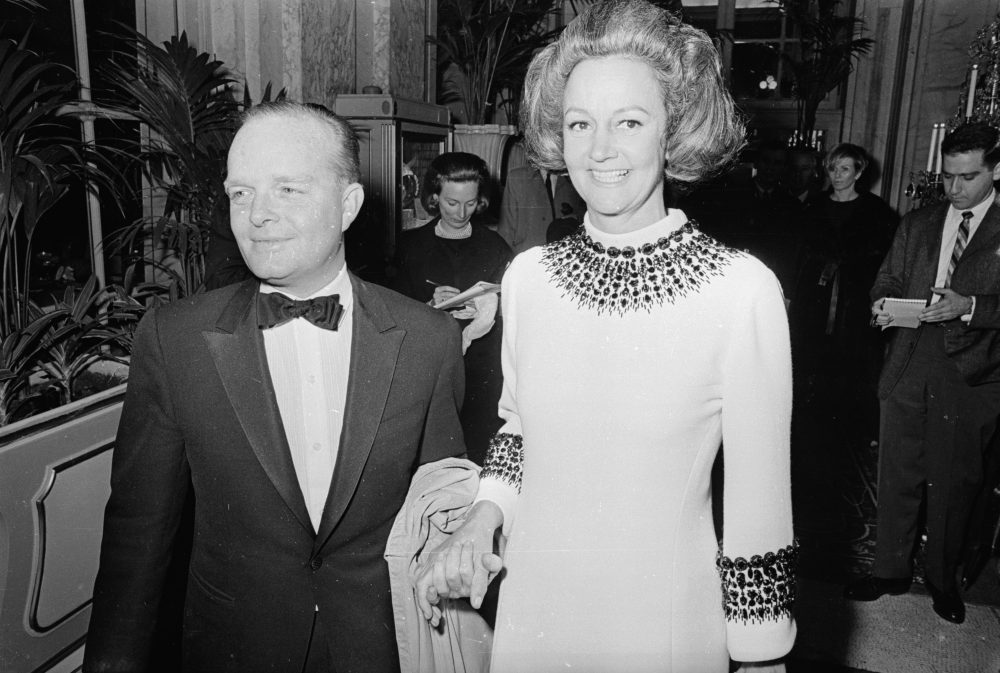
"Tru" and "Kay" at the Ball
While Other Voices, Other Rooms was his 1st published novel, the 1st he'd written was titled Summer Crossing, and its 1st scene was in a dining room at the Plaza Hotel. So he hired the Grand Ballroom of the Plaza. Red tablecloths, with gold candelabra as centerpieces. The menu, served at midnight: Scrambled eggs, sausages, biscuits (Breakfast at midnight?), pastries, spaghetti and meatballs, and, a specialty of the Plaza and one of Capote's favorite dishes, chicken hash. And 450 bottles of Taittinger champagne. How much did Capote spend on this thing? $16,000 -- about $147,000 in 2022 money.
Capote's 540 guests, asked to wear black and white, and masks, included luminaries from New York, Washington, Hollywood and New Orleans. They included the aforementioned Graham and Lerman; CBS chairman William S. Paley and his wife, the former Barbara Cushing, now known as Babe Paley; Scottish businessman Kenneth Keith, Baron Keith of Castleacre, and his wife, the former Mary Gross, now known as Slim Keith; polo champion Winston Guest and his wife, the former Lucy Cochrane, now known as C.Z. Guest; and Prince Stanisław "Stash" Radziwiłł, and his wife, the former Caroline Bouvier, now known as Lee Radzill, sister of former First Lady Jacqueline Kennedy -- but the invited guests did not include Jackie herself.
Babe, Slim, C.Z. and Lee were the leading members of a group of fabulously wealthy and stylish women who glommed onto Capote as a "safe" gay man that they could talk to while their husbands were off making deals and having affairs. He glommed onto them, too, calling them "my swans." He turned out not to be trustworthy, and exposed them in a very nasty article for Esquire magazine in 1975.
Also among the guests: First Lady Claudia "Lady Bird" Johnson (but not President Lyndon Johnson), the Duke and Duchess of Windsor (formerly King Edward VIII of Britain and Wallis Simpson); Ford Motor Company chairman Henry Ford II, journalist Walter Lippmann, economist John Kenneth Galbraith, National Security Adviser McGeorge Bundy, writers Lillian Hellman, Norman Mailer, John Knowles and George Plimpton; Random House publisher and What's My Line? panelist Bennett Cerf, his wife, and his children; San Francisco Chronicle columnist Herb Caen, historian Arthur Schlesinger Jr., editor Norman Podhoretz, Frank Sinatra and his then-wife Mia Farrow, fashion designer Oscar de la Renta and his wife, Vogue magazine editor Françoise de Langlade; heiress and fashion designer Gloria Vanderbilt, philanthropist Brooke Astor, Harper's Bazaar editor Gloria Guinness, poet Marianne Moore, painter Andy Warhol, Broadway producer Hal Prince, Broadway choreographer Jerome Robbins, photographer Gordon Parks, singer Harry Belafonte, actors Douglas Fairbanks Jr. and Henry Fonda, then-married actors Lauren Bacall and Jason Robards, actress Tallulah Bankhead, and actress Candice Bergen.
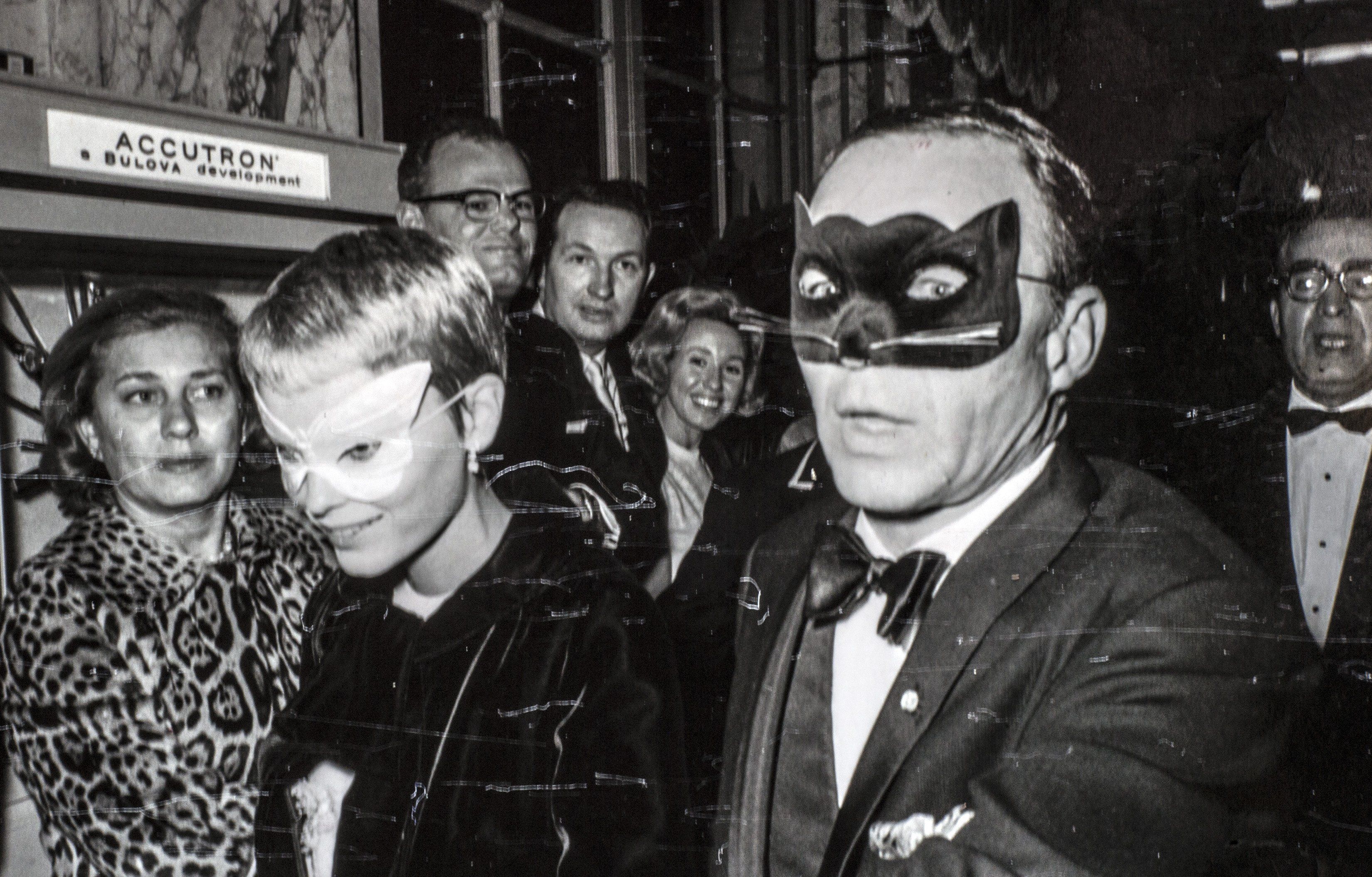
Mia looks comfortable attending. Frank does not.
Oddly, he didn't invite Dunne. Carson McCullers, a woman who, like Capote, was a novelist, a Southerner, and gay, and was allegedly a friend of his, was snubbed as well. Gore Vidal, also an openly gay writer, was not invited, but that wasn't a surprise: They were in a feud that lasted for the rest of Capote's life. Writer William Styron and his wife Rose were invited; he didn't want to go, and didn't, while she did want to go, and did.
Mailer and Bundy nearly got into a fight over the way the Administration was conducting the Vietnam War. Bergen -- only 20 years old at the time -- had misgivings involving the war as well:
I remember the guilt I felt, or actually the guilt that other people thought I should feel. I was 19, I think. Reporters accosted me. "Wasn't it inappropriate to have a ball for five hundred people, when a war was going on?"
Someone said -- could it have been Douglas Fairbanks, in his executioner's hood? -- "The question's inappropriate." Somebody else, who was wearing a mouse mask with little ears, said, "The war's inappropriate."
Nowadays, I don't see how anyone can rationalize a gesture like a ball.
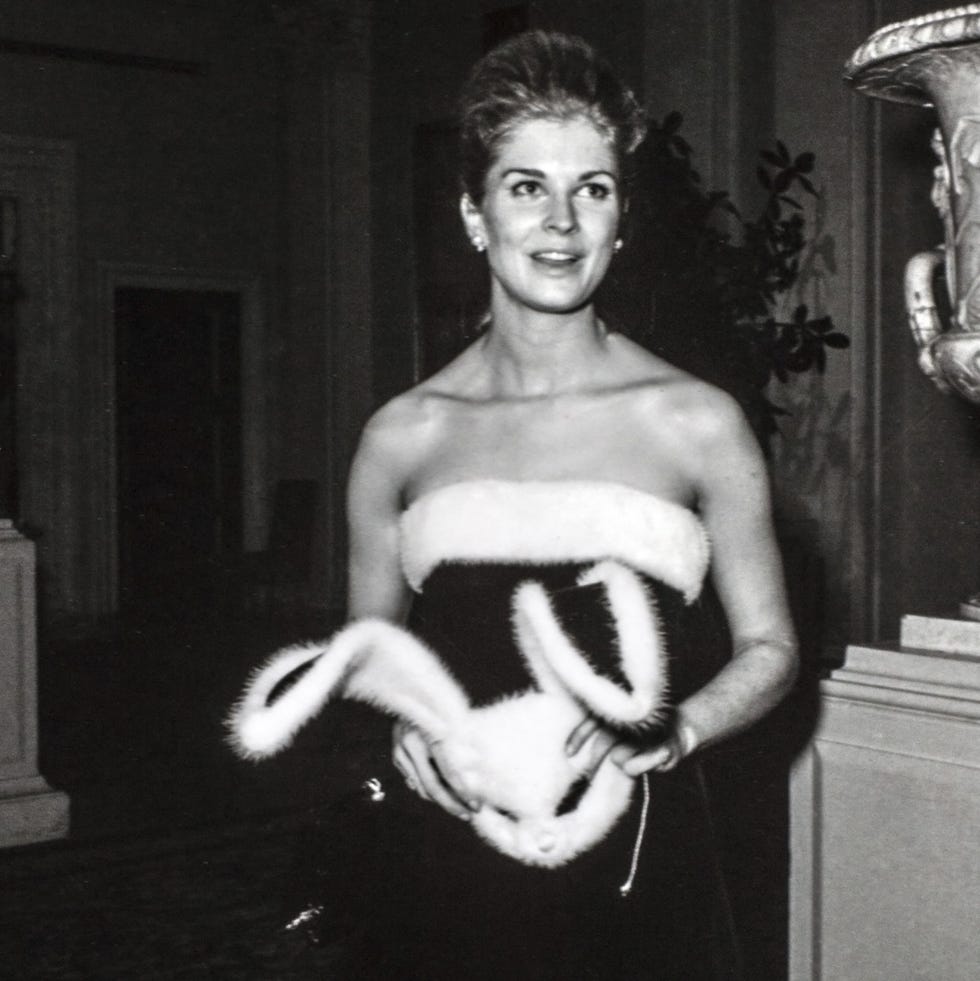
Candice Bergen, 22 years before becoming Murphy Brown
Sinatra did not have a good time. Just before midnight, when the food would be served, he turned to Caen, and said, "Hey, let's get out of here." They and their wives tried to sneak out. Capote tried in vain to stop them. Caen later said of Capote, "I think he was hurt. It was one of those great parties that never got off the ground."
R. Couri Hay, eventually a gossip columnist for Warhol's magazine Interview, but then only 17 years old, once wrote, "Truman always claimed that he invited five hundred of his friends, and made fifteen thousand enemies."
But Mailer, who infamously stabbed his wife at a party he'd hosted at his New York apartment 6 years earlier, said, "It was one of the best parties I ever went to. There was so much action… so many people whom you'd never met before... Everybody there felt anointed that night. I think that's Truman's greatest coup. To me, that party's greater than any of his books."
As Deborah Davis wrote in her book about the Ball:
There was no question that the party triggered an insatiable thirst in readers for the very, "who-wore-it-better" coverage that is so popular today. But the distinction is that, at that moment in time, you had to earn your place on the red carpet. And celebrity had a different definition, it wasn't the "15 minutes of fame."
The thing about the black and white ball was that it was a private party that we were given an insider peek at, and it did create a monster, and it also marked Capote's demise in a sense, because, before the ball, he had always said that gregariousness is the enemy of art. When he was writing a book, he would go off into seclusion and he would never be interrupted by any element of social life. After the ball, he became the world's best guest. And he just went from one event to another, and he lost his hold on his art. And that was very sad. The culture changed, and Capote changed as well.
Capote did a little acting, including in the 1976 murder-mystery comedy Murder By Death, where he played a party host who ended up killed; and became a regular on the talk-show circuit, including making several appearances on The Tonight Show Starring Johnny Carson. He hadn't invited Carson to the Ball, but he did become close friends with Carson and his 2nd wife Joanne.
But he never wrote another novel after the Ball. In fact, if you don't count In Cold Blood -- which could count as a novel, since he was accused of making a lot of things up in it -- he published Breakfast at Tiffany's at the age of 34, and then didn't write another novel for the rest of his life. He died on August 25, 1984, from the effects of drinking, drugs and phlebitis, at Joanne Carson's Los Angeles home, where he'd been staying. He was a few weeks short of turning 60. Vidal got the last word in their feud, calling his death "a good career move."
In 1990, Robert Morse won a Tony Award for playing Capote in the play Tru, and an Emmy Award for reprising the role on PBS 2 years later. Philip Seymour Hoffman -- who, sadly, died from drugs even younger, at age 46 -- won an Oscar for starring in the 2005 film Capote, which was about the making of In Cold Blood.
Capote has also been played by Paul Williams in Oliver Stone's 1991 film The Doors, Louis Negin in 54 (about the discotheque Studio 54) in 1998, Sam Street in the Jacqueline Susann biopic Isn't She Great in 2000, and Toby Jones in Infamous in 2006. Michael J. Burg has played him 3 times: In The Audrey Hepburn Story in 2000, in The Hoax in 2006, and in the 1973-set 2009 TV series Life on Mars. (UPDATE: He was played by Tom Hollander in the 2024 FX miniseries Feud: Capote vs. The Swans.)
*
November 28, 1966 was a Monday. Baseball was out of season. Football was in midweek: There would be no Monday Night Football for another 4 years. And no games were scheduled in the NBA or the NHL. So there were no scores on this historic day. Unless you want to count: "Guests 500, Capote 0."


No comments:
Post a Comment