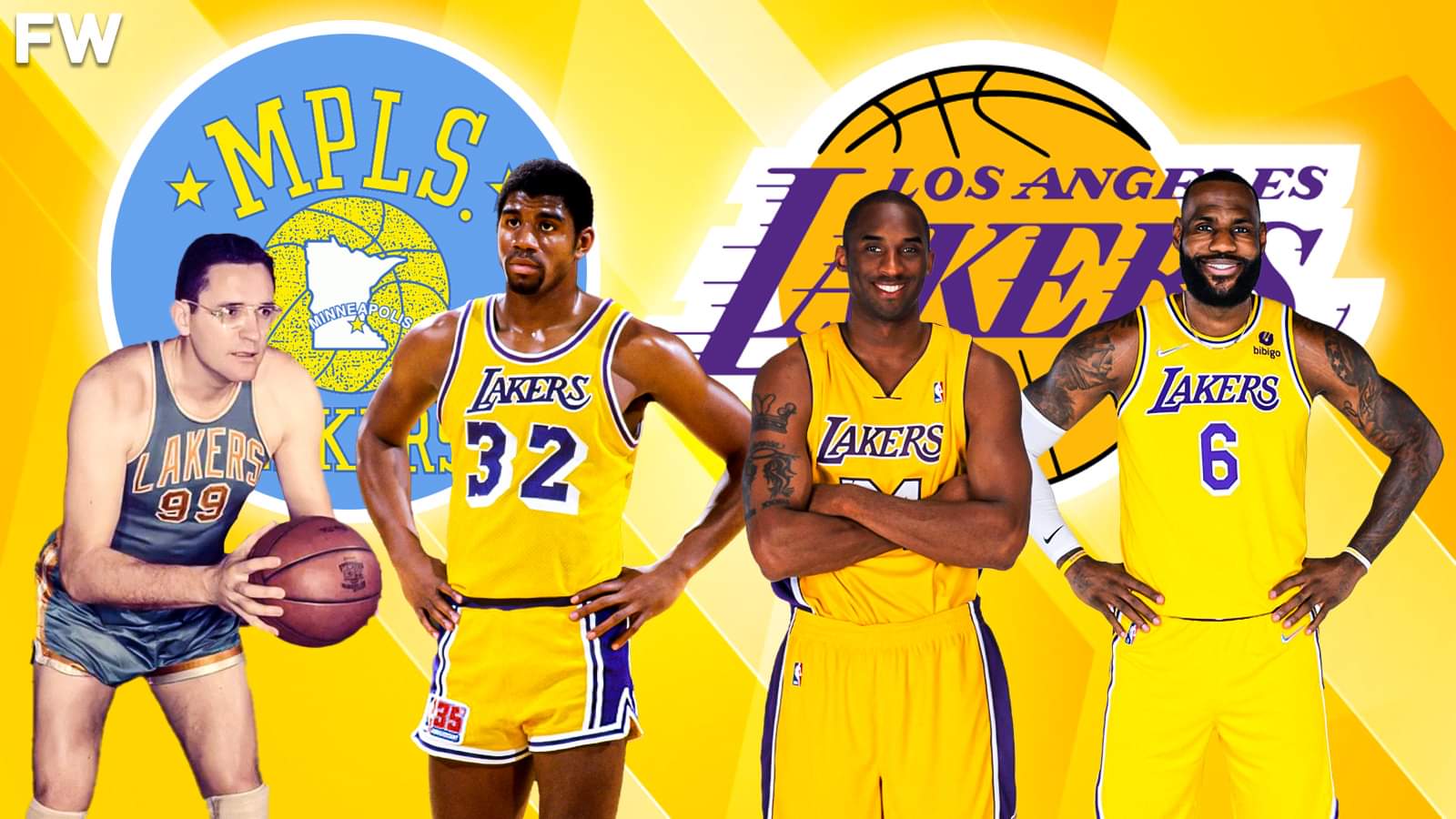
April 27, 1960: Bob Short, owner of the NBA's Minneapolis Lakers, announces he is moving the team to Los Angeles. For the 1st time, the NBA will be a coast-to-coast league. The NFL had already become one in 1946; Major League Baseball, in 1958.
The Lakers won the National Basketball League title in 1948, entered the NBA, and won the title in 1949, 1950, 1952, 1953 and 1954. They featured future Basketball Hall-of-Famers: George Mikan, Vern Mikkelsen, Jim Pollard, Slater Martin, Clyde Lovellette, and head coach John Kundla. They had another Hall-of-Famer: Pro Football Hall of Fame coach Bud Grant played for them.

Left to right: Arnie Ferrin, Vern Mikkelsen,
George Mikan, Jim Pollard, Slater Martin.
By 1959, the team had completely turned over, and reached the NBA Finals with rookie sensation Elgin Baylor, but lost the Finals to the Boston Celtics. And then, after the 1959-60 season, in which they lost the Western Conference Finals to the St. Louis Hawks, team owner Bob Short moved them across the country to Los Angeles.
How could Short move a team that had been to 7 league finals, winning 6 of them, in just 12 seasons? Especially since he was a Minneapolis native, and having Baylor, and being able to draft Jerry West, meant that they had 2 great drawing cards to fill the arena? It didn't make any sense. Talk about "Short-sighted."
Maybe not. There was the arena situation to consider. The Minneapolis Auditorium opened in 1927, and seated 10,000 people, but it was not designed with sports in mind. Nor was the Minneapolis Armory, which opened in 1936 and was the Lakers' home in their final Minneapolis season, 1959-60. The Auditorium was demolished in 1989, while the Armory still stands.
In contrast, the Los Angeles Memorial Sports Arena opened in 1959, seated over 16,000 for basketball, and had no tenant. The Dodgers had recently arrived to an overwhelming response, the Rams were successful, and both USC and UCLA attracted good basketball crowds. Short realized that the NBA could work there.
The Lakers reached the NBA Finals in 1962, 1963 and 1965, before Short sold them to Jack Kent Cooke. He built The Forum in Inglewood for them in 1967. They won the NBA Championship in 1972. In 1979, Cooke sold the Lakers to Jerry Buss, in whose family the team remains today.
In 1968, Short bought MLB's Washington Senators, and after the 1971 season, moved them as well, to the Dallas area, where they became the Texas Rangers. So he not only moved 2 different major league sports teams, he did it in 2 different sports, involving 4 different metropolitan areas. He died in 1982.
The Lakers are Los Angeles' most successful team, having won 12 NBA Championships. The rest of the city? The Clippers haven't yet reached the NBA Finals, but the Sparks have won 3 WNBA titles; the Dodgers have won 5 World Series (not counting 1955 in Brooklyn), while the Angels have won 1; the Rams have won 2 NFL Championships (counting 1 Super Bowl, but not counting the 1 they won in their sojourn in St. Louis), while the Raiders, who weren't there long, won 1; the Kings have won 2 Stanley Cups, the Anaheim Ducks 1; the Galaxy have won 5 MLS Cups, Los Angeles F.C. 1, and the Aztecs won an NASL title. And that doesn't count the 11 National Championships each won by the UCLA basketball team and the USC football team.
But it's more than just the success: There's "sizzle" to go with the "steak." With Elgin Baylor and Jerry West in the 1960s, West and Wilt Chamberlain in the early 1970s, Kareem Abdul-Jabbar and Magic Johnson leading "Showtime" in the 1980s, Shaquille O'Neal and Kobe Bryant in the early 2000s, and Kobe and Pau Gasol the last few years, their flashy image has been a perfect match for L.A.
And what about Minneapolis? They didn't miss the Lakers. Once Mikan retired, the Lakers' attendance was terrible. In 1961, right after the move, baseball's Twins and the NFL's Vikings arrived. By 1962, the Twins were contenders; by 1967, so were the Vikings. Also, at the time, the University of Minnesota's football team was a championship contender. So the Twin Cities weren't starved for sports entertainment.
True, the Twins lost the 1965 World Series -- to the Dodgers, no less. But they were still having more fun watching the Twins and the Vikings throughout the 1960s than they had watching the Lakers in the late 1950s.
In contrast, when the NBA finally expanded in 1989 to include the Minnesota Timberwolves, the response was underwhelming. The T-Wolves have never been a success on the court -- they've only reached the Western Conference Finals once in their 1st 33 seasons -- and they're not making the turnstiles spin, either.
The Twin Cities might not be big enough of a region to support teams in each of the Big Four sports, plus Major League Soccer. And, with the Twins, the Vikings, MLS' Minnesota United and UM football all having gotten new stadiums since 2009, the State of Minnesota being hockey-crazy, and the NHL not wanting to piss them off a 2nd time, if any team has to go, it's going to be the T-Wolves.
UPDATE: The T-Wolves made the Western Conference Finals in 2024, but lost.
The Timberwolves have retired 2 numbers: 2, for forward Malik Sealy, after his death in a car crash in 2000; and 21, for forward Kevin Garnett. Sealy had previously wore 21 throughout his career, but switched to 2 out of respect for Garnett. The T-Wolves have also honored the late coach Philip Saunders with a banner with his nickname, "FLIP."
In 2002, the Los Angeles Lakers hung a banner at the Staples Center (now the Crypto.com Arena), honoring their Minneapolis past. A single banner honors Hall of Fame coach John Kundla, and the 5 Hall of Fame players: Center George Mikan, Number 99; forwards Jim Polland, Number 17, and Clyde Lovellette, Number 34; and guard Slater Martin, Number 22.
The Lakers do not have a team Hall of Fame. But they have honored 13 players with the retirement of their uniform numbers:
* From their Minneapolis era, 1947 to 1960: 99, for Mikan. It was just as well: It was unlikely to ever be worn again, anyway.
* From the 1960s, but not their 1972 title: 22, for forward Elgin Baylor.
* From their 1972 NBA Championship: 13, for center Wilt Chamberlain; 25, for guard Gail Goodrich; and 44, for guard Jerry West. While Pat Riley, later to coach them to 4 NBA Championships, played as a guard on this team, his Number 12 has not yet been retired.
* From their 1980, 1982, 1985, 1987, and 1988 NBA Championships: 33, for center Kareem Abdul-Jabbar; 52, for forward Jamaal Wilkes (left after 1985); 21, for guard Michael Cooper; 32, for guard Earvin "Magic" Johnson; and 42, for forward James Worthy (arrived after 1982).
* From their 2000, 2001 and 2002 NBA Championships 34, for center Shaquille O'Neal; and 8, for guard Kobe Bryant.
* From their 2009 and 2010 NBA Championships: 24, to which Bryant had switched, making him the only athlete in the "Big Four" North American sports to have one team retire two different numbers for him; and 16, for forward Pau Gasol.
* As of the 2025-26 season, no player on their 2020 NBA Championship has had his number retired.
* And Francis "Chick" Hearn, who broadcast for the Lakers from 1961 to 2002, was honored with a banner with a microphone in place of a number.
*
April 27, 1960 was a Sunday. Hockey player Mike Krushelnyski was born.
Football was out of season. The NBA season had ended on April 9, with the Boston Celtics beating the St. Louis Hawks for the title. The hockey season had ended on April 14, with the Montreal Canadiens beating the Toronto Maple Leafs for their 5th straight Stanley Cup.
And these Major League Baseball games were played:
* The New York Yankees lost to the Washington Senators, 5-4 at Yankee Stadium. Jim Kaat, a 21-year-old rookie lefthander, outpitched Whitey Ford. Don Mincher and Jim Lemon hit home runs for the Senators. For the Yankees, Bill "Moose" Skowron hit a home run. Mickey Mantle went 1-for-4. Yogi Berra went 0-for-3 with a walk. Roger Maris and the Senators' Harmon Killebrew did not play.
* The Pittsburgh Pirates beat the Philadelphia Phillies, 3-2 at Connie Mack Stadium in Philadelphia. Roberto Clemente went 2-for-4 with a walk.
* The Baltimore Orioles beat the Boston Red Sox, 8-3 at Memorial Stadium in Baltimore. Brooks Robinson went 1-for-4 with a walk and an RBI. Ted Williams appeared only as a pinch-hitter, and did not reach base.
* The Milwaukee Braves beat the Cincinnati Reds, 8-5 at Crosley Field in Cincinnati. Hank Aaron went 4-for-6 with a home run. Frank Robinson went 1-for-4 with a home run.
* The Los Angeles Dodgers beat the Chicago Cubs, 9-4 at Wrigley Field in Chicago. Gil Hodges hit a home run. Ernie Banks went 0-for-4, but had an RBI on a groundout.
* The Kansas City Athletics beat the Detroit Tigers, 3-1 at Kansas City Municipal Stadium. Al Kaline went 0-for-3 with a walk.
* And the Chicago White Sox, the Cleveland Indians, the St. Louis Cardinals and the San Francisco Giants were not scheduled.


No comments:
Post a Comment