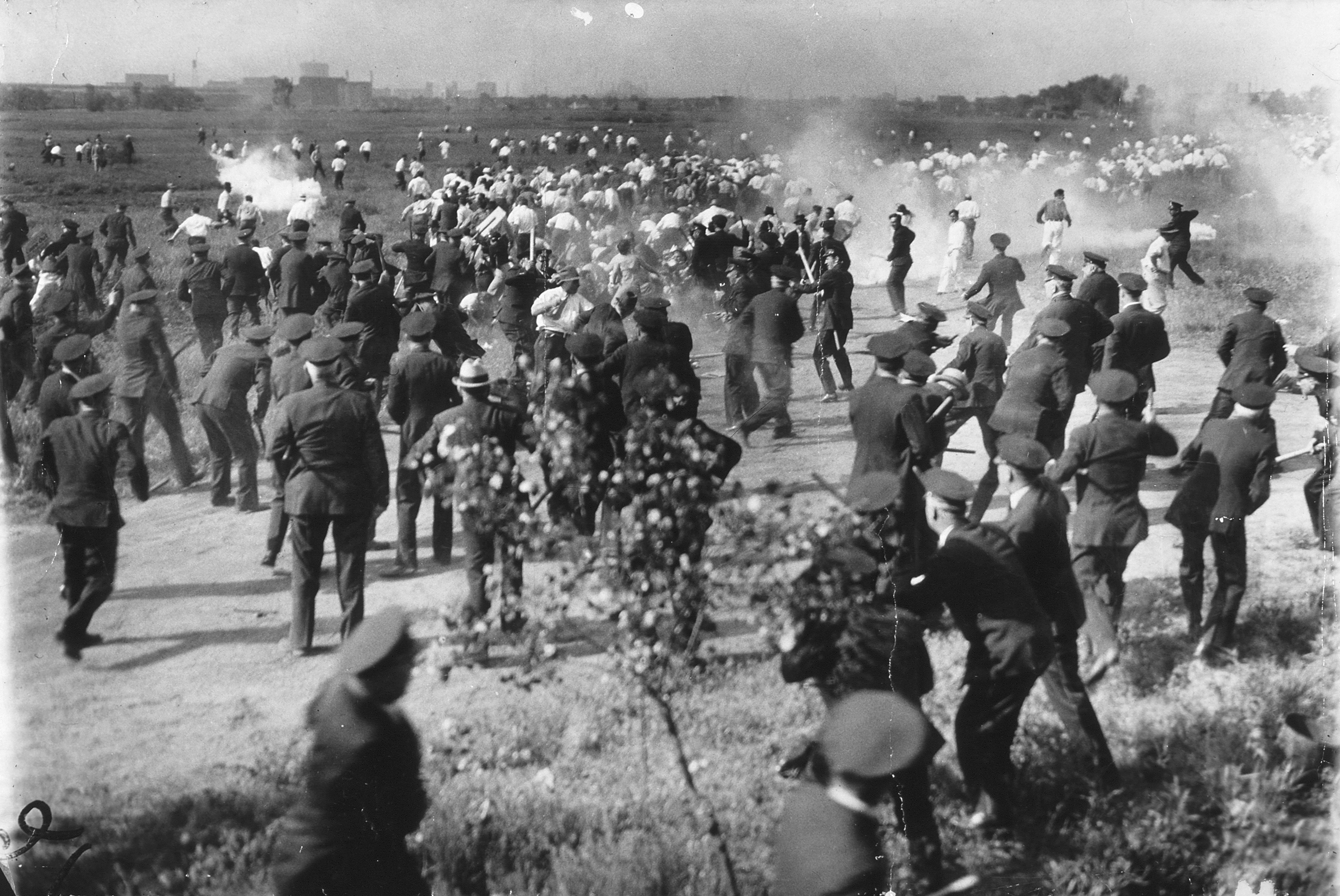
May 30, 1937: Chicago Police Department officers kill 10 unarmed demonstrators. It becomes known as the Memorial Day Massacre.
United States Steel, nicknamed "Big Steel," had signed a contract with the Steel Workers Organizing Committee (SWOC), a unit of the Congress of Industrial Organizations (CIO). But smaller companies, known as "Little Steel," including Republic Steel, refused to go along. So the SWOC called a strike.
From 1868 to 1970, America observed Memorial Day on May 30, no matter what day of the week on which it fell. Since 1971, it's been celebrated on the closest Monday to that date, anywhere between May 25 and May 31.
On May 30, 1937, a Sunday and a Memorial Day, unionists, their families and sympathizers gathered at Sam's Place, a former tavern and dance hall at 113th Street and Green Bay Avenue, on the South Side of Chicago, that served as the headquarters of the SWOC. There was an outdoor picnic lunch, speakers, and songs. The crowd was estimated to be between 1,500 to 2,500, including picketers and their families, strike sympathizers, and curious passersby.
The crowd began to march across the prairie towards the Republic Steel mill to picket, but a line of roughly 300 Chicago policemen blocked their path. The foremost protestors argued their right to continue. The police fired on the crowd. As the crowd fled, police shot and killed 10 people, 4 dying that day, and 6 others subsequently from their injuries. The youngest victim, Western Union telegraph company worker Leo Francisco, was only 17 years old. An additional 9 people were permanently disabled, and another 28 had serious head injuries from police clubbing.
Social reformer Dorothy Day, who was present, wrote: "On Memorial Day, May 30, 1937, police opened fire on a parade of striking steel workers and their families at the gate of the Republic Steel Company, in South Chicago. Fifty people were shot, of whom 10 later died; 100 others were beaten with clubs."
The American media corporations, conservative as usual, suppressed newsreel footage of the event, for fear of creating, in the words of an official at Paramount News agency, "mass hysteria." Initial news coverage of the event instead framed the crowd as a violent threat to social order, arguing that police merely acted in self-defense. Still photographs were published in major newspapers such as the then-archconservative Chicago Tribune, along with captions such as: "At the Height of the Battle--Here are policemen using their nightsticks and tear gas to subdue the attackers." Paramount did release edited clips from the newsreel footage of the massacre that portray the crowd as threatening and riotous.
Years later, one of the protesters, Mollie West, recalled a policeman yelling to her that day, "Get off the field or I'll put a bullet in your back." No policemen were ever prosecuted. A Coroner's Jury declared the killings to be "justifiable homicide." The press often called it a labor or red riot. Even President Franklin Roosevelt, normally friendly to labor, washed his hands of the event, responding to a union plea with a line from Shakespeare's Romeo & Juliet: "The majority of people are saying just one thing: 'A plague on both your houses.'"
The United Steelworkers (USW) were founded in 1942. Republic Steel was bought out, and essentially went out of business, in 1984. The USW are still in operation.
Game 1 of the 1985 NBA Finals, a 148-114 Boston Celtics victory over the Los Angeles Lakers at the Boston Garden on May 27, was immediately called "The Memorial Day Massacre." But the term faded a bit when the Lakers won 4 of the next 5 games to win the Championship, including Games 2 and 6 at the Garden.
*
May 30, 1937 was, as I said, a Sunday. These baseball games were played:
* The New York Yankees beat the Philadelphia Athletics, 13-1 at Yankee Stadium. Lefty Gomez went the distance for the win. Red Rolfe and Lou Gehrig his home runs. Joe DiMaggio went 1-for-5 with 2 RBIs.
* The New York Giants lost to the Philadelphia Phillies, 6-3 at Baker Bowl in Philadelphia. Mel Ott hit a home run.
* The Brooklyn Dodgers lost to the Boston Bees (as the Braves were known from 1936 to 1940), 11-4 at Ebbets Field.
* The Washington Senators beat the Boston Red Sox, 11-4 at Fenway Park in Boston. Pete Appleton not only went the distance pitching, he went 4-for-5 with 6 RBIs. Jimmie Foxx hit a home run in defeat.
* The Chicago White Sox beat the Cleveland Indians, 9-6 at Cleveland Municipal Stadium. Zeke Bonura went 3-for-4 with 5 RBIs.
* The Detroit Tigers beat the St. Louis Browns, 18-3 at Navin Field in Detroit. (It was renamed Briggs Stadium the next year, and Tiger Stadium in 1961.) Gerald "Gee" Walker went 4-for-6 with 2 home runs and 7 RBIs. Hank Greenberg went 5-for-5 with 2 home runs and 5 RBIs.
* The Chicago Cubs beat the Cincinnati Reds, 7-1 at Wrigley Field in Chicago.
* And the Pittsburgh Pirates beat the St. Louis Cardinals, 7-4 at Sportsman's Park in St. Louis.


No comments:
Post a Comment