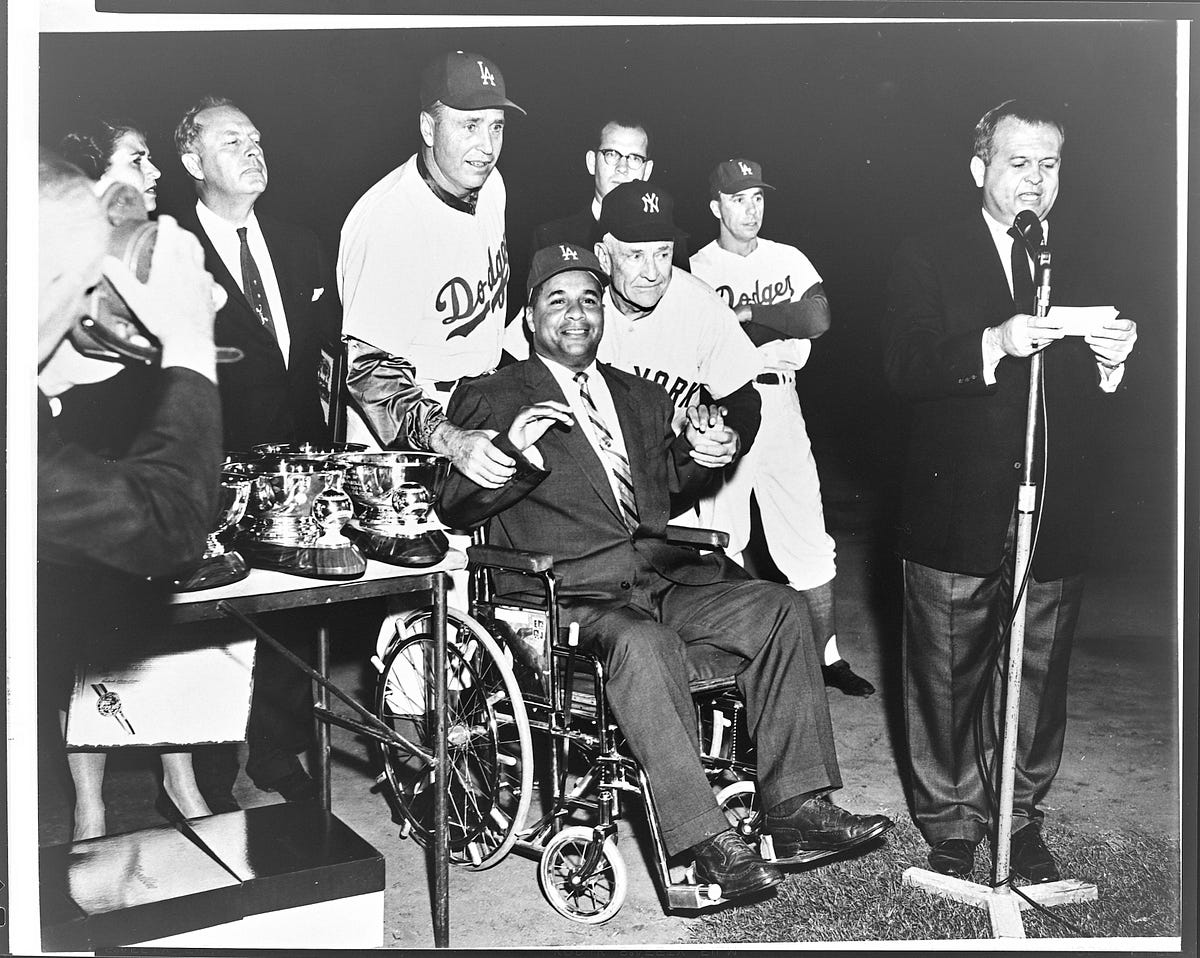
May 7, 1959: The Los Angeles Dodgers do something not often done in baseball, but common in soccer: They hold a testimonial game to raise money for a good cause in a player's name. Roy Campanella Night was held at the Los Angeles Memorial Coliseum. The New York Yankees, in the middle of a Western roadtrip, agreed to be the opponents for this exhibition game.
A native of Philadelphia, Roy Campanella had starred in the Negro Leagues before joining the Brooklyn Dodgers in 1948. From then until 1957, he had played in 8 All-Star Games, batted over .300 3 times, hit 259 home runs, topped 100 RBIs 3 times including a League-leading 142 in 1953, won 3 National League Most Valuable Player awards, and helped the Dodgers win 5 Pennants, facing the Yankees in the World Series each time, winning in 1955.
After the 1957 season, the Dodgers announced their move to Los Angeles. "Campy" was just 36 years old, and already in something of a decline, but the close left-field fence at the Coliseum, necessary until Dodger Stadium could open in 1962, was thought to be a way of helping his power numbers.
He lived in Glen Cove, on New York's Long Island, and owned a liquor store in Harlem. On January 28, 1958, he drove home from the store in his 1957 Chevrolet sedan. He was less than a mile from home when, while driving only about 30 miles per hour, he hit a patch of ice on an S-curve, hit a telephone pole, and overturned.
He broke 2 vertebrae, and was paralyzed from the shoulders down. Eventually, he regained enough mobility to feed himself, but he required the use of a wheelchair for the rest of his life.
Dodger owner Walter O'Malley, usually known for being incredibly greedy and cheap, named Campy a scouting supervisor and a special coach at their "Dodgertown" Spring Training camp at Vero Beach, Florida, paying his travel expenses. It kept him involved in baseball. And he announced the scheduling of Roy Campanella Night for May 7, 1959.
On a Thursday night, 93,103 fans -- most of whom were West Coast residents, and thus had never seen him play, and didn't really have an emotional connection to him -- came out, the largest crowd in baseball history (until 2008). The lights were turned out, and all 93,103 fans held lit candles aloft. The Yankees won the game, 6-2, and the proceeds were used to pay down Campy's medical bills.
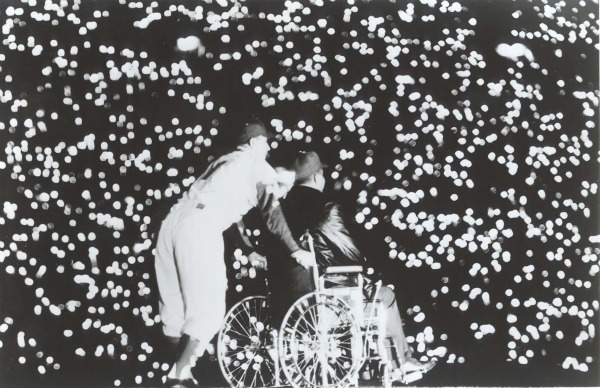
Campy, pushed by former teammate Pee Wee Reese,
surrounded by 93,000 candles
In 1969, Campy was elected to the Baseball Hall of Fame, becoming the 2nd black player so honored, after Jackie Robinson. In 1972, in a pregame ceremony at Dodger Stadium, the Dodgers retired Campy's Number 39, Jackie's Number 42, and Sandy Koufax' Number 32. He remained in the Dodger organization until he died on June 26, 1993. He was 71 years old.
One more thing: Like O'Malley, Chicago Bears owner George Halas was known for his cheapness. O'Malley held a testimonial game to help pay for Campanella's medical bills. In 1969 and '70, when running back Brian Piccolo was dying of cancer, Halas paid his medical bills, and his funeral costs, in full.
When another catcher, the Yankees' Thurman Munson, went down in a plane crash in 1979, his injuries were such that, had he been rescued, he would have been paralyzed. I have no doubt that team owner George Steinbrenner would have paid Thurman's medical bills himself, and, with Roy Campanella Night in mind, would have invited the Dodgers to play an exhibition game at Yankee Stadium to raise money to start a new charity for spinal cord patients.
Walter O'Malley could have afforded that. He did not try. He did the minimum that was necessary for public relations, enough to show the people of Southern California that he wasn't the uncaring, greedy monster that New Yorkers thought he was, and that was it.
*
May 7, 1959 was, as I said, a Thursday. This was also the day that Philip Roth published his 1st book, the short story collection Goodbye, Columbus. I have a separate entry for this event.
Football, basketball and hockey were out of season. There were 4 regular-season Major League Baseball games played that day:
* The Pittsburgh Pirates beat the Philadelphia Phillies, 5-4 at Forbes Field in Pittsburgh. Roberto Clemente went 0-for-4. Ted Kluszewski won it for the Pirates with a home run in the bottom of the 10th inning, but would soon be traded to the Chicago White Sox, and helped them win their 1st American League Pennant in 40 years.
* The Baltimore Orioles beat the Washington Senators, 10-1 at Griffith Stadium in Washington. Harmon Killebrew went 1-for-4 for the Senators, who became the Minnesota Twins 2 years later, and were then replaced by a new Senators team that became the Texas Rangers in 1972. Brooks Robinson did not play for the Orioles.
* The Detroit Tigers beat the Boston Red Sox, 3-1 at Briggs Stadium in Detroit. (It was renamed Tiger Stadium in 1961.) Al Kaline went 0-for-3. Ted Williams did not play.
* And the St. Louis Cardinals beat the Chicago Cubs, 4-3 at Busch Stadium (which had been Sportsman's Park until 1953) in St. Louis. Ernie Banks went 2-for-4, Stan Musial 1-for-4, each with a solo homer.


No comments:
Post a Comment