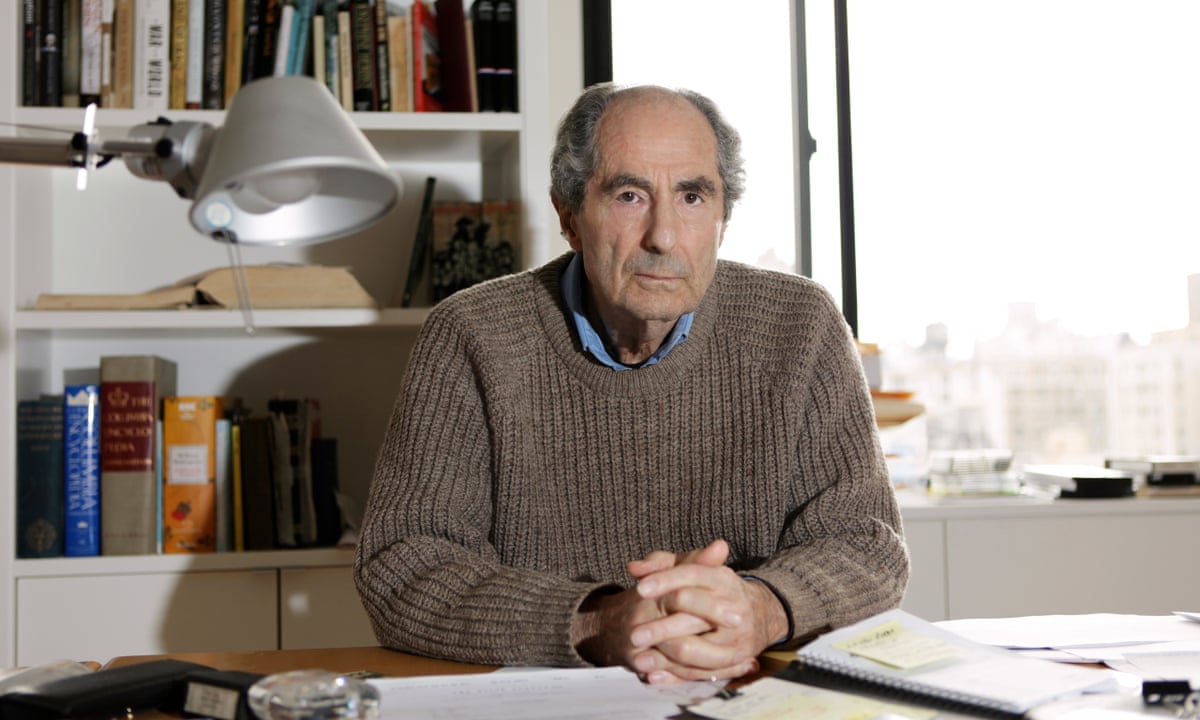
May 7, 1959: Philip Roth publishes his 1st book, the short story collection Goodbye, Columbus. It launches him on a career as one of America's best, and most troublesome, writers.
Philip Milton Roth was born on March 19, 1933 in Newark, New Jersey, and grew up on the South Side of town, in the Weequahic neighborhood, which was then mostly Jewish. Locations in Newark, especially in Weequahic, would feature in his writing for his entire life.
He graduated from Bucknell University, then enlisted in the U.S. Army, but hurt his back in a training exercise, and received a medical discharge. He began teaching at the University of Pennsylvania in Philadelphia, and taught there until 1991.
Goodbye, Columbus includes the title novella, originally published in The Paris Review, and set in the Newark suburb of Short Hills, Essex County, New Jersey. It contains the five short stories "The Conversion of the Jews," "Defender of the Faith," "Epstein" (not about Jeffrey, who was then a child and not famous), "You Can't Tell a Man by the Song He Sings," and "Eli, the Fanatic." Each story deals with the concerns of second- and third-generation assimilated American Jews (he was second-generation, the grandson of immigrants) as they leave the ethnic ghettos of their parents and grandparents, and go on to college, to white-collar professions, and to life in the suburbs.
The book was a critical success for Roth, and won the 1960 U.S. National Book Award for Fiction. It helped launch a subculture of "assimilated Jewish" fiction that included the standup comedy of Alan King, Joan Rivers and Woody Allen (before Allen began directing films starring himself and a succession of real-life girlfriends), the song parodies of Allan Sherman, and sitcoms with vaguely Jewish overtones such as The Dick Van Dyke Show and Get Smart.
The book was not without controversy, as people within the Jewish community took issue with Roth's less than flattering portrayal of some characters. "Defender of the Faith," about a Jewish Sergeant who is exploited by three shirking, coreligionist draftees, drew particular ire. Many accused Roth of being a "self-hating Jew," a label that stuck with him for years.
The title novella was made into the 1969 film Goodbye, Columbus, starring Ali MacGraw and Richard Benjamin. This release came shortly after that of Roth's novel Portnoy's Complaint, a title he explained on the first page: "A disorder in which strongly felt ethical and altruistic impulses perpetually are warring with extreme sexual longings, often of a perverse nature."
I won't go into further detail than that, but I will quote Jacqueline Susann, author the similarly-controversial novel Valley of the Dolls: "Philip Roth is a good writer, but I wouldn't want to shake hands with him." Portnoy's Complaint was filmed in 1972, again with Richard Benjamin in the lead role, alongside Karen Black.
The success of Roth's books helped launch Allen as a film director, and his films also wrestled with the themes of being Jewish in modern America, and also with being a man wanting sex in modern America, and how both distinctions tended to mess up relationships with women, Jewish and Gentile alike.
In 2004, Roth published The Plot Against America, which imagined an alternate history in which the Nazi Party and American business lords teamed up to elect hero pilot turned anti-Semitic isolationist Charles Lindbergh as President over Franklin Roosevelt in 1940, and the Nazi-inspired government that followed.
Roth died on May 22, 2018, having lived long enough to see Donald Trump become President, but not long enough to see 2020, the year that The Plot Against America became an HBO miniseries and Trump was defeated for re-election by Joe Biden. (UPDATE: He also didn't live long enough to see 2024, when Trump got back into power, and brought America closer to the novel than he did in his 1st term.)
*
May 7, 1959 was a Thursday. This was also the day that the Los Angeles Dodgers held Roy Campanella Night, attracting the largest crowd in baseball history to that point, and lost to the New York Yankees in an exhibition game. I have a separate entry for this event.
Football, basketball and hockey were out of season. There were 4 regular-season Major League Baseball games played that day:
* The Pittsburgh Pirates beat the Philadelphia Phillies, 5-4 at Forbes Field in Pittsburgh. Roberto Clemente went 0-for-4. Ted Kluszewski won it for the Pirates with a home run in the bottom of the 10th inning, but would soon be traded to the Chicago White Sox, and helped them win their 1st American League Pennant in 40 years.
* The Baltimore Orioles beat the Washington Senators, 10-1 at Griffith Stadium in Washington. Harmon Killebrew went 1-for-4 for the Senators, who became the Minnesota Twins 2 years later, and were then replaced by a new Senators team that became the Texas Rangers in 1972. Brooks Robinson did not play for the Orioles.
* The Detroit Tigers beat the Boston Red Sox, 3-1 at Briggs Stadium in Detroit. (It was renamed Tiger Stadium in 1961.) Al Kaline went 0-for-3. Ted Williams did not play.
* And the St. Louis Cardinals beat the Chicago Cubs, 4-3 at Busch Stadium (which had been Sportsman's Park until 1953) in St. Louis. Ernie Banks went 2-for-4, Stan Musial 1-for-4, each with a solo homer.


No comments:
Post a Comment