Wells' story first appeared in London-based Pearson's Magazine in 1897. That same year, in America, Cosmopolitan serialized it. (It was a literary magazine until 1965, when Helen Gurley Brown was named editor, and turned it into a women's magazine.) It appeared in hardcover in 1898.
To make a long story short, with a spoiler: Creatures from the planet Mars invade Earth by attacking the greatest city of the age, late-Victorian London, and terrorize humanity, but soon die due to having no immunity to Earth germs.
It's been filmed in 1953 by George Pal, starring Gene Barry and moving the location to Southern California -- in other words, Hollywood itself -- and in 2005 by Steven Spielberg, starring Tom Cruise and set in New York. In each case, the film was set in what was then the present day.
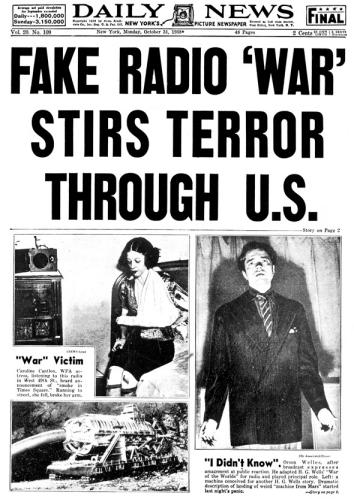
The 1938 radio version was also set in its present. Howard E. Koch adapted the story for the broadcast, and lead actor Orson Welles (not related to H.G. Wells, note the different spelling), just 23 years old, tells of creatures from Mars landing in Grover's Mill, in the Township of West Windsor, Mercer County, New Jersey. The site is about a mile east of where the Princeton Junction train station now stands, about halfway between Midtown Manhattan and Center City Philadelphia, and 17 miles from East Brunswick, where I grew up.
To make a long story short, with a spoiler: Creatures from the planet Mars invade Earth by attacking the greatest city of the age, late-Victorian London, and terrorize humanity, but soon die due to having no immunity to Earth germs.
It's been filmed in 1953 by George Pal, starring Gene Barry and moving the location to Southern California -- in other words, Hollywood itself -- and in 2005 by Steven Spielberg, starring Tom Cruise and set in New York. In each case, the film was set in what was then the present day.
The 1938 radio version was also set in its present. Howard E. Koch adapted the story for the broadcast, and lead actor Orson Welles (not related to H.G. Wells, note the different spelling), just 23 years old, tells of creatures from Mars landing in Grover's Mill, in the Township of West Windsor, Mercer County, New Jersey. The site is about a mile east of where the Princeton Junction train station now stands, about halfway between Midtown Manhattan and Center City Philadelphia, and 17 miles from East Brunswick, where I grew up.
The story is told as if it were a live news broadcast. While it ends with the Martians dying -- after having devastated New York -- it also ends with Welles, as the surviving Professor Pierson, interviewing a man in Newark, who holds fascist ideals, and wanting to use the Martian weaponry to take over what's left of Earth. It's worth noting that it had been one month since Britain and France caved in to Nazi Germany's demand for Czechoslovakia's Sudetenland. I have listened to the broadcast on YouTube. It clocks in at a little under an hour.
Legend has it that people heard that the alien invaders were killing people and advancing toward New York, panicked, grabbed their shotguns and pitchforks, and evacuated. However, Welles said at the end of every commercial break that it was just a show, not actually happening, and repeated this at the end.
 Furthermore, it would have been very easy for people to turn to another radio station -- say, their local NBC affiliate -- and hear regularly-scheduled programming, and not any "special report" of a Martian invasion and attack, and know that everything was as it was before. Welles publicly apologized the next day -- Halloween. But it made him a legend.
In 1941, Welles co-wrote, produced, directed, and starred in Citizen Kane, one of the greatest movies ever made. But because Charles Foster Kane was, despite all denials, an obvious sendup of newspaper baron William Randolph Hearst, Hearst told his media empire, now including film newsreels and radio stations, to blast the film.
Welles never fully recovered, despite making some more good films (The Magnificent Ambersons, The Third Man, Touch of Evil), reduced to a punchline due to his fall from grace, his "slumming" with things like commercials for Paul Masson wine, his wasted genius, and his, uh, geniused waist. He died in 1985, having been mostly irrelevant from ages 26 to 70.
 While many sports teams, professional and collegiate alike, have given themselves nicknames of various kinds of warriors, none has ever named itself "The Martians" or "The Aliens." Although the Las Vegas 51s, named for the nearby U.S. Air Force base nicknamed "Area 51," use "the Roswell Alien" as their logo.
*
Legend has it that people heard that the alien invaders were killing people and advancing toward New York, panicked, grabbed their shotguns and pitchforks, and evacuated. However, Welles said at the end of every commercial break that it was just a show, not actually happening, and repeated this at the end.
In 1941, Welles co-wrote, produced, directed, and starred in Citizen Kane, one of the greatest movies ever made. But because Charles Foster Kane was, despite all denials, an obvious sendup of newspaper baron William Randolph Hearst, Hearst told his media empire, now including film newsreels and radio stations, to blast the film.
Welles never fully recovered, despite making some more good films (The Magnificent Ambersons, The Third Man, Touch of Evil), reduced to a punchline due to his fall from grace, his "slumming" with things like commercials for Paul Masson wine, his wasted genius, and his, uh, geniused waist. He died in 1985, having been mostly irrelevant from ages 26 to 70.
October 30, 1938 was a Sunday. Baseball season was over. The NBA hadn't been founded yet. And the NHL season wouldn't start for another 4 days. But there were 3 NFL games played that day:
* The football version of the Brooklyn Dodgers played the Washington Redskins to a 6-6 tie at Ebbets Field.
* The Green Bay Packers beat the Cleveland Rams, 28-7 at League Park in Cleveland. The Rams moved to Los Angeles in 1946.
* And the Detroit Lions beat the Chicago Bears, 13-7 at Wrigley Field.
Despite it being a Sunday, there was one notable college football game played: Southern Methodist University (SMU) beat the University of Texas, 7-6 at Ownby Stadium in Dallas.


No comments:
Post a Comment