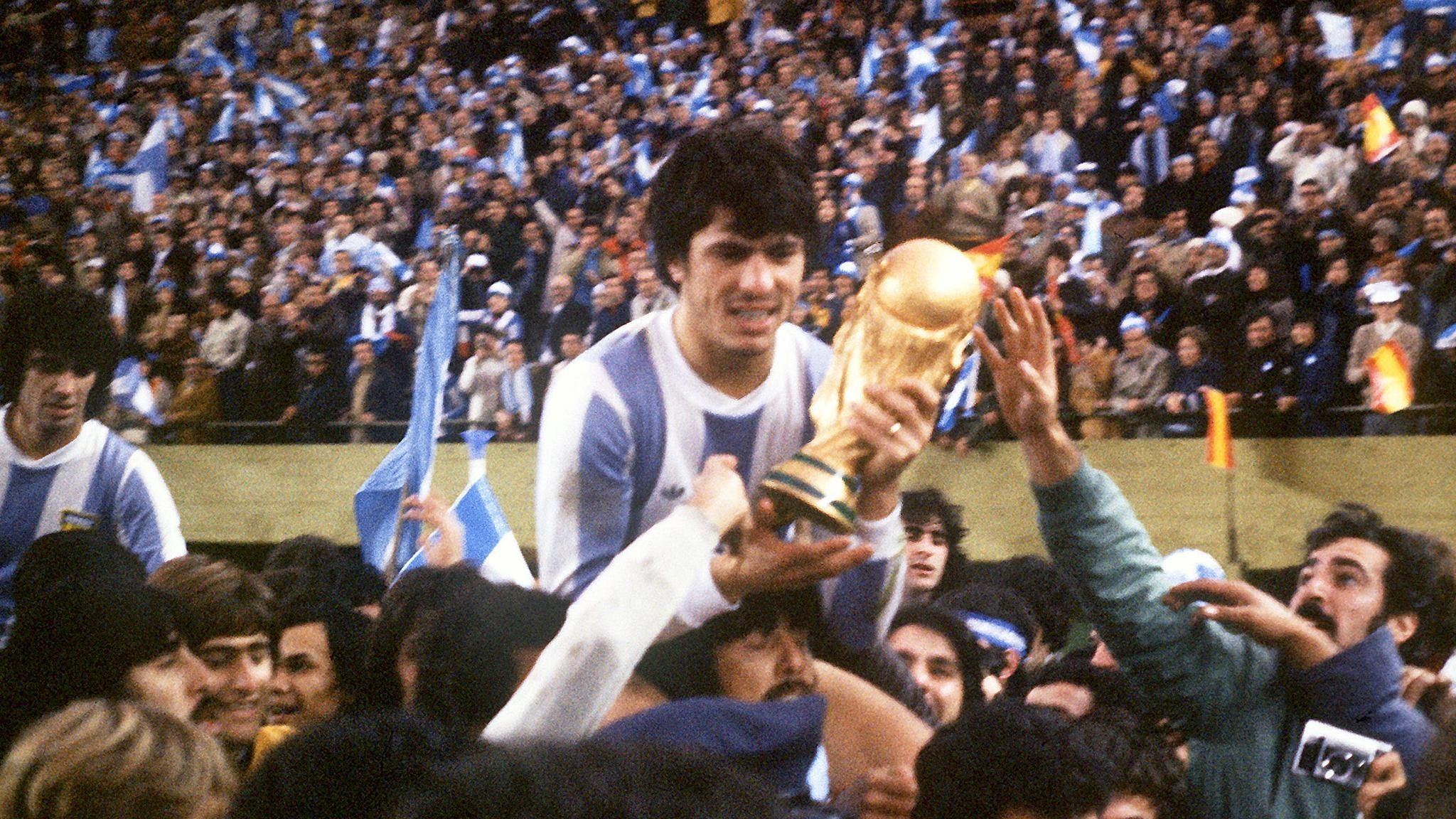
Argentina Captain Daniel Passarella, with the Jules Rimet Trophy
June 25, 1978: The World Cup Final is held at Estadio Monumental in Buenos Aires, Argentina. In this most corrupt of sports, it may have been the most corrupted game ever. And the scariest.
Not that Americans knew: Despite the North American Soccer League being probably at its peak, the country's English-language commercial networks did not broadcast the tournament, marking the only World Cup between 1966 and the modern era to have zero coverage on mainstream home TV. The Spanish International Network (SIN), which later became Univision, secured the U.S. broadcast rights and televised up to 25 games in Spanish to major American cities.
In 1973, Argentina was awarded the 1978 World Cup by FIFA, the International Federation of Football Associations. But in 1976, a coup resulted in a Fascist military dictatorship. It would be one of the ugliest governments in the history of the world, with tens of thousands of people labeled as "disappeared."
In 1974, Johan Cruyff led the Netherlands to the World Cup Final, where they lost to West Germany. It wasn't a "home soil victory": The Germans had a goal incorrectly waved off. Still, the Oraanje were considered favorites to stay among the world's elite. After all, Cruyff would only be 31 during the 1978 World Cup.
But in 1977, Cruyff announced his retirement from international soccer, refusing to play in the tournament. For 30 years, it was believed that he was protesting the military dictatorship. But in 2008, he revealed the truth: There was a threat against his family, and it got into his head, and he didn't think he would be at his best for the tournament.
Defending champions West Germany failed to make the Final, by losing 3-2 to Austria, at Chateau Carreras in Córdoba. For Austria, which hasn’t had a good national team since the 1938 Anschluss, it is known as Das Wunder von Córdoba: The Miracle of Cordoba. For Die Mannschaft, it is Die Schmach von Córdoba: The Disgrace of Cordoba.
Again, the Netherlands reached the Final, even without Cruyff. They would play the hosts and the Argentines' mere qualification for the Final under the system then in place was dubious. Following Brazil's 3–1 win over Poland, Argentina needed to win their last game in the Second Group Stage by a margin of 4 goals to proceed to the Final, and did so by defeating Peru by 6–0.
There were allegations that the military government interfered to ensure Argentina would defeat Peru through intimidation, though these were denied by Peruvian captain Héctor Chumpitaz and several Peruvian players.
Some accusations originated in the Brazilian media (Brazil being Argentina's soccer arch-rivals), and pointed to the fact that the Peruvian goalkeeper, Ramón Quiroga, had been born in Argentina. here was also an alleged deal, reported by the British media as an anonymous rumor, that involved the delivery of a large grain shipment to Peru by Argentina, and the unfreezing of a Peruvian bank account that was held by the Argentine Central Bank.
Another alleged deal, published by a Colombian drug lord in a controversial book, involved the Peruvian team being bribed without any political implications. A third alleged deal, stated by a Peruvian leftist politician, encompassed sending 13 Peruvian dissidents exiled in Argentina back to Peru.
There was also a rumor that the referee was initially supposed to be Abraham Klein of Israel. This was before Muslim countries began refusing to allow Israel to compete in Asian tournaments, and FIFA had to reassign Israel to UEFA for Europe. The referee for the World Cup Final should be from a continent other than that of either team.

El Monumental
But, according to the rumor, Argentina had asked for a different referee: Sergio Gonella, of Italy. FIFA accepted the request. Was this meant to help the Netherlands, the European country? No: Italians are one of the largest ethnic groups in Argentina. Argentines of Italian descent have been common in Italy's league, and were vital in helping Italy win the World Cup in 1934 and 1938. Of Argentina's starting XI, 3 were of Italian descent, including Captain Daniel Passarella, then with River Plate and thus playing on his home field, but would later play in Italy for Fiorentina and Inter Milan. Those who believed the rumor believed that Gonella was in the Argentines' pocket.
Regardless of what was true, the Final itself was controversial, literally from the start. The Dutch accused the Argentines of using stalling tactics to delay the match, causing tension to build in front of a hostile home crowd. The host team eventually came out 5 minutes late, after the audience was whipped into a frenzy.
The Argentines also questioned the legality of a plaster cast on the wrist of René van de Kerkhof, despite him having worn it in earlier games without objections, causing the Dutch to threaten to walk off the pitch. (He and his twin brother, Willy van der Kerkhof, played together in this game, as they did for Dutch team PSV Eindhoven.) Gonella upheld the Argentine complaints, and forced Van de Kerkhof to apply extra bandage.
Throughout the game, the Argentines made dirty tackles, and threw punches and elbows at the Dutch players. The fans threw confetti and other things onto the pitch, making it look like a ticker-tape parade had been held there. Gonella looked the other way at all of it.
For most of the 1st half, neither team looked like scoring. Argentina tallied in the 38th through Mario Kempes, who then played for Spanish team Valencia. It was on an assist from Leopoldo Luque, who had thrown a vicious elbow at Ernie Brandts.
Under normal circumstances, that goal would never have been allowed to stand, and Luque would have received no less than a yellow card. These were not normal circumstances. There were 5 yellow cards in the game, 2 to Argentina, 3 to the Netherlands.
Rob Rensenbrink, of Belgian team Anderlecht, and probably the best Dutch player at the time other than the absent Cruyff, almost tied it shortly thereafter, but Argentine goalie Ubaldo Filliol made a brilliant kick save. The clock wound down, and it looked like Argentina would win 1-0. Had it ended like that, with the controversy of before, it would have been bad enough, but it would have been a lot simpler. But in the 82nd minute, Dick Nanninga headed in a cross from René van de Kerkhof. In stoppage time, Rensenbrink nearly won it, but the ball hit the post, and regulation ended tied, 1-1.
In the 105th minute, at the end of the 1st half of extra time, Kempes charged toward Dutch goalie Jan Jongbloed, and shot. Jongbloed could only deflect it, not stop it, and his forward momentum caused Kempes to jump. The ball bounced off Kempes twice as he came down, then off Jongbloed's head, and into the net. It was an unorthodox goal, but a legal one. It was 2-1 Argentina.

In the 115th minute, Daniel Bertoni -- of Italian descent, then with Avellaneda team Independiente but later to play for 3 Italian teams -- put the game away, after committing an obvious handball, which should have gotten the goal waved off, and himself sent off. Gonella looked away again, and Argentina won, 3-1.
Ruud Krol, the great sweeper from Cruyff's team Ajax Amsterdam and his successor as Dutch Captain, said, in an interview with David Winner for his book Brilliant Orange: The Neurotic Genius of Dutch Soccer, "Of course, we felt the referee was not with us, that's for sure. Everybody knew that on the field. We spoke at halftime about it: 'That fucking referee, is he playing for Argentina, too?' That's a normal reaction from the players."
Johnny Rep, a former Ajax winger, then playing with Bastia, on Corsica, in France's league, went further than that. In an interview with Winner for the same book, he said, "Maybe we wouldn't have got out alive from the stadium... It was not a good atmosphere. It was too hot. All the military, not a good atmosphere. It was too heavy...
It was boiling. When we went to the stadium, there were so many people on the street. And all the people banging on the windows of the coach (meaning the team bus)...
Is it possible that the Argentine army had some Dutch players intimidated into not trying their best? Is it possible that the Argentine government would have had the victorious Dutch players arrested -- or even shot? What could have happened? Would President Jimmy Carter have accepted this as an attack on one NATO nation, therefore on all of them, and rallied the rest of NATO to go to war with Argentina? Would the sport have been forever poisoned? Would there ever have been another World Cup?
We'll never know, because the Dutch players lost, and they did leave the stadium alive.
So the Dutch, who came from a very liberal country and played a very liberal kind of soccer, lost to Argentina, a very conservative country then with a tyrannical right-wing government, which wouldn't fall until 1983, after their disastrous war with Britain over the Falkland Islands.
In 2010, Chateau Carreras in Córdoba, where Austria upset West Germany, was renamed Estadio Mario Kempes, as Kempes is a native of the city.
I'll let Argentina's 1978 manager, César Luis Menotti, a Socialist unlike his country's government at the time, have the last word. He had starred as a striker, winning league titles with Boca Juniors in 1965 and Brazilian team Santos in 1968 (where he was a teammate of Pelé), and had managed a league title winner with Buenos Aires team Huracán in 1973. He would later manage FC Barcelona to Spain's Copa del Rey in 1983. He once said:
There's a right-wing football and a left-wing football. Right-wing football wants to suggest that life is struggle. It demands sacrifices. We have to become of steel and win by any method... obey and function, that's what those with power want from the players. That's how they create retards, useful idiots that go with the system..
UPDATE: An article for ESPN.com, published after the 2026 World Cup, ranking all 23 tournaments, rated this one 21st, 3rd from last, and the worst since 1934. Author Bill Connelly cited Cruyff's withdrawal having hurt star power, and added, "controversy was rampant, and not of the 'fun to discuss in retrospect' variety."
*
June 25, 1978 was a Sunday. Baseball All-Star Aramis Ramírez was born. And these Major League Baseball games were played:
* The New York Yankees beat the Detroit Tigers, 4-2 at Tiger Stadium in Detroit. Don Gullett was the winning pitcher. Due to injury, he won only 1 more game in the major leagues. Thurman Munson went 3-for-4 with a walk and 2 RBIs. Manager Billy Martin gave Reggie Jackson the day off.
* The New York Mets lost to the Pittsburgh Pirates, 4-0 at Shea Stadium. Bert Blyleven pitched a 5-hit shutout, to beat Nino Espinosa. Steve Henderson got 2 of those hits. Willie Stargell did not play.
* The Boston Red Sox beat the Baltimore Orioles, 4-1 at Fenway Park in Boston. Carl Yastrzemski went 0-for-4. Eddie Murray went 0-for-3 with 2 walks.
* The Philadelphia Phillies beat the Chicago Cubs, 4-2 at Veterans Stadium in Philadelphia. Mike Schmidt went 1-for-4. Greg Luzinski and Garry Maddox hit home runs.
* A doubleheader was split at Cleveland Municipal Stadium. The Toronto Blue Jays won the opener, 2-1. The Cleveland Indians won the nightcap, 3-2.
* The Minnesota Twins swept a doubleheader from the Chicago White Sox, 8-5 and 9-6 at Comiskey Park in Chicago. Over the 2 games, Rod Carew went 3-for-7 with a walk and 3 RBIs, despite not even starting the 2nd game.
* The Seattle Mariners beat the Milwaukee Brewers, 10-8 at Milwaukee County Stadium. Robin Yount went 1-for-6.
* The St. Louis Cardinals beat the Montreal Expos, 7-5 at Busch Memorial Stadium in St. Louis.
* The Oakland Athletics beat the Kansas City Royals, 6-3 at Royals Stadium (now Kauffman Stadium) in Kansas City. George Brett went 1-for-3 with a walk and an RBI.
* The Texas Rangers beat the California Angels, 7-0 at Arlington Stadium in the Dallas suburb of Arlington, Texas. George "Doc" Medich pitched a 7-hit shutout.
* The San Diego Padres swept a doubleheader from the Houston Astros, 6-1 and 7-4 at San Diego Stadium (later renamed Jack Murphy Stadium and Qualcomm Stadium). Over the 2 games, Dave Winfield went 3-for-8 with a walk and 4 RBIs.
* The Cincinnati Reds beat the Los Angeles Dodgers, 5-4 at Dodger Stadium in Los Angeles. Pete Rose, then in his 44-game hitting streak, went 2-for-3 with a walk. Johnny Bench did not play.
* And a doubleheader was split at Candlestick Park in San Francisco. The San Francisco Giants won the 1st game, 9-3. The Atlanta Braves won the 2nd game, 8-4. After relieving Gary Lavelle in the 9th inning, Randy Moffitt, an All-Star in his own right, and the older brother of tennis star Billie Jean King, fell apart in the top of the 11th inning, allowing 5 runs. The Giants could only pull 1 run back in the bottom of the 11th.


No comments:
Post a Comment