Showing posts with label year of the pitcher. Show all posts

Monday, October 10, 2022

October 10, 1968: The Tigers Win One for Detroit

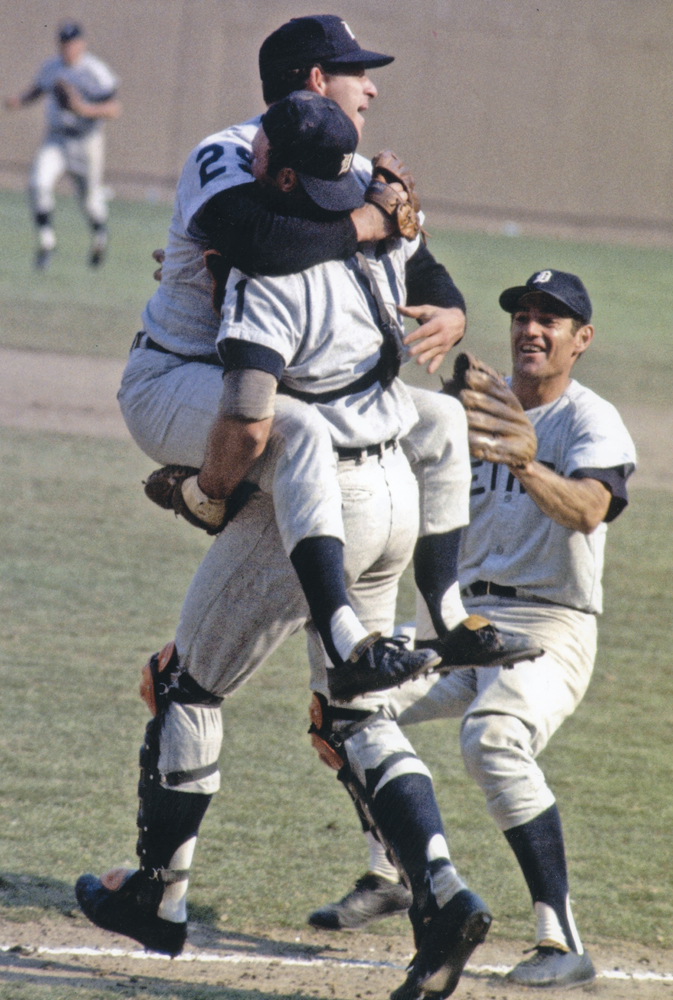
October 10, 1968: Mickey Lolich wins his 3rd game of the Series – matching Harry Brecheen as the only lefthander ever to do it thus far – and the Detroit Tigers win their 1st World Series in 23 years (to the day), beating the indomitable Bob Gibson and the defending champion St. Louis Cardinals in Game 7, 4-1 at Busch Memorial Stadium.

Mike Shannon hits a home run for the Cardinals, Jim Northrup's triple past the normally sure-fielding Curt Flood in the top of the 7th makes the difference. In the bottom of the 7th, Roger Maris, the Cardinals' right fielder pops up to short, closing an 0-for-3 day. It is the last at-bat of his career, as he has already decided to retire.

After the race riot and near-miss for the Pennant in 1967, after 23 years without a Pennant (let alone a title), after 11 years without a World Championship in any sport (since the 1957 NFL Champion Lions), and after 16 years without a Pennant for their legendary star Al Kaline, Detroit needed this World Championship very badly. With Kaline, Lolich, Northrup and Willie Horton being the stars of the Tigers' comeback from 3-games-to-1 down, the '68 Tigers remain the most beloved team in the history of Michigan sports, ahead of any Lions, Pistons, Red Wings, Michigan Wolverine or Michigan State Spartan team.

Lolich, who would retire with 217 wins and as the all-time strikeout leader among lefthanders with 2,832, was criticized for being fat. He was the original "hefty lefty." He was 6 feet even, and is usually listed as having been 210 pounds. Seriously, that was considered fat for a pitcher in 1968. Paging David Wells. Paging CC Sabathia. And on the right side, paging Bartolo Colon. Paging Rich Garces.
The last at-bat was future broadcaster Tim McCarver, popping up halfway down the 1st base line. Catcher Bill Freehan caught it, and Lolich jumped into his arms. Freehan must have been a very strong man to be able to hold Lolich in his arms for 6 seconds.
Michigan sports fans have held the '68 Tigers in their hearts ever since. In spite of the achievements of the Tigers in 1984, the Pistons in 1989-90 and 2004, the Red Wings from 1997 to 2008, and various teams at the University of Michigan and Michigan State University, the 1968 Tigers remain the most beloved team in Michigan sports history.
UPDATE: The Tigers do not have a team Hall of Fame. But they honor their players who have been elected to the Baseball Hall of Fame on the outfield wall at Comerica Park. From the 1968 World Champions, they honor right fielder Al Kaline and broadcaster Ernie Harwell. They also honor left fielder Willie Horton, who is not in the Hall of Fame, but whose uniform Number 23, like Kaline's 6, is retired.
They are in the Michigan Sports Hall of Fame, along with shortstops Dick McAuliffe and Mickey Stanley, 1st baseman Norm Cash, catcher Bill Freehan, outfielder Gates Brown, center fielder Jim Northrup; pitchers Denny McLain, Mickey Lolich and John Hiller; executive Jim Campbell; and broadcasters George Kell and Ray Lane. Manager Mayo Smith, however, has not received any of these honors. 
*
October 10, 1968 was a Thursday. This was the only baseball game played that day. Football was in midweek. The NHL season started the next day, the NBA season 4 days after that, and the ABA season 3 days after the NBA. So there were no other scores on this historic day.

Sunday, October 2, 2022

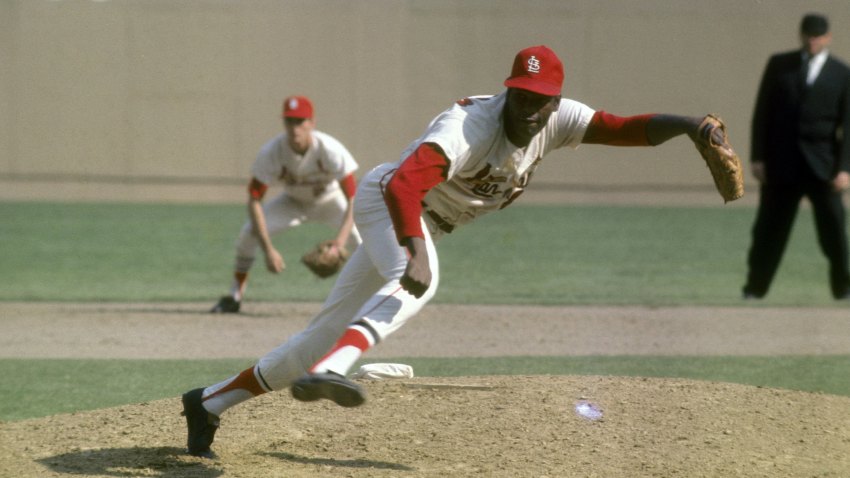
October 2, 1968: Bob Gibson Strikes Out 17 In a World Series Game

October 2, 1968: Bob Gibson, baseball's most fearsome pitcher, unleashes his pièce de résistance.

The 1968 season became known as "The Year of the Pitcher." Denny McLain won 31 games, the major leagues' 1st 30-win season since 1934, and his Detroit Tigers roared to the American League Pennant. Juan Marichal led the National League with 26 wins. Drysdale pitched 58 2/3rds consecutive scoreless innings for a new record, including 6 straight shutouts. Luis Tiant, then with the Cleveland Indians, had an earned run average (ERA) of 1.60.

Baseball as a whole was just not hitting. All hitters combined had a batting average of .237. Carl Yastrzemski of the Boston Red Sox, who had won the Triple Crown the year before, including a .344 average, was the AL's only hitter above .300, batting .301. (Pete Rose led the NL with .335.)

Most amazing of all was Gibson. In June and July combined, he made 12 starts, completing and winning all of them, pitching shutouts in 8 of them. He had a streak of 47 consecutive scoreless innings, then 3rd all-time behind Drysdale's new record and the old one he broke, 56 by Walter Johnson in 1913.

He finished with an earned run average of 1.12, the lowest ever in the post-1920 Lively Ball Era. The last pitcher with a lower one was Dutch Leonard, who had one of 0.96 in 1914.

Just to show that Gibson wasn't only taking advantage of The Year of the Pitcher, his ERA+ was 258 -- meaning he was 158 percent better at preventing earned runs than the average pitcher of the season, even that season. His WHIP was just 0.853. He also led the NL in strikeouts for the 1st time, with 268.

There was another factor at work: Gibson's intimidating presence. Like Jim Bunning, another Hall of Fame pitcher of the 1960s, his pitching motion resulted in his right leg swinging around, making it look like he was jumping toward the hitter.

Gibson was listed at 6-foot-1 and 189 pounds, but this, and the 15-inch height of the pitcher's mound, made him look much bigger. It was very distracting, and, against Bob Gibson, a batter needed as few distractions as he could get.
Much like Ty Cobb and Ted Williams, Gibson could be charming to people he liked; but, once on the field, he played with a snarl. He was known to brush hitters back, to let them know that he owned the plate -- and he had the control to enforce that. "I didn't throw at a lot of guys," he later admitted, "but when I did, I made sure I hit them."
Never in the head: He would mess with a player's mind, but wouldn't threaten his career. He hit 102 batters over 17 seasons. Compare that with Drysdale, also known as a "headhunter," who hit 154 in 14 seasons.
Tim McCarver practically built a broadcasting career telling stories about being the catcher for Bob Gibson and Steve Carlton. One time, McCarver went to the mound to talk to Gibson. Gibson told him, "The only thing you know about pitching is that it's hard to hit!" That wasn't completely fair: McCarver's lifetime batting average, over 22 seasons, was .271. But Bob Gibson did not need a pep talk.
Jim Ray Hart, a 3rd baseman for the San Francisco Giants, told this story about a doubleheader against the Cardinals, with advice from Willie Mays:
Between games, Mays came over to me, and said, "Now, in the second game, you're going up against Bob Gibson." I only half-listened to what he was saying, figuring it didn't make much difference. So I walked up to the plate the first time, and started digging a little hole with my back foot... No sooner did I start digging that hole than I hear Willie screaming from the dugout: "Noooooo!"
Well, the first pitch came inside. No harm done, though. So I dug in again. The next thing I knew, there was a loud crack and my left shoulder was broken. I should have listened to Willie.
Ya think? Dusty Baker was a rookie with the Atlanta Braves in 1968, and told this story:
Hank Aaron told me, "Don't dig in against Bob Gibson. He'll knock you down. He'd knock down his own grandmother if she dared to challenge him. Don't stare at him, don't smile at him, don't talk to him. He doesn't like it. If you happen to hit a home run, don't run too slow, don't run too fast. If you happen to want to celebrate, get in the tunnel first. And if he hits you, don't charge the mound, because he's a Gold Glove boxer."
I'm like, "Damn, what about my 17-game hitting streak?" That was the night it ended.
In 1964 and 1965, Bob's roommate on roadtrips was 1st baseman Bill White, later a Yankee broadcaster and President of the National League. In 1966, Bill was traded to the Philadelphia Phillies. He knew he would have to face Bob. He did not dig in. Bob brushed him back anyway. "I knew what the message was," Bill later said. "It was, 'We're not roommates anymore.'"
"I'd like to think that the term 'intensity' comes closer to summarizing my pitching style than do qualities like meanness and anger, which were merely devices," Gibson said. "My pitching career, I believe, offers a lot of evidence to the theory that baseball is a mental discipline as much as a physical one."
Gibson's record in 1968 was 22-9. How did he lose 9 games, with a 1.12 ERA? The Cards weren't really hitting, either. He lost 2 games 1-0, including a game in which the opposing pitcher, Gaylord Perry of the Giants, pitched a no-hitter. One if his losses was 1 of Drysdale's 6 straight shutouts, a 2-0 Dodger win.
He started 34 games, completed 28, and he was never relieved due to his own failings: All 6 times, Schoendienst removed him for a pinch-hitter in that season in which runs were most at a premium. Sportswriter Roger Angell once asked Gibson, "Are you surprised at what you do?" Gibson said, "I'm never surprised by anything I do."
And, a quarter of a century before basketball star Charles Barkley faced the question of whether he was, or should be, a role model, Bob Gibson said, "Why do I have to be an example for your kid? You be an example for your own kid."
Gibson and McLain were named their respective Leagues' Most Valuable Players in 1968. This remains the only season in which both Leagues' MVPs have been pitchers, and not until Clayton Kershaw in 2014 would another pitcher win it in the NL. (In the AL, 7 pitchers have won it since.)
It was obvious that Gibson and McLain would be named as starting pitchers in Game 1 of the World Series. On September 29, before the Series began, they were invited to appear together on The Ed Sullivan Show. McLain had actually played organ in Las Vegas casino lounges, and Gibson could play guitar, so Sullivan had them perform together. Neither minded, and each said complimentary (if not "nice") things about the other.
Gibson strode to the mound at Busch Memorial Stadium on October 2, 1968, for Game 1 of the World Series. Unlike other sports, especially college football, baseball has never had a media establishment that previews games as "The Game of the Century." After all, if a Series goes to 7 games, then, theoretically, the aces could face each other 3 times.
Nevertheless, this was the most-hyped starting pitching matchup in World Series history: Gibson with his 1.12 ERA vs. McLain with his 31 wins. WHIPs: Gibson 0.853, McLain 0.905. ERA+'s: Gibson 258, McLain 154.
The established record for strikeouts in a World Series game was 15, by Sandy Koufax, 5 years earlier. Gibson mixed in blazing fastballs and devastating sliders. He struck out Al Kaline and Norm Cash 3 times each; Jim Northrup, Bill Freehan and Willie Horton twice; and Dick McAuliffe, Mickey Stanley, Don Wert, Eddie Mathews and McLain once each. His 143rd and last pitch was a perfect curveball on the inside corner that froze Horton, for his 17th strikeout of the game.
No pitcher has come close to this mark since -- or even to the 15 that Koufax did. Since 1968, the most is 12, by Tom Seaver in 1973 and Orlando "El Duque" Hernández in 2000. 
Baserunners? Gibson gave up a single to Stanley in the 1st, a single to Wert in the 3rd, a walk to Freehan in the 5th, a single to McAuliffe and a double to Kaline in the 6th, and another single to Stanley in the 9th. That was it: 5 hits and 1 walk, compared to 17 strikeouts.
"We were fastball hitters," Northrup said, "but he blew the ball right by us. And he had a nasty slider that was jumping all over the place."
And McLain? Unlike Gibson, he didn't have good stuff: The Cardinals scored 3 runs off him in the 4th, and Lou Brock added a home run off Pat Dobson in the 7th. Cardinals 4, Tigers 0.
I wasn't around yet, but from everything I've read, it seems that was the most-hyped pitching matchup of all time, and Gibson lived up to it, and McLain didn't. Or, to put it another way: The guitarist played like Eric Clapton, and the organist played like Linda McCartney.
Gibson outpitched McLain again in Game 4 at Tiger Stadium, riding the Cardinal bats to win, 10-1. As in 1967, the Cards needed just 1 more win to take the Series.
As in 1967, the AL Champs won Games 5 and 6. But this time, Game 7 would be in St. Louis. And Gibson would be matched against Mickey Lolich, who had won Games 2 and 5. Gibson would have 3 days' rest, Lolich 2 -- just like Gibson vs. Lonborg the year before. All signs pointed toward Gibson leading the Cards to a 3rd title in 5 years.
But Gibson was not at his best. A Horton throw from left field nailed Brock at the plate. And Northrup hit a triple over the head of normally sure-fielding center fielder Curt Flood. Lolich went the distance, and the Tigers won, 4-1. Gibson had won 7 straight World Series games, but the streak was over.
Before the 1969 season, Major League Baseball reacted to The Year of the Pitcher by changing some rules. The strike zone was lowered a little, and the pitcher's mound was lowered from 15 inches at its crest to 10 inches. Scoring rose throughout baseball. 
Suffice it to say, Gibson's 1968 ERA of 1.12 has never been seriously threatened. In 1978, Ron Guidry went 25-3, and his ERA was 1.74. In 1985, Dwight Gooden went 24-4, and his ERA was 1.53. Pedro Martínez had ERAs of 1.90 in 1997 and 1.74 in 2000. Jacob deGrom was at 1.70 for the 2018 season.
The changes didn't hurt Gibson much: He went 20-13 with a 2.18 ERA in 1969, 23-7 with 3.12 in 1970 (for his 2nd Cy Young Award), and 16-13 with 3.04 in 1971. On August 14, 1971, he pitched a no-hitter, something he hadn't done before the changes; and his teammates backed him up in an 11-0 pounding of the Pittsburgh Pirates at Three Rivers Stadium.
On July 17, 1974, at Busch Memorial Stadium, he struck Cesar Geronimo out for his 3,000th career strikeout, making him the 2nd player after Walter Johnson, the 1st National Leaguer, and then the only living human to reach that milestone. But he lost the game to the Cincinnati Reds, 6-4.
He closed his career in 1975, with a record of 251-174, an ERA of 2.91, an ERA+ of 127, a WHIP of 1.188, and 3,117 strikeouts. He struck out 7.2 batters per every 9 innings pitched, and had 2.33 strikeouts for every walk. He played in 9 All-Star Games, and won 9 Gold Gloves.
He was elected to the Baseball Hall of Fame in 1981, in his 1st year of eligibility. The Cardinals elected him to their team Hall of Fame, retired his Number 45, and dedicated a statue of him outside Busch Memorial Stadium, which they moved next-door to the new Busch Stadium in 2006. He died in 2020, a month short of his 85th birthday.
McLain had another Cy Young season in 1969, going 24-9. But the combination of too many innings too soon bringing about a shoulder injury, and suspensions due to misdeeds, shortened his career. He was passed off by 4 different teams, and last pitched in Spring Training 1973, finishing 131-91, with an ERA of 3.39, an ERA+ of 101, only 1,282 strikeouts, 6.1 K/9 IP, and 3 All-Star berths -- but his career WHIP of 1.163 was actually lower than Gibson's, and his 2.34 K/BB was higher than Gibson's.
At the risk of sounding like Yogi Berra, when he could pitch, he could still pitch. But, by the time of his 29th birthday, he had been released for the last time, as no longer worth the aggravation, to either his shoulder or his team. And things would get worse for him. Amazingly, for all he's done to himself, as of October 2, 2022, he is still alive.
*
October 2, 1968 was a Wednesday. This was also the day of the pre-Olympics Mexico City Massacre. I have a separate entry for that event.
There were no other baseball games. Football was in midweek. The new NHL season was 9 days away; the new NBA season, 13 days. So there were no other scores on this historic day.
Czech tennis player Jana Novotná, who won Wimbledon in 1998, was born on this day.
Wednesday, September 14, 2022

September 14, 1968: Denny McLain Wins His 30th Game of the Season

September 14, 1968: Denny McLain performs a pitching feat not seen in 34 years -- and he isn't even on the mound when it's completed, despite having pitched a complete game.

The Detroit Tigers were playing the Oakland Athletics at Tiger Stadium in Detroit. The Tigers went into the game leading the American League over the Baltimore Orioles, by 9 1/2 games with 14 games to play. They were almost certain to with the Pennant.

It was being discussed that New York Yankees superstar Mickey Mantle might be retiring after the season, but he hadn't made it official yet. (He did so at the start of the next season's Spring Training.) And the National League race was also pretty much over: The St. Louis Cardinals led the San Francisco Giants by 11 1/2 games with 13 to play.

So, pretty much the only suspense left in the season, other than the World Series that would be played between the Tigers and the Cardinals, was whether McLain would become the 1st pitcher in the major leagues since Dizzy Dean of the 1934 Cardinals to win 30 games in a season.

It had been "The Year of the Pitcher." From the current Cardinals, Bob Gibson would finish with a record of 22-9 and an ERA of 1.12, the lowest in the major leagues since the start of the Lively Ball Era in 1920. Don Drysdale of the Los Angeles Dodgers had pitched a record 58 2/3rds consecutive scoreless innings, including 6 straight shutouts. Juan Marichal of the San Francisco Giants led the NL with 26 wins against 5 losses. And the American League as a whole batted just .237. Carl Yastrzemski led it in batting average at just .301.

McLain came into the game with a record of 29-4. He did everything he could, going the full 9 innings. He allowed 4 runs on 6 hits and 1 walk, striking out 10. But he gave up 2 home runs to A's rookie Reggie Jackson. Norm Cash had hit a home run for the Tigers, but they went into the bottom of the 9th, trailing 4-3.

Cliché Alert: Walks can kill you, especially the leadoff variety. Al Kaline, the most popular player in Tiger history, led off the inning by drawing a walk off Diego Seguí. Dick McAuliffe popped up, but Mickey Stanley singled Kaline over to 3rd base. Jim Northrup grounded to 1st base, and Danny Cater dropped the ball, allowing Kaline to score. And Willie Horton singled Stanley home.

Tigers 5, Athletics 4. WP: McLain (30-4). He would finish 31-6 on the season. No pitcher has won 30 games in a season -- or even 28 -- since.

Gibson would beat McLain in Games 1 and 4 of the World Series. But Mickey Lolich would win Games 2 and 5. McLain won Game 6. Lolich would outpitch Gibson in Game 7, and the Tigers won the Series.

*

September 14, 1968 was a Saturday. These other Major League Baseball games were played that day:

* The New York Yankees beat the Washington Senators, 4-1 at District of Columbia Stadium in Washington. (It was renamed Robert F. Kennedy Memorial Stadium the following June.) Al Downing went the distance for the win. Roy White hit a home run. Mickey Mantle did not play.

* The New York Mets lost to the Pittsburgh Pirates, 6-0 at Shea Stadium. Bob Veale pitched an 8-hit shoutout. Roberto Clemente hit 2 home runs.

* The Minnesota Twins beat the Boston Red Sox, 7-3 at Fenway Park in Boston. Carl Yastrzemski and Reggie Smith hit home runs for Boston, but it wasn't enough. Harmon Killebrew appeared as a pinch-hitter, and drew a walk.

* The Philadelphia Phillies beat the Chicago Cubs, 4-1 at Connie Mack Stadium in Philadelphia. Ernie Banks went 0-for-3 with a walk.

* The Baltimore Orioles beat the Cleveland Indians, 5-3 at Cleveland Municipal Stadium. Frank Robinson hit a home run. Brooks Robinson went 0-for-3, but had an RBI on a sacrifice fly.

* The California Angels beat the Chicago White Sox, 5-4 at Comiskey Park in Chicago. An error in the top of the 10th inning gave the Angels the win.

* The St. Louis Cardinals beat the Houston Astros, 8-0 at the Astrodome in Houston. Nelson Briles pitched an 8-hit shutout. Lou Brock went 2-for-4 with a walk, 2 stolen bases and an RBI.

* The Los Angeles Dodgers beat the Atlanta Braves, 3-0 at Dodger Stadium in Los Angeles. Don Sutton pitched a 6-hit shutout. Hank Aaron went 1-for-3 with a walk.

* And the San Francisco Giants beat the Cincinnati Reds, 9-1 at Candlestick Park in San Francisco. Willie Mays hit 2 home runs, and rookie Bobby Bonds hit one. Pete Rose went 1-for-4, Rookie of the Year Johnny Bench did the same, and Tony Pérez hit a home run.

This was also the opening weekend of the college football season. But only 1 Top 10 team played that day, and it didn't work out so well for them: Number 9 Tennessee were held to a tie by Georgia, 17-17, at home, at Neyland Stadium in Knoxville.

And in English soccer, Arsenal beat Staffordshire team Stoke City, 1-0 at the Arsenal Stadium, a.k.a. Highbury, in North London. In his memoir Fever Pitch, Nick Hornby wrote of this being the 1st game he ever went to, at age 11, taken by his father.

The only goal of the game was scored by Terry Neill, on a rebound of his own penalty, deflected by not stopped by Gordon Banks. Neill would later manage Arsenal to win the 1979 FA Cup. Banks had been the goalkeeper on the England team that won the 1966 World Cup. At the time, he was playing his "club football" for another Midlands team, Leicester City.

Also on that Stoke team, and the '66 England team, was George Eastham, who had previously starred for Arsenal. In the film version of Fever Pitch, Paul Ashworth, the character based on Hornby and played by Colin Firth, admitted that Eastham was "before my time," but the real Hornby saw Eastham play in this game.

Wednesday, June 8, 2022

June 8, 1968: Don Drysdale Pitches 58 2/3 Consecutive Scoreless Innings:

Don Drysdale, June 8, 1968.
Note the black armband on his left sleeve.

June 8, 1968: So long in the shadow of his teammate Sandy Koufax, Don Drysdale achieves something never done by Koufax, or by any other pitcher before him.

Born in 1936 in Van Nuys, in the San Fernando Valley region of Los Angeles, he seemed destined to star for a Los Angeles sports team, although he didn't start pitching until his senior year at Van Nuys High School, where he was a classmate of actor Robert Redford. The Brooklyn Dodgers signed him, and he debuted with them in 1956. Two years later, they moved to Los Angeles, and the young man who would be nicknamed "Big D" was home.

He made 9 All-Star Games, led the National League in strikeouts 3 times, and won the Cy Young Award (then a both-leagues award) in 1962, going 25-9. He was the Dodgers' ace when they won the 1959 World Series, and was the righthanded half of a devastating duo with lefthander Sandy Koufax, leading the Dodgers to win the World Series in 1963 and 1965, and the NL Pennant in 1966.

In 1965, Drysdale won 23 games and hit 7 home runs. He became only the 3rd pitcher ever to win at least 20 games and hit 7 home runs in the same season, following Wes Ferrell of the 1931 Cleveland Indians and Don Newcombe of the 1955 Brooklyn Dodgers. No pitcher has done it since.

Drysdale was also known as a "headhunter," who hit batters on purpose. His motto was, "If one of our guys gets hit, two of yours get hit. If two of ours get hit, four of yours get hit."

Arthritis forced Koufax to retire after the 1966 season, restoring Drysdale's ace status. That was also the 1st season for Don Sutton, who would join Koufax and Drysdale in the Hall of Fame. Drysdale was nicknamed "Big D" and "Double D," so Sutton became "Little D" -- even though he ended up with more career strikeouts than either Koufax or Drysdale.

On May 10, 1968, the Dodgers lost to the Atlanta Braves, 2-1 at Atlanta Stadium. (That facility was renamed Atlanta-Fulton County Stadium in 1975.) Drysdale allowed a run in the 4th inning, and was removed from the game in the 7th. A runner he allowed on base scored, and was thus charged to him. He was the losing pitcher, and finished the game with no consecutive scoreless innings. But then, in what became known as "The Year of the Pitcher," came 6 straight shutouts:

1. May 14, Dodger Stadium: Dodgers 1, Chicago Cubs 0. He allowed 2 hits and 3 walks. 9 straight scoreless innings.

2. May 18, Dodger Stadium: Dodgers 1, Houston Astros 0. He allowed 5 hits and 2 walks. 18 straight scoreless innings.

3. May 22, Busch Memorial Stadium, St. Louis: Dodgers 2, Cardinals 0. He allowed 5 hits and no walks. 27 straight scoreless innings.

The losing pitcher is Bob Gibson, who finishes this "Year of the Pitcher" with a 1.12 ERA and a record of 22-9. He would have a streak of 47 straight scoreless innings that season, 3rd all-time at the time.

If you want to know how he had the lowest ERA of the post-1920 Lively Ball Era, and still lost 9 games, this is one of the reasons. 

4. May 26, the Astrodome, Houston: Dodgers 5, Astros 0. He allowed 6 hits and 2 walks. 36 straight scoreless innings.

5. May 31, Dodger Stadium: Dodgers 3, San Francisco Giants. He allowed 6 hits and 2 walks. 45 straight scoreless innings.

6. June 4, Dodger Stadium: Dodgers 4, Pittsburgh Pirates 0. He allowed 3 hits and no walks. 54 straight scoreless innings.

In 1913, Walter Johnson pitched 55 2/3 straight scoreless innings. Drysdale was now 6 outs away from breaking that record.

That night, in his victory speech for the California Primary at the Ambassador Hotel in Los Angeles, Senator Robert F. Kennedy of New York mentioned Drysdale, who had campaigned for him. A few minutes later, RFK was shot, and died the next day.

On June 8, a few hours after RFK's funeral, the Dodgers took the field at Dodger Stadium wearing black armbands, in RFK's memory. Whether the sadness of the last 3 days had any effect on Drysdale, or if it was just time for the streak to end, is unclear.

Against the Philadelphia Phillies, Drysdale got through the 1st 2 innings. He struck Clay Dalrymple out to finish the 2nd, giving himself the record at 56 straight. He got through the 4th, making it 58 straight.

Finally, Tony Taylor led off the top of the 5th with a single. Dalrymple followed with another, advancing Taylor to 3rd base. Drysdale struck Roberto Peña out. But Howie Bedell hit a sacrifice fly to left field, and Len Gabrielson was unable to throw Taylor out at the plate. The streak was over, at 58 2/3 consecutive scoreless innings.

The Dodgers still won, 8-3. Despite the streak, and despite this being "The Year of the Pitcher," Drysdale battled injury and finished just 14-12 for the season. After 1 more year, he retired, with a record of 209-166, an ERA of 2.95, and 2,486 strikeouts.

The Dodgers retired his Number 53, and he became an admired broadcaster. His 2nd wife was basketball star Ann Meyers. They are the only married couple ever to both be elected to their respective sports' Halls of Fame. (As of June 8, 2022, he legalization of same-sex marriage has not yet led to this distinction losing its uniqueness.) He died in 1993.

*

June 8, 1968 was a Saturday. It was the day of Robert F. Kennedy's funeral. Because of this, many players asked for postponements of the day's games. The team owners didn't want to lose the revenue of a Saturday crowd, but they also didn't want to antagonize RFK's supporters. Some teams did postpone their games to set up Sunday doubleheaders. Others moved their afternoon games to night games, so they wouldn't coincide with the funeral. So there were only night games, 5 of them:

* The Chicago White Sox beat the Boston Red Sox, 4-0 at Fenway Park in Boston. Gary Peters pitched a 3-hit shutout. Carl Yastrzemski went 0-for-3 with a walk.

* The Baltimore Orioles beat the Oakland Athletics, 8-1 at Memorial Stadium in Baltimore. Brooks Robinson went 2-for-4 with an RBI. Frank Robinson went 1-for-3 with a walk. Dave McNally went the distance for the win. The only run he allowed came on a home run by the opposing pitcher, Jim "Catfish" Hunter. Reggie Jackson went 0-for-3.

* The St. Louis Cardinals beat the Cincinnati Reds, 7-2 at Crosley Field in Cincinnati. Lou Brock went 1-for-5 with an RBI. Roger Maris went 0-for-5. Of the Reds' 9 hits, Pete Rose got 3, and Johnny Bench got 1.

* The Detroit Tigers beat the Cleveland Indians, 3-1 at Tiger Stadium in Detroit. Mickey Lolich outpitched Sam McDowell. Al Kaline did not play.

* And the Houston Astros beat the Pittsburgh Pirates, 3-2 at the Astrodome in Houston. Willie Stargell did not play, but Roberto Clemente went 1-for-3 with an RBI.

* The New York Yankees and the California Angels postponed their game at Yankee Stadium until the next day, as part of a doubleheader. The Yankees swept, 8-1 and 3-2. Mickey Mantle went 1-for-2 with 2 walks and an RBI in the 1st game, and walked as a pinch-hitter in the 2nd game. The Yankees won the 2nd game in the bottom of the 9th, when Charley Smith, the player they got when they traded Roger Maris, singled Bill Robinson home.

The Atlanta Braves and the Chicago Cubs postponed their game at Wrigley Field in Chicago to the next day, as part of a doubleheader. The Braves won the 1st game, 4-0. Ken Johnson pitched an 8-hit shutout, to beat Ferguson Jenkins. Joe Torre hit 2 home runs. The Cubs won the 2nd game, 6-5. Over the 2 games, Hank Aaron went 2-for-8 with a home run and 2 RBIs, and Ernie Banks went 3-for-7 with a walk and an RBI.

* The New York Mets and the San Francisco Giants postponed their game at Candlestick Park in San Francisco. The game was postponed, and played as a doubleheader on August 11. The Giants swept, 2-1 and 5-0. In the 1st game, Ray Sadecki outpitched Tom Seaver. Willie Mays did not play. In the 2nd game, Mike McCormack pitched a 5-hit shutout. He and Willie McCovey each hit a home run. Mays went 2-for-4.

* And the Minnesota Twins and the Washington Senators -- the "Old Senators" and the "New Senators" -- postponed their game at District of Columbia Stadium in Washington -- the stadium that, the following June 8, would be renamed Robert F. Kennedy Memorial Stadium. The game was made up as part of a doubleheader on August 27. The Senators won the 1st game, 2-0. Camilo Pascual, who had starred for the Old Senators and the Twins, pitched a 4-hit shutout for the New Senators. Over the 2 games, Rod Carew went 1-for-7. Harmon Killebrew did not play.

December 31, 1999 & January 1, 2000: The Millennium

December 31, 1999:  The Millennium arrives. The people of planet Earth survived. At a terrible cost. But we hadn't destroyed ourselves. ...